











Customers who viewed this item also viewed
Buy new:
-46% $9.17$9.17
FREE delivery Thursday, February 5 on orders shipped by Amazon over $35
Advertisement
Ships from: Amazon.com Sold by: Amazon.com
Save with Used - Very Good
$1.70$1.70
$3.98 delivery Monday, February 9
Advertisement
Ships from: World of Books (previously glenthebookseller) Sold by: World of Books (previously glenthebookseller)
Sorry, there was a problem.
There was an error retrieving your Wish Lists. Please try again.Sorry, there was a problem.
List unavailable.
Download the free Kindle app and start reading Kindle books instantly on your smartphone, tablet, or computer - no Kindle device required.
Read instantly on your browser with Kindle for Web.
Using your mobile phone camera - scan the code below and download the Kindle app.
Image Unavailable
Color:
-
-
-
- To view this video download Flash Player
-
-
3 VIDEOS -
Follow the author
OK
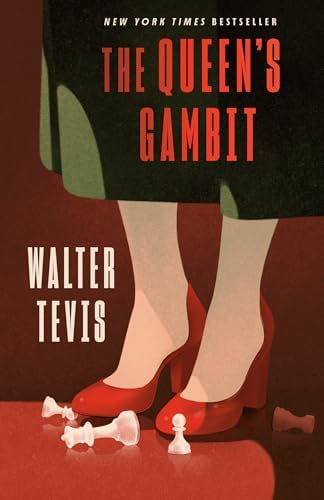
The Queen's Gambit: A Novel (Vintage Contemporaries) Paperback – March 11, 2003
Purchase options and add-ons
Eight year-old orphan Beth Harmon is quiet, sullen, and by all appearances unremarkable. That is, until she plays her first game of chess. Her senses grow sharper, her thinking clearer, and for the first time in her life she feels herself fully in control. By the age of sixteen, she’s competing for the U.S. Open championship. But as Beth hones her skills on the professional circuit, the stakes get higher, her isolation grows more frightening, and the thought of escape becomes all the more tempting.
- Print length256 pages
- LanguageEnglish
- PublisherKnopf Doubleday Publishing Group
- Publication dateMarch 11, 2003
- Dimensions5.19 x 0.58 x 8 inches
- ISBN-101400030609
- ISBN-13978-1400030606
Book recommendations, author interviews, editors' picks, and more. Read it now.
Frequently bought together

Similar items that may deliver to you quickly
The Queen's Gambit Series 3 Books Collection Set by Walter Tevis (The Queen's Gambit, The Hustler & The Color of Money) NETFLIXPaperbackFREE Shipping on orders over $35 shipped by AmazonGet it as soon as Thursday, Feb 5
The Queen's Gambit: Music from the Netflix Limited Series Arranged for Piano SoloCarlos Rafael RiveraPaperbackFREE Shipping on orders over $35 shipped by AmazonGet it as soon as Friday, Feb 6Only 2 left in stock - order soon.
The HustlerPaperbackFREE Shipping on orders over $35 shipped by AmazonGet it as soon as Thursday, Feb 5
The Color of MoneyPaperbackFREE Shipping on orders over $35 shipped by AmazonGet it as soon as Thursday, Feb 5
MockingbirdPaperbackFREE Shipping on orders over $35 shipped by AmazonGet it as soon as Thursday, Feb 5
The Queen's Gambit: Book One of Imirillia (The Books of Imirillia)PaperbackFREE Shipping on orders over $35 shipped by AmazonGet it as soon as Thursday, Feb 5
Customers also bought or read
- Endgame: Bobby Fischer's Remarkable Rise and Fall - from America's Brightest Prodigy to the Edge of Madness
Paperback$17.00$17.00Delivery Thu, Feb 5 - How to Win at Chess: The Ultimate Guide for Beginners and Beyond#1 Best SellerChess
Hardcover$21.67$21.67Delivery Thu, Feb 5 - Searching for Bobby Fischer: The Father of a Prodigy Observes the World of Chess
Paperback$14.78$14.78Delivery Thu, Feb 5 - The Most Instructive Games of Chess Ever Played: 62 Masterpieces of Chess Strategy
Paperback$15.30$15.30Delivery Thu, Feb 5 - How to Reassess Your Chess: Chess Mastery Through Chess Imbalances
Paperback$24.05$24.05Delivery Thu, Feb 5
From the Publisher
Editorial Reviews
Review
“Compelling. . . . A magnificent obsession.” --Los Angeles Times
“Beth Harmon is an unforgettable creation--and The Queen's Gambit is Walter Tevis's most consummate and heartbreaking work.” --Jonathan Lethem
“Gripping reading. . . .Nabokov's The Defenseand Zweig's The Royal Gameare the classics: now joining them is The Queen's Gambit.” --The Financial Times
“More exciting than any thriller I've seen lately; more than that, beautifully written. “ --Martin Cruz Smith, author of GorkyPark
“It’s advisable to tape your fingers before opening The Queen’s Gambit. Otherwise, the suspense may bring on nail-chewing right to the elbow.” --Houston Chronicle
“Tevis traps us in the breathless drama of the moment and makes us feel the same intense involvement his characters feel.” --The Plain Dealer
“There’s more excitement in Beth than in the collected works of Robert Ludlum.” --Forth Worth Star-Telegram
From the Inside Flap
From the Back Cover
About the Author
Excerpt. © Reprinted by permission. All rights reserved.
BETH LEARNED OF HER MOTHER'S DEATH FROM A WOMAN WITH A clipboard. The next day her picture appeared in the Herald-Leader. The photograph, taken on the porch of the gray house on Maplewood Drive, showed Beth in a simple cotton frock. Even then, she was clearly plain. A legend under the picture read: "Orphaned by yesterday's pile-up on New Circle Road, Elizabeth Harmon surveys a troubled future. Elizabeth, eight, was left without family by the crash, which killed two and injured others. At home alone at the time, Elizabeth learned of the accident shortly before the photo was taken. She will be well looked after, authorities say."
In the Methuen Home in Mount Sterling, Kentucky, Beth was given a tranquilizer twice a day. So were all the other children, to "even their dispositions." Beth's disposition was all right, as far as anyone could see, but she was glad to get the little pill. It loosened something deep in her stomach and helped her doze away the tense hours in the orphanage.
Mr. Fergussen gave them the pills in a little paper cup. Along with the green one that evened the disposition, there were orange and brown ones for building a strong body. The children had to line up to get them.
The tallest girl was the black one, Jolene. She was twelve. On her second day Beth stood behind her in Vitamin Line, and Jolene turned to look down at her, scowling. "You a real orphan or a bastard?"
Beth did not know what to say. She was frightened. They were at the back of the line, and she was supposed to stand there until they got up to the window where Mr. Fergussen stood. Beth had heard her mother call her father a bastard, but she didn't know what it meant.
"What's your name, girl?" Jolene asked.
"Beth."
"Your mother dead? What about your daddy?"
Beth stared at her. The words "mother" and "dead" were unbearable. She wanted to run, but there was no place to run to.
"Your folks," Jolene said in a voice that was not unsympathetic, "they dead?"
Beth could find nothing to say or do. She stood in line terrified, waiting for the pills.
"You're all greedy cocksuckers!" It was Ralph in the Boys' Ward who shouted that. She heard it because she was in the library and it had a window facing Boys'. She had no mental image for "cocksucker," and the word was strange. But she knew from the sound of it they would wash his mouth out with soap. They'd done it to her for "damn"--and Mother had said "Damn" all the time.
The barber made her sit absolutely still in the chair. "If you move, you might just lose an ear." There was nothing jovial in his voice. Beth sat as quietly as she could, but it was impossible to keep completely still. It took him a very long time to cut her hair into the bangs they all wore. She tried to occupy herself by thinking of that word, "cocksucker." All she could picture was a bird, like a woodpecker. But she felt that was wrong.
The janitor was fatter on one side than on the other. His name was Shaibel. Mr. Shaibel. One day she was sent to the basement to clean the blackboard erasers by clomping them together, and she found him sitting on a metal stool near the furnace scowling over a green-and-white checkerboard in front of him. But where the checkers should be there were little plastic things in funny shapes. Some were larger than others. There were more of the small ones than any of the others. The janitor looked up at her. She left in silence.
On Friday, everybody ate fish, Catholic or not. It came in squares, breaded with a dark, brown, dry crust and covered with a thick orange sauce, like bottled French dressing. The sauce was sweet and terrible, but the fish beneath it was worse. The taste of it nearly gagged her. But you had to eat every bite, or Mrs. Deardoriff would be told about you and you wouldn't get adopted.
Some children got adopted right off. A six-year-old named Alice had come in a month after Beth and was taken in three weeks by some nice-looking people with an accent. They walked through the ward on the day they came for Alice. Beth had wanted to throw her arms around them because they looked happy to her, but she turned away when they glanced at her. Other children had been there a long time and knew they would never leave. They called themselves "lifers." Beth wondered if she was a lifer.
Gym was bad, and volleyball was the worst. Beth could never hit the ball right. She would slap at it fiercely or push at it with stiff fingers. Once she hurt her finger so much that it swelled up afterward. Most of the girls laughed and shouted when they played, but Beth never did.
Jolene was the best player by far. It wasn't just that she was older and taller; she always knew exactly what to do, and when the ball came high over the net, she could station herself under it without having to shout at the others to keep out of her way, and then leap up and spike it down with a long, smooth movement of her arm. The team that had Jolene always won.
The week after Beth hurt her finger, Jolene stopped her when gym ended and the others were rushing back to the showers. "Lemme show you something," Jolene said. She held her hands up with the long fingers open and slightly flexed. "You do it like this." She bent her elbows and pushed her hands up smoothly, cupping an imaginary ball. "Try it."
Beth tried it, awkwardly at first. Jolene showed her again, laughing. Beth tried a few more times and did it better. Then Jolene got the ball and had Beth catch it with her fingertips. After a few times it got to be easy.
"You work on that now, hear?" Jolene said and ran off to the shower.
Beth worked on it over the next week, and after that she did not mind volleyball at all. She did not become good at it, but it wasn't something she was afraid of anymore.
Every Tuesday, Miss Graham sent Beth down after Arithmetic to do the erasers. It was considered a privilege, and Beth was the best student in the class, even though she was the youngest. She did not like the basement. It smelled musty, and she was afraid of Mr. Shaibel. But she wanted to know more about the game he played on that board by himself.
One day she went over and stood near him, waiting for him to move a piece. The one he was touching was the one with a horse's head on a little pedestal. After a second he looked up at her with a frown of irritation. "What do you want, child?" he said.
Normally she fled from any human encounter, especially with grownups, but this time she did not back away. "What's that game called?" she asked.
He stared at her. "You should be upstairs with the others."
She looked at him levelly; something about this man and the steadiness with which he played his mysterious game helped her to hold tightly to what she wanted. "I don't want to be with the others," she said. "I want to know what game you're playing."
He looked at her more closely. Then he shrugged. "It's called chess."
A bare light bulb hung from a black cord between Mr. Shaibel and the furnace. Beth was careful not to let the shadow of her head fall on the board. It was Sunday morning. They were having chapel upstairs in the library, and she had held up her hand for permission to go to the bathroom and then come down here. She had been standmg, watching the janitor play chess, for ten minutes. Neither of them had spoken, but he seemed to accept her presence.
He would stare at the pieces for minutes at a time, motionless, looking at them as though he hated them, and then reach out over his belly, pick one up by its top with his fingertips, hold it for a moment as though holding a dead mouse by the tail and set it on another square. He did not look up at Beth.
Beth stood with the black shadow of her head on the concrete floor at her feet and watched the board, not taking her eyes from it, watching every move.
She had learned to save her tranquilizers until night. That helped her sleep. She would put the oblong pill in her mouth when Mr. Fergussen handed it to her, get it under her tongue, take a sip of the canned orange juice that came with the pill, swallow, and then when Mr. Fergussen had gone on to the next child, take the pill from her mouth and slip it into the pocket of her middy blouse. The pill had a hard coating and did not soften in the time it sat under her tongue.
For the first two months she had slept very little. She tried to, lying still with her eyes tightly shut. But she would hear the girls in the other beds cough or turn or mutter, or a night orderly would walk down the corridor and the shadow would cross her bed and she would see it, even with her eyes closed. A distant phone would ring, or a toilet would flush. But worst of all was when she heard voices talking at the desk at the end of the corridor. No matter how softly the orderly spoke to the night attendant, no matter how pleasantly, Beth immediately found herself tense and fully awake. Her stomach contracted, she tasted vinegar in her mouth; and sleep would be out of the question for that night.
Now she would snuggle up in bed, allowing herself to feel the tension in her stomach with a thrill, knowing it would soon leave her. She waited there in the dark, alone, monitoring herself, waiting for the turmoil in her to peak. Then she swallowed the two pills and lay back until the ease began to spread through her body like the waves of a warm sea.
"Will you teach me?"
Mr. Shaibel said nothing, did not even register the question with a movement of his head. Distant voices from above were singing "Bringing in the Sheaves."
She waited for several minutes. Her voice almost broke with the effort of her words, but she pushed them out, anyway: "I want to learn to play chess."
Mr. Shaibel reached out a fat hand to one of the larger black pieces, picked it up deftly by its head and set it down on a square at the other side of the board. He brought the hand back and folded his arms across his chest. He still did not look at Beth. "I don't play strangers."
The flat voice had the effect of a slap in the face. Beth turned and left, walking upstairs with the bad taste in her mouth.
"I'm not a stranger," she said to him two days later. "I live here." Behind her head a small moth circled the bare bulb, and its pale shadow crossed the board at regular intervals. "You can teach me. I already know some of it, from watching."
"Girls don't play chess." Mr. Shaibel's voice was flat.
She steeled herself and took a step closer, pointing at, but not touching, one of the cylindrical pieces that she had already labeled a cannon in her imagination. "This one moves up and down or back and forth. All the way, if there's space to move in.
Mr. Shaibel was silent for a while. Then he pointed at the one with what looked like a slashed lemon on top. "And this one?"
Her heart leapt. "On the diagonals."
You could save up pills by taking only one at night and keeping the other. Beth put the extras in her toothbrush holder, where nobody would ever look. She just had to make sure to dry the toothbrush as much as she could with a paper towel after she used it, or else not use it at all and rub her teeth clean with a finger.
That night for the first time she took three pills, one after the other. Little prickles went across the hairs on the back of her neck; she had discovered something important. She let the glow spread all over her, lying on her cot in her faded blue pajamas in the worst place in the Girls' Ward, near the door to the corridor and across from the bathroom. Something in her life was solved: she knew about the chess pieces and how they moved and captured, and she knew how to make herself feel good in the stomach and in the tense joints of her arms and legs, with the pills the orphanage gave her.
"Okay, child," Mr. Shaibel said. "We can play chess now. I play White."
She had the erasers. It was after Arithmetic, and Geography was in ten minutes. "I don't have much time," she said. She had learned all the moves last Sunday, during the hour that chapel allowed her to be in the basement. No one ever missed her at chapel, as long as she checked in, because of the group of girls that came from Children's, across town. But Geography was different. She was terrified of Mr. Schell, even though she was at the top of the class.
The janitor's voice was flat. "Now or never," he said.
"I have Geography . . ."
"Now or never."
She thought only a second before deciding. She had seen an old milk crate behind the furnace. She dragged it to the other end of the board, seated herself and said, "Move."
He beat her with what she was to learn later was called the Scholar's Mate, after four moves. It was quick, but not quick enough to keep her from being fifteen minutes late for Geography. She said she'd been in the bathroom.
Mr. Schell stood at the desk with his hands on his hips. He surveyed the class. "Have any of you young ladies seen this young lady in the ladies'?"
There were subdued giggles. No hands were raised, not even Jolene's, although Beth had lied for her twice.
"And how many of you ladies were in the ladies' before class?"
There were more giggles and three hands.
"And did any of you see Beth there? Washing her pretty little hands, perhaps?"
There was no response. Mr. Schell turned back to the board, where he had been listing the exports of Argentina, and added the word "silver." For a moment Beth thought it was done with. But then he spoke, with his back to the class. "Five demerits," he said.
Product details
- Publisher : Knopf Doubleday Publishing Group
- Publication date : March 11, 2003
- Edition : Reprint
- Language : English
- Print length : 256 pages
- ISBN-10 : 1400030609
- ISBN-13 : 978-1400030606
- Item Weight : 6.7 ounces
- Dimensions : 5.19 x 0.58 x 8 inches
- Best Sellers Rank: #43,436 in Books (See Top 100 in Books)
- #644 in Coming of Age Fiction (Books)
- #1,234 in Literary Fiction (Books)
- #3,093 in American Literature (Books)
- Customer Reviews:
About the author

Walter Stone Tevis (February 28, 1928 – August 8, 1984) was an American novelist and short story writer. Three of his six novels were adapted into major films: The Hustler, The Color of Money and The Man Who Fell to Earth. His books have been translated into at least 18 languages.
Bio from Wikipedia, the free encyclopedia.
Related products with free delivery on eligible orders
Customer reviews
Customer Reviews, including Product Star Ratings help customers to learn more about the product and decide whether it is the right product for them.
To calculate the overall star rating and percentage breakdown by star, we don’t use a simple average. Instead, our system considers things like how recent a review is and if the reviewer bought the item on Amazon. It also analyzed reviews to verify trustworthiness.
Learn more how customers reviews work on AmazonCustomers say
Generated from the text of customer reviewsSelect to learn more
Reviews with images
Great Book
Top reviews from the United States
There was a problem filtering reviews. Please reload the page.
- Reviewed in the United States on May 23, 2024Format: KindleVerified PurchaseI’m a great fan of The Queen’s Gambit streaming series, having watched it three times. It’s a great series that can be read as a coming-of-age story about a young chess prodigy – or as a feminist tale of a woman striving towards the top of a man’s world. And, of course, as both.
The book and series are notably faithful to each other, with each offering insights that are unique to their storytelling forms.
As a reader would expect, the book contains more background color about the characters themselves (except for the protagonist’s friend Jolene, a pivotal character who is developed more assertively in the streaming series). The book reader also gets more of the protagonist’s family backstory: how did she become an orphan? And what was her actual family background? These elements are mostly absent from the book. The book excels at taking you inside the story’s chess play, describing the decisions made – interpreting the otherwise cryptic moves, so the reader has a technical context for better understanding them. (It won’t make you a chess expert; it will make you better appreciate some of the complexities beneath the chessboard.)
Where the streaming series excels over the book is in its wonderful attention to period detail: we’re shown the protagonist’s world of the United States, Mexico, and Russia in the 1960s. That detail is captured richly and well, at least to someone who lived through a part of that time and remembers it. Very little of this element comes through the pages of the book.
It's worth noting that the story as told via both media ends too abruptly -- the book even more so. Both would have benefited well from more of a denouement.
The feminist theme of the book and streaming series is particularly well done. Both media invoke the reality of the times they’re depicting with clarity – but without hammering the reader/viewer over the head: “see how awful women had it back then? See how hard they had to work to overcome male bias?” No, it’s not a feminist manifesto. It’s a story well told that is both faithful to its times and prescient in that it heralds a time when women can truly "master” a male-dominated pursuit such as chess.
In summary, the book is worth reading in its own right. And it perhaps serves best to enhance one’s understanding of the streaming series, making that excellent production more nuanced, well-rounded, and comprehensible. I strongly advise consuming the story via both media: book and streaming series. I don't think the order in which they're consumed matters that much. But if you can only consume this story via one media, reach for your remote. It's well cast and well acted, and the period detail alone is worth watching.

- Reviewed in the United States on September 19, 2015Beth is a chess prodigy, possessed of a natural talent for the game. Such people are rare but do exist. I found the book very enjoyable with Beth a very engaging character. Tevis writes well and the book is fast-moving, filled with believable characters. I would recommend this book highly to people who know nothing about chess. I might suggest, if this book is ever revised, that more explanation go into the chess notation as that would make the book more enjoyable for those who can't read the notation. (And maybe, replace descriptive notation with algebraic.)
Unfortunately, if I were writing this review for a publication like Chess Life, read by knowledgeable chess players, I would give this book only 3 stars. The chess world presented in this book is not very true to life. Here are some of the problems I see:
Beth enters a state tournament and wins, having studied chess from Modern Chess Openings (MCO). Yes, even prodigies have to study the game, but Beth doesn't study the middlegame or endgame?
Well into her career, Beth is still studying the games of Paul Morphy. Morphy was a genius for his time (1850-60's) but today, his chess knowledge is primitive. It would be of little use.
Beth studies openings she prefers from the aforementioned MCO such as the Sicilian Defense. She then goes to a tournament and is apparently surprised when her opponent responds to pawn to king 4 (e4) with pawn to king 4 (e5). Some surprise! About 40% of king pawn openings begin this way! Beth can't be choosy about the openings she wants to learn because opponents might not respond the way she wants.
Beth is recognized as a person with a rare gift by both her school principal and a local chess club president after she puts on an astounding demonstration of her skill. But then they ignore her! Huh? When Fischer was a young prodigy, New York's most prestigious chess clubs were fighting tooth and nail to get him as a member. A person of this talent lends prestige to a chess club or a private school!
Beth's games all seem to end at about 30 moves. Highly unlikely! Although she is reportedly a great attacking player, even the greatest attackers in chess history, like Alekhine and Fischer, played many endgames.
There are far too few drawn games. At high level tournament play, draws account for about half the game results. Yet Beth and the fictional world champion seem to win tournaments with scores of 7-0. I think Beth is reported to have only one drawn game! More commonly, a round robin of 8 players would be won by a score of, say, 3 wins, 3 draws, and 1 loss.
Beth struggles to find money to enter tournaments. Again, with her talent and being a woman chess master in a man's world, this would be unlikely. The U.S. Government, during the cold war, would have probably found money to send her to Russia, but if not, there would have been private sponsorship.
As already noted by other reviewers, there are a few technical problems with the game descriptions, where for example, Beth, with the white pieces, plays black's move in a Sicilian.
All in all, an enjoyable book, although the world of chess is fanciful.
- Reviewed in the United States on August 30, 2025Format: PaperbackVerified PurchaseThis book was well written and as exciting as a book focused on chess strategies can be when read by a non-expert of the game. The characters were fascinating, but I did have a little difficulty with the over sexualization of Beth’s early years (ages 8- 14/15). A bit of @menwritewomen worthy material in the beginning.
All in all it was worth the read and the hype and I enjoyed it.
Top reviews from other countries
M. van DrielReviewed in the Netherlands on November 15, 20205.0 out of 5 stars I am in awe
Meticulously written, not a word too much, mostly just describing what happens, not falling into the trap of familiar tropes, The Queen’s Gambit is such a tender and warm and generous book. Beth Harmon is not playing chess against grandmasters, she’s playing against herself. And isn’t that what we all are doing?
AnoopReviewed in India on October 27, 20225.0 out of 5 stars Superb plot of the story
The rise of an orphan from zero to hero with Chess.
But to enjoy this, you must have the basic idea of Chess.
-
Romulo SousaReviewed in Brazil on December 22, 20205.0 out of 5 stars É um livro muito gostoso de ler e a história é legal.
Fora um detalhe menor ou outro tudo que foi retratado na série está no livro. Ao invés de reassistir a série eu estou lendo o livro e está sendo bem legal. Recomendo.
-
carla bertanaReviewed in France on October 20, 20235.0 out of 5 stars passionnant
Livre absolument passionnant qui se lit comme une vraie partie d’échecs et qui vous tient en haleine jusqu’à la fin. Je n’arrivais pas à le poser… cela explique d’une façon fascinante comment un grand champion visualise les parties, c’est impressionnant.
Très intéressant, à lire!
-
Marco_MRReviewed in Mexico on August 24, 20235.0 out of 5 stars Jaque mate
Insuperable Walter Tevis con este libro, la serie le hace justicia y las licencias que se toma, son validas en pos de un drama soberbio.