A COMPLETE DIRECTORY

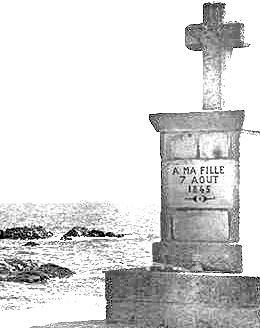
Colonsay Cross Grab Sept 13, 2023


There is a New Introduction which goes with this page. It’s called THE HARD PART FIRST, and explores the idea of a poet writing about himself as a ‘conflict of interest.’ If you haven’t seen it you  can  click on the image of it here.

The page also includes A FORTHRIGHT APPEAL, which Christopher Woodman hopes very much you will want to read as well.


.Image

This is the ‘BAW PLAA’ at the poet’s home in Chiang Mai.  In Thai a ‘baw’ is a hole in the ground, a well, a mine shaft or pond, and ‘plaa’ means fish — amidst the paddies the baw’ fills up with water, so this is a baw plaa.’ There are huge fish in this one, some of which, like its best poems, are over 20 years old. Click twice on the photo and you can see them.


A COMPLETE DIRECTORY
September 25th, 2025.

Cowpattyhammer consists of 20 years of discussions and essays composed and edited by the poet, Christopher Woodman.  If this is your first visit you might want to start with ABOUT THE AUTHOR  which includes how the site got it’s name.

If you click HERE instead you can visit Christopher Woodman’s personal pages on Homprang.com, the website of the Baan Hom Samunphrai School for Traditional Medicine in Chiang Mai, Thailand.  That’s where he lives and works with the Director, his Herbal Doctor-wife, Homprang Chaleekanha.

There is also a NEW BIO there  which Christopher wrote for his 80th birthday.

Over half the articles in the COWPATTY ARCHIVE are not listed in the Index on the left.  To access this earlier material, you can enter the site with the URL: https://cowpattyhammer.wordpress.com — click on ‘Older  entries’  if that option comes up before you reach the earliest post on this site, September 22nd, 2009.

A quicker method would be to click on the small ARCHIVES window at the bottom  of the left hand Index and scroll down to the very earliest posts, 2009-10. The CATEGORIES window just below that may direct you even more specifically to what interests you.

The earlier parts of the site, pre-2014,  are also preserved in the Scarriet.com archives. This sister site is  still edited by his old friend and companion-in-arms, the dazzling critic, literary historian, sports scholar, musician and indefatigable poet, Thomas Graves (aka ‘Monday Love,’ ‘Tom West’  and still ‘Tom Brady’).


 AN OBITUARY for W.F. KAMMANNHow much we miss our great-hearted friend Bill, indeed revere him — the unwavering integrity, courage and ferocity combined with such warmth!


AN ANNOTATED INDEX, 2011-2025

You can click on the highlighted TITLES
below to view the full Articles.

THREE SHORT PREFACES.

a.) FIG LEAF SUTRAS: at the Roots of the Tree.

Fig Leaf Sutras: A Memoir in Poems, 1994-2024, is a very different book from my earlier books, La-Croix-Ma-Fille and Galileo’s Secret. It’s a Memoir, and embraces in reverse order Technicians of the Sacred Grabthe whole range of my styles and interests from my most recent metaphysical riffs & glosses on Chiang Mai back to my very first dot-matrix mutterings in Brooklyn before there was poetry at all. The heart of the book contains some of my most unaffected “pure poetry,” and at the very end there are three lyric triumphs over time, art, and adversity — which is  why they’re still there. In so far as the book has a theme, it’s my own trajectory as a poet with the last tracks first, dignifying as they do the mountains of compost that still nourish me from way back before there was even a start.

b.) Getting ready for GALILEO’S SECRET.

A blessing on those young Forest Row students who assumed I knew the “secret of life” but which, like Denise Levertov herself, I’m afraid, I’d already forgotten by then. That was way back in the 70s, and indeed I didn’t get around to my own book of poetry until 30 years later mainly because I kept losing touch with whatever it was I was supposed to know. And then there was the South East Asian ‘Hill-Tribe’ expatriate linguist and drifter I picked up incoherent on the streets of Chiang Mai, and goodness knows what he meant, or why I kept the interview with him secret for so long [it’s attached!]. And of course there was Galileo Galilei himself who suffered such profound dislocations in his inner life, ones which I came to understand better after suffering a breakdown of my own one summer while living close by his villa in Florence. And that other physicist too, also famous but much younger — he suffered his dislocations in the body, not mind, while I was in Cambridge as well dealing with my brother’s broken back. AboriginalsAnd finally the small Australian Aborigine Elder listening so attentively with his brilliant young grand-daughter beside him — not to understand anything at all, just to share companionship for a few blesséd moments, not a vision or a voice but a flicker of recognition, a settling, an exhalation. A moment of simple-minded reflection, a moment just to be there, not to decide which road to take, or what things to weigh, or whether there are secrets of life to believe in, God forbid, what is more to remember.

c.)  Gilding the Pieces: LA-CROIX-MA-FILLE.

Version 2It started out short — but such ‘rewriting’ can also create relics, and if such relics are fertile like fantasies and crystals they grow, sometimes exponentially. Like this statement for example: “I have very few friends who read poetry, and even fewer who read the poetry I write. This is partly because at two very important junctures in my life I parted with poetry altogether, and as a poet I have no past.”

There is a New Introduction which goes with this page. It’s called THE HARD PART FIRST, and explores the idea of a poet writing about himself as a ‘conflict of interest.’ If you haven’t seen it you  can  click on the image of it here.

The page also includes A FORTHRIGHT APPEAL, which Christopher Woodman hopes very much you will want to read as well.


….

TWENTY-TWO  SUMMARIES:
THE MAIN THREADS, 2011-23.

I. “GALILEO’S SECRET:”  (2 Threads, 2019-22).

1.)  FOR THOSE LIKE GALILEO   (

This is a detailed attempt to cast light on some of the complex graphics, images, and metaphors in Part II of GALILEO’S SECRET,  and includes the title phrase which appears for the first and only time in the book in a light-hearted poem called “Celestial Observations.”  The much more difficult title-poem of the thread, on the other hand, “For Those Like Galileo Who No Longer Read,” is from Part III and is accompanied by one of the strongest graphics in the whole 10 years of Cowpattyhammer — in fact the image appears twice in the blog,  and you always have to Click more than once to see them fully as on this little b/w index photo right here.Image This theme is developed in the 26 ‘Essais’ in the Comments that follow including in the two discussions of Breugel’s “The Fall of Icarus” as well as in the intimate encounters with, among others, the Strangler Fig, the Wizard of Oz, Sonya & Leo Tolstoy at home, and the Archimandrite Seraphim Bit Haribi chanting The Lord’s Prayer in Aramaic. It’s a curious thread, bizarre even, and there’s a strong feeling of more to come — no thread is ever really “over” on Cowpattyhammer, and you can leave a “Reply” to start up the discussion again anywhere you like. (26 Comments)
….

2.) IN PURSUIT OF THE STILL UNWEIGHED: Off the Record at 80
……(

A long and passionate self-examination culminating in a detailed exploration of the moods and modes of the 9 short poems  that make up Part I of GALILEO’S SECRET. There are 50 substantial ‘Essais’ written over a 4 1/2 month period, and I don’t think my personal development or my values have ever been more effectively explored. Image It’s about Hope, really, the small bird that we all know as “that thing with feathers,” and, needless to say,  Emily Dickinson is the hero of the whole thread alone up there in her bedroom — closely followed by the visionary mentor/muddler, Sir Stanley Spencer. Here he is pushing his pram through his beloved Cookham’s lanes, for him as exotic as any Shangri-la or Chiang Mai haunted jungle. (50 Comments)….

…..

II. “LA-CROIX-MA-FILLE:” (5 Threads, 2017-18).

3.) LA-CROIX-MA-FILLE (

An introduction to the final ‘illuminated’ version of LA-CROIX-MA-FILLE which highlights the distinction between those poems which are written by a personal hand and those which have lived long enough on their own to become self-generating ‘Relics:’
 width=….— like a ‘hex’ or ‘ruin’ at the site of a betrayal or massacre, the title represents not something that once ‘happened’ but is happening all the time like an icon, a mantra, a prayer or a spell;
….— like the “Notes on the First and Last Poems” at the very end of the book, the thread sets the whole scene in the present without compromising any of the original intentions or participants. The same is true of the “Hexes, Ruins, Riddles and Relics” of the subtitle there’s too much ‘danger’ in such mysteries to risk more in the details;
….— like the final illuminated haiku in the book, everyone who has been through such things must “stoop to grace the water’s fall” whether it be to ‘take a knee’ or ‘a bow’ — or, as the 16th Century poet, Sir Thomas Wyatt, acknowledges when he uses the Anglo-Norman word ‘danger,’ to place a ‘neck on the block;’
….“So it is that LA-CROIX-MA-FILLE takes its place in the same perilous tradition as “Sir Gawain and the Green Knight,” “They Flee From Me That Sometime Did Me Seek,” and “La Belle Dame Sans Merci.” And with reference to the latter in particular, the old Middle-English word ‘daunger‘ is French while at the same time as English as the fleurs de sel on your table, or the coup de grâce at hers.” (You’ll find the original of this riff Here.) (7 Comments).
.

4.) for FRANZ WRIGHT: “dark, then bright, so bright.”
…..(

This thread is a Coda to the preceding thread and puts Franz Wright in the context of “He Reflects on What His Genius Means,” the opening poem of LA-CROIX-MA-FILLE. If you have the time it might be better to read thread #7 first as of course it precedes it chronologically. Delia Sculpture #1 Jan 12, 2022 (1)This one, “For Franz Wright,” introduces the theme of creative anger with the opening ‘Relic’ poem of the book (it’s “thought to be Samson’s,” after all, “found amongst the ruins”), and then takes the opportunity to tell the story of Franz Wright’s life (March 18th, 1953 to May 14th, 2015) in some detail. The mood is indeed almost hagiographic — and what a paradox, like Raskolnikov, or indeed anything out of Dostoievski. The thread is addressed to my Latvian friend, Jūlija Lebedeva, who was in the process of ‘illuminating’ the book at this very time, and whose contribution has so deepened it. [ * Sculpture: “Head with Windshield Shards” by Delia Woodman. Be sure to CLICK on all the graphic tabs at least twice as many of them expand.]
.

5.) WHY IT’S MORE IMPORTANT FOR A WRITER TO SLEEP WELL THAN
……
BE READ, OR ALMOST  (

Despite it’s contemplative graphic, this very long thread is constructed like a whole hornet’s nest of Russian dolls — a paradox indeed! In fact, the thread straddles 6 years of debate about the poet Franz Wright’s bizarre intervention in a much earlier thread which culminated in his calling Christopher Woodman’s poem, “Leonardo Amongst Women,” “perfectly awful.” This event occurred just before Christopher’s Blog:Cowpattyhammer went off in one direction and Thomas Brady’s Blog:Scarriet  in another, a painful break which changed both of them. An important plus in the thread is the way it illustrates both the creativity and the negativity that underlay the original Blog:Scarriet experiment, a paradox which was also at the very heart of Franz Wright’s genius — he was one of the most quarrelsome, ornery poets who has ever lived with the hugest heart and almost flawless broken voice. Image Its a very rich thread indeed, I think — one of my favorites. So please do give it some time and celebrate with me ‘Franz Wright, the most valuable of companion-poets on the loneliest of roads.’ He too published almost nothing before he was 50, and was dead by 63. Illustration: “Sleeper,” by Michael Borrëmans for the cover of Kindertotenwald, Prose Poems by Franz Wright (2007). ………………….(Annotated Appendix with 56 Comments.)
.

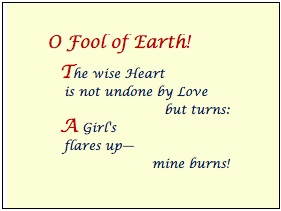
6.) “O FOOL OF EARTH!”  A Haiku by Samson illuminated by Julija with
……Caravaggio, T.E.Lawrence & an encore by our Christy himself.

……(Nov 21, 2017)

This is a bravura thread built around a single illuminated Haiku, one of Julija’s earliest sketches for LA-CROIX-MA-FILLE — at the time still subtitled A Book of Poems & Relics. The conceit is that “O Fool of Earth” is one of the artifacts that has been “found amongst the ruins,” not “written,” and is therefore, like the other “Relics” in the book, formatted in Lucida Blackletter with capitalized nouns and red illuminations. ImageIn addition, the two towering “pillars” of the drama, the Prophet Samson over here and Lawrence of Arabia over there, are displayed in the genius light of Caravaggio’s mannerist heroes, and are at the same time admired and ridiculed as “Fools of Earth.” Those are the words of “our Christy” from J.M.Synge’s The Playboy of the Western World which introduce ‘Pillars on the Beach,’ Part I of the book. “It’s a passionate, over-the-top thread,” Christopher says, “an apotheosis of shame combined with valor, and it still makes my heart miss a beat as well as beat a bit faster.  And to tell you the truth, I don’t really know the difference — ‘Been there, done that’  is all anybody can say!”
.

7.) ON HOW I MAKE SENSE OF IT: the poet deconstructs somebody
……else’s Haiku.
  (

A deconstruction of the last Haiku in LA-CROIX-MA-FILLE
this reading combines close metrical analysis with New- as well as Post- ImageCritical observations left over from Christopher Woodman’s years at Columbia, Yale and Cambridge. But even more importantly, the critique relives in detail how the little poem found its true form over a period of 30 years, and has now settled down as one of the most important ‘Relics’ in the book, gilded and framed. “It never changes yet never stays still,” the author says. “For me it embodies all the richnesses of a ‘Hex,’ a ‘Ruin,’ and a ‘Riddle.’  And it just never stops giving.”

III. “ON WHAT I CAN SAY:” (5 Threads, 2015-17).

8.) ON WHAT I CAN SAY: deconstructing the spirits’ beguiling
……but awful mess…
 

In this section of the Index there is a big shift of focus from Christopher Woodman’s  books to the mysterious world around him in Chiang Mai. This thread describes a visit to one of his favorite Wats (Temples) on the ancient pilgrim trail through the jungle on the way up Doi Suthep, the Holy Mountain that hangs over the city, indeed one of the most revered Shrines in Thailand. small white chicken There are many strange and exotic surprises in the thread both about what is “spiritual” about the place as well as about what is taught in such a fey, chaotic environment. Indeed, you have to click yet again on everything to see it all like the seductive little Nang Ram dancer behind the chicken in the bushes, and there’s a great deal more like that buried in the thread itself. The very end includes what the author feels is probably the best thing he’s ever written about the Buddha story — which, he says, is also about what a writer learns from such an experience and, more likely than not, has simply got to unlearn. Because this thread is about reading and writing poetry too.
.

9.) ON WHAT WE’RE NOT ALLOWED TO SAY: deconstructing
…….iindiscretions
……(October 7, 2017)

ImageUnlearning also means learning not to ask too many questions but to remain in uncertainty as John Keats suggested and so eloquently bore witness to both in his brief, febrile life and forever in his poetry. “For you can never stop on such a road,” it says in this thread, “it’s that steep and narrow, indeed, any attempt to turn round and head back is curtains. Why, even just pausing to catch your breath can trigger an avalanche!” So the “indiscretions” are multiple, both my own and those of other unfortunates, and clicking through them will take you to some places as strange as any Wat-Pha-Lad-type reliquary junk-pile. (2 Comments)
.

10.) WHY I WROTE HOW BAD IS THE DEVIL (

This is the thread I most often touch back to, and if you’ve been following me recently will recognize you’ve been here before:  for my brother Tony, for Galileo’s daughter; for why I make it all up, how relics rewrite, why Immanuel Kant, Emily Dickinson, G.F.Handel, and Winslow Homer, and the Canal de Bourgogne quite specifically. Here’s a graphic followed by a short excerpt you may well  remember:Image…..“And that’s how bad the Devil is, not knowing your place in the grown-up world, not just lying down and being quiet like the big dog Sam. Being soft in the head like being Eve in God’s grown-up Garden, like not only rejecting Heaven but being in cahoots with the Devil in a serious effort to rewrite Paradise. ‘Unless we become as Rogues we cannot enter the Kingdom of Heaven,’ Emily Dickinson wrote to a friend at age 50, and I’d say courage like that coupled with a delicate body and a diamond mind is heroic!”
…..“Which is why I write as well, as if my desk were underground in Lascaux — as if the hunt depended on my depiction of the beauty and grace of the animals as well as my reverence for them. And even the sun rising.” (57 Comments)

……….
12.) SAVAGE BEAUTY: (do I dare? do I dare?)  (

A short but extravagantly illustrated thread: “the hidden waterfall,” entered through the jungle on the other side of the Holy Mountain; “Merlin collared,” or how to get cornered at home plus a black magic  adventure with an intrepid friend from the Tetons, Brian Hayden. Ottoman Miniaturist (200)And always the very big question: “do I dare? do I dare?” — the words of the failed poet whose success is writing-on anyway and then arriving at a whole riff on Orhan Pamuk’s My Name is Red, a great novelist’s greatest novel and at the same time a great treatise on refinement and passion in Turco/Persian culture and miniaturist art which seems to say, We’re here! An autobiographical thread full of passionate photos and poems with a lot of help from my friends including Omino 23, a rapper from the Turks and Caicos Islands who turned out to be Bill Kammann’s diver-son, Matthew Kammann — and Paddy Linehan, of course, the great old-soul writer from Ireland. A gathering thread, startled and started but never quite finished. (22 Comments)

Read the rest of this entry »

THE HARD PART FIRST (Autumn 2025)

You’re in Cowpattyhammer.com, the blog of Christopher Woodman. You can click on About the Author if you have no idea where you are. The current page is a new Preface not only to the Blog but to the whole idea of a poet writing about himself as aConflict of Interest.’  If you prefer not to read it you can click on The Complete Directory which will return you to the Homepage.

IMG_0551

The last  Haiku from La-Croix-Ma-Fille in the process of being illuminated
in Chiang Mai by Julija Lebedeva of Oslo, Norway.

Image

The earliest posts in the Cowpattyhammer/Scarriet Archive were written between September and November, 2009, the last throes of what was essentially an ‘Uprising’ in contemporary American poetry. If you are unfamiliar with what happened at that time you may find some of the early discussions on this site unsettling. But they’re important, and we do hope you will give them a chance.

  1.
A PAINFUL BUT HEALTHY CONFLICT
OF INTEREST.

 Finally done – October 17th; 2025
Pruned substantially – October 20th & 21st;
Sealed & submitted – October 22nd;
A few clarifications – November 6th;
Jean Rhys — November 9th to the 26th;
Dylan Thomas — November 28th;
‘Organic Writing’ — December 2nd, 2025;
Signposted — December 5th, 2025;
Bonsai-d — January 4th, 2026
(at´ten´tion´) — January 19th, 2026

1.)  Why the whistles blew and who came running then:
The establishment of the first American MFA program in 1940 saw the American poetry community expand almost as fast as the post-war economy, and as in all such success stories there were inevitably some wobbles. This was true not only in the awarding of poetry prizes and book publications, but also in the distribution of the new teaching posts upon which American poets were becoming increasingly dependent. Prizes led to publication and the best teaching jobs — there was no abuse there as long as the process was transparent. Colonsay Cross Grab Sept 13, 2023But what happened was that a handful of MFA programs became particularly influential because their teachers were so much admired and their students won the big prizes over and over again. Perhaps it was just because the best teachers were teaching the best students at the best schools, as was at first argued, but little by little evidence emerged that some of those teachers were indeed manipulating the judges, and some significant resignations followed. Not many but more than enough to justify the smoke.

That’s why the whistles blew so hard during the American ‘Poetry Uprising’ (2004-2010), and it wasn’t always pretty. As a result, strict anti-conflict-of-interest Rules and Regulations did get to be introduced all over the country, and our American poetry house is certainly in better shape today. It’s perhaps too early to tell, but one hopes our poetry has expanded its wings too, and that our palates are fresher and more open to unexpected flavors, tones and shading.

Not surprisingly, most of those who challenged the conflicts of interest in American poetry came from outside the academic community — i.e. poetry people who had chosen not to opt for an MFA degree. They were Extra-curriculars, so to speak: homesteaders and hobbyists, expatriates, mavericks, artists, librarians, free-thinkers, home-schoolers, and single-handed parents. Among them were also a few even a bit over-educated ‘outliers’ with a strong aversion to being told how to think about anything what is more about how to read, write or evaluate poetry.

Whoever they were, the extracurriculars involved in the American Poetry Uprising were summarily put down by the establishment critics as “amateurs,” their observations were dismissed as “irrelevant,” and their voices as “shrill” (weak? immature? unrefined?) Colonsay Cross Grab Sept 13, 2023They hadn’t been trained in the writing, critiquing or publishing of poetry, one very influential critic insisted, and were therefore not qualified to comment on how poetry should be written, taught, judged, or published. And this statement isn’t made up either. Ideas of this sort were current in all the poetry Forums and Magazines at the time. On the other hand, some of the most revealing exchanges were deleted by the moderators of the Forums because they were felt to undermine the tone and propriety of the Institutions themselves.  Indeed, the best Forum of them all, the brand-new Poetry Foundation of America’s Blog:Harriet, closed itself down altogether because it simply couldn’t handle the heat. Its custodian mistook unique creative energy for ‘snark,’ and in his effort to clean up the site banned the most engaged and articulate contributors until there was no dialogue left.

NOTE #1 (September 2024):
    After safe-guarding the
Blog:Harriet Archive for 14 years following its closure to Comments in 2010, the APF has decided to delete all the Comments that had made it such a vibrant site. The cuts included the whole discussion following Joel Brouwer’s excellent “Keep the Spot Sore” article, for example, 103 comments on Robinson Jeffers. [July/August 2009]. 
….That discussion was particularly important to Cowpattyhammer because it contained the exchanges in which our nickname was invented. In addition, the destruction of Blog:Harriet began there as our editor was the 1st of the 4 very important Blog-Harriet participants to be expelled.

NOTE #2: There’s a great deal more on all this on Cowpattyhammer.com — you can scroll back through the whole site to September 2009, selecting “Older entries” at the bottom of each full page as you go.
N.B. You can get to the early posts more easily by clicking on the CATEGORIES window at the bottom of the left hand Index and selecting whatever interests you. The ARCHIVES window allows you to select the Dates that interest you going right back to September 2009.

One of the ‘outliers’ involved in all this was an expatriate American poet in his 60s who was sending out new work from a small post-office in South East Asia. He loved what he was doing  and assumed it would be considered carefully for publication by the recipients — which initially it seems to have been as poems of his were accepted by the best journals almost immediately. As a result he hoped that a future book of his might eventually be made available for others to read, and that he might actually meet some English-speaking poets and poetry readers in person as there were none where he lived.

That amateur poet was me, of course, Christopher Woodman, and little by little I came to realize what the protests were about. I realized that getting published in America had come to have a lot to do with where you had been taught how to write poetry — Colonsay Cross Grab Sept 13, 2023 a professional craft or ‘guild’ sort of training in writing that was not yet on offer at any of the 3 universities I attended from 1958 to 1970 on both sides of the Atlantic. Indeed, the closest I came to anything like what is widely known today as a ‘writing workshop’ was in the ’80s when, as Head of the English Department at the Brooklyn Polytechnic Preparatory School in New York City, I was introduced to ‘Process Writing’ by some very bright young teachers in my own Department. I was fascinated to watch them work with it, because how to think while writing an essay had been taken for granted in my own education. Yes, I’d been writing as well as  teaching poetry all my life, but it never occurred to me to seek publication until poetry became my life’s ‘occupation,’ so to speak.  It was only in my 53rd year that I began to think of myself as a poet, and it never occurred to me that there was anything particularly late about that.

2.) ‘Organic writing:’
Which leads to a very important point, I think. In the past poets developed their creative writing skills on their own through intensive reading, imitation and practice, and indeed some of those accomplished a very high level of proficiency at a very young age without any coaching at all: John Keats, the Brontë sisters, and T.S.Eliot in their early 20s, Rimbaud, Rudyard Kipling, Paul Laurence Dunbar and Jean Rhys at 18, Edna St Vincent Millay younger still. And whether or not you love and respect these writers as much as I do, all of them were consummate stylists right from the start. But Jean Rhys I particularly admire for the single-mindedness of what might be called her ‘organic writing,’ augmenting and deleting and then greening itself again and  again for years, a plant alone in the forest.

Jean Rhys’ particular forest was like this:

Born Gwen Williams in the West Indies in 1890, she was shipped off to England at 16 to attend the much respected Perse Boarding School in Cambridge. But she was laughed at for her Creole accent, and after just one term she decided to leave and train as an actress. Same problem, and by 18 she found herself on a chorus line in the provinces, a bleak and dreary life with no prospects. Yet, miracle of miracles, she reinvented herself as ‘Jean Rhys’ and managed to publish 4 extraordinary novels in Paris in her 30s — much admired by critics but unfortunately not read at all by anybody else. ImageAnd little by little she began to fade away, leaving everybody including her own self behind, and in her 40s went missing altogether. When 20 years later she was found again at 66 in a small village in Devon, she cried out, “It’s too late!” — and just went on as she had been doing for over 15 years, writing and rewriting her dark, amorphous saga. Indeed, even after 10 more years of support and encouragement from new friends, the editors Francis Wyndham and Diana Athill, it was very difficult for her to let the thing go, and it wasn’t published until 1966.

Jean Rhys was back at age 76 with a unique book, the 20th Century ur-text, Wide Sargasso Sea.

The image in the title is a real area in the Atlantic doldrums so wide and so clogged with dense seaweed and marine life ships avoid it to this day.* Much later I came to know it first-hand Imageas I sailed all the way through it in a small sailboat in 1981 with just my daughter Delia (17) and Agnés on board, a slow, sweltering  passage from the West Indies to New York City. That was the last leg of a  2 1/2 year voyage home as NYC was where I was born. I was 42, and I’d been away for almost 2 decades. **

I first read Wide Sargasso Sea while at Cambridge in my late 20s, and looking back on it I realize how deeply both my own deracinated life and very late writing habits have paralleled her experience. As a poet I’m even now under that spell and will be reading the same copy of her book again for sure, maybe even this evening in Chiang Mai — and after that I know I’ll dive back into one of my own unfinished manuscripts in the morning with renewed confidence and vigor.  As she did, and I do every day.

Most likely this time it will  be  La-Croix-Ma-Fille, probably “He Writes How to Keep” along with “Fleurs de Sel.” (One word tweaked is such an accomplishment in that sort of writing, no word touchable overwhelming.)

Decades passed. When I reached the same age Jean Rhys was when Wide Sargasso Sea was being re-written, my own difficulties as a writer came to a head and I didn’t know how to give up either — which you’ll see if you visit the earliest Cowpattyhammer/Scarriet posts on this site. The irony is that that was also the moment of my greatest success.  “He Mistakes Her Kingdom for a Horse”  was published in The Beloit Poetry Journal in 2009 and then just a few months later nominated for a  Pushcart Prize, i.e. designated the Best of the Year at the BPJ, the best journal of them all. I was so excited to be recognized as a poet at last, you can’t imagine. “And I’m only 70!” — that’s what I felt.

But this is life, and things are seldom what they seem. In a very strange reversal, that success in December 2009 marked the end of the road for me as a poet as nothing of mine ever got accepted for publication again. I continued to send out to my favorite sites for another 3 years, (9 more packets to my beloved BPJ alone, 2-4 poems in each) without a single acceptance there or anywhere else.  And then one morning in 2013 I just quit.

But I didn’t give up, not at all. That was just the moment when I turned away from ‘sending out’ and began instead to live alone with my own present work like Jean Rhys did, celebrating and rewriting it as she did day by day without any hope it would ever be read. And I have done that for 12 full years now, 2013 to 2025 — Cowpattyhammer.com for exercise and swashbuckling adventure and my three blessed friends, Galileo’s Secret, La-Croix-Ma-Fille, and Fig Leaf Sutras for companionship. Yes, and those close friends have flourished even though they have known only me right on up to the present. And we never get bored with each other, even when it rains.

Image

3.) On my own  way through  the woods.
Looking back over all this I realize how much of a total outsider I was, culturally as well as geographically. But I want to say as well that at no point did I consider the consequences of my ‘activism,’  or even that that’s what it was. It wasn’t a lack of respect or aggression that drove me to debate so fiercely either. It was sheer ebullience combined with naivete about how things actually worked in the brave new world of American poetry. From direct experience I came to realize that even some of the most respected professionals, editors, publishers, critics and teachers, had their ‘thumbs on the scale,’ so to speak, unwittingly in some cases, no doubt, but nevertheless. Indeed, had those ‘thumbs on the scale’ not been so common the new ‘Conflict of Interest’ Regulations would never have been so badly needed what is more so swiftly and universally adopted. Those rules  were a popular shoo-in, after all, based as they were on our fundamental American values: openness, fairness, and trust. In fact there was a terrible, unseemly squabble going on, and it was obvious those values were not yet there for some of our most visible poetry leaders as they fought tooth and nail to protect both themselves and, crucially, each other against any hint of impropriety.

NOTE #3: In a case in which I was personally involved I wrote the offender and begged him or her simply to apologize, it was all so out in the open. I encouraged the person to explain that he or she was trying too hard to be everything to everybody and just got over-the-top-exhausted and confused. That would be plenty, I said, and people would even admire him or her for the honesty, it was so obviously a mess-up, and indeed almost everybody else was involved in it to some extent. But the public perception of fault was something he or she simply couldn’t countenance, and the case was allowed to slip into the messy dustbin of Foetry’s unresolved struggle against business interests in poetry. And of course it was extremely hard to prove because none of it was illegal, just very, very sticky.

And then, lo and behold, the  most gracious twist of the knife, the Proof. The new Regulations were so obviously correct that the grass-roots ‘Poetry Uprising’ (2004-10) that championed them was almost immediately forgotten. That’s why so much of what I say here in this Preface may be new for younger readers and even for a number of those who were there but were not interested or preferred not to see. Indeed, that’s why I’m trying so hard not to be too specific about my own experiences at the time. Indeed, I could even say that I ‘speak in tongues’ to avoid opening old wounds, that I’d rather hide things to hasten the healing.

But there are still aspects of all this that bother me personally. For example, I still don’t understand why I was called a “Sock Puppet” on Blog:Harriet — I never imagined that my very particular sort of articulate passion could make people assume I was a fake. They claimed that I was actually the critic “Tom Brady” in disguise (“using a false IP,” they said, and the on-line Moderator nodded his head in agreement).Colonsay Cross Grab Sept 13, 2023 And of course in the end they took out the brilliant critic Thomas Graves (aka “Tom Brady” himself) along with Desmond Swords, the dynamo-druid from Ireland with more training in Poetics than any of us. And finally, with one last back-handed swipe, the shy Robin-Hood-genius behind Foetry.com, Alan Cordle, was swatted away, suggesting that we were all just cogs in his uncouth, anti-intellectual rag. And he was “just a librarian,”  some of them smirked, and threatened to sue him. (Please take note that nobody did despite a lot of very aggressive posturing.)

Needless to say, you won’t find this selfless man or his brave, ingenious work anywhere on the web anymore — the goal he set out to achieve is done and he’s free to be just who he is wherever.

NOTE #4: And Pace indeed to the Foundation — such a valuable new ally for us all!
My personal up-ending just happened to happen on its most beautiful of all Blogs
called Harriet, but exactly how or why I can’t imagine. Our new Benefactor was just too open, perhaps, too brave, too ready, or perhaps just not quite ready enough, naive even, trying too hard at the end as well. For me it was heartbreaking to watch such a vibrant community self-destruct, and now there’s no record to show just how brilliant it had actually been, how positive. There’s no record either of just how quickly it was undermined and vanished. And that’s h
ard on everybody who loved it as well as on researchers who would like to know more about it including checking out the details in my own veiled account right here.

4.) The hardest part:
 The hardest part, for myself? — my relationship with my own poetry. Because my poetry, however late and/or lame, has always been ‘vested’ for me, and therein, of course, lies both my Virtue and my Fault. Yes, Ambition, certainly — which is not always bad but still hard to admit for someone like me, at least when it’s about my poetry it is. And you can hear all the over-refined ghostly sensibilities clustering around that statement. Yes, and so can I.

And the Conflict?  During the whole time of the struggle I never stopped trying to get published by the same world that made me feel so unwelcome, and which I’m sure was not ready to make peace with me. Little by little I had had to acknowledge a conflict of interest in myself:  to keep sending out and sending out and sending out even when I knew it was not only wrong but that it was damaging my own prospects. Indeed, it got more and more complicated the longer I kept at it — complicated for me, needless to say, but I’m sure complicated as well for the hard-working ‘screeners’ who must have wondered why this old guy just didn’t seem to get it, wasting other people’s time year after year after year with his hapless submissions.

But that sort of hope dies hard, as Dylan Thomas put it.

The 15 year suspension of my work from the Pushcart nomination in 2010 to the present has been a huge set-back for me as my time is running out — I’m in good health but 85 now, not 70.  On the other hand, how deliberate my suspension was I will never know, and to be frank I don’t really want to know. Because those years of isolation have turned out to be my most creative, helping me to pioneer my very own sort of patient, self-crafted ‘Books-in-the-Woods.’

And those three books are much more ‘ready’ as well than when the axe fell all those 15 years ago, ‘ripe’ as they might be called in the orchard, or ‘aged’ down in the cellar — or, as they seemed to me just yesterday evening upstairs at my desk, ‘bonsai-d.’ Because although they are fully formed they still demand constant, devoted attention’ — a wonderful Romance word which French Buddhists still use because their language lacks our more technical word, ‘mindfulness.‘  And they’re lucky, the French, because the Romance word, ‘at´ten´tion´,’ includes not only the concentration but the meticulous loving-care which are essential  to contain such intimate growth and, of course, to  sustain it

Bonsai-ing, that’s it. That’s the hard part first!
                                                                    Christopher


* A Footnote on the Sargasso Sea. The painting below is by my daughter, Delia Woodman, and is as good an image to accompany Wide Sargasso Sea as I could imagine. The sea depicted in the painting is as huge and deep, as complex and yet at the same time as single minded as the book’s article-less title, yes, and the painting is also as in-your-face as Jean Rhys writes, as ornery one might even say. And as ravishing — ‘organic painting’ one might even call the very slow, layered, essentially female technique behind it. Rhys-ish.

Image

DELIA WOODMAN, 150 x 130cm, #94, London 2007

** Footnote #2 Having tied up at the 79th Street Boat Basin in Manhattan in 1981, we immediately started looking for a school for Delia and found Walden — which everybody interested in progressive education will know. Indeed. what other high school would have given a 17 year old girl credit for  2 1/2 years at sea with no other lessons, and have handled her so respectfully as well? Unity, the youngest, just 15, went to the United Nations School (not so happy there) and on to San Francisco State where she studied with everybody she admired. She then moved to Paris and worked on the Catalogue Raisonné of Wifredo Lam. The oldest, Sophia, went off to SOAS in London at 21, and then disappeared into human rights work in China. (40 years later she’s a Trade Union Leader in Edinburgh.)

Delia did get her high school diploma and then studied sculpture at SUNY Purchase and eventually Art Therapy at Goldsmiths in London. Her paintings are an inspiration to me every day and, needless to say, to the many others who get to live with them.


2.
A FORTHRIGHT APPEAL

20210808_131514 (1)
Driggs, Idaho, July 2022.

I’ve been been working for sometime on this Appeal — some of you may even have seen it when it was first visible way back in 2020. After that it was up and down for a long time, punching way over its weight and much of the time flailing.

At 85 my time is growing shorter, needless to say. On the other hand, I’m still in excellent health and good spirits and have no intention of going gently into that good night.  Just bring on the new, I say.

And at the very least I hope that this Appeal will give anyone who lives on the margins with his or her distinct voice intact but unheard a lift.

          ……………..Christopher Woodman (17/10/2025)

 A FORTHRIGHT APPEAL

You can CLICK on the Title to read the Appeal.


FIG LEAF SUTRAS: at the Roots of the Tree.

Image
updated September 14th, 2025

At an important moment in my life, Jerome Rothenberg and his Technicians of the Sacred: A Range of Poetries from Africa, America, Asia, Europe and Oceania appeared on the scene, helping me to understand how much poetry meant to me personally as opposed to what I was doing with it as a flamboyant  25 year old graduate student in Renaissance Studies at Cambridge. It was 1965, the  year of the International Poetry Incarnation at the Royal Albert Hall in London, and everything in the world was loosening up just then. European students were getting themselves ready to come out on the streets of Paris in just 3 more years, and the Tibetans, having escaped over the Himalayas in just 1959, were busy learning English and French and, of course, how to talk to people — which they had never done before in our sense. And there was lots going on in America too, needless to say — that’s why some were here!

The International Poetry Incarnation was the moment when the ‘Beats’ descended on London to put Modern American Poetry on the map, as the British critic, Eric Mottram, put it — ‘on the mat’ would better describe what I saw at the time. (You can CLICK HERE to read more about the event including who was there and what they did.) And this certainly fired me up, indeed I’m not sure I ever cooled down what is more got my feet back on the ground. An odd metaphor because although it’s true, my subsequent life as a father, teacher, builder, gardener and blue-water sailor defined me more as a worker than as a dreamer. And I don’t particularly value feet-on-the-ground anyway, unless they’re naturally bare, of course —  like  ‘good-fella’ feet, I mean, and would you say they were on the ground?

What I liked about Jerome Rothenberg was his way of chanting, winging it, voicing his own verbal rituals and transliterations, and of course his Native American and Oceanic tapes which he played at the Polytechnic of Central London. That was one of the new Technical Colleges ImageImagespringing up all over the U.K. with the very first ‘Modern Poetry’ departments in Europe. I myself wasn’t yet involved in ‘creative writing’ and wouldn’t take it up seriously for another 25 years — I taught poetry but I didn’t write it. Indeed, years before I started writing it I moved up to Scotland with a Himalayan refugee who badly needed shelter. That was the Lama Chögyam Trungpa, of course, almost 30 by then, I think, and already astonishingly articulate. But he was also in a very vulnerable position as he was paralyzed on one side and drinking heavily plus downing whatever was handed to him by his adoring disciples — they just drifted into Garwald like ghosts with their bottles and bags. And it was in this milieu that I helped Trungpa ‘invent’ his own way of ‘writing’ Modern American Poetry long before I began to write poetry myself — you can GO HERE AGAIN & SCROLL DOWN for a glimpse of how that ‘transliteration’ worked. Needless to say, my household in Scotland fell apart very rapidly, and I had to go deeper and deeper into the woods as well as way, way out to sea, literally as well as figuratively, indeed to get so lost I could only start all over again — which is the subject of the latter (chronologically earlier) parts of FIG LEAF SUTRAS: A Memoir in Poems: 1994-2024 (unpublished).……[To see better you can click on the Bo Tree at home in Chiang Mai.]

~…………….~…………….~…………….~

There’s an aspect to all this that I rarely talk about but need to, it’s so near the roots of my ‘Fig Leaf Trajectories.’ So forgive me if I go back a bit and tell my story all over again on another level.

I came to King’s College, Cambridge, from Yale in 1962 as a 23 year old Kellett Fellow  — my thesis topic had already been approved by C.S.Lewis and, after Lewis’ death, was supervised by the distinguished Cambridge Professor of English and WWII Singapore survivor, G.G.Hough, whose life experience had led him to many of the same interests as my own including Edmund Spenser and C.G.Jung. With the latter’s trust and encouragement, my unfinished thesis won a Research Fellowship in 1965, one of the highest honors at Cambridge at the time, and my academic future seemed assured. But I was impatient, on fire almost, and to make a long and foolish story very short, I resigned my Fellowship at Christ’s College, sold my beautiful windmill, and went off to Scotland with my young family by the one hand and my new friend Trungpa by the other. I became a Trustee of the new Samye-Ling Tibetan Centre in Eskdalemuir and at the same time renovated a huge pile of stone called ‘Garwald House’ — to put Trungpa & entourage in (we the family lived in the servants’ quarters). I also took a job teaching the teenage children of Scottish shepherds and mill-workers nothing they wanted to learn — Langholm Academy, 18 miles down the road, the closest job I could find and certainly the most difficult I ever had. (I tried for months not to use ‘the Belt,’ and I failed — from the students’ point of view, of course, they won. And that was also Hugh MacDiarmid’s school!)

But there was one more life-changing twist to this transition. Just before I left Cambridge, the formidable Shakespearean scholar and Mistress of Girton College, M.C.Bradbrook, was charged with the task of examining me and my 400pps thesis orally, which she certainly did. “Too psychological,” she implied — too “Jungian,” “too Buddhist for an English dissertation” quite specifically — indeed, during my ‘Viva’ in her rooms at Girton we talked mainly about my relationship with the Lama Trungpa. (“Why?” was her question over and over again. “How could you?”) And to make a short story even shorter, Polyphonic Narrative in Elizabethan Literature exited with the traditional “M.Litt (Cantab.)” —  a grand-sounding degree, certainly, but not the shiny new “PhD” my thesis was registered for, and that I would have very much needed had I gone home to continue the same sort of work in the States.

The disaster sent more than ripples through the graduate student community at Cambridge — everybody else felt their own necks must surely be on the block if mine was. But I was already way up in the hills of Dumfriesshire by the time I heard the news, many miles from the nearest shop by a one track road with sheep lying all over it. And I never went back to Cambridge — which I probably should have, but that’s where I was and still am, never going back anywhere. And today I’m even a bit proud of myself for not having challenged the decision — and I’m sure the English Faculty must have been very relieved indeed that I just moved on.

At this point I want to say that I harbor no hard feelings toward M.C.Bradbrook, indeed I think her decision was actually helpful to me as I could never have become the sort of literary scholar the degree was supposed to prepare me for. And I did moon the establishment, which was certainly how my behavior felt to Muriel Bradbrook. Cambridge at the time was a ‘scientific’ university which didn’t teach ‘Modern Poetry’ as an academic subject at all, just Chaucer, Milton, and Wordsworth along with assumptions about Classical Languages and Prosody. Of course there were active poets in Cambridge, many of them, but at Cambridge that’s what you did with your life, not what you ‘read!’ At Cambridge you gossiped about contemporary poets in your ‘rooms’ like T.R.Henn did about W.B.Yeats in his, for example (I was there — crowded, fascinating!), but you didn’t ‘study’ them! And yes, in many ways I still sympathize with that position, and am very glad I was there and not somewhere else.

The fact is that I just didn’t fit in, at least with the establishment I didn’t. But for me Cambridge was the most wonderful place to be just as I was and as it was — not fitting in was just what I needed. Of course Cambridge has always been one of the great Thinking Places of the world, and I still get fired up just thinking about the profound scholarship combined with quotidian genius-folly of Christopher Smart in the 18th Century, for example, what is more about Samuel Taylor Coleridge in the 19th (he quit twice!) or Ludwig Wittgenstein in the 20th (say no more!). In my own time E.M.Forster ate at the high table at King’s every evening, Thom Gunn was still a phantom presence, and F.R.Leavis talked about everything you’re not supposed to.

In some ways I was over-the-top too, of course I was, but I know I was also appreciated for my energy, resourcefulness, and courage — I was often asked to head this or that, for example, local community-boards, societies. But I was also considered disrespectful by some, a little dangerous even, and I was certainly not the only one who got dished. Any day, rain or shine, you could see what appeared to be a tramp on an old bicycle with a torn gown, disheveled hair, and wild, wild eyes with his basket stuffed with books and his paper-bag lunch. He often talked informally while eating his lunch in a drafty courtyard at Downing College Imagewith anyone interested, and there were many outliers there beside me. Because that was F.R.Leavis himself, one of the greatest 20th Century English Literary Critics, still there and still on fire in words not just about D.H.Lawrence but about “Tom” (T.S. Eliot) as well. In many ways his renegade status as an Engaged Critic suited him even better than a Chair would have. He felt good in his own skin like that — more an outcast Prophet than a Professor. …………………………………………………………[Stefan Collini on F.R.Leavis, TLS, Sept. 2000]

Another inspiration at the time was the newly arrived polyglot American, George Steiner. He was even more threatening as he ‘read’ not just ‘English’ but all the European languages (‘read’ is what you did at Cambridge as no Lectures or Course Work were required for a graduate degree at the time). George Steiner was not invited to become a University Lecturer — but don’t worry, he lectured still but unofficially, with people sitting in the aisles and on the window sills, just to get an ear in! Although he was Senior Tutor at the new Churchill College (I ‘tutored’ his undergraduates in Shakespeare), his association with me made the C.U. Faculty of English worry even more about what they were going to do with Christopher Woodman. And I solved that for them by just doing it myself, absconding with the Tibetans!

I just want to add that it’s a mystery to me why I was so good at Literary Criticism in the first place,Image and why I won all those prizes. Because I wasn’t cut out to be an Academic — Polyphonic Narrative in Elizabethan Literature was beautiful scholarship but at the same time a touchy-feely pot-boiler just waiting to be satirized by Vladimir Nabokov. For I was as much into Jerome Rothenberg as Edmund Spenser, and most of all bringing up children, building the most beautiful tree-houses in the world for them and then steadfastly sailing away with everybody on board. Indeed, after ‘going down’ from Cambridge in 1969 I eventually became the person you see in the photo. It’s 1980, I think, in the Windward Islands somewhere, possibly even Dominica, and I’m all of 40 already — another decade to go before I would write the first (i.e. last) poem in this book just below.

All I know that’s important is laid out in FIG LEAF SUTRAS — “the radiant cruelty of what is,” as James Agee put it in Let Us Now Praise Famous Men (cited on the title page). The book moves backwards in time, starting as it does in Chiang Mai and reversing its way through three decades of basements, boats, broken hearts, temples, revelations and scribblings to where I am now, just Lung Kip. That’s what I’m called here in Chiang Mai, “the old man who is older than your father.”

James Agee was dead at 45 — this book is about what there is to add after you’re 70.

Trust in water
words white
and buoyant like
an iron hospice bed
and do not fear
to live or hope
beyond the soft
morning light
or soft voices
of the children
in the park.

These are the very last words in FIG LEAF SUTRAS: A Memoir in Poems, 1994-2024, though chronologically they are the youngest. They first began to compose themselves very near the beginning in a basement in Carroll Gardens, Brooklyn (“basement” is a recurring image in the book). The fact that FIG LEAF SUTRAS is a young man’s book written by a much older man may be one of it’s most positive characteristics — that such poetry can mature even as fresh wine does in an aging dark cellar.

Like blessings, Christopher

…………….

Image.

……………….……..+………+………+………+………+………+………+…….

[There are no ‘Major Threads’ devoted to my 3rd book,  FIG LEAF SUTRAS, as the poems for it were collected after I stopped writing-about-writing in this Blog. In a sense it is itself about writing-about-writing from beginning to end, which is why this Preface is so autobiographical.

[If you haven’t yet seen it you should have a look at THE HARD PART FIRST which digs a bit more deeply around the Roots of the Tree in the present  thread.]

[You can also go on to the 2nd Preface, On Living with GALILEO’S SECRET, or choose another Thread from the ***MAJOR THREADS*** listed in the left hand margin.]

On Living with GALILEO’S SECRET.

Wildfire #1 (AP Photo/Noah Berger – Las Vegas, Sept.9th, 2020)

What is really different about our times is what is happening to Time itself. Because we assume the quicker the better, and behave as if we were on top of a powerful rocket that would deliver us from all our problems as soon as it got up a bit more speed. And we really are living like that right now, even as the rockets underneath us are disintegrating in balls of fire, clouds of ash, pollution and pestilence.

We forget entirely that the rocket is a very primitive form of locomotion, indeed on the same tinker-toy scale as the internal combustion engine. Because the latter’s hot, noisy, smelly technology with its flashing lights, sirens and big boots has been with us for just a bit over two life-times, don’t forget, and is, like the steam engine before it, the ham-fisted fire-power-in-your-face that has poisoned the whole of our planet in just two centuries. The irony is that as a method of propulsion the rocket won’t get us very far into space anyway — why, even our own moon is a dangerous long shot in a fiery tin-can like that.

But there are other people who don’t want to go, unassimilated stragglers washed up on alien shores who remember and weep. For example this quite recent, Studs Terkel-type interviewee:

I ought to say right here that I take no particular position — I’m no more this or that, both of which some suspect I am and criticize me for it too, either for being it or for not really being it. I can just say that in the light of what we now call ‘light-years’ there is for me something more important than the Impermanence and Suffering of the Buddha or even, for that matter, the personal Sin and Redemption of Jesus.

That’s why the indigenous people up the road are so important to me, because Animists can tell me so much more about who I am right here right now without any of the higher stuff. When I look in the mirror these days it’s not an elevated sight either, because it’s one of their old wizened ‘good-fella’ faces that looks back at me now and tells me that nothing that really matters is ever outdated what is more undreamt. That’s what I’m about, that’s the gist of who I am and what I believe.

A single lifetime is the only thing worth having in the light-years of the multiverse we live in, that’s all. And to be honest, I never think about Heaven or Eternal Life, or pay much attention to what my New-Age friends call “Spiritual” like “Good Karma” and “Future Lives.” I’m concerned with something much simpler than all that, more fundamental, close, intimate and familiar, a living ‘hunch’ that can’t be taught but is there in the nature of things for anybody anywhere and on any level. And I certainly don’t mean anything like the genius theories of the scientists who are trying to get all the forces in the cosmos to come together at last and make sense out of everything. Making sense, I’m afraid, isn’t me at all.

Of course in the end even Einstein couldn’t manage to reconcile the beautiful Unified Field Theory with the messy Quantum Physics that is still bewitching all the sciences. With the most celebrated mind on earth, Albert Einstein worked tirelessly on one beautiful yet inexplicable hunch alone at home in Princeton for three decades, thinking and thinking but never publishing anything. And then he died. He was 76, and left no further Papers, just unforgettable glimpses of who he was as a person. Indeed, is there any human face more companionable and liberating than Albert Einstein’s the older he got?

Was he bitter that he couldn’t work it out in the end, do you think? Did he feel discouraged? humiliated? left behind?  Or was he at last, as I believe with all my heart and soul he must have been with a face like that, “like honey, like water?” * 

That’s what I want to say.

That’s what I want to say as well, more or less.

Because I’ve been thinking again about the life of another great one, our own little ‘Good-fella’ physicist, Stephen Hawking, who confronted Infinity so bravely in his twisted, space-age body while grappling with the dreaming underground at Cern and among the dishes at Socorro while at the same time grappling with two women in two marriages in the same body in a real bed on earth. Extraordinary, miraculous  —  altogether beyond belief!

……………………But superstition, like belief, must die,
……………………And what remains when disbelief has gone?
………………………………………………………..Philip Larkin, Church Going

And thinking much, much more as well about Galileo Galilei, about what must have occupied him, indeed obsessed him during those grievous last years side-lined at Il Gioiello — the world’s greatest scientist with no instruments to measure things with, or paper on which to write them down, or audience to give him feedback. I want to know, what did Galileo glimpse in his own private dreaming? Where did it go for him between the cracks of the very lonely empirical floor under his feet, a loneliness that must certainly have been deepened by the loss of his beloved daughter, Suor Maria Celeste, ‘Virginia,’ as he called her as a little girl, who died in her cell just two years after he was placed under house-arrest? Though she was 34 and a close neighbor in Arcetri, he scarcely saw her because she never came out of San Matteo — her father had put her there at just 13 because he had never married her mother and so the poor girl could never be married. Can you imagine? And on top of everything else? And there were still 6 more years to go for him with both her cloister and her grave just a bit higher up the Florentine slope over his head from where he lived.

And, finally,  what are we ever going to do about this little scene, or at least what is a poet as old as I am going to do about it?

James Cook  Aboriginal Elder and granddaughter

“Do you think that when the first white man arrived in Australia 250 years ago, a Native Australian would have had a problem showing him a ‘God-particle’ had he asked? I mean, had the white man been able to ask the venerable Elder and his perplexed young granddaughter that question — had the European had the expertise to navigate that sort of thinking, or the language to discuss it with a Master so skilled in the bright art of dreaming for 30,000 years?

“And of course, had the Good-Fella Grand Master been willing to betray such Truths by sharing them with such a big, crude, ignorant stranger, a nobody from nowhere who couldn’t read anything were it thrust straight in his face or passed right under his feet. (‘And those feet, grand-dad, did you see what he’d done to his feet?’)”


*..“Every individual … has to retain his way of thinking if he does not want to get lost in the maze of possibilities. However, nobody is sure of having taken the right road, me the least.”

74 year old Albert Einstein in a reply to an unknown, 20 year old amateur science-buff named John Moffat (May 25th, 1953).
John Moffat has become one of our most important  physicists and, seven decades after his letter to Albert Einstein, is still working on the same unresolved issue. His most recent  theory  is called  ‘
Inhomogeneous Cosmology.’


.

1

THE PAST CATCHING UP  WITH THE PRESENT.

Speaking as a very new old poet I have an important question.

How many Americans today can afford to live and at the same time learn and grow wings in myth-time, something which human beings do quite naturally in smaller, less competitive, more egalitarian communities? What does a contemporary American have to do to succeed in a creative activity, I want to know, and I’m asking the question quite specifically about Poetry, that most private and introspective of the arts — the writing, the publishing, and the business  of poetry among us? Precisely what does one have to do to succeed in poetry in America today?

“Succeed?” you ask?

“Be fulfilled” maybe. Or just “satisfied” in the sense of “sufficient,” the “having enough” feeling  that lies at the heart of communities NOT so in thrall to ownership.

Like bards singing the blues all over the world — resisting tyranny, celebrating love, living grief or just loosening limbs & tongues. In Anatolia, Namibia, Patagonia, Connemara, Turtle Mountain, Papua New Guinea, Sapmi, Bali, Broome (Rubibi), Mindanao, down on the Bayou, up in Peru. And with so little, sometimes even with nothing.

“Lazy” we call those peoples who only “work” when they have to — “undeveloped,” we say, “left behind.” James C. Scott calls what they do  “the art of NOT being governed.”

The richest country on earth, so far ahead and at the same time so far behind. Pray, what are we doing at home in the Land of the Free, crazed as we are with work, debt, and self-slaughter? Terrible word, but that’s why Shakespeare coined it!

.

………………    ……..+………+………+………+………+………+………+…….

[To exit this Preface you can visit the first Major Thread  on Galileo’s SecretFOR THOSE LIKE GALILEO WHO NO LONGER READ .

[Alternatively you can move on to the third of the Prefaces:  GILDING THE PIECES  for LA-CROIX-MA-FILLE. ]

[Finally, you can choose another Thread from the Index in the left-hand margin.]

Gilding the Pieces: LA-CROIX-MA-FILLE.

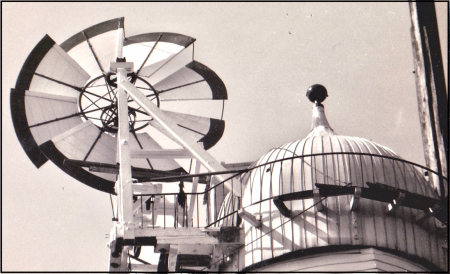
Fan Tail 450
The old Impington Windmill at Histon, Cambs, 1967.

Histon is the small village near Cambridge where Christopher Woodman began to restore an old windmill in the 1960s. The ‘fan-tail’ which you see here drives a series of cogs and shafts that turn the whole top of the mill so the wind-blades always face the wind. This meant that when Christopher Woodman looked out of his window from the Miller’s Cottage each morning, having completed that part of the restoration, he was never quite sure where he was as the world changed all its coordinates when the wind shifted directions in the night.

.
PARTINGS & RESTORATIONS

……………………………………………………………………..updated May 12th, 2022
To start with, I have very few friends who read poetry and even fewer who read the poetry I write. This is partly because at two very important junctures in my life I quit poetry altogether, and as a poet I have no past.

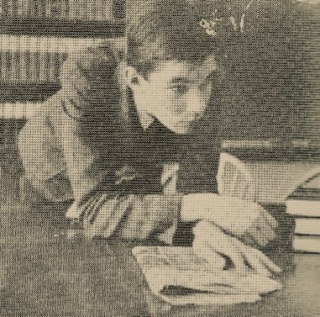
The first time I quit was in my teens when I stopped writing because I knew my poetry was fake. Even at sixteen I was aware that I wrote poetry because I wanted to be a poet, and would cobble together anything and call it a poem for that reason. CW Yearbook 1957Indeed, I was aware that I was putting on a mask in order to hide my own struggle with myself, not to express it — I couldn’t tell anybody that but knew it myself. That’s one of the reasons I’m still so interested in W.B.Yeats who was an out-of-touch adolescent with similar obsessions all his life. On the other hand, right from the start Yeats built on an ancient mythology that had everything to say in itself however much he fudged it, and of course he was also a genius in so many other ways. I posed as Yeats did but with a great deal less skill and with no effective schtick of my own at all. I pretended to be Shelley, for example, and even nourished the fantasy that my boy’s boarding school was the school that imprisoned 19 year old Percy Bysshe’s 16 year old Harriet! But all the same I did get a superb education there and, perhaps even more importantly, the experience of waking up among the magical New Hampshire lakes and forests for five of my most sensitive years.

I also arrived with a beautiful soprano voice, and from the age of 11 sang solos in the St. Paul’s School boy’s choir, Handel to Mendelssohn. I did it for that long because my voice remained clear as a bell until I was all of 15, no less. And of course I was just getting ready to quit poetry at the same time that my voice was finally changing, and little did I realize what all that would mean for the latter part of my life!

To finish up the First Parting, then, I fell in love with the girl in the red silk dress at 17, married her at 20, and had my first child as a sophomore at Columbia in 1960, just 5 days after I turned 21. I loved my young wife to distraction too but lost her not so long after I married her, just one single fraught decade out of 8 of them — and lost her in much the same way as both the hero and the author lost Yvonne de Galais in Le Grand Meaulnes, that most important of all tropes.

ImageAt a séance in New Haven, Conn., 1962.

It was thus that women trumped poetry in my life, and in a sense still do. But I’m not in any way a threat to anybody, not even to myself, nor have I ever been ‘any of the above’ what is more promiscuous. On the contrary, I’ve been much too fond of my wives even when the marriages failed, and they were long ones, an inspired 10+ years each. That always made it especially hard to let them go and, like Alain-Fournier, to my detriment I didn’t.

Women have always been it in my poetry as well — as it was for the Troubadors, for Dante and Petrarch, for Goethe and Coleridge to John Fowles and his mentor, Alain-Fournier. On the other hand, this pedigree has had less to do with my personal relationships with the women I have loved than with what might be called my ‘magical thinking.’ Indeed, it lies at the core of my inner life as a seriously engaged Buddhist/Christian/Animist who remains both an undeveloped enfant terrible and an old hurt soul to this day. As silly as all that may sound, I wouldn’t be me without any of it!

And just to mention that I’m now in the 30th year of a marriage with a very real, dynamic, professional woman, Homprang Chaleekanha, and if you want to know more about that sort of love relationship you should read the last of my 3 books, Fig Leaf Sutras: a Memoir in Poems, 1994-2024. I just hope you will be able to get hold of it soon. Indeed, it’s out there right now, fishing with the very brightest feathers and most succulent bait it can manage.)

The Second Parting was not with writing poetry but with studying the history of it as a graduate student at King’s College, Cambridge. C.S.Lewis accepted my research proposal based on the reading of Edmund Spenser’s The Faerie Queene I had developed under Professor Harry Berger at Yale, and C.S.Lewis was my Supervisor until he passed away leaving me just with the title of my thesis, “Polyphonic Narrative in Elizabethan Literature” — which remains to this day the origin of my style, my imagery, and my modus vivendi both as a poet and as a person.

That Second Parting happened just four years after my brother Tony’s accident in 1965, and was certainly hastened by it. In the interval I had won a Research Fellowship at Christ’s College and at the same time become Chairman of the Cambridge University Buddhist Society, a delicate balancing act if there ever was one. And what I did after that shocked everybody, even myself — I resigned my Fellowship at Christ’s, sold my beloved windmill in Histon, packed up my beautiful wife and by then 3 little girls, and went off to Scotland with a Tibetan Lama. But the really devastating event in that Second Parting was the moment when my beautiful wife, aka ‘the girl in the red silk dress,’ departed with another of the Lama’s disciples, and I found myself at 29 alone with 3 small children and a whole lot of relics already — memories, images, artifacts, whatever you want to call them — all of which are covered in the gold leaf that has always sanctified my turbulent, topsy-turvy past.

Indeed, “La-Croix-Ma-Fille!” used to be called “Gold Leaf on the Waters” but has now moved on to a title that’s more like life as mine actually turned out to be. And how I hope you will be able to get hold of my book in the very near future as it’s so winsome and so longs to be read. It’s out trolling at the moment too — you can click on the title, “LA-CROIX-MA-FiILLE!” to see what it’s doing right now.

……………………………..My fingers ache with so much crossing,
………………………………………………………..Christopher

RELOCATIONS & RECASTINGS

Image
Tea break at the Old Windmill with Sophia & Delia in the sandpit.

Christopher Woodman restored the old ‘Impington Windmill’ in the village of Histon while living in the Miller’s Cottage at the base of the mill in the 1960s — those are wooden cog-wheels that he’s sitting on which he intended to restore as well. He had already rebuilt the whole fan-tail porch in hard wood and recovered the dome-like cap as well with lap-strake cedar. Fortunately there were blacksmiths in Cambridgeshire at the time who still knew how to find and/or recast the broken iron parts of the machinery just as his writing attempts to relocate and sometimes to recast the missing parts of himself and his life. Much of that was also involved in his 400pps Cambridge thesis, “Polyphonic Narrative in Elizabethan Literature,” which was not liked at all by any.

Image1910

This is an old photo of the ‘Impington Windmill’ in 1910 with young women in white bonnets picking strawberries for the Chivers jam factory in the nearby village. If you look closely you can see two figures standing on the fantail of the mill. There are also two horse-drawn wagons, and the overseer is wearing a suit and fine hat. This is very much the worlds of both Tess of the d’Urbervilles (1891) and Le Grand Meaulnes (1913), remnants of both of which were still there in rural England and France when Christopher Woodman arrived just 50 years later. The miller’s cottage where he lived with his wife and children is visible just to the left of the mill, indeed his third and youngest daughter, Antonia Unity, was born in the cottage in 1967.

1

THIS IS THE END OF THE THIRD SHORT PREFACE...

…………………
            ……..+………+………+………+………+………+………+…….

[To exit this Preface you can visit  LA CROIX MA FILLE! , the first Major Thread on this theme.

[You could also choose to go on to the   ***FIRST Major Thread*** in the Index:  FOR THOSE LIKE GALILEO WHO NO LONGER READ .

[Alternatively you can choose any other title from the Index in the left-hand Margin.]

A FORTHRIGHT APPEAL

CONFESSION, FABLE, or SHORT STORY?

………………………………………………..  August 11th, 2020, revised  September 25th, 2025
Two major threads on this site, For Those Like Galileo and In Praise of the Still Unweighed; Off the Record at 80 occupied me for over six months each, and in the process made me realize that I needed to be more forthright. And then months later, whatever it was started to grow roots and the roots green sprouts — and I knew that even if it achieved nothing it was still greening something in myself bit by bit.

And then one night I woke up with a word,* and not knowing what it meant scribbled it outImage in the dark on the scrap of paper marking my place in “The Invisible Woman” lying beside me. I copied the last four letters out twice so I could decipher the word in the morning — yet to this day I still don’t understand it in the context. Why me? Why then? Why this?

THE APPEAL

I published such a lot so easily when I first started sending out my poetry in the 1990s, and I thought my time had come at last when I was nominated for a Pushcart Prize in 2010 by one of the best poetry journals in America. But just the opposite happened. In the  months that followed I was drawn into what I now realize was very serious Poetry Publishing Politics and, much to my chagrin, not one of my poems was accepted ever again even by those editors who had already published me or had been giving me regular encouragement.  In despair I gave  up sending out new work altogether, and gave my books my undivided attention.  And lo and behold,  that’s how my beautiful three books, Galileo’s Secret, La-Croix-Ma-Fille!, and Fig Leaf Sutras, came into being on a so much higher level than even I had ever envisioned.

“Under a hiatus of ash,” I used to say to say to myself 10 years ago. As it turns out it was rain in the forest, and I disappeared into it — but I never gave up.

…….

Here’s what I still want to say about myself. 
As a start I’d like editors today to read some of my poetry as did James Laughlin, Theodore Weiss, Marvin Malone, Alice Quinn, Marilyn Hacker, Joseph Parisi, David Young, Lee Sharkey, John Rosenwald, Dan Veech, Ronald Wallace, and Susan Terris, among the many distinguished editors who published my work and/or reached out to help me 10, 15, 20 years ago, an unknown poet with no poetry degrees or affiliations.

I sent “Connemara Trousers” to The New Yorker, one of my earliest submissions. Alice Quinn wrote back right away. “Much too long for us,” she said, ” — try The Kenyon Review.” And Marilyn Hacker replied almost immediately:

“Yes!”

[Can you imagine? Just click on it and see!]

And just a few years later Theodore Weiss short-listed a very early version of my Galileo’s Secret for the QRL just before ill-health forced him to retire after editing the famous Book Series for 50 years. Wiki says; “Ted Weiss showcased emerging and major writers including William Carlos Williams, Wallace Stevens, e. e. Cummings, Thomas Merton, Mark Van Doren, Ezra Pound, Henry Miller, and Jean-Paul Sartre, and also introduced some that were not widely known to Americans, including Franz Kafka and Eugenio Montale.”

I still have the little scraps of note-pad paper on which Ted Weiss encouraged me with his stubby pencil. Among my most precious relics, his last words were safely conveyed to me all the way to Chiang Mai in the safe hands of his wife and right-hand man,  Renée Weiss.

I share my even earlier correspondence with James Laughlin with the Houghton Library at Harvard, but I think my hard copy is probably the top one he stripped off his old Remington to mail to me in person. I didn’t even have a book to show him at the time, just individual poems which he liked enough to write a lot to me, and to share with me his own struggles too as I am sharing mine with you.

…………………………………………..‘Dona nobis pacem,
………………………………………………………..    Christopher

* “RECEPTACLE:”

1. Object: A container that holds items or matter;
2. Botany: The expanded tip of a flower stalk or axis that bears the
….floral parts or the florets of the flower head;

3. Electronics : A fitting connected to a power supply and equipped
….to receive a plug;

4. Poetry: A supra-dimensional quantum or ‘ravishment’ as contemp-
….lated in a spontaneous celestial observation.

THE DISCUSSION CONTINUES IN THE COMMENTS

FOR THOSE LIKE GALILEO

Peniche Original

 A Péniche on the Canal de Bourgogne.
(Click on the photo to see better.)

……….
…….FOR THOSE LIKE GALILEO WHO NO LONGER READ
……………………………………………..Le Canal de Bourgogne

……………….So where are they now the poems
……………….For those who do no longer read
……………….But lose their way in words,
……………….Their overheated selves
……………….Closed down like God’s own
……………….Disowned fools in
……………….Damp, forgotten locks
……………….And other fasts and solitudes—
……………….Fisher kings, tall stilt-legged birds,
……………….The mist-wrapped walker with
……………….The busy dog and old felt hat—
……………….Mute, pre-dawn souls bewildered by
……………….The wash and roar of meanings when it’s all
……………….Gunnel-rubbing function transport
……………….Pumping huge breast-plates of
……………….Greased iron up and down
……………….A ruined cut?

……………….In what remains of waterways
……………….The late unharnessed signs
……………….Solicit violence from the banks—
……………….They gesture darkly from the verges,
……………….They flash behind the trees.
……………………..DO NOT PASS HERE
……………….Someone shouts with dented palms.
…………………………..BLACK SPOT
……………….Cries another lover, forehead
……………….Rusting with bullet holes.
……………….And what’s that hanging man
……………….Muttering in the shadows
……………….Underneath the low bridge?
……………………………..STOOP
……………….He seems to be saying, taking
……………….Some deeply-laded pleasure
……………….On all fours.

……………….Or is such uninhibited display
……………….Just loose sluice valves stuttering?

……………….For see—
……………….How easy it is to swing
……………….Those mossy lock-gates to
……………….And turn the handles down,
……………….The act that predicates
……………….A dryer route, faster,
……………….Less brave and spectacular,
……………….Its tow paths like third rails
……………….That sheltered spark
……………….Over-night delivery,
……………….Shinnying under ground.

……………….I want poems for those
……………….Who are like me
……………….Not chosen to dance
……………….By the girl in the red silk dress,
……………….That the words may be hard
……………….And penitential like the chairs
……………….We fast to inhabit while
……………….We wait by the wall,
……………….Plain and patient
……………….Until the music stops
……………….And we all go home.

……………….Write me a dozen poems
……………….That cover their heads in white
……………….Like girls who have taken vows.
……………….I will listen hunkered down
……………….With the quiet doves at dawn
……………….While they kneel humbly in starch
……………….And crocus dust for seven days,
……………….The ecclesiastical calendar
……………….Going from purple to green.
……………….The lines will tremble
……………….Around their eyes
……………….Like veins in silver leaves.

……………….Oh, I’d lock into
……………….Any old post-industrial canal
……………….To hear such winsome
……………….Angel rhymes and
……………….Early morning cloister traffic—

……………….The reverie of antique grease like myrrh
……………….Or amber-wax on iron plates,
……………….The stricken wicks,
……………….The cranks like icon sheets
……………….Turned down for one last night
……………….Beside the basins full of spirit silt,
……………….The huge rustling posts and pedestals
……………….That mesmerize the undergrowth,
……………….Murmuring in the rushes where no moth
……………….Wrapped in its own juices has no robe
……………….Or swaddled Moses goes unfloated.

……………….And all the while the mist-wrapped
……………….Walker’s sheltered track,
……………….The busy dog,
……………….The heron’s tact.

………………………………..from GALILEO’S SECRET: Two Decades
………………………………………  of Poems under House Arrest. (unpublished)

…………………………..………

You can Click on the Stamp on the old Postcard to go through the Tunnel.

Image

A personal Note:
The venerable industrial canal has provided much of the transport for heavy cargo in Europe right up to the present, yet few of us are familiar with the gates, cranks and levers, or understand the complex hydraulics of the dams and reservoirs that feed them. The 242kms Canal de Bourgogne, a truly sacred relic with its 189 shaded locks, ascends 400 meters vertically in the Burgundy region of central France and then descends to meet the Yonne and the Seine rivers and on down through Paris to Le Havre and the sea. An engineering masterpiece, the canal linked the Mediterranean with the English Channel and at the same time put the finishing touches on one of the most beautiful old-world landscapes in Europe. Much less known is the fact that it came to shelter a unique community of people who lived on boats, and whose identity was formed not by place or jurisdiction, but by how they worked apart and at the same time respected each other.

The Canal de Bourgogne is one of the places I have loved most in my long life away from home. Image I still rejoice in the thought of it but know it’s unlikely I shall ever visit it again as it’s no longer a place to work one’s way through, just to play around in, to pretend. For that reason I’m not really very interested in it anymore  — it was ‘working my way through it’ that so engaged me right from my first passage 50 years ago to the moment when it was closed to heavy traffic in the 1990s. “Se frayer un passage” (“to ‘force’ or ‘work’ one’s way through something, like a blacksmith ‘works’ wrought-iron) is what the French “bateliers” (‘barge people’) have always called working their huge 125ft steel barges through the complex system of wrought-iron gates, sluice valves, levers and ladders for days on end to wherever they happened to be going  — and it could be grand places too, Marseille,  Lyon, Paris — or anywhere in Holland, Belgium, Germany, indeed all the way from the Rhone to the Rhine and back again to humble St Jean de Losne on the Saône or Conflans-sur-Seine. And they did all that not only with 350 tons of sand, stone, coal or grain on board, but with the whole family — home was aboard and everybody was there all the time!

Alone and always pushing the limits, the bateliers are fiercely proud of who they are and what they do to this day, indeed as proud as the ‘Roma,’ Tinkers,’ or ‘Travelers’ in Ireland and the U.K. or the ‘Gitanes’ in France are proud, all unique people who work their way stealthily through long, hard, isolated lives on the back roads of modern life. Deracinated and forever on the move, they dedicate their lives to wrestling with the loss of so much that was once so kind and familiar, and to watching the world self-destruct on the high roads. And that’s heroic, isn’t it, even if it means you look down on everybody else? (I add that last while bowing, quietly, as a poet, out of sight myself.))..C.W. (photo March 2nd, 2025)

.

Image

…………………..A Batelier family photographed at home on a Sunday.

A sensitive reader who has been through a Galileo-like “house arrest,” and I think many of us have, will understand the extreme dislocation, the burden, the longing  and the loneliness he must have experienced. Even more importantly, such a person may have experienced the mysterious resolution at the end of the poem, of being as alone as that yet well and whole at last.

………………
CONTINUED IN  THE FOLLOWING DISCUSSION.

IN PURSUIT OF THE STILL UNWEIGHED: Off the Record at Eighty.

……………………………“I am on the side of angels and of dirt.”
………………………………………………Sir Stanley Spencer (1891-1959)

ImageThe Lovers (The Dustman) (1934) *

……

…………….GRAVITY’S RAINBOW:
…………….SUNDAY IN THE PARK WITH SIR STANLEY

……………………O rejoice in the women,
……………………And the white perfect ducks
……………………With their fashionable heads in the mud,
……………………How they tether themselves down
……………………With pegs in the ground
……………………So they won’t float up in the air,
……………………The feathery dry air that is brighter than gold
……………………But stays unredeemed on the shelf.

……………………For the ducks like the women
……………………Turn weight upside down
……………………By the water on Sunday to stay down,
……………………Not to be better, or up nearer the sun
……………………With the buskers, fine philharmonic
……………………Conductors, preachers, teachers,
……………………Invalids in chariots, toddlers and clowns —
……………………Ah those sweet little flippers that tickle the air,
……………………As pliant as play-dough or beeswax,
……………………Useless as paperweight slippers,
……………………Ballast for butterflies, barbells for kittens —
……………………Perfect as the lead in the magician’s tight furnace
……………………Or the sticky brown muck in God’s oven.

……………………“O the big wide basket of my body,”
……………………The duck woman cries,
……………………“O the piles of starched linen, the fillips,
……………………The white cotton aprons and tea-towels
……………………Folded so nicely in my trembling arms,
……………………Down on my knees by the pool!

……………………“Take this fine little turn-up,
……………………For example,” she says,
……………………“Do you see how it’s paddled and done?
……………………“The masterful curl at the end of the tail,
……………………How the bottom turns upward as if at a ball,
……………………The crinoline, the petticoats,
……………………The old-fashioned drawers that kick highest of all —
……………………And O how they flutter with each do-si-do,
………………….. And how the heart goes — can’t you feel it?
……………………And aren’t it worth the applause?”

…………………… “Come on in then, come on in!”
……………………The duck-caller cries,
……………………And when she comes in on his arm
……………………To waddle like a lover on the velvety floor,
……………………Or soon to be mother,
……………………Which is very good too,
……………………How he dips by the water for a nod or a snooze
……………………Any day in the park, old poet by the pool —
……………………Takes his nap on a folding green chair and the paper,
……………………A moist royal nap amongst women,
……………………Head-over-heels in God’s pool.

………………………………..from GALILEO’S SECRET: Two Decades of
……………………………………….poems under House Arrest.
……………………………………              ….[unpublished]

…………

AD HOC
This poem from the very end of GALILEO’S SECRET has a whole bibliography just waiting to be discovered by some ardent young academic a few years after my death. “And the guy never got published,” he may recount breathlessly to his friends over his latte at Starbucks. “So nobody’s ever done him!”

For a whole lot more on what’s to be done, the discussion continues below — and needless to say, anybody is welcome to join in ruffling through the profligate mess. **

………..Christopher Woodman
…………

……* NOTE #1:
“dustman” in England is to this day what Americans call a “garbageman.” In Sir Stanley Spencer’s The Lovers (The Dustman) (click on the title to see the whole painting better), the dustman/artist is in the arms of the most important lover who is offering him the last of the fresh milk in a jug. The other lovers are offering him bits of sacred garbage from the “dustbins” (garbage cans) he so loved to see set out on the street every Tuesday morning in Cookham: a broken teapot, some cabbage leaves, an empty jam tin.

I have just added an INTERJECTION on Sir Stanley Spencer. Indeed, you should have a look in this particular ‘dustbin’ ahead of time as this whole “off-the-record” thread has been conceived in similar terms.

……** NOTE #2:
A REPLY can be inserted anywhere you wish in the discussion. A COMMENT will always appear at the very end of the thread.

…………
…………………THE DISCUSSION CONTINUES IN THE COMMENTS

LA-CROIX-MA-FILLE!

LA CROIX 512
[You can click your way right onto Julija’s desk in Baan Uii Dee.]

It’s three months later and Julija is back, and I’m writing what follows as much for her as for you and me. Because we’re all working on this project together, though Julija’s Latvian, of course — Russian is her first language, Latvian her second, lives in Norway and was brought up in the Russian Orthodox Church, all powerful influences on her work. Today Julija’s desk is no longer under the volcano on Bali as it was before but up here on the porch of one of our old wooden farmhouses in Chiang Mai where she’s working on the first draft of a cover for La-Croix-Ma-Fille. If you click on the sketch you can see in detail what’s emerging, an illuminated vision every bit as fey yet as final as the book’s last words:

……………………………………..Grâce à la croix,
……………………………………..Grâce à la fille,
……………………………………..Fleurs de sel,
……………………………………..Delivery.

…………….

PERSONAL NOTE: Please, please don’t worry about the French — indeed, if you don’t speak French the lines may well say more to you than if you do. Because French phrases and place-names have come to have an almost sacred quality in the anglophone imagination,  like “je t’aime” and “Côte d’Azur” for example — or for gourmands at least, “sauté,” “vinaigrette” and, most beautifully and appropriately of all, “fleurs de sel.”  In my experience, poetic phrases based on subliminal, polyglot fantasies come more out of the shadows of the heart than the light of the head, indeed, they resonate magically like “Shanti Shanti Shanti,” “Sadhu Sadhu Sadhu,” and “Amen” — in silence, or in tongues, or under the bed.

And be honest with yourselves. Which word in the above lines do you really not understand? Is it by any chance “Delivery?” Well, me neither — which is why the whole book not only got written but still matters!

C.

…………………………..

SOME NOTES FOR JULIJA

“La-Croix-Ma-Fille!” is the local nick-name for a 170 year old stone memorial just outside the Breton fishing village of Le Croisic. The cross stands alone on the cliffs of the Côte Sauvage high above one of the most dangerous lee-shores on the whole north-west coast of France — which is why the title is in French as well as why the love story that runs through it is set there.

But what makes these rocks particularly menacing is that they are right beside the entrance to Le Traict du Croisic ( = “the tract, area, sand flats of Le Croisic”), one of the safest havens for storm-tossed mariners on the whole of the Brittany coast but extremely difficult to get into in heavy weather. And that’s the terrible irony, because as the mariner-poet runs for the perfect shelter behind the breakwater he takes the risk of being dashed on the rocks just on the other side of his salvation, and many widows have been made in one last desperate effort to avert that all too familiar disaster.  Like the tides of life, half a dozen of one equals six of the other — and of course that applies to any dangerous crossing what is more love story like this one.

La Crox Ma Fille B:W tweaked 1 copyThe stone cross in question was erected as a memorial to a much loved daughter who died on the rocks below on August 7th, 1845 — its inscription reads simply, À MA FILLE/ 7 AOUT/ 1845. Over time the local people have  realized that this solitary, wind-swept cross has come to have  a life of its own, and that it’s power resides in the mysterious phrase, “la-croix-ma-fille.” Indeed, this tragic stone cross has become a sort of magical ‘hex’ or ‘totem’ for the Le Croisic community, a ‘spirit house’ one might even call it (‘hôtel’ in French also means ‘altar’ when translated into English). Whatever, the local people know that what they now call La-Croix-Ma-Fille can reach out to their storm-bound loved ones as they struggle to stay off the terrible rocks below, that in the darkest moments its power guides and protects them like a lighthouse or an angel, and brings them safely home to the hearth in one piece.

“Fille,” of course, can mean either ‘daughter’ or ‘girl’ in French, just as “my girl” in English can mean ‘my daughter’ or ‘my girlfriend.’ So the expression, “la-croix-ma-fille,” just says “the cross my girl,” which is what it says in the title of the book as well as in Samson’s haiku at the beginning and in the long love-poem, “Fleurs de Sel,”  right at the very end. And it’s that mystery which is at the heart of what Julija is trying to illustrate too (I like this attempt in particular — and this one because it’s by Samson which means it’s even closer to home…).

Perhaps it’s clearest of all at the very end of the poem called “La-Croix-Ma-Fille” — it’s Part IX of “Fleurs de Sel” which terminates the book. I’ve never put up this poem before, and have a feeling I’ll eventually chicken out and take it back home and look after it in silence for the rest of my life.

But in case I don’t, I just want to say that there’s a boat beached on the sand flats of the “Traict du Croisic” at low tide with four heavy anchors set out fore and aft, two off the ‘samson-post’ on the foredeck and two more off the post on the stern, the rush of the last outgoing tide having been as ferocious as that which will surge back from the opposite direction in just an hour or two more.

…..
……………………………..LA-CROIX-MA-FILLE!

………………………………….Relict fast on an alien strand
………………………………….Flaked out like an idle rope—
…..
………………………………….The plaits loose in their tress,
………………………………….The cradled belly soft and toes

………………………………….Uncleated, the cross of the limbs
………………………………….A hammock loosely swung between

………………………………….Four great anchor posts dry but deep
………………………………….In the leavening sand where the gulls

………………………………….Wait the turn like soft marbles
………………………………….Disposed on a board of white leather

………………………………….Worked to a maiden smoothness
………………………………….Fresh, unstained, released from all

………………………………….The muscle loads and lust
………………………………….Of the great beast that once in-

………………………………….Habited that hide, the tongue
………………………………….Cupped in the silent cavity

………………………………….Of words all said and signed
………………………………….And thoughts a mirror sunk

………………………………….Like the sea when it lies down
………………………………….In the sand to sleep, its blind might

………………………………….Cupped in the great callused hands
………………………………….That lie half-closed, half-open—

………………………………….Infant hands that once
………………………………….And once only water held

………………………………….And wash and wash
………………………………….Like off-shore bells—

………………………………….Grâce à la croix,
………………………………….Grâce à la fille,

………………………………….Fleurs de sel,
………………………………….Delivery.
…………

I thank you for still being there, and ask that you continue to be gentle too,
Christopher

More for FRANZ WRIGHT: “dark, then bright, so bright”

An antique Relic found amongst the Ruins,
thought to be Samson’s.

He Reflects / 450………………….[Click twice on the old script to read it more easily.]

A further antique Relic thought to be Samson’s:
illuminations on Julija’s desk under the volcano on Bali.

0831 / 450

…………….God Burns 4 …………..[Click twice on both to see better, & read carefully for clues to decipher the text.


A BIT MORE ON THE PREVIOUS CONVERATION WITH  FRANZ WRIGHT

Dear Jūlija,……………………………………………………….December 9th, 2017
I love what you say in your last paragraph about the “message of the relics” — it’s very exciting how we’re finding our way there together, and I’m tremendously grateful to you for the help.

In answer to your question about Franz Wright, he was a unique, and uniquely great, American poet who also had a uniquely troubled life. He died just two and a half years ago after a long struggle with lung cancer, having essentially smoked himself to death. He had been abusing drugs and alcohol and everything else for 40 years, was in and out of mental hospitals, and was famous for being extremely angry and aggressive in public and especially  on-line. For examples of the latter you can go to For Franz Wright (2010) cited in my previous post. In particular you can read his Comment 34 followed by his Comments 38 & 39, and finally his very moving last Comment 41.  (For convenience sake I have highlighted all Franz Wright’s Comments in Green.) And you can also read a short reply of my own to him in Comment 40, which will give you an idea of how I dealt with all this at the time.

Insufficiently, needless to say, and why I have felt compelled to revisit the original thread 7 years later, and of course why I am dedicating “He Reflects on What his Genius Means” to Franz Wright along with your beautiful illuminations.

Also why I have high-lighted in blue the discussion with my co-editor at the time, the anti-modernist critic, Tom Brady, who mocked Franz Wright ferociously both as a poet and as a person throughout. My feeling is that readers will be interested not only in Tom Brady’s ‘Old- (as opposed to ‘New-) Critical’ views but also in the way my own understanding of both ‘the poet’ and ‘poetry’ in general developed during the discussion. Because I was caught between a rock and a very hard place, pushing against two uncompromising Savanarolas, Tom Brady on the own hand and Franz Wright on the other, the former dismissing my poem, “Leonardo Amongst Women,” as “didactic” and the latter as “perfectly awful.”

Which was a lot to deal with then, and still is.

[Cont. in the Comments.]

WHY IT IS MORE IMPORTANT FOR A WRITER TO SLEEP WELL THAN BE READ, OR ALMOST

sleeps in the monring 450……………………………………………………………..“Morning” by Dod Procter (1926).

………………………………………………………………………… December 2nd, 2017
My writing is for me like a journal that sleeps in in the morning…

that wakes itself up every day from scratch…

that is always the same yet always completely different…

that like time itself starts over again every time it’s aware of the time…

that like time is aware of itself only in a present that has neither a past nor a future or anything in common with anything defined, labelled, catalogued or published…

that is always there in my present because it has never had to become like another person’s book on my shelf…

that is never finished because it has no other reader to fix it like a butterfly on a pin, a print in the darkroom, or a boat with a chart and a hand-bearing compass somewhere out there on the ocean…

that is never opened because it’s a book that has never been cut even after it has been selected, edited, printed, purchased and held in a hand or a wrapper or warmed in a pocket or by the pillow in somebody’s bed…

that is susceptible to revision but not editing, i.e. susceptible to being re-seen but not re-said because it might sound better any old way…
………………

[continued…] ……………………………………………………………… December 3rd, 2017

Image
…..

…………………………...‘LIBERATION’  (vendredi, 19  janvier 1990)

[continued…] ……………………………………………………………… December 4th, 2017
I lay in for a long time yesterday morning, figuratively speaking, and my sense of it is that that was good. It meant I didn’t have to explain anything to you about what I was doing and, low and behold, that worked out brilliantly. Because it was obvious — you just clicked on the clipping to get in and even if you didn’t speak a word of French the drapes showed you everything. And of course Cristina Szemere then set that up beautifully in her elegant précis: “persistent absence…awareness because there is no revelation, no un-dressing.”

Oh my!

And then on top of all that there were you visitors from France, Spain, Angola, India and Thailand along with the anglophones from the U.K. and America, all clicking on ‘Liberation’ to get a life in the next:  FOR FRANZ WRIGHT – January 21, 2010.

What I’ve done today is highlight the relevant passages in blue so that if you’re ready you can breeze through it all quite easily and I can continue to lie in.

Oh yes, and the keywords, of course: Didactic, Perfectly and Awful.

[continued in the Comments.]…………………………………………. December 6th, 2017

“O FOOL OF EARTH!” A Haiku by Samson illuminated by Julija with Caravaggio, T.E.Lawrence & an encore by our Christy himself.

O Fool of Earth 450

……………………………………………………………………November 21st, 2017
A first draft of an illuminated haiku by a very special and gifted new friend, a Russian speaking Latvian calligrapher who goes by the single name of Jūlija. And there’s going to be lots more of her, including an illumination of the haiku in the previous post. At the moment her version of “Stumped like this” is lying on her scriptorium desk on the island of Bali, and I just read that Mt. Agung is going off so there may be a delay.

Just a few weeks ago, Jūlija and I started working together on a project to illuminate a series of what I call “relics” in my latest book called La Croix Ma Fille. And just to lay this new card on the table from the start, should La Croix Ma Fille find a publisher it might now include Jūlija’s work. Because what she is doing has inspired me so — lifted my spirits, confirmed my hunches, and given me the courage to believe that, even at just a few days short of 78, this author might still manage to publish the book!

I’ve had the idea for years — that I might assemble a book that would include some poems that I didn’t write myself but were “found.” So La Croix Ma Fille has a Foreword entitled “Three Relics Found Amongst the Ruins, Thought to be Samson’s,” the last poem of which is the haiku called “O Fool of Earth” — which, if you please, was written not by me but by the “front-line saint” called Samson, a Justice League enforcer if there ever was one. Because he’s God’s own body-guard, bouncer, and batman — yet he’s also humanity’s fool like the shy inventor, Bruce Wayne, which means not unlike me and perhaps even a bit like you. And don’t forget that these jottings were discovered “in the ruins” sometime after Samson pulled the temple down about his ears — “So the dead which he slew at his death were more than they which he slew in his life,” as the Bible puts it. And if that doesn’t sum up our own well-meaning but tragic interventions at home and abroad, what does, and I mean both on the personal and national levels?

Here is the “relic” as it appears in my typed m.s. in 12 point Lucida Calligraphy — that’s as far as I dare to go for open submissions, but I’d love to see what a good book designer could do with the fonts, colors and spacing . It’s a ‘Haiku’ as well as a ‘Relic,’ of course, so there’s that too to take into consideration.

O Fool of Earth - Relic

Jūlija’s version of the same poem at the top of the page is an early sketch with the script partly in black-letter and partly cyrillic, a fusion which creates an ageless sort of sacred cypher, which I love. Because the reader mustn’t forget that the original was transcribed in long-hand by a prophet in a most challenging position — trussed up between pillars with his God on the one hand and his girlfriend on the other (my imagination still goes to  Caravaggio*  for that, the saint’s bare head, her lap, the nipple, and God flaring up all over the place…).
………………

*Note: CARAVAGGIO! or How the Samson of Painters Paints Samson.
……………………………………………………………………..November 25th, 2017
It’s the prophet himself who wrote this little poem so forthrightly, of course, and by my way of thinking it’s the weakness of Samson that demonstrates his ‘chosen’ status more than his brute strength ever did. That’s why I think Samson was granted even more divine strength for that one last shove, and why the effects of it were even more cataclysmic than what he managed to do with the jawbone of the ass. And that’s how Caravaggio painted him as well, didn’t he? Doesn’t his shaved Samson reveal a prophet who is even more powerful sexually than he was before, his smooth skin, his feminine curves in silk and his hands just like her’s? And don’t the lovers fit together just about perfectly? And doesn’t everybody inside and outside the painting know just what that means? (Click more than once to see that even better.)

What also makes this haiku holy is the simplicity of its vocabulary: “wise,” “heart,” “love,” “girl’s,” “flares up,” and “burns.” Had someone like me written the poem you’d think it was by a middle-school student trying to make his creative writing teacher happy, whereas the author is actually an ancient prophet who is just about to discover his true strength by acknowledging that he has not only lost it but abused it. He admits, moreover, that his heart is not “wise,” and whereas the girl’s heart in the poem just “flares up,” his goes on burning and burning, a self-destructive and at the same time self-affirming conflagration not unlike Caravaggio’s. And it’s not demeaning for him to use the word “girl” either — indeed, he’s mocking himself, not women, exposing his fatal attraction to fantasy lovers as opposed to real or ‘other’ persons, and that’s a man-problem that no amount of man-splaining can ever cover up. Samson may be a saint but he knows he’s also a fraud ** — which is precisely what makes this humble scrap of a relic-poem so precious, and why any human being might think to fold it up carefully and place it in a small reliquary on a string about the neck, a talisman to keep from being undone by gently, humorously, respectfully turning oneself away from the self-serving self to behold. And “turns” is just the right word to describe whatever that is, I feel sure, though I haven’t a clue what that is myself.

**NOTE: The flawed saint I admire above all, and the one I never stop thinking and writing about, is T.E. Lawrence, and in a sense all of the above is about him. While actually on the road to Damascus at the very end of the Arab Revolt in 1918, [and with the Morte Darthur in his camel’s saddle bag, dear Jūlija and Romain], Lawrence realized that “all established reputations were founded, like myself, on fraud.” He removed himself from public life altogether shortly after representing King Faisal at the Treaty of Versailles in 1919, the outcome of which broke his heart as well as the whole of the Middle East. He died in 1935 under the name of T.E.Shaw, an ordinary mechanic in the Airforce. It was just a local motorcycle accident on a small country lane, but his funeral entourage a few days later included everybody from Bernard Shaw and E.M.Forster to Winston Churchill, and many born like myself too late are still there.

……
ONE LAST FINAL ACT AND DEPARTURE
By way of an encore to all these final acts and departures I’d like to bring in for one last bow another Irishman, J.M.Synge’s almighty wastrel/minstrel hero from “The Playboy of the Western World.” For it’s “our Christy himself,” that genius liar, lover and logos, who makes such an utter fool of himself that he can turn the tables on the whole world, and scold all the Fools of Earth in one hearty go as if he were some Old Testament prophet: “Shut your yelling, for if you’re after making a mighty man of me this day by the power of a lie, you’re setting me now to think if it’s a poor thing to be lonesome, it’s worse, maybe, go mixing with the fools of earth!”

Which should bring this to a close, I think — dear friends.

Christopher

ON HOW I MAKE SENSE OF IT: (the poet deconstructs somebody else’s haiku…)

IMG_0549(shopped)

Calligraphy by Jūlija added Nov 29th, 2017. CLICK HERE for more on Jūlija and our work together.
………………

…………………………..Stumped like this,
…………………………..we hear the Years
…………………………………………………..cascade
…………………………..And stoop to grace
…………………………..the Water
……………………………………………………..‘s Fall.

………………
a.) The poem has exactly 17 syllables, so it’s a haiku. That makes me slow down, reflect, get myself ready.

b.) The rhythm is, surprisingly, strict iambic — count the syllables and see. There are precisely 9 iambs which should add up to 18 as each foot has 2 syllables: da dah. So how can there be just 17, an odd number? Indeed, that’s the sort of simple-minded question any haiku worth its salt asks us, of course, and why we never get bored with the good ones. And the simpler they are the better — and the simpler we are too, needless to say.

c.) Perfection-in-imperfection, like everything. In fact there’s an invisible event at the very beginning of the poem which is unwritten, unaccented, and inaudible.  It’s simply not there in the poem — the first step has been lopped off, so to speak, truncated, ‘silenced’ as we say about an enquiry or execution, ‘stumped’ as we say in the forest or when we’re handicapped or failing. That’s why the first audible word in the poem works so well as a one syllable foot overshadowing the whole poem. “Stumped” from the very start, the poem is overshadowed by no shadow and left with no tree to bear, look up to, or hide under.

d.) “Stumped” is in the passive voice, an involuntary event that happens to someone or something — it’s done to you or me, not by us. The complementary “stoop” at the beginning of the second part is ‘active,’ as we say, and ‘finite.’ It’s what we-the-stumped do about it in the poem. And I’d say that rhetorical tension makes the poem a ‘haiku’ far more than the syllables do, or the layout — at least it does for me, and I’ve been living with this poem for over 20 years. Indeed, I’m writing this not because I wrote the poem but because it’s still talking to me.

e.)  There’s an even noisier event toward the end of the poem which constitutes a whole foot in itself, as huge as it’s empty and speechless like the swish of the axe to the block. The final ” ‘s” on “water’s” cracks off the edge of the 5th line to plunge down through the open space and land next to “fall” on the 6th line far below at the end. And it shushes us as it goes, indeed silences us completely as it plummets through space to rest at last beside the noun it owns at the end in perfect silence.

f.) A technical detail to further that. Like so many final events in stress-based languages, the apostrophe-s on “water’s” is not counted as a syllable. Yet in actual practice we pronounce “water’s” in three distinct parts: wa/- ter/- ‘s, almost as if there were three syllables. In vowel based, tonal languages as in Asia, for example, this is hard to say as there is no vowel to support the final consonant, and what does one do about that? Indeed, that’s why I’m called Kitofer where I live, the crush of 3 consonants at the beginning of my name, Christopher, being almost impossible to enunciate in an unstressed, tonal, vowel-based culture.

g.) Perfect iambics, yes, but not perfect pentameters — the poem is deficient again as there are only four feet in the final line. On the other hand, there’s so much happening in that apostrophe s as it tumbles off the edge of the poem that the numerical deficiency is filled up with something else in mid air, and in a poetical as well as a graphic sense fills in for the missing foot. In addition, the missing syllable makes just the right sound in its spectacular descent, the cascading sssssssss of the star which brings the poem to an end with no ripples, impatience or movement in ‘fall.”

h.) I’m pleased to say that none of the above attempts to explain anything at all about the meaning of the poem — haikus worth their salt rarely do. That’s why we so often choose to live our whole lives beside the ones we like best, as I have beside this one. They are never stingey.

Christopher

…………………
            ……..+………+………+………+………+………+………+…….

[To exit you can move on to the next Major Thread, ON WHAT I CAN SAY, or choose from the ***MAJOR THREADS*** that are listed in the left hand margin.]

ON WHAT I CAN SAY: (deconstructing the spirits’ beguiling but awful mess…)

Man Fishing     Mae Toranee copy

Here’s a writer at work beside what he’s working on — and as usual you can click on him to see better, indeed more than once if you really want to get into his world as well as into hers which is multiple too. He’s fishing on an autumn day in Stuttgart, Germany, and she’s wringing the very same water he’s fishing in out of her hair at Wat Pha Lad in Chiang Mai. And for the record, he’s Everyman and she’s Mae Thorani,

Some of you reading this will have been to Wat Pha Lad with me, and will understand what I mean when I say it’s the most beautiful mess in the world, an abandoned other-world nursery full of broken toys, baby buddhas, bric-a-brac, cast-offs, and basketfuls of dressing-up glitter. A very old water Wat in the jungle on the way up Doi Suthep, the holy mountain that hangs over Chiang Mai, Wat Pha Lad is a spiritual honey-pot that every day attracts mysterious little things that seem to sprout up out of the ruins — like that preposterous white chicken rocking back on its heels to gaze up at Mae Thorani wringing the water out of her hair. Indeed, this image of the goddess herself just turned up out of nowhere the other day, complete with the over-the-top dime-store necklace, and I was so excited I had to go all the way home and come back the next day with my camera. I almost said fishing rod, but that would be getting way ahead of myself.

I’ll get back to you as soon as I can.
Christopher. ….

P.S. Next day. ……………………………………………………..November 1st, 2017.
If you clicked twice on the goddess you might have noticed the bejeweled dancing girl scrunched up in the lower left corner behind the white chicken. When I first saw her I thought the curled leaf was her skirt, but in fact it’s not clear where her legs are, which of course are important for who she is and what she does, which is dancing. For she’s a Nang Ram, and even disheveled in the undergrowth she minces and glitters with her beautiful bare arms and her bracelets thrown back on the pillow beside her slightly turned head. What you might not have noticed is that her body is poised on the edge of an upturned bowl — that’s the remains of a red lacquer offering tray which may or may not have been instrumental on the day of her arrival.  On the other hand, the offering tray could have brought up anything that matters, the place being piled so high with the detritus of hope.*….

* NOTE:…………………………………………………………..November 3rd, 2017.
Things that are really important like hope shouldn’t be talked about, that’s my feeling, and I know I’m already skirting dangerously near the edge. That’s why I’m not going to tell you what a Nang Ram is, because if I do I’ll tell you things that I don’t know myself, and those things will get in the way not only of your understanding of them but, even worse, indeed fatally, of my own. Because in my experience the deepest things have to be seen out of the corner of the eye, so to speak, a flickering shadow, an apparition, a bump in the dark, and the moment you turn your head to focus on such things directly, turn on the lights, let’s say, they vanish into things you already know. And that’s simply not what or who they are.

It’s in the detritus of hope where the meaning lies, remnants in the bushes at the back of the house, for example, or buried in the leaves, broken and twisted or lost — off the path, off the record, off limits /sides /color /balance /duty /one’s rocker etc.

The evidence of the spirit world that we can see is way beyond its expiry date, if I might be so bold — it’s because the spirit has ‘gone off’ that we can follow its scent like the physicist can ‘track’ the fading footprints of atomic particles in a cloud chamber, or the mathematician ‘crunch’ what is left of what may or may not have been there in the numbers at Cern. You may remember some of the photos I’ve posted of what I sometimes call the ‘cloud chambers’ where I live, like the terrible mess in this one. (Forgive me for coming back to that, but I think it’s really worth visiting again.)

Human beings are afraid so they sweep the floor and make lists. The spirit lives equally in disorder as in order, and it falls apart as fast as it’s born. It’s on- and off-hours, on- and off-work all at once.**…..

**NOTE 2:…………………………………………………………November 4th, 2017.
The “writer at work beside what he’s working on” is off-work, of course he is, and the water he’s ‘working,’ as we fishermen say, is the same water that she’s wringing out of her long black hair. In addition, do note that Mae Thorani is gathering the water that flows from her hair into her cupped hand — and that’s woman’s work, needless to say, and why men need her so badly and hope she’ll understand when they come home from the river full but empty-handed.***

Here’s another with a clay pot for the water she’s gathering this time, and a fish.…..

***POSTSCRIPT…………………………………………………November 5th, 2017.

So here’s what I think happened.

Because the original fisherman had been sitting there for so long with his eye fixed on that one still spot which all fishermen know is just where it happens, he was absolutely sure this was it. But the place was also the lair of the beautiful goddess called ‘Earth,’ and she loved her fisherman so much, and wanted him so passionately, so ‘badly’ as we say, to stay right where he was. That was because when he was there on the bank beside her, everything in the world mattered, everything was full and steady, everything moved so smoothly with the light caressing the eddies and the ripples and the flicker of the leaves and the shadows of the birds overhead and the fish slipping like lovers into each other’s perfect shelter beneath. But if her fisherman went away, if he left her, how would she ever recover from that? How could she ever let the man she loved so much slip away like some dirty little hermit out of her life?

So she decided to keep him, and to do that she would have to make him surrender, make him give up his selfish quest to abandon her world for another place he preferred — an unreal, negative place where there was no more desire, or so he explained it, no more impatience, no more striving or anger, conniving, or killing above all, and no more broken hearts, at least that’s what he said. But this would-be lover-woman was a fierce-some power to be reckoned with, no doubt about that — because she was Mara herself,  the invincible Wicked Witch of Nature, the fanged woman, the specter of lust, rivalry, betrayal and anger, and totally red in every root, rotten tooth and wretched claw of her being.

So Mara came out perfectly suited in her slippery-wet dappled trout-skin with her bright red gills and mascara and musk, irresistible for the task at hand — which was to seduce the Buddha and knock him off the Path of Enlightenment once and for all. With nothing on but her bracelets and bangles she knelt before him perfectly at ease, and she reached up over her head with her strong brown arms as all women do with supernatural grace so many times each day all over the world. And she drew her heavy black hair out in a long thick plait that gleamed with the water she’d just come up out of herself —  and she twisted it deftly and the water streamed out in a jet of perfectly clear, perfectly uncluttered, perfectly free water. And the water was the new water in which all human beings are blessed and fulfilled and feel right in themselves, i.e. just as we are if we’re patient whether we catch a fish or not. So Mara the Whore is also Mara the Nang Ram, the lovely, light-hearted Dancing Girl crumpled in the bushes as well as the heavenly Deva with the necklace above, indeed both up and down come together in the frank, irresistible allure of Mae Thorani.

That’s what the Thais call her, Mae Thorani — and how they love her. “Mae” means “Mother” in Thai but you have to bleat her name like a goat to get the full sense of the sort of mother she is, that rough and that intimate. The name “Thorani” comes into Thai from the sacred language of the Theravada scriptures, Pali, a close cousin of Sanskrit — dhāraṇī, earth. And her name is often preceded by the highest celestial title of  them all:  Phra —  Lord, God, Brahma, Seigneur!Mae Thorani**
Phra Mae Thorani is everywhere in Thailand, Laos, Cambodia and Burma — almost every shrine, temple, garden and ordinary household has at least one of them. The figure I have chosen here is even more naked than usual — but that’s the whole point, isn’t it? On the other hand, she’s never immodest, even this one, and how could she be, being who she is and so close to you, and the hope in the water she brings!

C.

Christopher

…………………
            ……..+………+………+………+………+………+………+…….

[To exit you can move on to the next Major Thread, ON WHAT WE’RE NOT ALLOWED TO SAY, or chose from the ***MAJOR THREADS*** that are listed in the left hand margin.]

ON WHAT WE’RE NOT ALLOWED TO SAY: (deconstructing indiscretions…)

Dear Bill,
I never forget your final comment at the very end of one of our most fruitful collaborations, “Kim, Kipling and Kakamura:”

Christopher,……………………………… ……………… July 4th, 2011
Have enjoyed our adventure with Kim. To quote the holy man:
“‘Go in hope, little brother,’ he said. ‘It is a long road to the feet of the One; but thither do we all travel.’”
………………………………………..
Bill.. (W.F.Kammann)

And yes, that is the great adventure, but it’s also the great conundrum, at least for me it is. For you can never stop on that road, it’s so steep and narrow, indeed, any attempt to turn round and head back is curtains. Why, even just pausing to catch your breath can trigger an avalanche!

Which is why I’m still trying to be here, to move on anyway, to trouble the world with my precarious, unstable words and images. And I don’t always like the words that I write either, but I have to live with myself, and they’re there. On the other hand, if I keep at the words long enough, and I mean for years and years, what emerges sometimes speaks to me in an independent voice, telling me important things I never knew or even guessed at before.

For me the process feels like I look in the photo below — because it’s obvious I hadn’t a clue what all those signs were saying when the photograph was taken in Yangon. Yet three years later I dare to write about what they mean today, and yes, I hear what I’m saying.

INDISCRETION 2

Indiscretion #1.

It’s now October 6th, 2017, and I have just finished rewriting an old post that’s been haunting me ever since it went up on our East is East and West is West thread on May 22nd, 2011 . You can click on the old date to read the new version. And if you do, please be sure to include the accompaniment as the post makes no sense without it, or at least it doesn’t for me.

You can also click here  to read what Kipling actually said in his poem called “The White Man’s Burden.” (I still like what I say about the poem, and have left the notes alone. See what you think.)

Although the May 22nd, 2011 essay has been extensively revised, the gist of the argument remains the same,  and that’s very important to say as I’m not trying to cover up anything or to apologize. On the other hand, because the writing is better, more fluent, more attentive, less self-serving, the essay says more of what I was trying to say 6 years ago but couldn’t. The whole thing is still very borderline, I know, but in such musings it’s the risk that occasions the rising, isn’t it? Isn’t that what makes whatever it is happen, because you can’t just say certain things, that you’re simply not allowed to?

Here’s another “not allowed to.”

A few days ago in The Guardian, the British Foreign Secretary, Boris Johnson, was scolded for reciting Kipling’s famous poem, “Mandalay”  “live” and “on mic,” —  a situation that was deemed “not appropriate” by the British Ambassador to Burma. For of course the recitation was in Yangon, right in front of the Schwedagon Pagoda no less.

I do understand the discomfort of the Ambassador, given his position, but to conclude that Boris Johnson’s recitation is “not appropriate” in Burma today is to misunderstand the whole poem, and in particular its very moving invocation of  Burma, love, nostalgia and worship as experienced by a common soldier in 1890. The narrator is  just a bloke,  after all, a Cockney “10 year man” without any social, imperial or so-called “British” pretensions. Furthermore he’s ‘back home’ in London feeling lonely and displaced, and missing what he almost worships as a heaven on earth. Indeed, to be ashamed of the poem is to misunderstand entirely what’s being expressed in it and, even more importantly, to demean the very people whom the British Ambassador thinks are going to be offended by hearing the poem recited in their country. For those Burmese who are literate, and there are many, know and admire Rudyard Kipling — yes, and in some ways they understand him a whole lot better than the self-conscious Ambassador does. Because the Burmese actually read English poetry thanks to the British education they still receive, and are very proud of too, and they not only know the poem personally but can recite it as fluently as Boris Johnson can, and indeed in much the same ‘I’m-not-just-a-bloke’ accent, which is a subject in itself.*  Because you simply can’t take away that Britishness from the Burmese, however politically correct you think you are or they ought to be — indeed, not even the brutal social and economic scorched-earth-regime imposed by the Junta on the whole region could do that, even after 60 years of trying really hard.**

And another parallel indiscretion — a much harder one that you can only talk about in a whisper:

The modern history of Myanmar is terrible, and the Rohingya nightmare just the worst of a great many ethnic entanglements the region faces. And here’s the rough part that very few understand. Just as we have to try hard to understand why it’s not actually offensive for the British Foreign Secretary to recite Kipling’s “Mandalay,” even in the shadow of the Shwedagon Pagoda, we westerners have got to try to understand Aung San Suu Kyi’s mind-boggling silence on the subject of the Rohingya. For the issue is not a national problem that can be settled by any Burmese  leader, however loved and charismatic he or she may be, but rather the expression of the profound anxiety of a huge, displaced, muddled region that isn’t a coherent nation at all, and in many ways still doesn’t want to be. And most of that we’re not allowed to say.

To put that in another, no less shocking but more familiar context, Rakhine State is subject to an ethnic blight as sore and as septic as that which plagues Charlottesville, Virginia in the U.S.A. Because America is infected by exactly the same ethnic malaise, and has lived with it for an almost identical time-frame too.

So here’s the big question. Which is less destructive, a genocide that inches its way along like a glacier, demeaning, thwarting, imprisoning and snuffing-out the lives of generation after generation of individuals in the same family, or one which scorches the earth like a forest fire, consuming a whole community of families in just one day? Yes, and which one in the end will prove to be more destructive to human dignity and potential?

And here’s another very hard thought for me personally. Though I try to be sensitive to Aung San Suu Kyi’s silence, to hear what she is saying by not saying anything,  I have to admit how disappointed I am that such a great, strong, courageous, near perfect heroine has emerged with such dull feet of clay. Indeed,  I’m writing this in part to have the opportunity to say that Aung San Suu Kyi can still count on my trust, love and respect for her as a person, because my own feet are so parochial, so low, colonial and clayish too — as revealed in my May 22nd, 2011 imperial-sized, blotched-copy text on Privilege and Service.

Which was and still is very hard to say, yet is even harder not to say, at least right now as I sit at my desk in Chiang Mai.

Christopher Woodman

* In another article the day after the one above, The Guardian referred to the Foreign Minister’s “schtick:” “Etonian accent, Latin tags, supposedly lovable Wodehousian eccentricity, sub-Churchillian evocation of the glorious past of this island race.” And of course there’s the orange hair and the smirk, as if we hadn’t seen that before!

** And yet another Guardian article today (Oct. 7th, 2017),  ditching both the Ambassador and the Foreign Secretary but redeeming “Mandalay.” “Kipling saw a road that led to romance rather than to slaughter,” Ian Jack writes, and then quotes the famous opening lines:

,……    By the old Moulmein Pagoda, lookin’ lazy at the sea,
,……    There’s a Burma girl a-settin’, and I know she thinks o’ me;
,……    For the wind is in the palm-trees, and the temple-bells they say
,……    Come you back, you British soldier; come you back to Mandalay!”

WHY I WROTE HOW BAD IS THE DEVIL

Rebecca's CW
…………………..

I was born the year Yeats died. He was 73 and I’m now 76.

That’s important for me as the reward for the effort I put in everyday. It’s the strength to go on even with so little encouragement, a strength which is also a certain softness that inspires and protects me.

My wife Homprang often asks me how someone with so many degrees can be so stupid, and I always reply the same way, that unlike me she’s a genius. Which she really is — because reading and writing so little has given her a distinct advantage over me when it comes to sharpness and sanity. Because of course she can see ghosts and things like that which is a great advantage because they terrify her and make her refrain from doing or saying anything stupid or risky.

And I’m just the opposite, of course — I’m a bit soft in the head from reading and writing too much. It’s my rarefied education that has made me so fearless as well as foolish, a fact that makes Homprang even more impatient — because just imagine what she might have done had she had an education like mine instead of leaving school at eleven? I mean, she could have made up ghosts and spirits like I do instead of being careful never to look in their direction what is more to mention their names.

On the other hand, isn’t it also a certain softness in the head which makes us love and admire a great poet like William Butler Yeats so much, that he could have worshiped Maud Gunn like that for so long, for example, and then proposed to Iseult? Or sat up and read what his very young wife George wrote down restless beside him on their honeymoon, as if she were Ishtar or the Angel Gabriel descended on the Ashdown Forest Hotel? And never even to have suspected — as in a sense she didn’t either, both of them being in the softness way over their heads? And to have actually believed in “The Circus Animal’s Desertion” too even when he was always so nicely put up in Anglo-Irish country houses right to the end, an emperor with a mechanical bird for eternity in a gilded cage?

Or Eliot in his own foul rag and bone shop of the heart down-and-out in Harvard and Paris?

…………………………………Between the conception
…………………………………And the creation
…………………………………Between the emotion
…………………………………And the response
…………………………………Falls the Shadow.

And how we love the really great ones for being soft in the head like that, neurasthenic even, connecting nothing with nothing. How they expose us and redeem us, and make us whole.…………………………………<…………………………………In an Emergency.

~

I lived for 10 years in Coleman’s Hatch on the Ashdown Forest just down the road from the Pooh Bridge in one direction and the cottage where Pound wintered with Yeats in 1913 in the other, and I walked by the Ashdown Forest Hotel everyday on my way to teach school with my children, and drank at the Hatch in the evening. That was back in the ’70s.

~

What’s important is something way out there, that’s the point, and I mean having the courage to do whatever it is all by yourself regardless and always in a sense upstairs alone in your room late at night. Because there’s no other activity that counts one iota but being alone with a loaded gun and a delicate body.

…………………..Much Madness is divinest Sense —
…………………..To a discerning Eye —
…………………..Much sense — the starkest Madness —
…………………..’Tis the Majority
…………………..In this, as all, prevail –
…………………..Assent – and you are sane –
…………………..Demur – you’re straightway dangerous –
…………………..And handled with a Chain –

And that’s how bad the devil is, not knowing your place in the grown-up world, not just lying down and being quiet like the big dog Sam. Being soft in the head is like being Eve in God’s grown-up Garden, I’d say, like not only rejecting Heaven but being in cahoots with the Devil in a serious effort to rewrite Paradise. “Unless we become as Rogues we cannot enter the Kingdom of Heaven,” Emily Dickinson wrote to a friend at age 50, and I’d say courage like that coupled with a delicate body and a diamond mind is heroic!

Speaking as a poet I say that, because in fact I know almost nothing about “diamond minds” or “heroic” but just what I write.

Which is why I write as well, as if my desk were underground in Lascaux — as if the hunt depended on my depiction of the beauty and grace of the animals as well as my reverence for them. And even the sun rising.

~

Emily Dickinson’s named her huge black and white Newfoundland ‘Carlo’ after St John River’s old pointer and not after Mr Rochester’s huge black and white Newfoundland called ‘Pilot.’

With that in mind, can you imagine Emily Dickinson out for a walk on the treacherous, ice-bound cart-road to Hay being rescued and steadied by Jane Eyre as if she were the one who was mounted? The clatter of the hooves and the crash? The neat little boots and the hot breath of the gytrash on your neck? And is that why you name your dog ‘Carlo’ instead, to reject the tall, perfect, god-like ‘Master’ on the straight and narrow path? For the Rogue himself do you name him, tumbling on the causeway at your feet?

And can you see then how the truth is more important than the facts? Can you imagine what ‘Pilot’ was like before the Wright brothers put that neat blue-serge suit on him and made him a captain at 35,000 feet? Can you rather hear the crash of the sea as the earlier ‘Pilot’ guides you over the bar to land-locked Florence and on up the hillside to La Gioiella? Can you go somewhere you can never be but you have to arrive at — where everything that has ever happened happens to you for the first time alone in your room upstairs?

Here’s how I say that upstairs alone in my own delicate body.

…………………..“Yet still it moves!” the old beard raves,
…………………..The moon girdling a softer quarter —
…………………..The impossible return,
…………………..Ocean fins quickening the landlocked water.

………………………………………..from GALILEO’S SECRET: Two Decades
………………………………………………..of Poems Under House Arrest

Christopher Woodman

THIS THREAD IS CONTINUED IN THE COMMENTS THAT FOLLOW.

HOW BAD IS THE DEVIL?

Mantegna 466

At the very end of his life, Andrea Mantegna inscribed the answer to the question on the tree in this delicate cameo-painting of Delilah snipping away at Samson’s hair — as if the fountain next to the tree weren’t clarification enough.

If it’s hard to read the words on the tree, you can click on the tree itself to read them more easily — and if that’s still not enough you can click yet again on the bigger picture. Then it’s a piece of cake — that is, the riddle’s a piece of cake, not the beautiful, dignified, introspective young woman trimming the hair of her grizzled, old, pumped-up and psyched-out lover, the act that reduces all men to the divine fools they are destined to be. Because the Divine Fool is the true message of the Samson story, it seems to me, that is if you read the details of the story very carefully — or, alternatively, if you carefully and exhaustively read your own life, or even read me if you know where to look — which is why I am writing what follows, to find out.

I’m going to leave some space on that now, for reflection.

[ADDED A WEEK LATER]

My reflections on Mantegna’s dictum, foemina diabolo tribus assibus est mala peior, are developed day by day in the Comments below, and if you are interested in such things I hope you will be able to read them with as much hope for an answer as I posted them. On the other hand, if you’re impatient you can skip ahead to a specific discussion of HOW BAD IS THE DEVIL IN THE END.  But fasten your seat belts as you scroll down, because jumping ahead is going to make for a very fast ride!

And those of you who start at the beginning, be warned as well: the discussion that follows thrives on hair-pins and other sticky corners, and very often paints itself into untenable places as well — I do hope you’ll be charitable and forgive me for all the dead-ends. I’m an Old Father William, and all I can tell you is that this is how it goes. Indeed, that’s part of the riddle of knowing where you are in the space you inhabit, and it doesn’t much matter whether it’s on earth, in space, buried in your own person or in some other idea or dimension, or perhaps even suited up in a New Age space-vehicle transitting infinity to arrive where you actually are, like in Carl Sagan’s Contact.

Wrapped up in your own cocoon like Eve, in other words, even if you’re a man and not yet ready to be that beautiful, powerful, and fey. Or a snake with your own tail in your mouth like Satan in the Garden of Eden — indeed, you may even be impatient enough to want to go straight to the discussion for men and women who are no longer inhabitants of the Garden of Eden but would like to know what really happened back then.

……….1.) CLICK HERE TO START AT THE BEGINNING OF THE END.

Or if, like most of my friends, you’re more interested in my own demise as a soi-disant angel and poet yet again you can begin at that end:

……….2.) CLICK HERE FOR THE END OF WHAT WAS ACHIEVED IN THIS THREAD.

Or if you’re really impatient and just want to know what happens at the various ends:

……….3.) CLICK HERE FOR THE SECOND TO LAST POSTSCRIPT.

And finally, if you don’t want to begin at any end but just keep on fooling around like Old Father William:

……….4.) CLICK ON THE END OF HIS NOSE TO SEE HOW EVERYTHING GOES.

Image

Christopher Woodman,
Chiang Mai, March 3rd, 2016
….

THIS THREAD IS CONTINUED IN THE COMMENTS THAT FOLLOW.


CLICK THRICE, THEN LET ME KNOW

“I want poems that don’t tell secrets but are full of them.”
………………………………………………………………………….Stanley Kunitz
..
SONY DSC SONY DSC
……………….photos by Brigitte Garnier

..

..

..So what do people do?
..Is what they do who they are?
..Click twice on each, then let me know.
………………………….Christopher

..

..

..
………THE COMMENTS THAT FOLLOW DEVELOP THE THREAD

ONE FOR SORROW, TWO FOR JOY

Piero de la Farncesca 475..Piero della Francesca, Nativity (1475) (you can click on it to see the birds better)

…..
……………………..POST HOC, ERGO PROPTER HOC

………………………..“Two magpies,” she wrote him
………………………………….on shore again in February.

………………………..He propped them up above
………………………………….the herb jars in the galley

………………………..All that winter while she
………………………………….traveled overland in Africa—

………………………..Others hung there too, almost
………………………………….a dozen as the days lengthened

………………………..And the bright green shoots
………………………………….shone like spring in porthole pots.

………………………..He lay more naked in his letters then
………………………………….but the light-sick moths powdered

……………………….His thighs, made his eyes
………………………………….dapple and water as if he missed her.

………………………..Then she wrote again about
………………………………….small birds that migrate pole to pole

………………………..And told him he really ought
………………………………….to have more Arctic dreams.

………………………..It was then he began to notice
…………………………………the way the sheets twisted oh so

………………………..Tight like water-wings about him.
………………………………….He wrote her twice to Porto Ferraio

………………………..But the letters came back
………………………………….to an empty berth and bits

………………………..Of white silk on the bulwarks
………………………………….as if he’d undressed or cracked

………………………..In the terrible rush of the hatch—
………………………………….the brightness of a sheltered reach

………………………..Perhaps, the ease with which
………………………………….mayflies rise on the silvery stream.

…………………………………………………..~

I was encouraged to find this list of popular references to my Latin title, which I feel sure will cause difficulties sooner or later — and now I know there are even children out there who can stand up for me. So I’m not so hard after all.

The second episode of The West Wing, titled “Post Hoc, Ergo Propter Hoc”, makes use of the phrase.

In the first episode of the third season of The Big Bang Theory, “The Electric Can Opener Fluctuation”, Sheldon Cooper states to his mother that she is committing this logical fallacy.

In the Dinosaur Comics comic titled Post Hoc Ergo Propter Hoc, T-Rex points out this logical fallacy committed by Utahraptor.

Tim Minchin explains this phrasing in his 2010 comedy special “Ready For This.”

The thirteenth episode from the sixth and final season of “Crossing Jordan” uses “Post Hoc, Ergo Propter Hoc” as the title of the episode.

In ‘Fortune,’ a season 10 episode of Smallville, Dr. Emil Hamilton, while being tortured by Amos Fortune for information, quotes the phrase and then explains its meaning.
…….

But will these viewers ask themselves “post hoc, ergo propter hoc?” when they re-evaluate their own lives as this poem re-evaluates my own? And will they suspect it’s in fact a love poem, or will they just know it’s a nativity at sea or at least somewhere on or near the surface of water?

And what about the magpies in both? One is all very well, like in the painting, but the “dozen” in the poem? Will they worry about that, because it’s my fondest hope they will?

…………………………………………………..~

This is a very small poem in a very small style, indeed as bare and simple as a Piero della Francesca painting, and as dependent on faith. That means your faith, the faith you have in yourself, the viewer, not in Jesus or Mary or anything like that but just in how much faith you are able to bring to whatever you see without rhyme or reason, like that tiny little bird on the left, or the big one on the stable roof for that matter, which is unmistakably a magpie. How still can you rest as you view two birds like that, for example, how long can you hold your gaze without blinking, without starting all over again to define what you see in relation to who you are, where you stand, what you expect, and what you know about me? Can you do that? Can you rest in uncertainties when you don’t even know who a poem is by or what it’s getting at? Can you trust yourself, in other words, and not just rush in to either explain it away, or appropriately file it ditto?

Like the poem of Gennadiy Aygi I quoted a few weeks ago and nobody seems to have noticed? Or Pierre Puvis de Chavannes?

Can you be as quiet and uncritical as that? Even if, as in my case, I’m the poet and I’m not Russian or French?

Or what if a friend sent you this poem because he or she wanted you to have it. Would you hold back the joy or the sorrow?

Christopher Woodman

………THE COMMENTS THAT FOLLOW DEVELOP THE THREAD

TEA BREAK BY THE FORGE

The forge is a hot and noisy place—but it has it’s quiet moments too, and even that blast of red hot flame pumped up by the bellows can quiet down and brew a nice pot of tea.

DSCN3871 - Inle Lake Forge

The events leading up to Galileo’s house arrest were full of such hot air too as the modern world was in the forge, so to speak, and the hammer blows were hard.

But now we can stop and use another sort of hammer, like delicate compost that flakes in your hands like spring snow to lift up your plants and make them flower. Think about that — let those hammer blows flower like that kettle on the fire.

………………………………………
There was a huge amount of hot air generated in the Vatican in the decade leading up to Galileo’s censure in 1615. But it’s very important to remember how complex the riddle was. Galileo understood very well the Curia’s position, as the records show, and tried his best to explain why placing the sun at the center of a Copernican “solar system” could be reconciled with a theocentric, Ptolemaic interpretation of the same phenomena. And I think almost certainly the Church leaders understood both sides of the argument as well, though its pastoral obligations led the Curia to assert that it was a simple either/or issue which had to be decided on the basis of Authority, not Science. For that was the primary function of the Church, and still is — to serve the struggling Faithful by defending their Faith with Theology.

The paradoxes of life are unthinkable to the majority of people who are, like me, better at imagining perfection than at observing facts. On the other hand, gifted souls have always understood that as human beings we have intellectual as well as sense-based faculties, and I feel sure that primitive people had a much deeper understanding of the human condition than we give them credit for. I mean, do you think the naked little Good-fella didn’t understand and use the power of the intellect to thrive with so little for 30,000 years in the harsh Australian desert, or the Bushman in the equally harsh Kalahari? Or the Inuit on the ice? Or the Navajo? Do you think they weren’t intelligent or inspired enough to understand who they were and how to look after themselves for such a long time and in such a positive way?

I have none of those gifts myself — my eyes are blind to what I feel sure they saw, and some still see, indeed my intellectual powers are dwarfed by comparison with theirs. That’s why I turn to them, for a deeper understanding of my own isolation and poverty. And of course I turn to anyone whose words I can read too, or whose paintings I can look at, or costumes, or drama, or dreams even — for a glimpse that would make me, like Wordsworth, less forlorn. And of course I turn to great misunderstood scientists too to understand my own misunderstanding, and wasn’t Galileo Galilei the greatest and the most gratuitously misunderstood of them all?

When at last the Church rehabilitated Galileo over 300 years later, Pope John Paul II called it “a tragic mutual incomprehension,” which indeed it was — the pie has two halves but at the time everybody ended up with just half, and that’s all most of us are left with too, needless to say. On the other hand, I feel sure there have always been human beings who were able to reconcile the mind-boggling contradictions of the whole pie of life, like the fact that, despite all appearances and ‘proofs’ to the contrary, the soul exists in many places at once, in the theocentric mind for a start, then in the heliocentric body, and then everywhere, and of course, most certainly and most mysteriously of all, nowhere. Even more importantly, such human beings have always understood that such realms were a.) not separate and b.) non-existent in the sense that we experience the soul nowhere but in our own largely wishful, self-centered thinking. And I feel our understanding of all that is dwindling, that our modern minds are ever more conditioned by the demands of our well-serviced, well-exercised and well-medicated bodies. Indeed, we’ve got to the point now where we can only think like our bodies work, i.e. with minds fastened like railway bogies to our underbodies, strictly in one mode and strictly zapping down hi-speed rails. And as a poet I would say that the alternative to that way of thinking isn’t old-fashioned Mysticism or Theosophy either, what is more New Age fantasies about Purity, Spiritual Energy and Past Lives, etc. — which are all self-serving and equally materialistic. As a poet I’d say that wherever the soul is has got to be nowhere like that, indeed I’d say it’s got to be much closer to that no place where God lies stone dead.

Which is precisely how the language I’m looking for does it, and why such words are more important today than they have been ever before. It’s all we’ve got left yet we’ve only just started using the word in our times as a tool like a hex, jinx or spell.

One other inkling. In my experience, what might be called wise people have never been much interested in the idea of an individual soul what is more eternal life or personal salvation. It would be so selfish for one thing, to be alone with oneself like that for so long. And who would deserve it for another? Even a saint would surely have doubts about that, indeed, above all a saint.

By definition, Wisdom is associated with coming to terms with the paradox of birth as a brief prelude to death on the one hand, and life as the sole immortality on the other. Wisdom knows there is nothing in religious dogma but approximations and carrots, that in reality everything’s just nothing, and that nevertheless that nothing’s love. Yes, love, an embarrassing little Hallmark platitude of a word like that, yet still it creeps in if you’re Wise. On the other hand, to say it better or more truthfully requires that hardest of all things to be, a fool.

Like Emily Dickinson on the subject, and who could ever say it better than this?

……

…………….The Soul selects her own Society–
…………….Then–shuts the Door–
…………….To her divine Majority–
…………….Present no more–

…………….Unmoved–she notes the Chariots–pausing–
…………….At her low Gate–
…………….Unmoved–an Emperor be kneeling
…………….Upon her mat–

…………….I’ve known her–from an ample nation–
…………….Choose One–
…………….Then–close the Valves of her attention–
…………….Like Stone–
……………………………………………………..Emily Dickinson (1862)

……

And does she mean Samuel Bowles perhaps, or Judge Lord? Does she mean sex?

Yes, I think so. That too. Because I think she knew herself both as a woman and as in this painting by the Latvian painter, Normunds Braslins, in gold leaf and egg tempera:
……
Normunds Braslins - Girl Large ………………………………….Normunds Braslins, Riga, Latvia (1962- )
……

So that’s it, everybody. Of course this thread was from the start exploratory and still isn’t sure what it’s trying to say, though it might have this morning, Monday, March 17th, 2014.

That’s because much to my amazement I found myself yesterday face to face with a prostrate figure on top of a mountain, and if any Sunday moment wants to capture the whereabouts of the soul I think it’s going to have to be shaped, contoured and colored something like this.………………………..
……………………..

Image

I’ll try to get to that again when I can, but it’s not easy.

Christopher Woodman

………THE COMMENTS THAT FOLLOW DEVELOP THE THREAD

BORDANDO el MANTO TERRESTRE by Remedios Varo

Remedios Varo“Bordando el Manto Terrestre” [ Embroidering the Earth’s Mantle ] (1961) by Remedios Varo.

The Cowpattyhammer management apologizes for having closed “Make It New!” so abruptly.

One of the casualties was that we never got a chance to look at this painting by the Spanish-Mexican painter and anarchist, Remedios Varo. The title means “Embroidering the Earth’s Mantle,” and the imagery is probably the closest we got to the “secret” that was such an important part of the discussion. My own feeling is that with the exception of the sculpture of the tall Aborigine woman and her daughter that introduced the previous thread, this extraordinary painting was probably the most relevant.

You can click here to look at the painting in more detail. Once you have moved in, the definition of the graphic is quite high so you can zoom in as much as you like. Indeed, I’d be very interested to hear what you see.

In addition, if there are any matters arising from the previous thread do feel free to comment below — the management is very grateful to the increasing numbers of people who visited the site in the last weeks of the discussion, and would be very pleased to have more feedback.
Christopher Woodman

………THE COMMENTS THAT FOLLOW DEVELOP THE THREAD

MAKE IT NEW!

 Aborigine Woman

                               Many thanks to AUSTRAVELPHOTOGRAPHY for the photo. 

People have always felt the world was going down the tubes — from “hey, look at her!” to “ubi sunt,” indeed long before anybody ever thought to make it new!

One of the cultures I most admire is that of the indigenous people of Australia. What culture has ever produced greater artists, richer myths, or more healing images? Yet when they lost their past, all 30,000 years of it, it took just a few decades to bankrupt them entirely, economically, culturally, emotionally and spiritually. On the other hand, the tragedy was caused as much by our culture’s inability to cope with change as it was with theirs. They couldn’t deal with us any more than we could deal with them, a heart-breaking impasse for everybody involved right to the end, and still with us.

Two observations on “Make It New” with regard to the gifts of these extraordinary people.

The Australian aborigines were always in a sense  “contemporary” — they were “cartoon” artists, after all, and every image and artifact they made was “pop” in the sense that everybody was a fan, everybody loved it, read it and danced to it. Secondly, their culture didn’t change — for whatever reason they were locked in a time-warp, as we might say looking out into space, and as a result nothing ever became “dated” what is more “old fashioned” for them. “Make it new?” Why everything was new already!

I make these observations very much without blame — Jared Diamond’s Guns, Germs and Steel combined with James C. Scott’s The Art of NOT Being Governed confirmed what I had always suspected, that the Australian aborigines’ lack of ‘development’ had nothing whatever to do with inferior genes, hands or minds. On the other hand, they didn’t “change” at all in our sense — but that’s not quite the same as I have come to understand the word in Buddhist terms. The Buddha insisted over and over again that denying change was as self-destructive as any form of greed, control or domination. Anicca, or “impermanence” as it’s usually translated when the sutras are rendered into English, is the only certainty in life, says the Buddha, and holding on to things as if they weren’t going to change is the root of all suffering. That’s the fundamental Buddhist teaching, in fact, that Change and the inevitable Suffering that arises out of it are the fundamental truths of all being.

What’s really different about our times, it seems to me, is what is happening to time itself — the speed of change, as if we were already strapped in the rocket that will deliver us from our dwindling planet into the arms of space.

Try this to put our own sense of time into perspective:

I never even heard of television until I was 8 and didn’t live with a set until I was 42! Even more astonishing, I learned all my maths and physics without a calculator, sailed all over the world without a GPS or other electronic aid, and didn’t touch a computer keyboard until I was 52, the same age at which I published my first poem. And if that last one doesn’t put the word “dated” into perspective for a poet in America, what does?

But we’ll come back to that.

I just want to add that I’m not a Buddhist, whatever that might mean, and feel very strongly that in the light of Eternity there are other “universal truths” beside CHANGE and SUFFERING. Indeed, one of the reasons the aborigines are so important to me is that they tell me more than any other people I have ever encountered about who I really am — particularly as I look in the mirror on my birthday, not a pretty sight at all at 74. But then the old wizened aborigine that looks back at me over my shoulder tells me that nothing that really matters is ever outdated. Change is nothing in the light of eternity, he tells me — and I don’t mean by that Heaven or Eternal Life, God forbid, or indeed anything my new-age friends in white call ‘Spiritual.’ I mean eternity in the sense that I believe Einstein imagined it, or Stephen Hawking in his space-age body, our own little naked good-fella in Cambridge, who grappled with the dreaming that is  Cern. Or what surely must have occupied the mind of Galileo Galilei during those 8 years under house arrest in Florence or me here at my tiny speck of a desk in Chiang Mai.

Do you think when the first white man arrived in Australia an aboriginal would have had a problem showing him a God-particle? Had the white man been able to ask, that is? Had he had the intelligence or expertise to navigate that sort of thinking?

And of course, had the good-fella been willing to betray such truths by sharing them with such a big, crude, ignorant stranger?

Christopher Woodman

………THE COMMENTS THAT FOLLOW DEVELOP THE THREAD

THE MYSTERY OF BARABAR & THE MARABAR CAVES

“Having seen one such cave, having seen three, four, fourteen, twenty-four, the visitor returns…uncertain whether he has had an interesting experience or a dull experience or any experience at all. He finds it difficult to discuss the caves, or to keep them apart in his mind…”……………………………………E. M. Forster, A Passage to India

ImageClick on the cave to expand it, and give thanks to Tim Makins for his beautiful and informative site. This particular cave is called ‘Vadathika’ and is at Barabar north of Gaya in Bihar State, one of four carved in granite at the behest of the great Buddhist Emperor Asoka (269-232 B.C.).

…………………….what are they?

…………………who goes into them?

………………what comes out of them?

“… An entrance was necessary, so mankind made one.

“…But elsewhere, deeper in the granite, are there certain chambers that have no entrances? Chambers never unsealed since the arrival of the gods? Local report declares that these exceed in number those that can be visited, as the dead exceed the living – four hundred of them, four thousand or million. Nothing is inside them, they were sealed up before the creation of pestilence or treasure; if mankind grew curious and excavated, nothing, nothing would be added to the sum of good or evil. One of them is rumoured within the boulder that swings on the summit of the highest of the hills; a bubble-shaped cave that has neither ceiling nor floor, and mirrors its own darkness in every direction infinitely. If the boulder falls and smashes, the cave will smash too – empty as an Easter egg. The boulder because of its hollowness sways in the wind, and even moves when a crow perches upon it; hence its name and the name of its stupendous pedestal: the Kawa Dol.”
………………………………………………………….E. M. Forster, A Passage to India

Image……“If the doors of perception were cleansed everything would appear to man
…….as it is, infinite.  For man has closed himself up till he sees all things thro’ 
…….narrow chinks of his cavern.”.
.
…………….                            …
William Blake, The Marriage of Heaven and Hell

My mind enters here, William Blake’s ‘Sconfitta,’ among many other dark cavern-like places — including the cave in A Passage to India, of course, and still asking not just about Adela and Dr Aziz but about Morgan. For this was in fact E.M.Forster’s last novel, as hard as that may be to believe. 1924.

In 1964 I was a Research Student at King’s College and he sat at the High Table every evening. Everyone called him just “Morgan,” and I wondered at his smallness, availability and shyness. Or 1965, maybe, or 1966? — I was so troubled with entrances, with drugs, sex, music, speed as in over the ground, and children, lots of them, and of course Leavis, Lewis, Yehudi Menuhin playing all six Solo Sonatas and Partitas in King’s College Chapel, visions in Fiesole in August and nightmares in the orchard at Grantchester in October, Beatles-live the same evening at a cinema on Regent St. with the locals — no, I don’t remember when. And even more important, my first entrances elsewhere and beyond, as troubling as any Marabar Cave and as easy to get into yet hard to get out of in one piece.

So what happens anyway?

Christopher Woodman

………THE COMMENTS THAT FOLLOW DEVELOP THE THREAD

KIM, KIPLING & KAMAKURA

Image

………..“He lived in a life wild as that of the Arabian Nights, but
………..missionaries and secretaries of charitable societies could
………..not see the beauty of it.” ………..

Each of the first three chapters of Kim (1901-2) is introduced by a stanza from Kipling’s poem, “The Buddha at Kamakura,” which he wrote after a visit to Japan in 1892. It’s by no means his best poem, but it’s certainly one of the most detailed and challenging ones he ever wrote on the subject of East and West from a religious point of view. Needless to say, the poem must have interested Kipling a lot for him to have selected stanzas from it for such a crucial introduction.

And they’re not easy ones either, so Kipling must have wanted readers to spend some time figuring out what they meant. Most importantly, they’re not about exotic adventure in India, or even about India, for that matter, but rather move toward the quieter, deeper, more universal themes in Kim, many of which would be new to readers even today.

Kamakura is the 44 foot high, 800 year old bronze Amitaba Buddha near Tokyo so much loved by the people of Japan — ‘Amitaba’ is  the Japanese Buddha of love, a ‘Savior Buddha,’ really, and closely related in his origins to the female goddess Kwan Im in China. Kipling makes sure the reader knows it is precisely this Buddha and this place he is referring to by introducing Chapter I with the phrase, “And there is a Japanese idol at Kamakura“–  and of course the word “idol” was intended to provoke a negative response. The verses, on the other hand, succeed in doing just the opposite — which, I would argue, is precisely why they are there.…………………………………

…………………………………………..Kim,  Chapter I:
………………………………….O ye who tread the Narrow Way
………………………………….By Tophet -flare to Judgment Day,
………………………………….Be gentle when the ‘heathen’ pray
………………………………….To Buddha at Kamakura!

………………………………………….Kim,  Chapter II:
………………………………….And whoso will, from Pride released,
………………………………….Contemning neither creed nor priest,
………………………………….May feel the Soul of all the East
………………………………….About him at Kamakura.

………………………………………….Kim,  Chapter III:
………………………………….Yea, voice of every Soul that clung
………………………………….To life that strove from rung to rung
………………………………….When Devadatta’s rule was young,
………………………………….The warm wind brings Kamakura.

The first stanza tries to soften Christian distaste for other religions by appealing to the warm atmosphere at Kamakura.  Both “Tophet-flare” and “Judgement Day” are harsh Biblical allusions that contrast strongly with the gentle peace embodied in the place, Kamakura, and of course in the last line of every stanza in the poem. Chapter Two’s stanza, on the other hand,  praises Western, non-orthodox free-thinkers who take pride in their open-mindedness to “other creeds” (this is the age of “Spritualism,” don’t forget, Theosophy, Anthroposophy, and there were big personalities involved  in those movements too, needless to say).  The appeal to these two, diametrically opposed groups of people at the beginning of the novel shows the degree to which Kipling’s own heart was engaged in quite a different spriritual dimension in Kim.

The third introductory stanza is much more ambiguous. Devadatta was a very close disciple of the Buddha who actually rejected the Master’s “Middle Way,” preferring to stay behind in the old elitist spiritual life as an ascetic in the forest. Devadatta did not join the Buddha in his later, more gentle, holistic phase, and there is even a legend that he tried to kill the Buddha to prevent him from attaining Enlightenment. The stanza seems to suggest that whoever such people are, they are conservative and therefore unwilling, or not yet ready, in any case,  to move on. They belong to an earlier world order.

In fact, Kipling did not include this 3rd stanza in the full version of “The Buddha at Kamakura,” which he first published in 1892 in an article in the Times called “The Edge of the East,” an article specifically about Japan. The poem as a whole was eventually added to the collection called The Five Nations in 1903,  two years after the publication of Kim. In that version he included the following, much easier, more straightforward stanza, part of which is also quoted in the body of the first chapter of Kim, so we’re in the same place:

…………………………………Yea, every tale Ananda heard,
…………………………………Of birth as fish or beast or bird,
…………………………………While yet in lives the Master stirred,
…………………………………The warm wind brings Kamakura.

Ananda was the closest friend of the Buddha, if one would dare to say that about the Buddha, implying as it does some attachment on his part as well. In any case, this stanza would seem to celebrate the supportive presence of the Buddha in the pre-conscious mind,  so to speak, i.e. in those beings who have not yet had the chance to experience life as a fully conscious human being.

This is mainly just a hunch, but my feeling is that Kipling was addressing in both these last two stanzas the vast majority of Westerners, busy people too set in their ways to understand Eastern spiritual practices in their hearts. He seems to be saying that with a little help they could still come to respect and even be inspired by devotion like that shown to Amitaba Buddha at Kamakura, which has certainly proven to be true in our times.

The overall message in the introductory stanzas is one of love and respect for all people who worship out of the heart, whatever their creed or the form of their worship. It is indeed a blessing to find yourself among such devoted people, the poem says, so “be gentle” and respect them. “Feel the Soul of all the East
,” open yourselves up to “the warm wind of Kamakura.”

An extraordinary message for 1892, or anytime!

Christopher Woodman

Image…………………………………………… “Kamakura
…………Great Buddha, with an enlarged detail of a man standing on the hands.”
……………….Photo published in Brinkley’s Japan, a Guide Book (ca. 1890).
…………………………………The Buddha at Kamakura
………………………….“And there is a Japanese idol at Kamakura”

…………………………………O ye who tread the Narrow Way
…………………………………By Tophet -flare to Judgment Day,
…………………………………Be gentle when the ‘heathen’ pray
…………………………………To Buddha at Kamakura!

…………………………………To him the Way, the Law, apart,
…………………………………Whom Maya held beneath her heart,
…………………………………Ananda’s Lord, the Bodhisat,
…………………………………The Buddha of Kamakura.

…………………………………For though he neither burns nor sees,
…………………………………Nor hears ye thank your Deities,
…………………………………Ye have not sinned with such as these,
…………………………………His children at Kamakura.

…………………………………Yet spare us still the Western joke
…………………………………When joss-sticks turn to scented smoke
…………………………………The little sins of little folk
…………………………………That worship at Kamakura.

…………………………………The grey-robed, gay-sashed butterflies
…………………………………That flit beneath the Master’s eyes.
…………………………………He is beyond the Mysteries
…………………………………But loves them at Kamakura.

…………………………………And whoso will, from Pride released,
…………………………………Contemning neither creed nor priest,
…………………………………May feel the Soul of all the East
…………………………………About him at Kamakura.

…………………………………Yea, every tale Ananda heard,
…………………………………Of birth as fish or beast or bird,
…………………………………While yet in lives the Master stirred,
…………………………………The warm wind brings Kamakura.

…………………………………Till drowsy eyelids seem to see
…………………………………A-flower ‘neath her golden htee
…………………………………The Shwe-Dagon flare easterly
…………………………………From Burmah to Kamakura,

…………………………………And down the loaded air there comes
…………………………………The thunder of Thibetan drums,
…………………………………And droned — “Om mane padme hums ” —
…………………………………A world’s-width from Kamakura.

…………………………………Yet Brahmans rule Benares still,
…………………………………Buddh-Gaya’s ruins pit the hill,
…………………………………And beef-fed zealots threaten ill
…………………………………To Buddha and Kamakura.

…………………………………A tourist-show, a legend told,
…………………………………A rusting bulk of bronze and gold,
…………………………………So much, and scarce so much, ye hold
…………………………………The meaning of Kamakura?

…………………………………But when the morning prayer is prayed,
…………………………………Think, ere ye pass to strife and trade,
…………………………………Is God in human image made
…………………………………No nearer than Kamakura?

……………………………………………………………………..Rudyard Kipling, 1892

………THE COMMENTS THAT FOLLOW DEVELOP THE THREAD

EAST IS EAST AND WEST IS WEST

Image

Mandalay

By the old Moulmein Pagoda, lookin’ lazy at the sea,
There’s a Burma girl a-settin’, and I know she thinks o’ me;
For the wind is in the palm-trees, and the temple-bells they say:
“Come you back, you British soldier; come you back to Mandalay!”
………….. Come you back to Mandalay,
………….. Where the old Flotilla lay:
………….. Can’t you ‘ear their paddles chunkin’ from Rangoon to Mandalay?
………….. On the road to Mandalay,
………….. Where the flyin’-fishes play,
………….. An’ the dawn comes up like thunder outer China ‘crost the Bay!

‘Er petticoat was yaller an’ ‘er little cap was green,
An’ ‘er name was Supi-yaw-lat — jes’ the same as Theebaw‘s Queen,
An’ I seed her first a-smokin’ of a whackin’ white cheroot,
An’ a-wastin’ Christian kisses on an ‘eathen idol’s foot:
………….. Bloomin’ idol made o’mud —
………….. Wot they called the Great Gawd Budd —
………….. Plucky lot she cared for idols when I kissed ‘er where she stud!
………….. On the road to Mandalay . . .

When the mist was on the rice-fields an’ the sun was droppin’ slow,
She’d git ‘er little banjo an’ she’d sing “Kulla-lo-lo!
With ‘er arm upon my shoulder an’ ‘er cheek agin’ my cheek
We useter watch the steamers an’ the hathis pilin’ teak.
………….. Elephints a-pilin’ teak
………….. In the sludgy, squdgy creek,
………….. Where the silence ‘ung that ‘eavy you was ‘arf afraid to speak!
………….. On the road to Mandalay . . .

But that’s all shove be’ind me — long ago an’ fur away,
An’ there ain’t no ‘busses runnin’ from the Bank to Mandalay;
An’ I’m learnin’ ‘ere in London what the ten-year soldier tells:
“If you’ve ‘eard the East a-callin’, you won’t never ‘eed naught else.”
………….. No! you won’t ‘eed nothin’ else
………….. But them spicy garlic smells,
………….. An’ the sunshine an’ the palm-trees an’ the tinkly temple-bells;
………….. On the road to Mandalay . . .

I am sick o’ wastin’ leather on these gritty pavin’-stones,
An’ the blasted Henglish drizzle wakes the fever in my bones;
Tho’ I walks with fifty ‘ousemaids outer Chelsea to the Strand,
An’ they talks a lot o’ lovin’, but wot do they understand?
………….. Beefy face an’ grubby ‘and —
………….. Law! wot do they understand?
………….. I’ve a neater, sweeter maiden in a cleaner, greener land!
………….. On the road to Mandalay . . .

Ship me somewheres east of Suez, where the best is like the worst,
Where there aren’t no Ten Commandments an’ a man can raise a thirst;
For the temple-bells are callin’, an’ it’s there that I would be —
By the old Moulmein Pagoda, looking lazy at the sea;
………….. On the road to Mandalay,
………….. Where the old Flotilla lay,
………….. With our sick beneath the awnings when we went to Mandalay!
………….. On the road to Mandalay,
………….. Where the flyin’-fishes play,
………….. An’ the dawn comes up like thunder outer China ‘crost the Bay!

………………………………………………………………..Rudyard Kipling (1890)

………THE COMMENTS THAT FOLLOW DEVELOP THE THREAD

LOTUS BORN

Image

Padmasambhava —the Lotus Born

.

………………..DIE LOTOSBLUME

………………..Die Lotosblume ängstigt
………………..Sich vor der Sonne Pracht,
………………..Und mit gesenktem Haupte
………………..Erwartet sie träumend die Nacht.

………………..Der Mond, der ist ihr Buhle,
………………..Er weckt sie mit seinem Licht,
………………..Und ihm entschleiert sie freundlich
………………..Ihr frommes Blumengesicht.

………………..Sie blüht und glüht und leuchtet,
………………..Und starret stumm in die Höh;
………………..Sie duftet und weinet und zittert
………………..Vor Liebe und Liebesweh.

……………………………………………….Heinrich Heine

………………..THE LOTUS

………………..The anxious lotus flower
………………..Avoids the bright sun’s light,
………………..She bows her head and dreaming
………………..Awaits the fall of night.

………………..The moon her nightly lover
………………..Awakens her secret place,
………………..And she unveils in his presence
………………..Her shyly blooming face.

………………..She blooms and glows and glistens,
………………. With silent gaze fixed above,
………………..Her scent, her tears, and the trembling
………………..For love and the great pain of love.

……………………………………………….Heinrich Heine
……………………………………………….trans. W.F.Kammann
.

.

Schumann’s setting of the poem is brilliant.

The music starting Sie blueht … rises until the word zittert when it falls back trembling. The last line descends over and over rising slightly only to descend deeper ending on the low note with the word “Weh.”(Pain).

Romantic, orgasmic, the music and poem combine to expose the shy desire of the poet which meets only with rejection and great pain.

The 1965 version by Rita Streich gives you a sense of the song.

The lotus rises above the mud and slime of the pool, yet depends on it for its existence. A symbol of the enlightened mind, the lotus gives birth to Buddhas.

Om Mani Padme Hum.

W.F.Kammann

………THE COMMENTS THAT FOLLOW DEVELOP THE THREAD

An Obituary for W.F.Kammann: OUR FIERCEST CRITIC & BEST FRIEND.

Image.

The Temple Boy Who’s Not There

………………O, Flatbush Bill’s
………………the Steinway grand
………………of soup and barrel organs—
………………never short on time or change
………………he’s like a man made man
………………on his toes all the time,
………………a flyweight cockerel
………………stretching out the limits of each night
………………like a massive tenor in full flight
………………or temple gong so boozed
………………and tendrilled mothers
………………light their morning fires by the
………………rumble, cooking in the dark for several lives
………………of hungry monks and temple brats
………………just to share the merit—

………………whereas none of them can hold
………………a candle to our bowlful Bill’s
………………Brooklyn breadth
………………………………………..and warble.

………………So when the monks at Wat Phra Singh
………………offered him the post of Temple Boy
………………I wrote this poem
………………so they would know what
………………not to expect
………………or how to rise, or even bow,
…………………………………………………before him!

………………Yes, he’s better west, this Mister Bill—
………………the east’s too trim for so much
………………common sense and willingness to volunteer
………………or even rest
…………………………………at full stretch.

………………Coast, I’d say, choir master fiend
………………and rabble rouser—
…………………….homeless husband,
………………………………bubble buster,
………………saffron cockney on a Buddha barrow,
………………mighty long-armed-dharma duster-upper!

………………Damn, I say, let him
………………rest upon his lusty laurel laughter—
………………toast, and share it!

……………………………………from Fig Leaf Sutras: A Memoir in Poems
……………………………………………………………..
(unpublished).

______________________

I wrote this poem 15 years ago for my great friend, W.F. Kammann,  who died aged 77 on January 27th, 2024. The poem still says more about him than I could ever say again — which is why I’ve put this Obituary back here, to be with him where it is.

Note on the title: “Who’s Not There” is a play on the word “Tathãgata” — “The Once-Born.” That’s how we talked together, Bill and I. 
Koan chat‘ — he pulling up the  ladder behind him in his Patzcuaro retreat,  me in Chiang Mai.

I met Bill for the first time in Carroll Gardens, Brooklyn, 40 years ago — I was teaching at the Brooklyn Polytechnic Preparatory School in Bayridge at the time.  Bill himself was born in Flatbush but raised  in Upper New York State, which he loved just as much as The City: the big river, the forests, the myths and legends. And he was equally over-educated, of course.  A natural musician, he spent 7 years at the  famous Mozarteum in Salzburg, Austria —  and in due course became, as you might have predicted, the director of one of the largest shelters for the Homeless in the Five Boroughs. A dedicated Buddhist, he was at the same time both a charismatic Choirmaster and a leading member of the NY Tibet Center. In the second half of his life he devoted himself to Tibetan Studies, Meditation, Bird Watching, and eventually Cowpattyhammering.

One of the original Scarriet/Harriet survivors, Bill Kammann was the author of Cowpattyhammer’s all-time most popular thread, Pop Goes the Weasel with its 127 Mozartean comments, i.e. that brilliant yet scurrilous! He was also the co-author of the ground-breaking threads, Kim, Kipling and Kakamura and The Mystery of Barabar and the Maramar Caves — they kept us occupied for many months each. And t

What more could one say?

For the last decade of his life Bill lived in a beautiful house overlooking Patzcuaro in Mexico, and is survived by his mid-wife wife, Becky Hamilton, and their diver-son, Matthew Kammann. In 2014 the latter became a very important contributor to Cowpattyhammer disguised as an Intergalactic Visitor called ‘Omino 23.’  I learned a great deal from Omino 23 but never knew who he was until much later. Indeed, Matthew had first arrived on my doorstep in Chiang Mai way back in September 2001 — we watched the Twin Towers come down together on my very first television set.

Can you imagine?

For what it was like for the three of us, Bill, Matthew and myself, you might visit Click Thrice, Then Let Me Know (May 28th, 2014). You can start with ‘Omino 23’ at his clearest and most generous in Comment 9 and go straight on to Bill’s beautiful translation of Rilke’s “Der Panther” at the very end. Indeed, the brief  juxtaposition there  is the whole Cowpattyhammer kit-and-kaboodle in a nutshell, isn’t it — I mean, the four feet of the panther my friend trotting behind?  

Pure  koan schtick !!!

In Southeast Asia the Buddhist faithful, mainly mothers, get up very early to cook special meals for the monks who file through their villages barefoot at 6am on their daily alms round, and that’s what my Obituary for Bill is about too. The women fill the bowls and then kneel down for a blessing. No word is spoken during the whole exchange, and nobody serves what is more is served.

Some thought Bill was a bit cavalier not to notice what was being given sometimes, sometimes even a bit mean — like the monks not seeming to notice either. But by those who knew Bill well he is sorely missed just as he was, indeed irreplaceable.

A Great Soul has departed.

C. W. (Chiang Mai, 12/12/2024)

…………………
            ……..+………+………+………+………+………+………+…….

If you are unsure where to go next on the Site, you can return to A COMPLETE DIRECTORY. If you scroll down from there you will find short summaries of the 29 Major Threads.

You will find there as well detailed instructions for exploring the 50+ Scarriet/Compattyhammer threads from the Blog:Harriet ‘Banning’ in September 2009 to the creation of Cowpattyhammer itself  in  December 2010.

You should also  revisit THE HARD PART FIRST as it includes  a detailed discussion of what was so “hard” about that beginning.

THE ADORATION OF ANYTHING YOU THINK YOU OWN IS FIRE

Image
.For a closer view of this detail click here. For the whole tryptich click here.

The Adoration of anything you think you own is idolatrous.

The Adoration of anything you think you own, even Poetry, even Baseball, is idolatrous because, like the Critic on his knees in this painting, the fire’s in your own head. You worship at the shrine but you’re looking not into it but out at us. You’re looking back at your audience to be sure they’ll know how astute and well-informed you are, and, of course, how properly dressed. In turn, your ‘readers’ have a choice — to play ball or cry FIRE!

With regard to baseball, the strange beauty and fascination of it have never been explored more deeply than in the following poem. So what is it? And why has the discussion of poetry on Scarriet becoming so ugly and savage?

Christopher Woodman

.

………………………..The Crowd at the Ball Game

………………………..The crowd at the ball game
………………………..is moved uniformly

………………………..by a spirit of uselessness
………………………..which delights them —

………………………..all the exciting detail
………………………..of the chase

………………………..and the escape, the error
………………………..the flash of genius —

………………………..all to no end save beauty
………………………..the eternal –

………………………..So in detail they, the crowd,
………………………..are beautiful

………………………..for this
………………………..to be warned against

………………………..saluted and defied —
………………………..It is alive, venomous

………………………..it smiles grimly
………………………..its words cut —

………………………..The flashy female with her
………………………..mother, gets it —

………………………..The Jew gets it straight – it
………………………..is deadly, terrifying —

………………………..It is the Inquisition, the
………………………..Revolution

………………………..It is beauty itself
………………………..that lives

………………………..day by day in them
………………………..idly —

………………………..This is
………………………..the power of their faces

………………………..It is summer, it is the solstice
………………………..the crowd is

………………………..cheering, the crowd is laughing
………………………..in detail

………………………..permanently, seriously
………………………..without thought
………………………………………………………William Carlos Williams (Dial, 1923)

[This poem has been posted twice  on this site, here and here. The response has been desultory, though the themes have been crying out for discussion.]

………THE COMMENTS THAT FOLLOW DEVELOP THE THREAD

Ich weiss nicht, was soll es bedeuten dass ich so traurig bin


Image

Lyric Poetry

Sung to the lyre, it has a certain fascination. American lyrics from Irish ballads to Emily Dickinson to Annie Finch. Whitman, that lyric maelstrom. What about Heine? Could any man write these lyrics now? Is lyric poetry only written by women today? And then there’s Dylan (Bob) with the “lowest form” of lyric: the song lyric.

Most poetry is lyric, isn’t it?

W.F.Kammann

.

………………………………….Harlem

………………………………….What happens to a dream deferred?

………………………………….Does it dry up
………………………………….like a raisin in the sun?
………………………………….Or fester like a sore—
………………………………….And then run?
………………………………….Does it stink like rotten meat?
………………………………….Or crust and sugar over—
………………………………….like a syrupy sweet?

………………………………….Maybe it just sags
………………………………… like a heavy load.

………………………………….Or does it explode?

………………………………………………………………..Langston Hughes

.


« Older entries