Back from a brink

I’m back. Here’s where I’ve been. Most of you should not care, but for those wanting a medical update, here’s the tale. 

Two weeks ago, on Sunday, Jan. 11, I lost a test of strength with bedding on laundry day. As I’ve already recounted, My feet flew out from under me; I flew up and fell hard on my back. That Thursday, I went to urgent care (yes, should have gone sooner), where a CT scan revealed a compression fracture to my L3 vertebrae.

I was in pain but felt it was in control, so I (stupidly) refused pain meds. After all, I”d driven myself to my teeth cleaning and to a board meeting; I got around. 

But the next day, the pain got worse, drastically, unbearably worse. I started feeling crappy overall and lost my appetite. That Saturday, I simply could not get out of bed. I couldn’t even move myself away from its edge. In the dark, I fell out of bed with another thud.

Sunday morning, as snow fell, EMTs lugged me downstairs to the ambulance and Morristown Hospital. Because the drastic increase in back pain and the fever were coincident, the first hypothesis was that I had a spinal infection. The spinal specialist said he’d never seen such a thing. An MRI, a CT scan, and an X-ray backed him up.

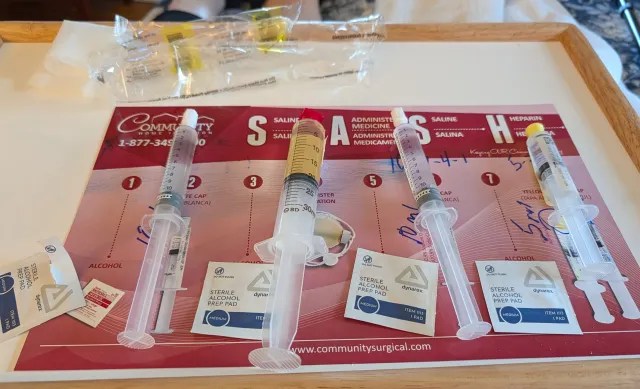
Meanwhile, the infectious disease doctor ordered a huge battery of tests and a blood culture. He put me on aggressive, IV antibiotics, dripping from my personal Festivus pole. Two mornings later, the doctor came into my room, excitedly announcing, “It’s growing! It’s growing!” Strep bacteria were growing in the cultures. He knew what to treat.

Image

Then, out of nowhere, my recurrent atrial fibrillation emerged with tachycardia — a very rapid heart beat at 133 — and low blood pressure (90/50 vs my usual 120/70). My oxygen was consequently low. After pumping me full of more fluids, that resolved.

An echo-cardiogram thankfully revealed no growth of the bacteria in my heart, but to be sure I’ll undergo another — a TEE or transesophageal echocardiogram, its wand stuck down my throat — for a closer examination later this week.

It’s likely, the doctors believe, that I got the blood infection from my dental cleaning. Happens. Years ago, folks like me with tricky heart valves had to take antibiotics before the procedure, but that standard was changed long ago. I’ll take them now.

It appears that the fall and the infection have nothing to do with each other, though we’re still baffled at how the latter coincided with much worse pain in the former. In any case, as serendipity, fate, or grace would have it, my fall — painful as it is — likely brought me to the hospital much sooner than my fever and appetite would have. I was a short walk away from sepsis: the infection spreading to organs, shutting them down in turn. The infection was treated sooner and more decisively because my back pain brought me in.

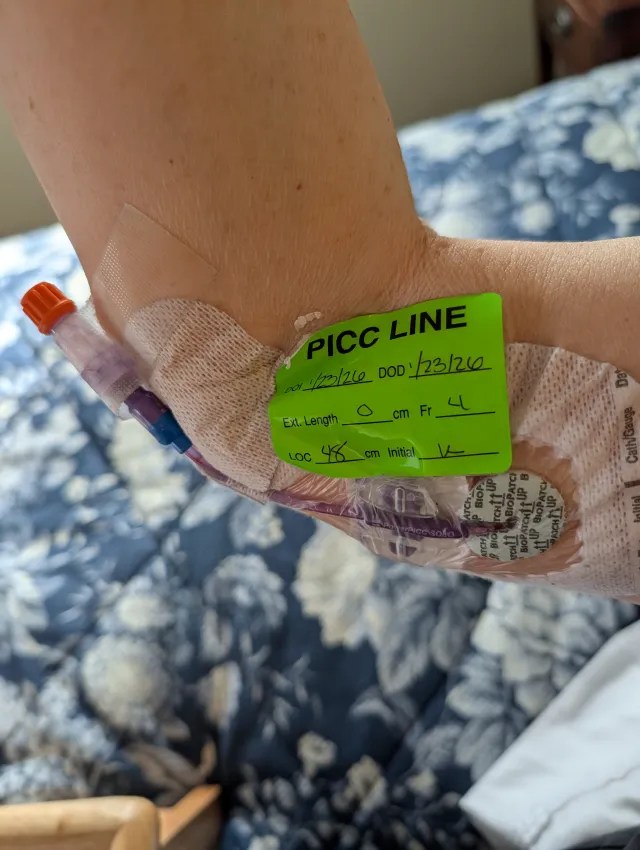
I’m trying to get back to work. The proofreading of my book is due now. I’m headquartered on a pile of pillows on the bed, forcing myself up with a cane, in a back brace. Every day, I now infuse IV antibiotics through a PICC-line, a 19-inch hose now installed from my right arm up to under my collar bone. I’ll do that for five weeks, with a kind nurse visiting to change the dressing and take blood draws once a week.
Image
Image

Before I left the hospital, a phlebotomist came to start another blood culture, pouring my precious humours into two little bottles that, to me, looked like hot sauce. He said most folks think they look like tiny booze bottles. Right. On second thought, this was a personal bloody Mary: Bloody Jeff.

Image

Moments ago, my wife looked up the latest lab results and the great news is that now germs are *not* growing in my blood cocktail. Science and medicine are working.

I’m so grateful to the doctors, nurses, and staff at Morristown. To hell with you and the ignorance you stand for, RFK Jr.

And I could not be more grateful to my wife, who already does everything and now is caring for my every pathetic need, with our daughter’s help. (Our son is way up in New Hampshire.)

All this has meant canceling my scheduled cataract surgeries. Next I’ll have cardiac ablation to try to rid me of AFib. Age. 

The nation is lost

Image

In this terrible time, what disappoints and angers me so about my own field of journalism — to which I have devoted 50 years of my life — is its refusal to recognize fascism, to even use the word so as to explain it, and to judge Trump and the Trumpists for their crimes against decency, democracy, and humanity. 

But I realize that by focusing on the failures of journalistic rhetoric I, too, miss the point of the bayonet held against our throats. I complain often about the #BrokenTimes and the very #BrokenPost — about their prevaricating headlines (“magnified questions”) and perverse euphemisms (“exerts control”) and their framing of extremism as one side of bothsidesed “politicization” and polarization. To them, we are perpetually “teetering” near an edge that is ever still ahead, out of sight.

This is so much worse than words. The nation has fallen over that edge. Our country is lost.

The other night, I listened to the latest episode of the Reading Hannah Arendt podcast in which Bard College’s Roger Berkowitz explains War and Revolution. In it, Arendt, as the great historian, philosopher, and educator of totalitarianism, explores violence and crime and “founding a new polity amidst the breakdown of traditions and authority.” 

I finally came to the realization that the revolution we are enduring is over. Some ask whether we will enter civil war, but in truth, that war did not end. The South — now merely metaphorical, as its border extends into every state — rose again. It won. 

I come to realize that the far-right’s fetishism over the Second Amendment was likely never about rising up in opposition to some feared socialist, gunnapping American regime. It was about recruiting and arming a disordered militia in support of the autocracy of the right — to fight not against government but as internal ally to the Project 2025 vision of the “unitary executive” (read: dictatorship), alongside the Army, National Guard, and ICE-Gestapo, who are given license to evade the rule of law (receipt: January 6) by the Justice Department and Supreme Court, now also under their control. Without the rule of law, the courts, and Congress, there is no check to their power. Then there is no Constitution. There is no democracy. 

So we dissent. But where? 

Not in media. That, too, is lost. I have lately been shouting fire! about Ellison père et fils, Larry and David, the miniMurdochs, taking control of Paramount and CBS and next Warner Bros. Discovery — and with it CNN. I appeared on CNN to raise that alarm. 

Jarvis: I hate to say this to my friends here at CNN, mass media is dying, so they're taking the last of these vestiges of institutions that matter and they're trying to turn them into propaganda organs under threat from the head of the FCC

Acyn (@acyn.bsky.social) 2025-09-18T02:19:33.269Z

Liberal media? It is time to burn that trope. Yes, there are liberals left in media, but the conglomerating corporations that employ them are either owned by the extremists or running scared from them, acceding to Trump’s every vindictive demand, blackmail, and bribe. Stop calling it MSM (it never was “mainstream” anyway). It is all MAGAmedia now. There’s no comfort to be had in the fact that Trump’s allies are taking control of the empty husk of the former Fourth Estate, for mass media are dead and dying. Propaganda isn’t a business, it’s a weapon.

If not in media, then can we not dissent in social media as our modern, online alternative: the press of the people? No. Twitter is the house organ of the extremists. Zuckerberg and his Facebook, Instagram, and Threads have gone full Quisling. Our one haven for dissent might have been TikTok. But the Ellisons — and now their models, the Murdochs — alongside venomous VC Mark Andreessen are subsuming that, too. 

Then perhaps we might find sanctuary in the academy. Cough. The most fundamental tenet and tactic of the fascist revolution has been to destroy education from bottom to top. Over the years, without notice, the right wing took over local school boards (just as they took over local TV and radio stations). Too many universities are proving to be ineffective and irresponsible stewards of enlightenment and academic freedom: surrender monkeys in the face of serious challenge. 

God then? Ha! He is their coopted coconspirator in this unholy Crusade, wearing one red hat or another.

/media/bd9d6e0e879b5eaa066db5645eeae183

Cardinal Timothy Dolan on Fox & Friends on Charlie Kirk: "This guy is a modern day St Paul. He was a missionary, he's an evangelist, he's a hero. He's one I think that knows what Jesus meant when he said 'the truth will set you free.'"

Aaron Rupar (@atrupar.com) 2025-09-19T12:39:15.101Z

Then to the ballot box! Well, sure, but as the extremists lie and cry that elections are rigged, they’re projecting while gerrymandering and ending voting rights and exploiting the advantages given their slave-holding forebears in the Senate and Electoral College. 

In The Guardian, Timothy Garton Ash warned that Americans have but 400 days and counting (394 as I write this) to perhaps save a last shred of hope by winning back the House. But our putative Democratic leadership can’t summon the spine to endorse the most exciting leader we have seen in a generation in New York, too busy as they are crawling out from under the used campaign bus they keep driving over each other. 

So then let us take to the streets! OK. But see where I began: They are in power. We are not. They are organized. We are not. They are masked. We are not. They are armed. We are not.

At the end of a despairing post such as this, you’d expect me to offer my solution, saving the nation if only we would…. But I cannot. This is my worse fear: I do not know where this ends. I look often to German history and to Arendt’s lessons from it. The nation that gave rise to the most odious regime in modern memory was able to rebuild only from the ashes of its complete destruction. What might it take to cauterize the wounds to our democracy? 

People like me — old, white men, going back generations — did not exercise our privilege to win the fight for all of us. Justice teetered and we sat silent, complacent for too long. Now we are silenced.

Oh, I will still speak up. I will dissent here. I will vote. I will march. But to what end when so much is lost? Is there any way that we, the democratic majority, can claw our way back to save any vestige of democracy? I do not know. 


I have vented my fears, frustrations, and fatalism these last days on podcasts, which is what they apparently exist — here with friend Pete Dominick, here with Daniel Fürg, and below on American Friction. These conversations inspired this mood and post.  

After writing this, I read a column by my former CUNY colleague, M. Gessen, about the recognition that one’s country is lost. They have experienced this loss twice. 

Len Tow

Image

We have lost a most generous soul. I have lost a benefactor, mentor, and friend. Leonard Tow died Sunday at age 97. 

Len held a PhD in economic geography from Columbia and taught at Hunter and Columbia before deciding to leave for business, first in theater and then in the infant industries of cable TV and mobile telephony, where he founded and built the nation’s fifth largest cable company. There he lead in technological innovation as he fought to defend freedom of expression in the new medium. That was enough accomplishment for a life. But in 1988, he and his beloved wife Claire created the Tow Foundation. In 2012, they signed the Giving Pledge. They supported so much important work in medicine, the arts, higher education, civic engagement, juvenile justice, and innovation. Please read the family’s and foundation’s celebration of his amazing life here

I came to meet Len almost twenty years ago, when he became concerned about the state of journalism in democracy. Len was a major backer of Brooklyn College at the City University of New York— his alma mater — and he told CUNY’s then-chancellor, Matt Goldstein, that he was planning to give money to Columbia Journalism School to nudge them into updating their curriculum. Hold on, said Goldstein: CUNY is starting a journalism school. 

And so Len came to meet with the founding dean, Steve Shepherd, and me, and we told him about our plans to build a new school around the innovation that was — and still is — so desperately needed in the field. Len held a competition between us and Columbia. Well, put air quotes around “competition.” We both won. Len gave each of us each matching grants, ours for $3 million to start a new center for innovation. 

Steve and I didn’t know what the hell we were doing in fundraising. Thank goodness, Len’s daughter, Emily, who leads the foundation, took us under her wing and schooled us in how to support our work. We missed the match deadline, but the Tows lent us slack. The Knight Foundation met Tow’s challenge and the Tow-Knight Center for Entrepreneurial Journalism began. I was its director. Columbia opened the Tow Center for Digital Journalism, recruiting friend Emily Bell, who did indeed bring its curriculum into the future. 

Thus began a wonderful relationship with Len and the foundation. He and Emily have been magnificent funders — never interfering, always ready to give advice when asked, eager to make useful connections, encouraging of every success, patient with lessons learned. I was fortunate to visit Len occasionally, and we could talk for hours. I would learn about his pioneering in media technologies and he would quiz me about innovations in the internet and artificial intelligence. I asked him for his wise advice on the next steps in my career. Whenever I tried to thank him for his support, he’d pshaw me away. 

Len had a wonderful habit of coming up with his own ideas for supporting us. After Steve Shepherd retired and Sarah Bartlett became dean, I saw Len at one of the fundraising galas we held then, featuring the inspiring work of our graduates. Len pulled me over and said he’d just decided to create a scholarship in investigative journalism named for Steve. He also funded annual faculty awards. 

One day, Len surprised me with the news that he was endowing the Leonard Tow Chair in Journalism Innovation, and I had the immense privilege of filling it. 

There are countless stories like mine of Len encouraging and supporting work: doctors researching cures to devastating diseases, playwrights developing their talents, professors building curricula, young people making new lives for themselves.

I am so grateful to have known and learned from Len. My heart goes out to Len’s and Claire’s children, Andrew, Emily, and Frank, and their grandchildren. I am grateful to the family for their continuing work in the Tow Foundation and for generously sharing Len with so many of us. 

Whither Colbert? Whither democracy

Image

Like every sane American, I am outraged that CBS/Paramount/Ellison Inc. canceled — in the true meaning of the word — Stephen Colbert, capitulating to Trump in the rapid Orbanization of American media.

Here I propose what I hope comes next for Colbert: that he build his own show and empire online. And I’ll tell for the first time of my foiled attempt, back in the day, to broker a deal for Howard Stern TV on the internet. 

But first, allow me to briefly address the state of mass media.

Mass media are dead. Larry Ellison et fils merely threw another shovelful of dirt on the coffin. Most newspaper chains are owned by hedge funds, cut to the stump and useless. Magazines are in hospice (I chronicle their fall in my book Magazine, now an audiobook!). Our national news, The Times and The Post — are irreparably broken. Terrestrial radio is the tower that falls in the forest, which nobody hears. Broadcast TV is the cultural Kmart. Cable has cooties. Streaming is sinking. Hollywood has no imagination. Books are suffering.

Trump is commandeering mass media because he thinks scale still makes stars and wields power. Joke’s on him: He’ll end up controlling a crumbling, cowardly relic of an age that opened in 1893, when magazine publisher Frank Munsey invented the attention economy, and began to close in 1993, with Mosaic and the link, which allow us all to become publishers. The masses don’t need media anymore. The masses are media.

The question is whether we — the people formerly seen as masses — can protect our voices and our independence from fascist authoritarians and craven capitalists. Colbert could lead the way by making his own, independent media.

This leads me to the story of Howard Stern and the internet. I think enough time has passed that I may recount it. One day in 2010, I got a call from Howard’s beloved and fabled agent, the late Don Buchwald. In 2006, Howard had left the censorious airwaves of terrestrial radio for Sirius’ satellites. His first contract coming due, Buchwald the master negotiator was looking for options and likely leverage. 

I had written then about my hope that Howard would become monarch of the web. When Howard answered my calls on-air, I tried to convince him that he could be the king of all podcasters. “I hate podcasts,” he said. “A jerk-off sitting in his living room talking for hours. If I wanted that, I’d get married.” He mocked me for podcasting. Fine. He also mocked Joe Rogan for podcasting. Ah, well. (And he’s happily married.) 

Buchwald, no doubt echoing Howard, had concerns about infrastructure if they tried to go it alone: making and serving so much video before ubiquitous broadband; selling subscriptions and ads. He wondered instead about YouTube and asked whether I could make connection. I emailed Eric Schmidt about Howard:

Just as he made satellite work as a business, I believe he could make the internet work as an entertainment medium at scale, with payment. I have no doubt that he’d bring some millions of paying fans with him and could make the business work at a very reasonable price point. And I think this could be wonderfully disruptive to the incumbent entertainment industry.

Schmidt replied, “obviously Howard would be a good partner for us if we can find a business structure that works.” He connected me with Robert Kyncl, who’d just arrived at YouTube from Netflix to head up TV and film relationships. I relayed my conversation to Buchwald: 

He’s quite enthused about this and grateful that you’re coming to them. It’s “right up our alley,” he said, and they have “utmost interest.” They are looking at building subscription businesses around personalities so this is a great first move. He sees big potential for global subscription; what interests him is the ability to go global without the border restrictions other entertainment properties bring. He also respects the value of Howard; when he was at Netflix, he told me he’d lusted after Howard TV. Finally, he asked whether this would be a JV and I said I had nothing whatsoever to do with that; my involvement was strictly in making the connection and nothing more. But don’t you love it when they start negotiating already?

Four months later, Buchwald emailed me with an update, reporting that Kyncl “was unable to keep several appointments (mainly phone). So I finally gave up.” Show biz. Howard signed a next contract and a next and next with Sirius. 

The lessons here: I still wish Howard had come online. But it’s just as well he didn’t do a big, exclusive deal with YouTube. This is why I would like to see Colbert come to the internet, not in some exclusive deal with YouTube or, please no, Substack. He can make his own home online, and from there post and stream on YouTube, TikTok, Facebook, everywhere — exploiting others’ audiences while maintaining his independence. 

As I lamented Colbert’s cancellation on the socials, some folks wondered whether he could go to Comedy Central. Sorry, I informed them, but guess who’s going to own it, too: Ellison the Trumpist. I worry, then, about Jon Stewart and the crew at The Daily Show at Comedy Central. I fret, too, about Jimmy Kimmel at blackmailed ABC/Disney. 

Therein lies the key lesson, especially in this day: Stay away from any entity that could be pressured by and become beholden to the fascists in power. Trump even wants to censor “woke AI” (thus I will argue that if companies are people then AI has First Amendment rights — but I digress).

Buchwald was not wrong 15 years ago to worry about the complexity of starting an online media empire. But in the meantime, all necessary roads have been paved. 

We on the left have long wished for our version of Rogan — not our ignorant, testosteroned asshole, but our popular, intelligent, and informed maypole of enlightenment to gather ’round in defense of democracy and decency. I wish that to be Colbert — and Kimmel and Stewart and Stern, plus Joy Ann Reid, Katie Phang, and other refugees from corporate, thus Republican media. I wish that to be on an open and free internet, where they can’t be bought and sold and silenced, and public discourse has its rightful proprietor: us, the public. 

The Times’ Mamdani vendetta

Image

The Times has it out for Zohran Mamdani. The record is clear. It is time to examine receipts. 

The latest attack on him is journalistically unconscionable, and so is the editors’ reaction to legitimate criticism. In a story played by its editors on its home page and boosted by its reporter as his scoop — when it was obviously planted by the right-wing based on the theft of documents from Columbia — The Times said teenaged Mamdani ticked boxes for Asian and Black or African-American on his application, implying he was trying to cheat — to DEI — his way in. 

Image

Never mind that Mamdani was born in Africa, that his father was on the university’s faculty and so his origins were clear, that he was 18 years old, that he was not admitted, and that, as Professor Siva Vaidhyanathan puts it,

Many people from Africa come to the US, find themselves baffled by our “racial” check-boxes, and just wing it. Many Eritreans, Malians, Egyptians, Moroccans, Algerians, Malagaseys, and South Africans don’t identify as “Black” regardless of skin color. But they are African. We make people make dumb choices.

I would say The Times was used, but that would imply that it did not willingly and wittingly make itself an accessory to the smear. 

Jamelle Bouie, just about The Times last saving grace, criticized the story, suggesting on the socials that journalists should inform readers when their anonymous source is a Nazi. He obviously was chastised by editors, for he soon deleted what he dared say.

Image

That Times policy is itself a journalistic travesty, for it decrees that no one is above criticism from The Times, but The Times is above criticism even from within. 

Of course, this comes after The Timesanti-endorsement of Mandani. After The (former New York) Times said it would no longer endorse candidates in local elections, it was stuck, wanting to throw its weight after sexual harasser Andrew Cuomo against the Muslim socialist. It couldn’t endorse Cuomo but said many New Yorkers would be voting for him because of his strong policy record and many endorsements: the non-endorsement-endorsement.

The Editorial Board’s policy of no longer telling New Yorkers whom to vote for did not stop The Times from telling them whom to vote against. “We do not believe that Mr. Mamdani deserves a spot on New Yorkers’ ballots.”

The Times’ hostility to Mamdani is not limited to its editorial page, nor is it consistent. Some of its columnists have written positively about him and there has been some favorable coverage. The Times has also covered the right’s odious attacks on him and his faith and background. But much has been shameful….

Upon his phenomenal victory in the primary, The Times first sought out everyone it could find who opposes him, as if any Democrat, any New Yorker, anyone should give a good fuck what Trumpist Bill Ackman thinks. 

Image

The Times wishes to stir fear and division. Business leaders “fear Mamdani.”

Image

The Times speaks with real estate executives as well as campaigners for tenants’ rights, but the headline says only that Mamdani “strikes fear in the real estate industry.” The piece does not point to The Times’ own interview in which the candidate said he has learned the importance of private-sector development in solving New York’s housing crisis. He advocates zoning more housing around public transit and reducing requirements such as parking. But fear makes for better headlines, as apparently does emphasizing the concerns of the rich. I’d like to read a report about what tenants themselves have to say.

Image

Out of a fairly wide-ranging Meet the Press interview, what did the newspaper of the rich — I mean of record — choose to report on in its headline? 

Image

The Times felt compelled to add: “Mr. Mamdani, a democratic socialist, asserted that he is not a communist.” Somebody alert HUAC

The Times chooses to focus on “a fractured Democratic Party.” Sure, there are fractures; there always are in democracies, for that is the point of them. The Times could have instead focused on the remarkable unity shown between a Democratic Muslim, Mamdani, and a Democratic Jew, Brad Lander, that made this victory possible. But unity doesn’t sell newspapers. 

Image

Similarly, The Times says Mamdani’s victory “spotlights a deepening rupture among U.S. Jews.” More likely, it spotlights The Times’ inability or unwillingness to cover that rupture over Netanyahu’s wars. But that’s another story. 

Image

Odd that The Times characterizes a campaign by a Muslim candidate for public office as “delicate.” Imagine if The Times said running as a Jewish candidate or a Black candidate or a woman candidate were “delicate.” (But then, in the day, it probably did.)

Image

The list-addicted Times tells us that these are the five things voters should know about Mamdani as presumptive nominee. The first is that he has a short track record; the second, his views on a controversial issue far from New York — Israel and Gaza; the third, he’s Muslim; the fourth, he is the supposed creation of that odd thing The Times still cannot grok, social media.

Image

The old farts’ daily still thinks social media is a new and puzzling thing…

Image

Only at the end, at the fifth of the five things New Yorkers should know about the leading candidate to be their mayor, is there mention of his “pithy policy solutions” — cheaper food, free buses, free child care. 

The Times dismisses what Mamdani stands for and what brought out voters (from the “Commie Corridor”) in his favor as simplistic and unrealistic.

Image

The Times asks — just asks — whether when these simplistic, unrealistic, foolish, Democratic New Yorkers — the people formerly known as Times readers until The Times pissed them all off — are shooting themselves on Fifth Avenue. 

Image

Looks to me like The Times is itching to give its non-endorsement-endorsement next to the worst mayor among so many awful mayors, quoting “business leaders” praising Adams for going on Fox and Friends to attack Mamdani. 

Image

In the end, The Times is simply confused, making another pathetic listicle seeking ways of making sense of Mamdani’s victory. 

Image

I would suggest that The Times look in the mirror, but that would violate its policy, for those inside who try to do that are reprimanded and forced to delete their legitimate criticism. 

Truth is, more than anything, Mamdani reveals just how out of touch The New York Times is with its city, with youth, with women, with Democrats and progressives, with under-represented communities, with the working class and poor, with tenants, with bus-riders, with people who buy their own groceries, with dogs, with the anti-Trump resistance … with the future.

But he wears nice suits. 

Image