Stacking the Shelves (690)

Image

This isn’t exactly a “pretty” list, is it? Pretty interesting, yes. Pretty is as pretty does, perhaps. Outright pretty, not so much. Although Magic and Mischief at the Wayside Hotel and Trouble’s Turn to Lose are both pretty cute and The Half Life is pretty in a realistic way. I guess they’ll have to do.

Very much on the other hand – or claw, as the case might be – Dragons Gone Wild is a cover that certainly does reach out and grab you, isn’t it? I’m looking forward to that one because the whole series so far has been an absolute hoot.

In fact, this list has a lot of books I’m really looking forward to, not just those Dragons but also An Artful Dodge, Fool, Life or Death, and of course the next Harmony book, Enter the Nightmare.

What are you looking forward to reading in your stack this weekend?

For Review:
An Artful Dodge by Karen Odden
Enter the Nightmare (Harmony #19) by Jayne Castle
Fabulous Bodies by Chuck Tingle
Fool by Mary Lawrence
The Half Life by Rachel Beanland
Henry Tudor Must Die by Jillian Laine
Ice Vegas by Larry Niven and Steven Barnes
Life or Death (Forensic Instincts #11) by Andrea Kane
Magic and Mischief at the Wayside Hotel by Elizabeth Everett
The Silent House of Sleep (Dr. Jack Cuthbert #1) by Allan Gaw
Sister Svangerd and the Devil You Know (Loyal Opposition #2) by K.J. Parker
The Three Coffin Problem by Lavie Tidhar
The Tinder Box by M.R. Carey
Trouble’s Turn to Lose (Carolina Tales #3) by Susan M. Boyer

Purchased from Amazon/Audible/Etc.:
Dragons Gone Wild (Build-A-Dragon #3) by Dan Koboldt
Struck Dead (Forensic Instincts #10) by Andrea Kane


If you want to find out more about Stacking The Shelves, please visit the official launch page

Please link your STS post in the linky below:


A+ #AudioBookReview: Junkyard Riders by Faith Hunter

A+ #AudioBookReview: Junkyard Riders by Faith HunterJunkyard Riders (Junkyard Cats #5) by Faith Hunter
Narrator: Khristine Hvam
Format: audiobook, ebook
Source: purchased from Amazon, purchased from Audible
Formats available: paperback, ebook, audiobook
Genres: dystopian, post apocalyptic, urban fantasy
Series: Shining Smith #5
Pages: 163
Length: 4 hours and 46 minutes
Published by Audible Studios, Lore Seekers Press on January 20, 2026
Purchasing Info: Author's WebsitePublisher's WebsiteAmazonBarnes & NobleKobo
Goodreads

Shining Smith returns, taking on the “Dark Riders,” a paramilitary group motorcycle gang searching for Gov. political power, military connections, and alien tech. The Dark Riders are closing in on Shining’s secrets and, while she would rather nest in her new roadhouse, Shining must protect her own, once again taking the battle to the enemy.
Unfortunately, CAIT, the original AI on the junkyard’s crashed spaceship, has its own agenda buried in the ship’s code and choses this time to implement it. There is nothing Shining can do to stop it, except what she does best – plot an offensive, get her people in place, and hope Jolene can outsmart the virtual alter ego.
But the cataclysmic snowstorm crashing in with all the power and subtlety of Mateo in his WarBot suit could be the end of them all.

My Review:

ImageThere’s a major snowstorm crashing down on Shining’s head in this one – and bloody damn (as Shining herself would put it – I didn’t need the up-close-and-personal reminder of what’s headed my way in real life as it headed towards hers in brilliantly realized fiction.

I’m still here for the cats, six years and four books after the first utterly terrific book in this series, Junkyard Cats. Because Shining and her allies, the more-or-less humans AND the self-proclaimed “destructions of cats” have just gotten bigger and more badass as the series has evolved.

And so have their enemies.

In this fifth entry in the series, the hard-won more-or-less peace that Shining has sacrificed so much blood for, particularly in the previous book, Junkyard Roadhouse, has been disturbed by the advent of an unnamed motorcycle gang that Shining calls the “Dark Riders”. She’s sure they have a name, she just doesn’t know what it is – yet. She just knows that these “Dark Riders” are in the sex trafficking business and don’t care who they have to kill in order to get their “stock” or how willing they might be to “serve”. The Dark Riders are threatening territory that is under the protection of Shining and/or her allies, and have now turned their sights on the Junkyard Roadhouse. Not directly, not yet, but attempting to pick off some of their more remote trading partners.

ImageWhich Shining cannot allow, both as the threat to her independence that it definitely is, and because some of her own people are on site. And mostly because she promised protection so now she’s duty bound to deliver it.

That her enemy is a whole lot bigger and more powerful than even rival queen Clarice Warhammer  in Junkyard War just means that Shining is going to need a lot more allies to help take them down. Even if this time around she’s putting herself directly against the Gov and their military forces.

Especially if it’s the Gov and their military. She’ll just have to be a bit sneakier about how she brings them down. Or out. Or into the bright, shining light of exposure.

Even if bringing down a bigger and more powerful – and connected – foe is a good deed that is guaranteed not to go unpunished. That’s a problem for ‘later’ Shining, if she survives this time around. Which she bloody damn WILL.

Escape Rating A+: I’ve adored this series from that very first book, Junkyard Cats, and I haven’t changed my mind one bit as the series has continued. In fact, I think they’ve gotten better as they’ve gone along. They’ve certainly gotten bigger – not necessarily in length but in scope. With each book we see more of how this effed up future is, well, effed up. And it’s FUBAR, glorious and terrible all at the same time.

ImageIn my personal opinion, it’s also better in audio, but that’s a shade of better that’s really, really close. Narrator Kristine Hvam remains the perfect voice of Shining, she’s gritty and snarky, self-deprecating and over-confident, desperate and determined, always, always picking herself up off the ground to DEAL WITH IT whatever IT might be.

She makes hard decisions, lives with the even harder consequences, and Hvam’s voice perfectly captures Shining’s first-person, internal voice every step of the way. The one problem I have with the narration being just so damn good is that now that the ebooks are released simultaneously with the audio, I’m caught very sharply on the horns of the dilemma of whether I want to hear Shining’s voice more than I’m desperate to find out what happened.

It’s a bloody damn hard call every time. But that’s Shining Smith all over.

This entry in the series reads like the set up for the next phase of Shining’s ‘adventures’ – to use that term very loosely. Alternatively, it’s the opening campaign in Shining’s next war. Because she is at war. In the first three books (Junkyard Cats, Junkyard Bargain, Junkyard War), she was at war with rival queen Clarice Warhammer. The previous book, Junkyard Roadhouse, represented a consolidation of the gains and alliances Shining gathered for and as a result of Warhammer’s destruction.

Those gains included a lot of intel on bad actors in what passes for the US government in this post-apocalyptic dystopia, and that intel has led her to a bigger, better equipped enemy. Taking on the Gov, even in the clandestine fashion she does in this story, is going to take more than one book and a whole lot more firepower. Those Dark Riders are the tip of an iceberg that goes a lot deeper and further than even Shining and her tendency to imagine worst-case scenarios had imagined.

On the surface, Junkyard Riders is another fantastic Shining Smith adventure, for multiple definitions of the word ‘adventure’. It’s also the latest chapter in an ongoing saga that gets bigger as it goes – even though the length of the individual entries is still relatively short. On my third hand (and some of Shining’s allies actually have such a thing), this story represents both an expansion and an escalation in the best ‘Old Skool’ urban fantasy tradition. At the end of every story, Shining takes her bow with more resources, more weapons, more POWER than she had at the beginning. Which forces her next enemy to match and exceed her in order to have a shot at taking her down.

ImageThis entry in the series was fantastic AND did a fantastic job of setting up the next book. Hopefully this time next year if not, fingers crossed, just a bit sooner. Because I’m already there for it.

One final note because I can’t resist. A ‘destruction of cats’ is a collective noun for a group of wild and/or feral cats. The junkyard’s cats are not exactly feral, but they certainly are both wild AND destructive. Tufts, the queen of the junkyard’s cats, took that name for her clowder HERSELF. Because of course she did. And her Destruction has certainly earned the moniker. I can’t wait to see how THAT works out in the books to come. Because I’ve always been all in on this series for the cats. And they get more badass every book – right along with Shining Smith herself.

#BookReview: Make It Out Alive by Allison Brennan

#BookReview: Make It Out Alive by Allison BrennanMake It Out Alive (Quinn & Costa, #7) by Allison Brennan
Format: eARC
Source: supplied by publisher via Edelweiss
Formats available: hardcover, paperback, ebook, audiobook
Genres: mystery, suspense, thriller
Series: Quinn & Costa #7
Pages: 400
Published by Hanover Square Press on January 27, 2026
Purchasing Info: Author's WebsitePublisher's WebsiteAmazonBarnes & NobleKoboBookshop.orgBetter World Books
Goodreads

Allison Brennan returns to her bestselling series with an edge-of-your-seat thriller that thrusts Quinn and Costa into the crosshairs of a sadistic serial killer.
Three newlywed couples have disappeared from an exclusive resort in Florida, only to turn up dead soon after. With the location and the similarities between the female victims as their only leads, it’s up to the FBI Mobile Response Team to catch a serial killer before anyone else ends up dead. And they have the perfect bait—Detective Kara Quinn, who bears an uncanny resemblance to the targeted women.
Undercover as newlyweds pretending to enjoy their honeymoon, Kara and FBI Agent Matt Costa set a flawless trap. When their plan works and they arrest the predator, Matt sends the rest of the team home so he and Kara can have the weekend for some much-needed R&R. But on Monday morning, the couple doesn’t show up to work, and the MRT learns they never checked out of their hotel.
As their team tries to find them, Matt and Kara learn the truth—the killer wasn’t acting alone. He had a partner who succeeded where he failed. Kidnapped and forced into a twisted escape room, they need to find a way out, because if they don’t escape, they’ll die.

My Review:

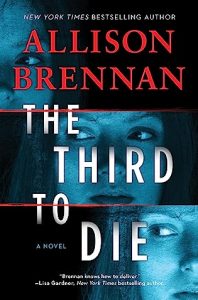
ImageI’ve read the Quinn & Costa series from the very first book, The Third to Die – albeit out of order. Nevertheless, I’ve found each and every book in the series to be compelling and absolutely un-put-downable in the reading – even if at the end I find myself wondering WTF happened along the way.

This book turned out to be one of THOSE kinds of reads.

The story begins at what feels like an ending. The FBI’s Mobile Response Team – and the local law enforcement in Flagler County, Florida (just south of St. Augustine) – are sure that they’ve just caught a serial killer in the act. Which they sorta/kinda did – just not the act that would have closed the case.

Someone has been killing newlywed couples on their honeymoons at a ritzy resort, so the FBI set Matt Costa and Kara Quinn up as a newlywed couple to capture the killer. But the team staking out the undercover agents jumped the gun on the takedown because one of them thought they saw a gun.

ImageSo instead of a slam-dunk arrest AFTER the killer had them trussed up and on the way to his vehicle they caught him after the pair had been drugged but before they’d been restrained. The perp’s explanation of oh-so-many coincidences is tissue-paper thin – but there’s really nothing that can’t be explained – however badly – and no physical evidence to tie him to anything at all.

He’s cool, he’s smart, he’s clever – and he gets out on bail.

But while their suspect is in jail, Matt and Kara take an extra day at the resort for themselves. As vacation. They’re sure the murderer is in custody, and the team’s crack profiler is certain the killer was working alone.

He wasn’t. A mistake that threatens to cost Matt Costa and Kara Quinn their lives. Unless, together, they can make their way out of a brilliantly engineered but diabolically twisted factory turned vast and deadly escape room. They had hoped to find the place where the previous deaths had occurred – but not from inside the exact, same trap.

ImageEscape Rating B+: This is a hugely mixed feelings kind of review, and I’m a bit bummed because I was expecting my second “Allison” of the week to be every bit as good as the first.

Don’t get me wrong, the story is a wild thrill-a-minute ride from beginning to end. It turned out to be a single-evening read that I couldn’t put down for a second. The pace is incredibly fast, the danger is ramped up to eleven from almost the first page and the opening, where the cops are all sure this is nailed and those nails get taken out one screeching pull at a time invests the reader in the story immediately.

Which is the point where, well, the point of view fragments into separate strands and things get wild and crazy but also go off the rails – including, at some points, actual rails.

For the rest of the story there are three main-ish perspectives. The one with the highest and craziest danger quotient is that of Costa and Quinn. They’ve been drugged, kidnapped, and dropped inside a remote house-of-horrors escape-room factory where every step is booby trapped and every door leads to more ways to die.

ImageTheir absence leads to the second thread, which is, of course, the mobilization of their team AND seemingly most of the resources of the entire FBI in finding them.

The third thread follows the actions of the real villain in this story. And this is where things fell more than a bit apart for this reader. Call it “villain fail”. The true villain of the story read very much like a cartoon supervillain. I want to say Harley Quinn, making the terrifying escape room factory into Arkham Asylum, but Harley Quinn was actually a whole lot smarter than this…person…although the resemblance to Arkham Asylum is still right on the nose.

The real villain in this was a whiny, bitchy, narcissist who seems to have been more lucky than smart. She was honestly kind of boring. Horrifying, crazy and even downright evil, but more of a caricature than a character. The person that the cops believed was the sole killer was a more interesting, and more nuanced, potential villain. Not that he wasn’t just as big a criminal in the end, but he wasn’t a villain.

ImageThrillers like this one where we see inside the killer’s head either creep me right the fuck out or trip my willing suspension of disbelief. This one did the second even though it was trying to do the first. She was just over the top and cartoonish even though she wasn’t a cartoon supervillain – no matter how much she wanted to be.

Of the three sides to the story, Matt Costa and Kara Quinn’s one-step-forward, one drop downward trip through the nightmare factory both propelled the story forward and provided the ticking clock that kept this reader on the edge of her seat.

The frantic investigation being carried out by their team added in the ‘competence porn’ element that I read this series for. They were all good at their jobs – at least once that mistaken profiler admitted her mistake. At the same time, this part of the story showcased the tight teamwork of the Mobile Response Team as well as displaying just how integral Quinn and Costa both are to their success.

ImageWhile on my third hand, I’d have liked this one a hell of a lot better if we didn’t have a peek into the villain’s head – even if, thank goodness, it’s not a direct first-person perspective. It was kind of expected that she was a self-centered narcissistic psychopath, but the one-note whininess was just over the top – and not in a good way.

Which leads back to my mixed feelings. That B rating is for the villain fail. The plus sign attached to it is for the compulsive read. This entry in the series was exactly like sticking my hand in a bag of potato chips – once I started I couldn’t stop sticking my mind back into the bag.

So I’ll be back for the next book in the Quinn & Costa series, both to see how they’ve recovered from their truly unfortunate adventure in this one – AND to see if they have a more interesting villain to catch the next time around!

#BookReview: The Case of the Murdered Muckraker by Rob Osler

#BookReview: The Case of the Murdered Muckraker by Rob OslerThe Case of the Murdered Muckraker by Rob Osler
Format: eARC
Source: supplied by publisher via NetGalley
Formats available: hardcover, ebook, audiobook
Genres: Chicago in fiction, historical fiction, historical mystery, mystery
Series: Harriet Morrow Investigates #2
Pages: 320
Published by Kensington on January 27, 2026
Purchasing Info: Author's WebsitePublisher's WebsiteAmazonBarnes & NobleKoboBookshop.orgBetter World Books
Goodreads

Harriet Morrow, a spunky, bike-riding, independent, lesbian P.I. in turn-of-the-20th century Chicago, is back on the case in this brilliant historical mystery inspired by a real-life Windy City detective – from the acclaimed author of the Anthony, Agatha, Macavity, and Lefty Award-nominated Devil’s Chew Toy. For fans of Lev AC Rosen, Ashley Weaver, and Stephen Spotswood.

Chicago, 1898.
In the midst of the Progressive Era, twenty-one-year-old junior detective Harriet Morrow is determined to prove she’s more than a lucky hire as the Prescott Agency’s first woman operative. But her latest challenge—a murder case steeped in scandal—could become a deadly setback . . .
As the Windy City thaws from a harsh winter, Harriet Morrow finds herself doubting her investigative skills when she’s assigned to solve a high-stakes murder case well above her pay grade. And there’s also a catch. Harriet must somehow blend in as an “unremarkable” young woman—one who feels confident in skirts, not men’s clothing—on a quest to infiltrate the immigrant community at the center of the grisly crime . . .
The mystery has more twists and turns than her morning bike commute, with a muckraker found murdered in a southside tenement building after obtaining evidence of a powerful politician’s corruption. While Harriet gains the trust of the tenement’s women residents to gather clues, the undercover mission reveals an innocent mother might have been framed for the crime—and exposes ties to another violent death . . .    
Harriet soon realizes she has few allies as new dangers explode around her. Enlisting the help of Matthew McCabe, her only true confidante at the agency, and growing more protective of her budding relationship with the lovely Barbara Wozniak, Harriet will need to survive rising threats to assert her place in a world that’s quick to dismiss her—and out a killer who’s always one step ahead . . .

My Review:

This is SUCH a Chicago story. Specifically a story about the “City of the big shoulders, hog butcher for the world” – even though Carl Sandburg’s famous poem won’t be published for another SIXTEEN years. It’s a story about a city whose politics are so thoroughly, infamously corrupt that its reputation was already made in 1898 and persists well into the 21st century.

A reputation that was certainly justified in Harriet Morrow’s 1898 and for decades thereafter. Whether or not it’s still true today is not within the scope of Harriet’s adventures.

However, the corruption exposed in THIS story, IS within the scope of Harriet’s adventures. After all, Harriet Morrow is the star of this show – even if it’s a show she’s still personally figuring out the scope of at this point in her fledgling career as the first female private investigator working for the prestigious Prescott Agency in 1898 Chicago. Not too far down the street – literally – is the more famous Pinkerton National Detective Agency.

Theodore Prescott’s reasons for hiring Harriet as his first female operative were more pragmatic than merely following in the footsteps of his better known rival. Not just that his wife was pestering him on behalf of their eccentric next-door-neighbor whose maid had gone missing. He threw Harriet at that problem because it seemed like it needed a woman’s touch – not to solve but to placate both women. Instead, Harriet found a real missing persons case (The Case of the Missing Maid), solved it, and made an excellent friend in Prescott’s neighbor Pearl Bartlett.

And earned herself a job as a private detective that pays 50% more than her previous job as a bookkeeper – although Prescott isn’t paying her nearly as much as he would pay a new MALE operative. She’s making enough to support herself and her 16-year-old brother – if barely. But she’s all too aware that she’s hanging on by a thread. She’s Prescott’s experiment, an experiment that he could end at any time.

Image
Typical Packingtown Street

Which doesn’t stop her from being more than a bit wary about the new case that she’s been assigned. Because the assignment has nothing to do with her skills and everything to do with her gender. A muckraking journalist who claimed to have dug through some particularly nasty muck regarding one of Chicago’s most notorious dirty aldermen, managed to get himself murdered. (All things considered, it would be more of a surprise the reporter hadn’t ended up dead.)

The location of his murder was a tenement building near the Stockyards. A killing committed during the day, while all the male residents were at work. The women, however, were home. The woman who found the body was arrested for the murder because the cops needed a scapegoat and didn’t want to – or had orders not to – poke their truncheons into anything the muckraker might have raked up.

Those women most likely know a whole lot more than any man is going to get out of them. But Harriet might. At least she might if she can find a way into the closed community – not as a resident – but as a female “do-gooder” from one of the nearby settlement houses.

Even if donning that role will require her to lie quite a bit and go back to wearing the dresses she’s just set aside for the more practical, more comfortable, and better fitting (in more ways than one) men’s suits she’s recently adopted.

She’ll have to pass as an “unremarkable” woman. Something that Harriet Morrow has never been able to do. But if she follows the trail that muckraking journalist left, she might just manage to fight City Hall exactly where it will hurt the most.

ImageEscape Rating B: There is simply a LOT to this story. So much so that it takes a while to build up to – and to get into. It also refers to the first book in the series, The Case of the Missing Maid, quite a bit, but in a way that begs the reader to go back and read it if they haven’t already.

And they really should to get where Harriet is at this point in her story. Because it’s only been three weeks in her frame of reference, so she’s still dealing with the personal consequences. Specifically, the personal consequences that she’s just at the beginning of her journey to discover herself as a queer woman and live as much as that truth as feels right for her. That she might get arrested for wearing men’s suits is part of that journey, as are her tentative steps towards a romance with the rescued “missing maid” from the first story, Barbara Wozniak.

Those factors are what make Harriet unique and interesting as an independent woman in late 1890s Chicago and as a female detective finding her way both personally and professionally.

What makes the story is the investigation that she conducts, and the bustling, booming, brawling city she conducts it in. The Chicago of the Progressive Era, with its burgeoning immigrant population, its packed tenement housing, its sprawling stockyards and its infamously corrupt politics.

Harriet’s second case is every bit as much of a sprawl as the first. A sprawl that Harriet experiences at ground level from the seat of her bicycle.

Image
Hull House

There’s a HUGE amount going on, from the settlement houses (like Jane Addams’ Hull House) to the Stockyard’s Packingtown to the tony North Shore to the pigeons pooping on City Hall. (There’s not literally a perspective from the pigeons but I honestly could not resist the metaphor.)

Harriet is in the thick of a whole lot of things that she has no clue about – on multiple levels. She’s never been rich, but she never truly had to worry about a roof over her head or where her next meal was coming from until after her parents died. Compared to the immigrants squashed into Packingtown, she’s rich and comfortable even though it hasn’t felt that way since she’s been supporting herself and her brother.

The condition of working people, especially immigrants, was absolutely gruesome. The journalists were called muckrakers because there was so much muck to rake over the way that the high-and-mighty took advantage of everyone and everything while the people they were taking advantage of starved and slaved their way into an early grave.

That her pursuit of this case, combined with Chicago’s then-recent history (the 1868 Haymarket riot), puts Harriet amid the waning socialists and the rising anarchists isn’t surprising – although it very nearly is deadly.

And all of that is merely the tip of a big, dirty, iceberg. An iceberg that is covered in the snow of Harriet’s journey of self-discovery as a queer woman at a time and place where she can be arrested just for wearing trousers.

The case is fascinating, but to get to the heart of everything requires a lot of back and side story. That Harriet is learning – and making mistakes – as she goes helps the reader to both feel for her and learn along with her, but occasionally the pace of the mystery slows down to cope with the amount of information it needs to get out of the way and into the reader’s head, first.

Image
Chicago City Hall 1885-1905

“The past is foreign country, they do things differently there.” And the reader finds themselves learning the lingo of that “foreign country” through every push of the pedals in Harriet’s journey. Whether the reader enjoys that part or gets bogged down in it will certainly be in the eye of the reader.

I had some mixed feelings. On the one hand, I loved the deep dive into the history of the city, and had to smile at the mention of a few landmarks that are still around, like The Berghoff. Overall, however, all of the information that is included in the story – and there’s a lot of it – while it adds to the atmosphere and paints a colorful picture of just how the sausage of Chicago politics got made – also slows down the pace towards solving the multiple mysteries that arise.

I like Harriet as a protagonist a lot. I love that her agonies – which she certainly would have – mostly focused on the difficulties of bicycling around the city and the sheer amount of time it takes her, making progress as a detective, getting the respect of her colleagues and making incremental progress in that direction AND the difficulty of “on the job” training when the person training her is generally herself.

But as much as I enjoy the history AND Harriet’s perspective, she fumbles and stumbles a lot – as she would. There’s also a lot of information to fumble and stumble over and convey to the reader. I did get bogged down in the middle but I still wanted to see how Harriet would get through.

And I’m glad I did. And I’m equally glad that it reads as though Harriet’s adventures will continue.

Grade A #BookReview: Fire Must Burn by Allison Montclair

Grade A #BookReview: Fire Must Burn by Allison MontclairFire Must Burn (Sparks & Bainbridge, #8) by Allison Montclair
Format: eARC
Source: supplied by publisher via NetGalley
Formats available: hardcover, ebook
Genres: espionage, historical fiction, historical mystery
Series: Sparks & Bainbridge #8
Pages: 255
Published by Severn House on January 6, 2026
Purchasing Info: Author's WebsitePublisher's WebsiteAmazonBarnes & NobleKoboBookshop.orgBetter World Books
Goodreads


The owners of The Right Sort Marriage Bureau are back, and more determined than ever to bring love matches to the residents of Post-WWII London . . . so something as trivial as
being dragged into a spy mission isn’t going to stop them!

Sparks fly when an old friend comes to town . . .
London, 1947. After recent events have left the normally steadfast Iris Sparks thoroughly shaken, she’s looking forward to some peace. With The Right Sort doing well, she and business partner Gwen Bainbridge are due a holiday. Until Iris’s former boss enlists their help for a secret mission.
Iris, who left British intelligence after the war, is being recruited for her Cambridge connection to one Anthony Danforth. She hasn’t seen Tony in almost ten years, yet she and Gwen must manipulate him into hiring their marriage service.
Tony’s suspected of being a Soviet operative, and an undercover agent posing as his perfect match could discover the truth. Despite her reluctance at being dragged back into the world of espionage, Iris agrees. After all, Tony was once a very good friend. If he’s innocent, she’ll happily prove it. If not? Well, no one ever said being a spy was easy . . .
Those who enjoy reading Kerry Greenwood's Phryne Fisher Mysteries and Dorothy Sayers will adore this warm and witty historical mystery!

My Review:

ImageThis series began with The Right Sort of Man about two women opening a marriage bureau in post-World War II London. Miss Iris Sparks, formerly something seriously clandestine during the late war, and Mrs. Gwendoline Bainbridge, formerly a resident of a sanatorium after the death of her husband and the loss of what would have been her second child, start their agency because they both need jobs. Gwen needs to focus on her recovery so can legally reclaim her sanity and independence and regain custody of her remaining son. Iris, so she can pay the rent. They are not from the same social class but they quickly learn that their own weaknesses are the other’s strengths.

Strength they both need when one of their first clients is charged with murdering one of the others.

By this point in the series, now eight books in, Sparks and Bainbridge are ride or die friends and partners, and the tables have sort of turned on the dynamics of their friendship/sisterhood. Sparks is recovering from the loss of her gangster lover, she’s houseboat sitting in lieu of getting her own apartment, and she’s at a low point, just ripe for manipulation by her old boss/spymaster. Bainbridge has reclaimed her legal rights to her life and her remaining child, she’s in the midst of a new romance, and has just signed the Official Secrets Act because Sparks has let too many cats out of too many bags that should have been kept firmly shut in order to save both of them from the consequences of some of their more dangerous cases.

ImageWhich puts Sparks and Bainbridge squarely into – or back into in Sparks’ case – the spy game. Not against Britain’s wartime enemies, but against the new enemies all around them. It’s 1947 and one of Sparks’ old friends from Cambridge is suspected of being a Communist. (The UK and the US were seeing communists under every hedgerow in the post-war period, which gave rise to McCarthyism and the “Red Scares” of the 1950s in the US.)

It’s also true that a lot of young people, particularly college students, flirted with both socialism and communism in the 1930s, between the wars and during the Great Depression. And some became communist agents before, during and after the war. A particularly infamous spy ring, the Cambridge Five, was uncovered in the 1950s.

However, this story takes place in 1947, and the Cambridge Five have not been uncovered yet. But Sparks’ friend Tony Danforth, and for that matter, Sparks herself, did flirt with both political movements in their Cambridge days in the mid-1930s. Sparks definitively turned away, the question that the Brigadier needs to answer is whether or not Danforth did as well. His plan is to use Sparks, Bainbridge and the Right Sort Marriage Bureau as a kind of honeytrap for Danforth.

It’s not going to work the way that the Brigadier thinks it will. He’s correct that Danforth is keeping a secret, but he’s very, very wrong about the nature of the secret that Danforth is keeping. Not that he cares. But Sparks and Bainbridge very much do.

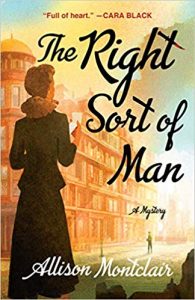
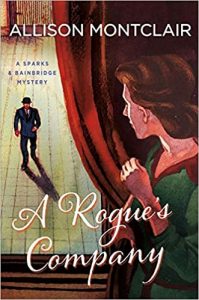
Escape Rating A: I’ve been reading this series from its opening in The Right Sort of Man, and have enjoyed every single one. But the tone of the series has changed over the course of those eight books, and the covers tell their own story. The first two covers were a bit soft-focused and reflected the romances that “The Right Sort” Marriage Bureau was working to create. Not that a murder didn’t occur, and not that the plot beats of a murder investigation didn’t drive both stories, but they were sorta/kind cozies – albeit with a more than a few twists.

Image
original cover
Image
current cover

The next several books, from A Rogue’s Company to Murder at the White Palace, look more like romantic suspense covers, which also represents one facet of those stories. It’s clear just from the covers that Sparks and Bainbridge are in a LOT more danger in those stories, and not just as a result of Sparks’ romance with gangleader Archie Spelling. If you compare the original version of the cover of A Rogue’s Company with the current version (both at left), that turn is made very manifest between the two.

The covers for the previous book, An Excellent Thing in a Woman, and this one, Fire Must Burn, represent another turn. They may be labelled as mysteries, but those are thriller covers, and so they should be. The Cold War is heating up – so to speak – and Iris Sparks and Gwen Bainbridge, both now signatories of the Official Secrets Act, are in the spy game up to their necks as a result of favors owed to Iris’ wartime boss, the mysterious Brigadier. Who is obviously a high-muckety-muck of one sort or another in MI6.

Image(I recognize that this series also experienced a change in publishers between Murder at the White Palace and An Excellent Thing in a Woman, but have no way of unraveling the reasons behind that ball of wax. I just see that the new covers EXCELLENTLY fit the new direction.)

This eighth entry in the series is a story about youthful folly, the power of privilege, the distribution of collateral damage and the price of consequences. And it kept me glued to my seat from beginning to end.

There were multiple strands to that glue. The story operates in two timelines, Sparks’ and Bainbridge’s 1947 present, AND Sparks’ own mid 1930s past at Cambridge. There are fascinating reveals in both timelines, with a kind of how it started vs. how it’s going feel. Sparks was a barely middle-class female student at Cambridge in the 1930s, and we see her as young, foolish, risk-taking and rule-breaking in a way that both fits with who we know AND shows how far she’s come as well as how the war and her own losses have changed her.

All of which are set in sharp contrast by the young female agent the Brigadier sends to seduce Danforth. A young woman very much like Sparks used to be, reminding her that she’s now 30 and scarred and jaded by her experiences. Especially the experience that set her on the course she is currently on – for both good and ill.

ImageThe story concludes with a whole lot of surprising reveals – not so much the whodunnits as a bunch of whydunnits all around. More importantly for both Sparks and Bainbridge, an all too intimate view of the changed nature of what seemed righteous in wartime but has now become a very dirty and dangerously clandestine war. One where not even the supposed “good guys” give a good goddamn about the cost – not even to their own.

It’s clear that Sparks is going to have to find a way to extricate herself and Bainbridge from the mess that necessity and expediency have gotten them into. The question is whether the Brigadier and MI6 will be willing to let them go.

A burning question – possibly literally – for the next book in the series. Hopefully this time next year.

A- #BookReview: Homemaker by Ruthie Knox and Annie Mare

A- #BookReview: Homemaker by Ruthie Knox and Annie MareHomemaker (Prairie Nightingale, #1) by Ruthie Knox, Annie Mare
Format: ebook
Source: borrowed from Amazon Kindle Unlimited
Genres: domestic thriller, mystery, suspense, thriller
Series: Prairie Nightingale #1
Pages: 297
Published by Thomas & Mercer on May 1, 2025
Purchasing Info: Author's WebsitePublisher's WebsiteAmazonBarnes & NobleBetter World Books
Goodreads

When a former friend and devoted mother vanishes, a confident homemaker turned amateur sleuth follows an unexpected trail of scandals and secrets to find her.
Prairie Nightingale is both the midlife mother of two teenage girls and a canny entrepreneur who has turned homemaking into a salaried profession. She’s also fascinated with the gritty details of other people’s lives. So when seemingly perfect Lisa Radcliffe, a member of her former mom-friends circle, suddenly disappears, it’s in Prairie’s nature to find out why.
Given her innate talent for vital pattern recognition, Prairie is out to catch a few clues by taking a long, hard look at everyone in Lisa’s life—and uncovering their secrets. Including Lisa’s. Prairie’s dogged curiosity is especially irritating to FBI agent Foster Rosemare, the first interesting man Prairie has met since her divorce. His square jaw and sharp suits don’t hurt.
But even as the investigation begins to wreak havoc on Prairie’s carefully tended homelife, she’s resolved to use her multivalent homemaking skills to solve the mystery of a missing mom—and along the way discover the thrill of her new sleuthing ambitions.

My Review:

I want to call Prairie Nightingale (and that really is the protagonist’s name and the story behind it explains SO MUCH about her character) a domestic goddess. But that’s not what she claims to be and that’s not what she really is. She’s calm on the surface and paddling like hell underneath just like everyone else – which we know because we’re inside her head.

What Prairie REALLY is is what the Brits call “a nosy parker”. It’s not so much that she can’t resist poking her nosy nose into other people’s business – although she honestly can’t. It’s that she can’t resist speculating about whatever part of someone else’s business she’s observed that just doesn’t add up.

But the thing that her former friends can’t forgive her for isn’t that she’s nosy. It’s that she’s right. And Prairie being right about something being wrong has a tendency to expose a whole lot of ugly secrets and dirty little lies that people around her have been pretending not to notice. Like when she exposed a well-respected local doctor for medically AND sexually abusing his patients.

Not that he got off “scot-free” but her former circle of “mom friends” pretty much shot the messenger. Meaning Prairie.

So when Prairie notices that one of the women waiting in the school pickup line is carrying a really expensive purse but looks really stressed and otherwise appears to be wearing older clothes and hand-me-downs when this same woman wore the newest and best of everything not all that long ago, Prairie’s sense that “too many of things are not like the others” goes off. Her ham-fisted “interrogation” of her former friend is embarrassing for all concerned, including Prairie but especially for her daughters.

It also confirms for Prairie that something is rotten in the state of Wisconsin, in the city of Green Bay, among at least one of the women who used to call her a friend. Which she shouldn’t poke into because it’s not her business.

At least not until another of those former friends is declared missing, the police and the FBI descend on her community, and Prairie’s need to find justice for a woman she wished she knew better, AND especially closure for the two children she seemingly left behind, pounds a drumbeat in her head that is MUCH LOUDER than the voices around her telling her to keep out of it.

Which Prairie is constitutionally incapable of doing. No matter how intriguing the FBI agent telling her to butt out might be.

ImageEscape Rating A-: Anyone who knows me at all would laugh at the idea of me reading a book titled Homemaker because of all the things I NEVER wanted to be, a homemaker is at the top of the list. I never had any ambitions whatsoever to be a domestic goddess, a domestic engineer, or a homemaker. Paraphrasing several Dr. Who incarnations, I mostly just don’t do domestic.

So this book seemed like it would be a bit outside my comfort zone, and it occasionally was, but one of the authors absolutely was not. I read – and adored – several of Ruthie Knox’ romances in the early days of Reading Reality, but I hadn’t seen much from her on NetGalley or Edelweiss (or I missed them because so many books, so little time). Then the second book in the Prairie Nightingale series, Trailbreaker, popped up as a tour book.

Since I did love Knox’ work, I decided to give this collaboration a try. And, since I’m a terrible completist, I had to start from the beginning with Homemaker. So here we are.

And I have to say that it was a surprisingly fascinating place to be. Also a whole lot deeper than it appears on the surface. Which I will get into.

But first, that surface. The surface is a compelling domestic thriller – and I’m saying that even though domestic thrillers are not usually my jam. What made it work was Prairie’s perspective and that her investigation is, of necessity, several steps removed from the violence that occurred. AND it manages to stick to a sphere that Prairie is intimately familiar with, while the police and the FBI definitely are not.

Prairie is an observer of people, and most of the people she comes into contact with are other women who have school-age children and who spend most of their time and mental energy trying to do all the physical, mental and emotional labor of keeping a family on track while trying to carve out small bits of time for themselves and not letting themselves feel too guilty about it.

(Prairie’s solution to that particular problem for HERSELF is fascinating. I wish we had more of the details but that’s a ‘me’ thing. I like process when it works, and Prairie’s mostly does – even if it also was a contributing factor in her divorce along with her nosy parker tendencies.)

The FBI and the local police ignore all the tiny clues that are hidden in the behavior of the women in Prairie’s circle – because that’s what they do. But that’s precisely where Prairie finds ALL the clues. The police, in the person of FBI agent Foster Rosemare, can find hard data to verify what Prairie uncovers – but only if they first know where to look.

So the investigation becomes a kind of partnership between Prairie and Foster – even though both of them are really skittish for really good reasons about their mutual attraction. I loved the way they worked together and towards each other at the same time. The very slow burn worked really well for the story.

But what kept me on the edge of my seat was the combination of Prairie’s painstaking, pain-making and occasionally outright painfully embarrassing investigation, not into motives and opportunities to commit a murder, but into the whys and wherefores of the whole of these women’s lives, and what it said – and what Prairie thought – about women’s voices, the value of women’s labor, the opportunities women are told they can have vs. the reality of what society expects, and especially the truth about the constant threat of intimate partner violence against women.

Parker is absolutely, totally, real-life/real-world correct that the two most dangerous things a woman can do are 1. Marry a man and 2. Get a divorce from a man. And that a lot of women spend their lives doing their very best not to ask for anything for themselves so as not to “upset” the man who just has to go “off the rails” ONCE to end their lives – and who will not be punished half as much for doing so as they would be if they do even if they are acting to protect themselves and/or their children.

So this story works, and works well, on both levels. The investigation is compelling, particularly as seen from Prairie’s point of view. But it’s her underlying thoughts and conclusions about women’s lives, the compromises they feel compelled to make and how all of that does and doesn’t work for the women living those lives that hooked me and kept me thinking as the story and Prairie worked their way to the awful truth.

If that interests you as much as it did me, there’s a surprising – but also marvelously short – readalike that explores some of the same territory in the short story “Four Sisters Overlooking the Sea” by Naomi Kritzer. Also Spider to the Fly by J.H. Markert for the combination of single ‘girlmom’ with professional-ish amateur investigation AND the way that communities protect men from consequences until the evidence is overwhelming. On the fun side, which Homemaker certainly has as well, the opening stages of Prairie’s romance with Foster read like Tabitha Knight’s slow burn romance with police Inspecteur Étienne Merveille in Colleen Cambridge’s Mastering the Art of French Murder series.

But I’ve already read those, so I’m itching to start the next book in THIS series, Trailbreaker, in AUDIO. I can’t wait to see what Prairie pokes her nose into next!

The Sunday Post AKA What’s on my (Mostly Virtual) Nightstand 1-25-26

Image

We’re supposed to be getting an ice storm today. So I’m probably huddled under a comforter with a good book and as many cats as I can get to cooperate. Not that cats are generally all that cooperative. OTOH, it could all blow over, or pass us by, or just not be, well, all that.

The last option is what we’re hoping for. Although I wouldn’t mind being the human under this particular cuddle puddle if it comes to it.

Image

As far as the coming, hopefully post ice storm week, I’m nearly certain that these are the books I’ll be looking at. The order in which the reviews will appear feels a bit up for grabs, but c’est la reading vie on that score. I just finished listening to Junkyard Riders so that might move up the queue a bit. We’ll see as the week progresses – or regresses – or whatever happens!

ImageCurrent Giveaways:

$10 Gift Card or $10 in Books in the Winter 2025-2026 Seasons of Books Giveaway Hop
$10 Gift Card or $10 Book in the Winter Wishes Giveaway Hop

ImageBlog Recap:

#GuestPost: Martin Luther King Day 2026
B #BookReview: Boy with Accidental Dinosaur by Ian McDonald
Grade A #BookReview: Eleanore of Avignon by Elizabeth DeLozier
A+ #BookReview: The Cyclist by Tim Sullivan
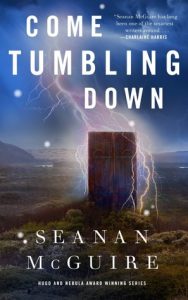
A- #AudioBookReview: Through Gates of Garnet and Gold by Seanan McGuire
Stacking the Shelves (689)

ImageComing This Week:

Homemaker by Ruthie Knox and Annie Mare (#BookReview)
Make It Out Alive by Allison Brennan (#BookReview)
Fire Must Burn by Allison Montclair (#BookReview)
The Case of the Murdered Muckraker by Rob Osler (#BookReview)
Junkyard Riders by Faith Hunter (#AudioBookReview)

Stacking the Shelves (689)

Image

This is another one of those stacks where there’s more “pretty creepy” than there is just plain “pretty”. The “pretty creepy” category includes The Way It Haunted Him and The Sleeping Sisters, while Snow Kissed is kinda creepy in that it might be predicting this weekend’s weather for everyone east of the Mississippi. We don’t normally get that much snow here in the ATL, but we might this weekend. We’ll see.

I think that the really pretty book in this stack is The Witch Below the Dreaming Wood. The books that I’m most curious about in this stack are The Last Mandarin, Talking Classics, and The Masala Chai Mystery Club, which also has a really cute cover. The ones I’m most looking forward to are The Case of the Murdered Muckraker and The Teacher. Especially the latter as I just finished the second book in The Teacher‘s DS George Cross series, The Cyclist, this week and it was TERRIFIC!

What’s in YOUR stack this snowy weekend?

For Review:
All We Hide by Robyn Gigl
The Case of the Murdered Muckraker (Harriet Morrow Investigates #2) by Rob Osler
Dead Weight by Hildur Knútsdóttir, translated by Mary Robinette Kowal
Jitterbug by Gareth L. Powell
The Last Mandarin by Louise Penny, Mellissa Fung
The Masala Chai Mystery Club by MJ Soni
No Matter the Cost (Unsanctioned #2) by Anna Hackett
Perun’s Hammer by Ian Heller
The Sleeping Sisters by Jennifer Givhan
Talking Classics by Mary Beard
The Teacher (DS George Cross #6) by Tim Sullivan
Time Travel for Beginners by Jaclyn Moriarty
The Way It Haunted Him by Laura R. Samotin
The Witch Below the Dreaming Wood by H. G. Parry

Borrowed from the Library:
Accomplice to the Villain (Assistant to the Villain #3) by Hannah Nicole Maehrer
Snow Kissed (Shelter Springs #3) by RaeAnne Thayne


If you want to find out more about Stacking The Shelves, please visit the official launch page

Please link your STS post in the linky below:


A- #AudioBookReview: Through Gates of Garnet and Gold by Seanan McGuire

A- #AudioBookReview: Through Gates of Garnet and Gold by Seanan McGuireThrough Gates of Garnet and Gold (Wayward Children, #11) by Seanan McGuire
Narrator: Cynthia Hopkins
Format: audiobook, eARC
Source: supplied by publisher via Edelweiss, supplied by publisher via Libro.fm
Formats available: hardcover, ebook, audiobook
Genres: fantasy, portal fantasy, urban fantasy, young adult
Series: Wayward Children #11
Pages: 149
Length: 4 hours and 33 minutes
Published by Macmillan Audio, Tordotcom on January 6, 2026
Purchasing Info: Author's WebsitePublisher's WebsiteAmazonBarnes & NobleKoboBookshop.orgBetter World Books
Goodreads

A fan-favorite character returns in this action-packed instalment of the Hugo Award-winning Wayward Children series.
After Nancy was cast out of the Halls of the Dead and forced to enroll at Eleanor West's School for Wayward Children, she never believed she'd find her door again, and when she did, she didn't look back. She disappeared from the school to resume her place in the Halls, never intending to return.
Years have passed. A darkness has descended on the Halls, and the living statues who populate them are dying at the hands of the already dead. The Lord and Lady who rule the land are helpless to stop the slaughter, forcing Nancy to leave the Halls again, this time on purpose, as she attempts to seek much-needed help from her former schoolmates.
But who would volunteer to quest in a world where the dead roam freely?
And why are the dead so intent on adding to their number?

My Review:

Whenever I think of the Wayward Children series, I imagine of the chase scene from Monsters, Inc. that takes place in the vast, cavernous space where all the doors are stored. I want to see a place just like that in this series – but I KNOW that the doors that these wayward children go through, sometimes back through, and very occasionally stride through one more time – or even more – aren’t stored that way.

Because the doors in this series have way more sentience of their own than that.

ImageNancy’s story turns out to be the rarest of all. Once upon a time she left our world for the stillness of the Halls of the Dead, stumbled back through her door to this world in Every Heart A Doorway, but found her door again at the end of that story and returned to the place her heart called home – a life of quiet, still, contemplation in the Halls of the Dead.

At least until the hungry dead start eating her friends, the other living statues, and the Lady of the Dead uses her powers to shove Nancy back through the doors to this world, specifically back to the one place where she hopes that Nancy can find help for whatever has gone wrong in the Halls.

That door leads to Nancy’s old room at Miss West’s School – and it is a place where Nancy can indeed find help and succor. Even though the provision of that help is certain to break Miss West’s one supposedly hard and fast rule – “NO QUESTS”

Of course there will be a quest to save the place their friend’s heart calls home. All their hearts are already in it. Because, even though they don’t know it yet, that this particular quest was theirs all along.

Escape Rating A-: This series opened with Nancy’s story in Every Heart A Doorway, and it feels right and fitting that the story return to Nancy yet again. Not for an ending – or at least I surely hope not – but for a bit of a catch-up. A catch-up with where and how Nancy is that ends on a surprisingly open note because Nancy’s story is clearly not over. So hopefully the series isn’t either.

ImageI listened to this entry in the series, and the narration was lovely. The narrators in this series switch depending on which of the children is the focus and whether their world is a ‘logic world’ or a ‘nonsense world. Cynthia Hopkins voiced Nancy’s first story, Every Heart A Doorway, and also voiced another logic world story in the series, In an Absent Dream. She did a particularly excellent job with Nancy’s voice and with all of the voices this time around, even nonsense-oriented Sumi as she reacts, lampshades and occasionally outright subverts the norms of this world that is antithetical to her very nature.

Then again, sometimes they need it.

Nancy is one of the long-standing, frequently appearing, characters in this series, so it’s not surprising that her – and everyone’s – equally long-standing nemesis appears in this story as well. After all, this is a universe where in the right worlds behind the right doors, the dead can rise again.

Which at first seems to be the story here. What made that story interesting, at first, was that the dead who are the foundation of the Halls of the Dead do, in fact, have cause to rise. They have been neglected and ignored if not outright mistreated. The Lord of the Dead has retreated to his private chambers and has begun to think of himself as a god and not merely the genius loci of this particular world.

ImageWhat – or who – has stirred the dead up so destructively is not of his world, it’s of ours. And it’s up to someone – or several someones – to help lay that evil to rest yet again. Because the children have met this particular hungry dead before – and quite likely will again because they are unlikely to rest for long.

The danger of the quest is real, because the dead are very, very hungry AND they have a grudge. Well, one of them does. So there’s a lot of chasing and racing and pounding hearts and feet in a place that has formerly known only stillness.

But the part that lingers of this story isn’t the quest or even the enemy they face – not that their enemy isn’t likely to linger, but that’s what this particular enemy has become infamous for. It’s not new although it does keep everyone on the edge of their toes every step of the way.

What lingers is Nancy’s insight into someone who has been both a hero and a figure of worship and reverence to her. She thought she was sure that the Halls where where she belonged. Her discovery that her hero isn’t remotely the hero she thought he was, that the Lord of the Dead has feet of clay up to his knees, might just have the power to change her mind.

Or at least make her much, much less sure. And that’s what the reader, and Nancy, are left with at the end. The possibility of change, and the recognition that her heart might call her elsewhere. Perhaps even back to Miss West’s, where a piece of her heart has been waiting for her all along.

I can’t wait for the next (very much hoped for) entry in this series, so that I can find out what happens next!

A+ #BookReview: The Cyclist by Tim Sullivan

A+ #BookReview: The Cyclist by Tim SullivanThe Cyclist: A DS George Cross Mystery by Tim Sullivan
Format: eARC
Source: supplied by publisher via NetGalley
Formats available: hardcover, paperback, ebook, audiobook
Genres: mystery, thriller
Series: DS George Cross #2
Pages: 272
Published by Atlantic Crime on January 13, 2026
Purchasing Info: Author's WebsitePublisher's WebsiteAmazonBarnes & NobleKoboBookshop.orgBetter World Books
Goodreads

Detective Sergeant George Cross returns to solve the case of a mangled body on a construction site and uncover a life of illicit drugs in the second book in Tim Sullivan’s internationally bestselling series

DS George Cross has unique and unmatchable talents. He uses a combination of logic, determination and exacting precision to get answers where others have failed for families who have long given up hope. So when a ravaged body is found in a local demolition site, it's up to Cross to piece together the truth from whatever fragments he can find.

From the faint tan lines and strange scars on the victim’s forearms, Cross meticulously unravels the young man's life, delving into the world of amateur cycling, an illicit supply of performance enhancing drugs, jealousy, ambition and a family tearing itself apart.

Cross’s relentless pursuit of the truth and eccentric methods earn him few friends. But just as the police seem to be nearing a conclusion, he doubles back. Could it be the biggest mistake of his career?

My Review:

ImageI fell hard for the first book in this series, The Dentist, so I’m ever so grateful to the publisher Atlantic Crime for bringing this series out in the US even if (and especially because at the same time) it’s been out in the author’s native UK for several years and is very popular there. I hope the same turns out to be true on this side of the pond, because, so far at least, the series is awesome – especially for mystery fans who love a detective with a unique perspective AND a thoroughgoing, intricate, well-executed, police procedural.

With an emphasis, perhaps on the executed part of that formula, as the stories begin and end with murder, AND, at least so far, the murder(s) at the end turn out to have been the murder(s) at the beginning after all.

Intrigued? I hope so. I certainly was.

Detective Sergeant (DS) George Cross fully admits that he’s on the autism spectrum, even if everyone around him tiptoes on eggshells about saying that out loud or even, sometimes, admitting it within the confines of their own heads. But Cross fully admits it, and even – on very rare occasions – hangs a lampshade over it or attempts to make a joke about it. His jokes land badly if at all, because he doesn’t get the social cues or understand the social taboos about when a joke is funny vs. too soon vs. in really poor taste – in general and not just in reference to his own circumstances.

(I get the feeling there is a part of his diagnosis in childhood – or at least other people’s reactions to it – that traumatized Cross and that he’s hiding from himself, but we haven’t quite got there yet because Cross isn’t ready to go there yet. And may never be.)

The case here begins with the discovery of a dead body – as murder mysteries so often do. It also begins with a pissed-off jobsite foreman, as quite a few mysteries do. The body has been discovered in the midst of a demolition site, and its discovery stops said demolition in its tracks. As such events do.

The body has NO identification on it, and does not match any missing persons case. It’s equally clear that the dead man didn’t kill himself, but he could have died either by accident or homicide. It’s evident that the dumpsite was not the killsite, and he absolutely could NOT have neatly wrapped his own body in plastic sheeting and carted it there. Somebody did something they shouldn’t have done, either to cause the death or to cover it up or both.

In order to figure out ‘whodunnit’ Cross must first determine who it was done to. And that’s where Cross starts looking for a thread to pull. At this blank canvas of a beginning, he doesn’t know which thread will be the right one. He’s just looking for a place to begin.

That the only thread he has turns out to be the correct one is a clue that is so deeply buried that not even Cross sees it at first. But in his single-minded need to dot every ‘i’, cross off every ‘t’ and check off every single box – he’ll get there in the end.

No matter how many times along the way his superior tries to close the case because said superior is “almost sure” they’ve got it wrapped. Cross never settles for “almost sure”. Only absolute certainty will do, and he’ll keep working until he finds it.

After all, Cross doesn’t care what his boss thinks. He only cares that the guilty can’t escape justice.

Escape Rating A+: This was, literally (in multiple ways), the perfect book to read at the end of a four-day Zoom meeting marathon. I needed to get back into my routine, but my brain had the consistency – and mental capacity – of a toasted marshmallow. I desperately needed a book to both suck me and AND wake my brain up, and I knew this book would deliver.

Which it most definitely did.

There are multiple things going on in this story, and this series, that I absolutely love, along with one that could have gone terribly wrong but so far hasn’t, so this was a win all the way around.

Let me explain…

Mysteries are one of my comfort reads. Not that I like to see people dead – even in fiction – but because the heart of a mystery is the return to order after it’s been broken. There’s a catharsis in that restoration of order out of the chaos. It feels good to see justice triumph and evil get is just desserts – or at least as much of those desserts as the situation allows for.

My reading catnip is competence porn. I enjoy seeing smart characters getting a job done well – whatever that job might be. Mysteries, with their outright requirement that a puzzle get solved, lend themselves to that catnip – although they’re not the only kind of story that does.

And I do love me a good police procedural with a quirky but cohesive ‘cop shop’ vibe, and this series is certainly building one of those. Although it’s a bit more twisted than that as the ‘cop shop’ that surrounds Cross has NOT been built with him as the center – except in an ironic way. The cop shop vibe in this series is built around dealing with, managing, and coping with Cross.

Which is where the thing that could go terribly wrong but hasn’t so far comes in. DS Cross is on the autism spectrum. That is not, as it was with Sir Gabriel Ward KC in A Case of Mice and Murder, the reader working out explanations that are not explicit in the story. Cross, like FBI Agent Gardner Camden in Head Cases and Miranda Chase in her series, knows and states that he is on the autism spectrum.

The danger that could occur, but so far hasn’t in any of those series, is a trope referred to as “autism is their superpower”. Because that can go very wrong, very quickly, and get very toxic. WHICH IS NOT HAPPENING HERE!

That doesn’t mean that the predilections, tendencies, and coping methods that Cross uses to deal with being himself in the world, don’t aid him in his work, because they certainly do. His hyperfocus is certainly a part of what makes his ‘solve rate’ so high. But they also harm his work, as is clear from the way the cop shop that surrounds him, well, works.

But it’s not one-sided. He is adapting, and so are they, and there’s growth on both sides – along with understandable frustration on BOTH sides.

The start of this particular case, now that I think about it, is a bit similar to the start of the case in the first book, The Dentist. (It’s looking like all the books in this series are titled for the identity of the victim, but we’ll see.)

ImageThe openings are similar in that initially, both victims are unidentified and the first part of the puzzle is figuring who they were so Cross and the team can figure out who had motive to do them in. So there’s a bit of a case before the case, but they do blend into a seamless whole – it’s just that the whole starts at an earlier point than mysteries often do.

However, since we’re all here for the puzzle – including Cross and the team – having a bit more of it is actually a good thing. As is this second installment in DS Cross’ series, from that mystery within a mystery beginning to the very satisfying end. And the even more surprising end after the end – which will hopefully intrigue you enough to try this series. It certainly works for this reader!

All of which means, of course, that I’ll be back next month with the third book in this series, The Patient. It’s looking like this series is going to be my ‘reading treat’ after I finish my regular deadline each month – and they absolutely are a treat worth looking forward to!