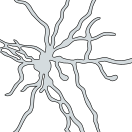
Our Biological Adapters use real neurons to improve performance and reduce the cost of foundation models.
Our Algorithm DiscoveryPlatform uses biologically derived principles to define what comes after transformers.
01
Our process translates real-world data of any kind into electrical signals.
02
We encode those electrical signals into a dish of living neurons. The neurons then decode them into richer, more complex representations of the data.
02
We encode those electrical signals into a dish of living neurons. The neurons then decode them into richer, more complex representations of the data.
03
Using a biologically derived adapter and principles from neural systems, we map representations onto state-of-the-art AI models to improve performance and enable algorithm discovery.
Deploy efficiently across generative video, computer vision, and state-of-the-art AI models.
Integrate TBC directly into existing AI workflows for improved training efficiency, measurable benchmark gains, and new algorithm discovery.
Today
We connect living neurons with modern AI, making frontier models more stable, scalable, and dramatically more efficient.
Computer Vision
TBC helps vision models recognize and classify images more accurately while reducing training cost.
We’re building biological computers that can make abstract associations, integrate multiple sensory information streams, remember, and adapt to new environments.
World Models
World models aim to help AI systems build internal representations of how the world works over time and across changing environments.
TBC is exploring how biological neurons can support richer internal models that capture long term structure, uncertainty, and change. This allows systems to reason, predict, and generate more coherent behavior, with applications in robotics and simulated environments.
Real-Time Biological Compute
Some problems require systems that respond continuously, not one step at a time.
By integrating biological neurons into compute workflows, TBC is exploring new ways to support real-time responses, memory, and adaptation with lower overhead than today’s architectures.
Pattern Completion & Prediction
Living neural systems are especially good at recognizing and completing patterns over time.
TBC is investigating how these properties can be applied to prediction and pattern completion in complex data, including time-series signals and large simulations.