
That means every decision we make aims to improve our understanding of ERW.
Our ERW project in Germany is a production-scale laboratory for testing methods and technologies that can transfer to business cases around the world.
2,000+
SIA devices installed worldwide
8
SIA devices per hectare in our German project
9
Research collaborations globally
After testing more than 100 rock samples, we identified the best ERW feedstock in central Europe
Rock used in our Vulkaneifel project
Calcium oxide
18.3%
Magnesium oxide
10.4%
Potassium oxide
3.4%
Sodium oxide
2.6%
Sequestration potential:

0.58
tons
of CO₂
per ton of basalt
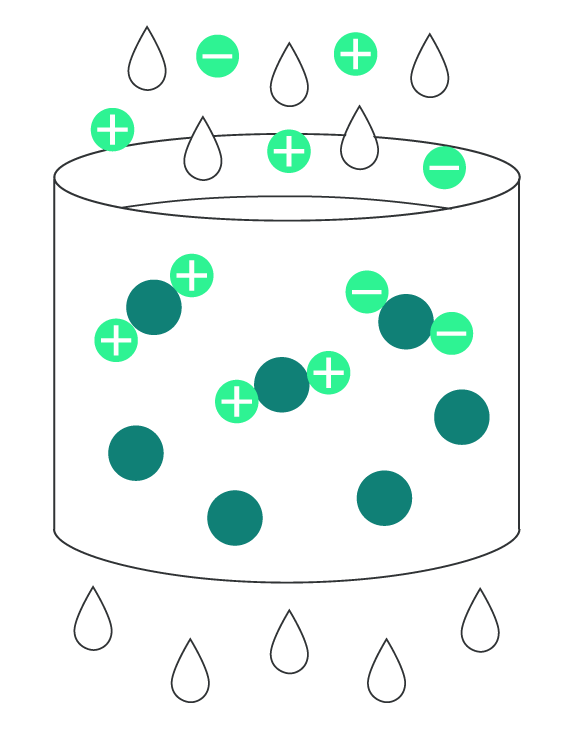
While the underlying reaction of ERW is well-understood, the trick is to speed up natural weathering as much as possible. By enhancing the rock surface area and optimizing distribution, we accelerate what would take millenia to happen and turn farmland into carbon-capturing ecosystems.
Measuring carbon removal rigorously and economically is still the biggest challenge.
So we developed a scalable and accurate solution:
There are some big scientific questions left to solve in ERW, and ZeroEx is in it for the long haul.
From bicarbonate lag time to secondary clay format ion, there isn’t much we aren’t interested in. If you are a researcher working on ERW, we want to hear from you!
Colaboração com a Universidade de Yale para testar o desempenho das SIAs em relação a vários outros métodos de MRV.
Experimento de mesocosmos em colaboração com a Novonesis para testar se a enzima anidrase carbônica (CA) pode acelerar a dissolução da matéria-prima de ERW.
Ensaio de campo conduzido pela Cascade Climate e Carleton College para testar o desempenho das SIAs em comparação com os métodos convencionais de MRV.
Ensaios de campo incluindo > 200 SIAs, testando diferentes métodos de instalação e profundidades em três parcelas de pesquisa na região de Eifel, na Alemanha.
Avaliação de elementos potencialmente tóxicos em ERW financiada pelo Climate Intervention Environmental Impact Fund (CIEIF).
Comparison of SIAs to alkalinity sensors in a field trial funded by the Cascade Climate ERW Field Data Partnership Grant in collaboration with Basic Dust and the University of Copenhagen.
Collaboration with Ludwig-Maximilians University (LMU) to evaluate the relationships between soil parameters and microbial community structure in rock-treated soils.
Our work contributes to the advancement of ERW science and its global scalability.
Our work contributes to the advancement of ERW science and its global scalability.
