-
-
Architecture
-
Container Mesh Forcast
-
Container Check - Check-in


Inspiration
Due to the flow imbalance on the transport of goods, there is a problem of managing the stock of empty ULDs and containers, both in terms of the availability of ULDs and containers at a given location and the environmental cost of managing returns.
What it does
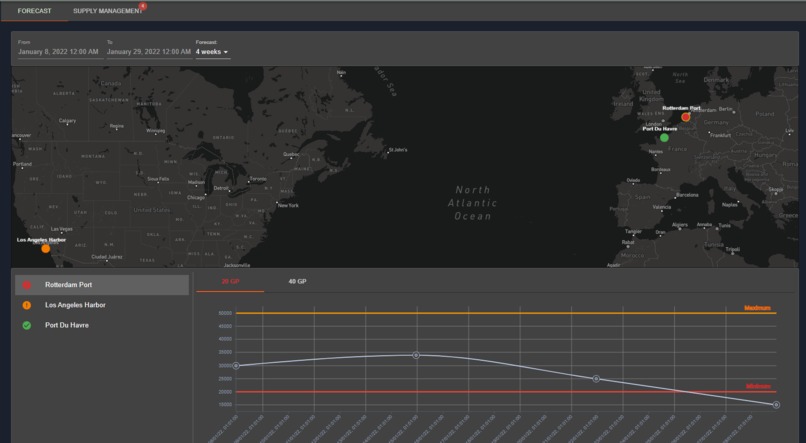
Our solution, ContainerMesh, is a market place aiming to connect the actors of the supply chain who have needs of empty containers, or who have transport capacities, to optimize the flow of empty ULDs and containers.
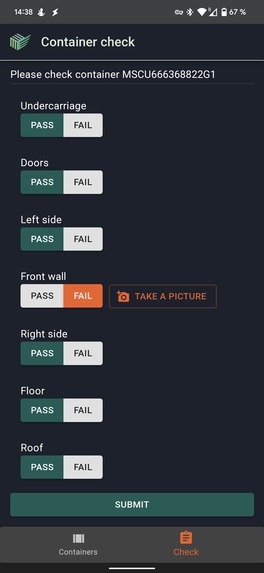
Our solution includes a desktop web application for Stock Managers and Carriers as well as a mobile application for port or airport operators.
Our solution is fully enabled by the adoption of communication standards like ONE Record or DCSA JIT and TNT by the actors of the supply chain.
Targeted Challenges
Challenge 1: DCSA Challenge
Our application will enable a better optimization of the flow of containers and will benefit both supply chain efficiency, fuel optimization, and help unblocking ports.
Challenge 3: Sustainable Air Cargo
Our application will enable a better optimization of the flow of ULDs and optimize the usage of empty space available. It will reduce fuel consumption and contribute for better management of empty ULD stock balance.
Challenge 4: Open Challenge
Our application will illustrate new possibilities enabled by interoperable standards like ONE Record and DCSA. Services proposed by our application do not exist nowadays and could significantly transform the current logistics chain towards a more optimized and sustainable way of carrying goods.
For this hackathon we will use an extended version of ONE Record, introducing scheduling of logistic activities in a multimodal ecosystem.
Try it Out!
Try our marketplace Container Mesh here : https://containermesh.onerecord.fr

Then, when you reach final steps of the demo data available in Container Mesh, that is to say when a Rental Service of containers taken from Los Angeles and released in Rotterdam has been booked. Our application Container Check is available here: https://containercheck.onerecord.fr

How we built it
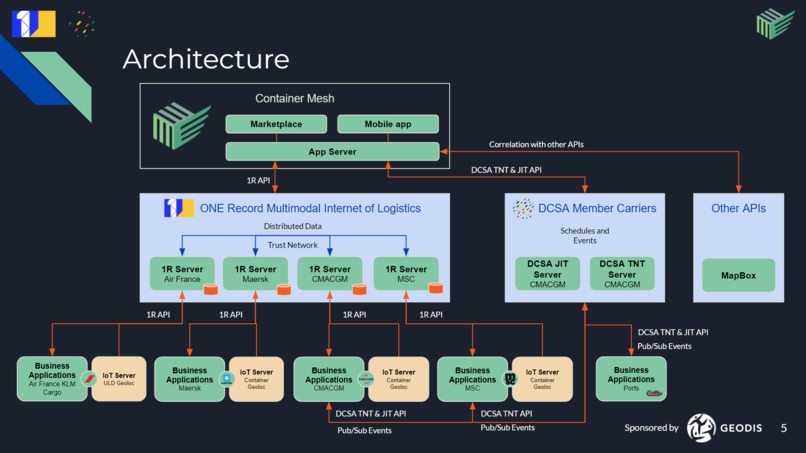
Architecture

Our solution, Container Mesh, is fully enabled by the adoption of interoperable communication standards by the actors of the supply chain.
So our solution is connected to the ONE Record Internet of Logistics and to a DCSA Just In Time PortCalls Event Server, in order to connect the actors who need empty containers and those who have transport capacities.
ONE Record and DCSA standards are used to schedule and track shipments for empty container replenishments contractualized via our application,and also to access other data like geolocation of containers.
We decided to show usage of our application with sea containers, but it could be also applied to other businesses like air cargo ULDs.
In our demo, we have deployed a DCSA JIT server and extended version of ONE Record allowing the management of services and activities in a multimodal context.
The platform is built on top of the Open Source Backend Kuzzle, designed for realtime IoT and data management applications.
How we used IATA ONE Record API
We have deployed an extended version of ONE Record allowing the management of services and activities in a multimodal context.
Our server is available at https://api.onerecord.fr
How we used DCSA Just In Time Portcalls API
We have deployed a DCSA JIT server that we use to publish maritime events that are correlated with ONE Record booked services data and events by our application Container Mesh.
Our server is available at https://dcsa-jit.onerecord.fr
How we simulate data
One of the challenges was to be able to populate and replay data sets according to the usecase we wanted to demonstrate.
We split our scenario in different steps so people from the team can create the data corresponding to each step. Later, documents from one step (such as events) will simply be copied when they are needed.
Then, we used a multi-tenant session system so the frontend can automatically choose an isolated session to play the scenario without disturbing other ongoing demo.
Challenges we ran into
- Building a realistic end-to-end replayable scenario with consistent data, dates, and all events to show both empty carriage services and rental services enabled by our solution.
- Analyze Schedules of Bookings of transportation services that involve containers or ULDs of a given carrier. ONE Record is not yet meant to execute such advanced search queries, so we had to support it in our platform storing ONE Record Data (based on Kuzzle)
- Building a desktop application and a mobile app to demonstrate our Demo scenario.
Accomplishments that we're proud of
- Our demo data includes pretty realistic bookings, events, with consistent routings and timestamp.
- Our app is totally or at least mostly bug free.
- Every technical part of our application (ONE Record server and API, IoT server, ONE Track app, ...) is automatically deployed and accessible behing onerecord.fr domain.
- We managed to accomplish what we were aiming at, with great teamwork and spirit!
What we learned
What's next for ContainerMesh
The application could have much more advanced features in the future, and we believe it could be totally relevant when carriers will have equipped their container fleet with geolocation IoT sensors and when ONE Record standard will be adopted by actors of the supply chain.
Why not continue developing this application and make it production ready?




Log in or sign up for Devpost to join the conversation.