Two ways to make an 8-page mini-zine using stuff you already have—and three reasons why you might do this.
Today, two ways to put together a specific type of mini-zine—an 8-page cut-fold-&-glue apparatus you can make on letter paper using any printer on hand. These are:
Method 1: a word processor, and
Method 2: whatever design-y software you like & a free web-based imposer.
But first: ↓
Why might you want to make a zine?
For ‘networking’ or other events, it is useful to have a zine on hand to give to people instead of a business card (dated) or nothing at all (the default). Share something relevant, personal, and provocative, as well as your contact info.
For in-person facilitated events, making a customized zine helps keep everyone on the same page. Laying out facilitation instructions as well as working/writing space helps guide participants through an activity. It also eases your job as facilitator by reducing explanation and grounding group work in a defined, page-by-page progression: e.g. you can ask everyone to turn to a specific page and keep things moving along. I’ve found that participants appreciate having something that encloses the entire activity. For those who want to read ahead or worry about structure or timing, the zine satisfies. It is also a signal that you take things seriously. People will notice that you created a custom zine for this specific gathering, and printed and folded the right number of them. This does not take long to do, but makes an impression.
Instead of a plain old handout for a presentation. It’s more fun to flip through a zine than flap a single sheet of paper. You also get to make some choices about structure and organization of the material. At the end of a talk, zines tend to go into pockets or bags while handouts are discreetly dropped into the trash.
Method 1: a word processor
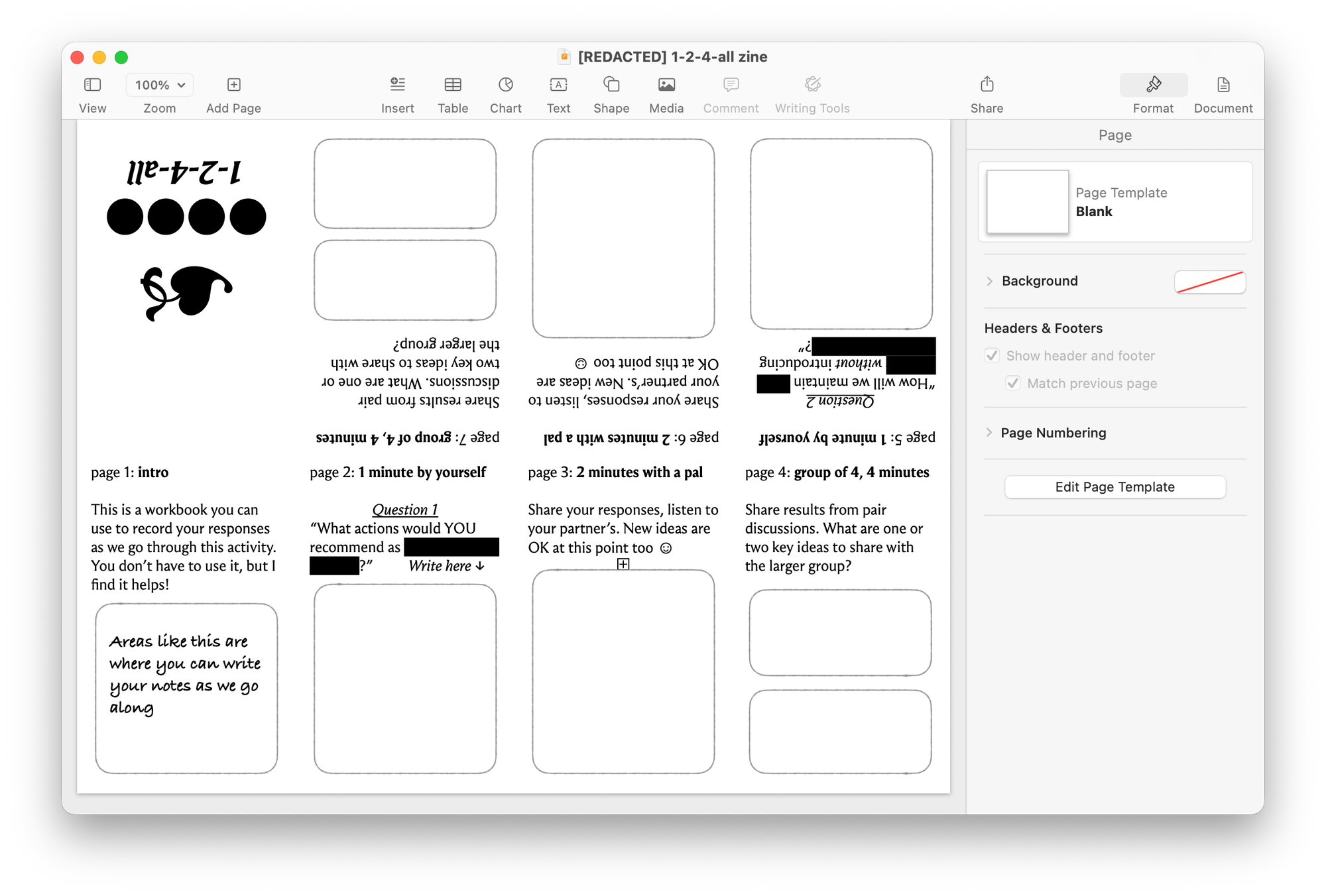
This is a simple but annoying method. Start with a ready-made template for your word processor of choice, and then fill in the blanks to lay out your zine. Here’s an example in Apple Pages, using these wonderful templates from Jess Driscoll:
In this example: a group was dealing with an organizational change that would split their one team into three parts. The discussion was about how the team could preserve some norms and quality standards despite the re-org.
What you may detect in the screenshot is that laying out pages 5 through 8 in this method is comically irritating. The advantage is that it’s simple to do: fill in and print. Word processing upside-down is possible but not recommended. As a result, I prefer the next method instead.
Method 2: whatever design-y software you like & a free web-based imposer
📖
Lingo alert: imposition is a printing term for pre-press arrangement of material on the page so it can then be printed, cut, folded, and bound.
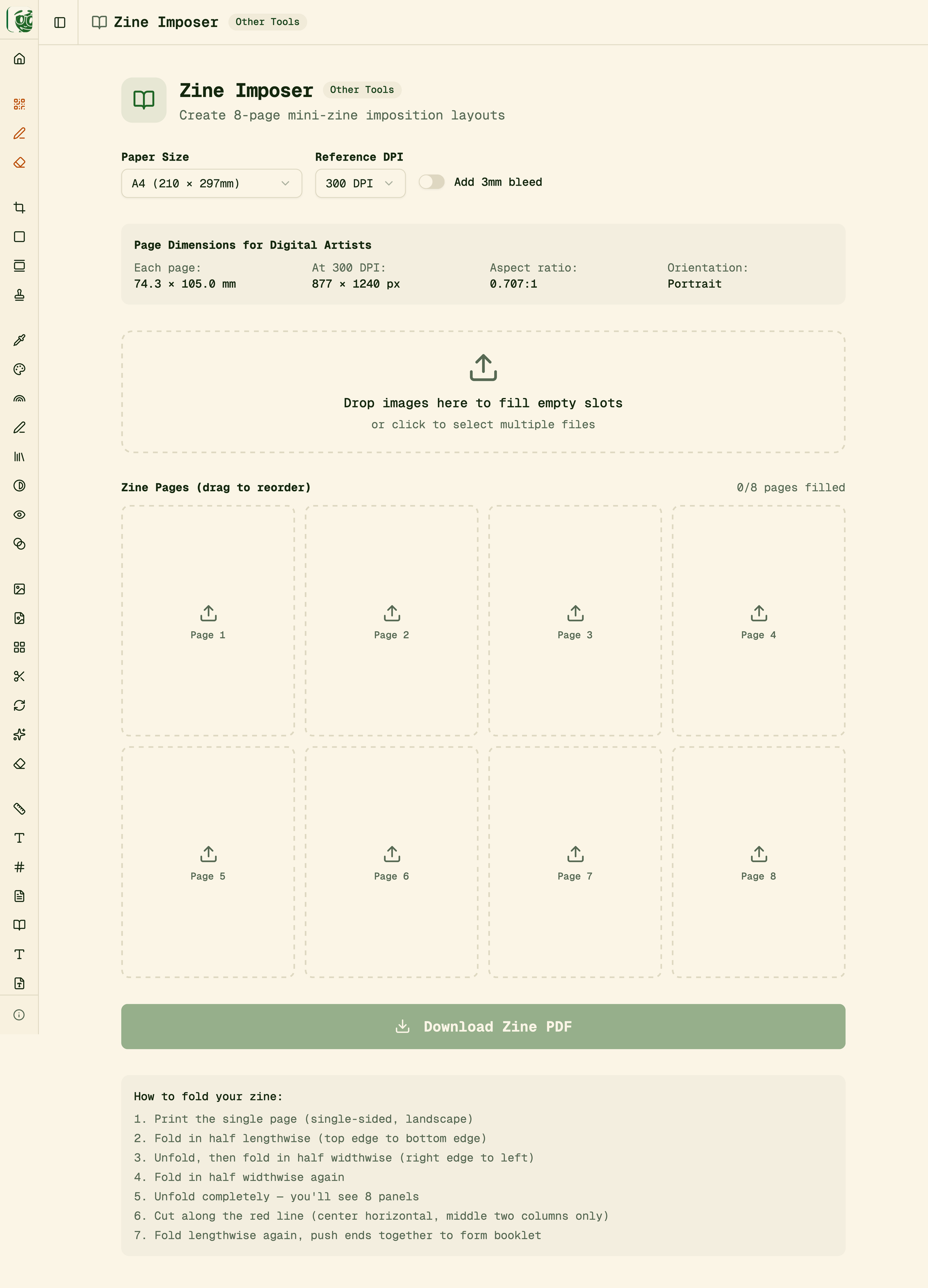
This method uses delphitools’ amazing online zine imposer to lay your zine out for printing. Specifically, the tool takes a set of appropriately-sized individual pages and gives you a printer-ready PDF in a layout similar to what you saw in method 1.
Use this thing by first selecting your paper size and then noting the dimensions it gives you for the zine pages. Next, in your software of choice, set your page size to these dimensions, and begin. You’ll want to create 8 pages, including front and back cover, and then export them as images to pull back into the zine imposer.
Options here include Keynote or other presentation software—or pretty much anything that can lay out images and text on pages.
I use Canva, where it’s simple to create pages at the right size and adhere to whatever aspects of the style guide seem important at the time. My only advice is to get the physical size of the page onscreen to roughly match what it’ll look like in print. Given Canva and my particular combination of hardware, that ends up being a 33% zoom.
Here are a few places to look for starting points or inspiration:
I’ve zine-ified various templates and handouts from my own downloads page. You might have a similar collection to work from.
Dan Klyn and colleagues have a great zine introducing their BASIC framework. (There’s also a video where Dan shows you how he prints and folds the things.)
For facilitated gatherings, use a step-by-step approach as shown in the method 1 example above. Take the instructions you’d project or write onto a whiteboard and put them into the zine.
If you want to put your contact information on the back page, use a QR code generator. Point it to your web site, a social media profile, or newsletter sign-up page. Make sure you list the exact page it’ll take someone to and what they’ll find there.
I’ll send you one
I’ve resisted putting PDFs of any zines online, preferring to keep it somewhat analog. But I’ll happily send you one—let me know where to send it.
Responding with attention, kindness & action as people return to work in difficult circumstances.
Two Januaries
It’s the first Tuesday of the month—January 6, 2026. I remember where and how I was five years ago today: holed up in my office, up in the finished attic of our previous home, cold but cozy, laboring desperately and fruitlessly to finish some mildly overdue items for a client, making no progress whatsoever, instead watching video feeds on C-SPAN and texting furiously with Liana and various friends. My consulting partner on that project (hi Jennifer! miss you & hope you are well) created a little wiggle room for us that day. People die only the once, but ideals fall again and again, and either way the absence and grief is felt whole-heartedly.
Yesterday was the first day back at work for many of us who had the good fortune to enjoy some downtime or time away around the end of the year. I felt tense going into the weekend, not from apprehension about returning to work but rather from worry about what they’d do on—or for—the fifth anniversary of January 6. I needn’t have waited. In 1992 Leonard Cohen sang that he couldn’t “run no more with that lawless crowd / while the killers in high places say their prayers out loud.” In the current circumstance the killers skipped the praying in favor of congregating in front of a wall-sized display with results of a search on X dot com for ‘Venezuela.’
Square that with the expectation that work happens underneath a context-free, ahistorical capitalist realism dome; in this dome the past is about two months long and the future extends only as far out as the end of the quarter or the next round of asinine bulk layoffs. I see cracks in the dome. I wonder what might shine through.
Three responses
How to respond in these conditions? I see three ways:
The first response is to remember. I wrote recently about undiscussables and shifting baselines. In both cases I think this is what I was really on about. We have to remember this, so we can give an account of what happened, and hold to account those responsible, and produce a better place in its aftermath, restoring rights and generating protections for all.
Another is to take time & show care. People are hurting, worried, scared. These are best antidotes I know of, at least on a the scale of local, daily interactions.
Taking time: this looks like 90 minutes with friends instead of 60; showing up early to arrange chairs and cushions into an inviting circle; and joining a few calls or meetings that are not strictly necessary but I hope will be beneficial.
Showing care: helping people around me ease back into things. At work this means a deliberate, gentle reiteration of commitments and arrangements. What have we all signed up for? By what method will we try to it get it done? We might adjust as needed, but largely I think people just need to hear it again.
A final response is to do what we can. My city elected its new mayor, someone I know and respect and for whose campaign our whole family was proud to volunteer. He’ll be sworn in at the top of tonight’s city council meeting. There is a sense that this is the start of something good, despite the limitations of that position and other constraints in place.
These three are incomplete, but it’s what I have, and how I’m operating right now.
The experiences of folks who find themselves fighting on a technical battleground—privacy, security, infrastructure, or even developer experience—have a lot of common themes. There’s a psychological fortitude that goes into becoming a Champion, a clarity of seeing the consequences that other people don’t like to see. Most people systematically underestimate the problems, failures, fragility, and errors around them … Researchers tested people’s estimation of failure rates across more than thirty domainsand found a consistent “failure gap.” Champions may just be the people who have learned to overcome the typical failure gap in a particular domain. They’re like our sociocognitive field scouts, with sharper prediction skills for the disasters most of us can't tolerate imagining for long.
People closest to a failure—those with the clearest access to information about a failure that occurred—will tend to be those with the strongest motive notto share it. This could seriously impede the accessibility of information. For example, a reporter looking to write a story about an individual, a company, or an organization, may find that the most knowledgeable and powerful sources more freely share information on what is going right, versus what is going wrong.
I’ve been thinking about how and why bad news related to likely failures or recent failures does not get communicated inside organizations, or is deliberately hidden from view; hence my recent posts on shifting baselines and undiscussables. As various initiatives don’t pan out—in the typical case of mandated ‘AI’ usage, because they won’t, and can’t—people are left the unenviable task of ‘easing in’ the bad news (to use Argyris’ phrasing).
Some good things from 2025
This is the part where we bask in the accomplishments of my friends, pals, and comrades. An incomplete, roughly chronological list:
Greg published Eject Disk, a set of 4 zines for people who are stuck in work or otherwise. Read online, or pay Greg to mail them to you. The first zine told me what I need to do in 2026, for which I’m grateful.
Shannon (singer) and Jamie (producer) released the album that is now part 1 of their 80s Kids project, toured all year, and have raised funds and released the first single from 80s Kids 2, for which a 2026 tour is already scheduled. When I imagine I am busy, I think about these two and sit back down.
Isabel launched flux studio. If you loathe ‘personal branding’ or ‘content marketing’ but gotta do it anyways, hire Isabel to help.
Beyond this, various friends left jobs (by choice or otherwise), started new work or adventures, and have done the right things for themselves. My family is healthy and mostly doing stuff they like. Walk into our home and beware sewing scraps, LEGO bricks, and books piled underfoot. Meanwhile: a steady, year-length drumbeat of protest. I love all of this, and this is what I celebrate.