
Pawn Stance is Objectively Correct*
*and if you disagree you’re doing it wrong.
Defining our Terms
Pawn Stance is an approach to play that treats the characters and events of your game as tools for accomplishing your goals.
It’s also objectively the correct way to play games.
A History Lesson
Narrative stances as used in this context were first formulated by Kevin Hardwick and Sarah Kahn and became part of the jargon used in the rec.games.frp.advocacy (RGFA) Usenet group sometime before 1996.1 They laid out a few different ways that players could position themselves relative to the events of the game. These terms weren’t formally defined but included (among others)-
focusing on portraying their character effectively to other players (Actor Stance)
aiming to affect the development of play through their choices (Author Stance)
only considering the perspective of their character when deciding on actions (Character Stance)
These stances aren’t mutually exclusive and the RGFA believed players might have a preference but would still often switch back and forth, so the focus was often on how to encourage and facilitate preferences.
Then in 2001, Ron Edwards wrote GNS and Other Matters of Role-playing Theory, which explains several of these terms in ways that don’t align with those definitions and distinctions.2 In particular,
Edwards defines Actor Stance the way RGFA explained Character Stance.
He adds Director Stance as having narrative control over elements of the environment separate from character action.
He defines Author Stance as including retroactive character motivation for decisions made to advance the player’s goals, and mentions that without those retroactive motivations this is called Pawn Stance- as in, treating the character like a game piece that matters only in so much as it’s a tool for accomplishing ludic goals.
Since then these terms have largely fallen out of favor, generally creating confusion rather than clarity when they do come up due to a lack of shared understanding of how they’re defined.
If any of that is wrong someone tell me, but that history is not particularly important here. I’m not going to fix any of the issues with that terminology or the semantic drift it’s undergone. I wanted to lay out what narrative stances are as context for how I’m defining Pawn Stance for the purposes of this manifesto. To be honest, I’m mostly using “Pawn Stance” as a concept that conveniently maps to my actual point and I wanted to say it a bunch to get your attention. I’m not here to be constructive, I’m here to be didactic.
The Issue
There’s a common pattern I have seen from players seeking advice on how to handle situations in a variety of games. They lay out what is happening in their game on a fictional level: the characters involved, the system structures, the story of the game so far, all the tiny details, and then they explain that for some reason or another they are having a bad time.
Maybe their character is an established coward who always chooses to stay behind rather than join expeditions, and they feel left out. Maybe they have uncovered a strategy that makes them invincible, and now their game has become boring. Maybe their table can’t come up with an explanation that makes sense for replacing their broken glasses in the middle of the jungle, so their character has been unable to see anything for three sessions. Maybe the game makes characters spending time with their friends costly, and the player feels left out avoiding that risk while the other people at the table get to have fun scenes with each other. Maybe the premise of the game implies that it is aimed towards characters with selfish intent, and you find playing that kind of character unpleasant and frustrating.
These examples involve some implied or explicit adherence to certain elements of play which restrict the player experience, such as Author Stance as Edwards defined it placing importance on justifying actions, or Character Stance as only considering information the character has. Players feel an obligation to the characters/story as established, or to playing optimally, or to their understanding of the designer’s intent, and in trying to meet that obligation they have a game that they aren’t enjoying.
The (Objectively Correct) Solution
Screw that. Play in Pawn Stance, and recognize that your character and game are toys to be played with for your own enjoyment. Any other goals like external logic, a satisfying and coherent narrative, or character internality come second.
As it has been used on various forum posts back, Pawn Stance was about accomplishing goals in the fiction- treating your character like a piece you can control in service of completing a dungeon without considering their personal justification for those actions is akin to how people usually treat a pawn in a game of chess. But there is no reason why the goals you’re trying to achieve have to be fictional.
Play games to have a good time with your friends.3 Your experience as individuals and as a group comes before everything else. If something is stopping you or your friends from having a good time, it must be recognized as less important than that goal and cast aside like dead weight. When you play in Pawn Stance, you are making decisions about what your character does and how the narrative will progress in service of having a good time without needing to justify your actions through character motivation or narrative development.
If you feel left out because your character is an established coward who always chooses to stay behind rather than join expeditions, choose to go on expeditions anyway! If your game is boring because you have uncovered a strategy that makes you invincible, don’t use that strategy! If your character has been unable to see anything for three sessions because the table doesn’t think it makes sense to find replacement glasses in the middle of the jungle, find new glasses anyway (or decide that they were never actually broken!) If you feel left out from fun scenes because you are avoiding a risk that the game makes costly, do those scenes anyway! If you find playing a character with selfish intent unpleasant and frustrating despite the game seeming to be aimed towards that, play an altruistic character instead!
If you prefer Character Stance but your character only acting on their knowledge is causing frustration in a particular situation, then play in Pawn Stance and act anyway. If you prefer Author Stance but find that centering a coherent or satisfying narrative is restricting your ability to play well, then play in Pawn Stance and ignore what would be the most appropriate narrative decision.
Not only is it acceptable to include some inconsistency or unjustified actions, it allows you access to various techniques which would be unavailable otherwise. When you don’t require seeing every action as a scene even if it might cost you some fictional justification, you are empowered to edit ruthlessly in pursuit of a faster pace.4 Advancing your character goals, helping your fellow players find what they are looking for out of the game, and reincorporating old ideas as callbacks are all easier when you allow yourself transparency between what your character knows and what you know as a member of the audience.5 When you decide the people playing the game are more important than the story of the game, rewinding to change how scenes went or declaring something different happened becomes a calibration tool for building safety, comfort, and trust and the table.
Sometimes prioritizing your own experience and the experience of your group over all else will mean doing things that seem to not have a fictional justification, having your character act inconsistently, rewriting prior events in the game to adjust what’s happening, changing or ignoring the rules, or even switching games.
That’s okay! The game is a construct! The designer is dead! It’s all in your head! Nothing matters, so you get to decide what matters!
How to Play in Pawn Stance, Even When You’re Playing in a Different Stance
Some of you will say that prioritizing fictional justifications for decisions is a good time for you, so Pawn Stance isn’t the right stance for you.
Skill issue!
Setting aside the real question (do you really care about fictional justifications more than you care about having a good time?) for now; You can construct a mental framework for approaching games with these features:
Life is a game you’re playing as a version of yourself (“Player-You”) that is playing a tabletop role playing game.
Your prelusory goal6 is to make sure that Player-You has a good time.
Player-You seems to have a good time when they consider the fictional justification for their actions.
You then proceed to operate that character in Pawn Stance, having Player-You take whatever game action best meets your goals, without concerning yourself with having any additional justification.
Often that will be by acting within Player-You’s priorities, but sometimes you’ll notice Player-You is having a bad time anyway.
Since you don’t have to share Player-You’s goals, you can have them take whatever action would make the game better without feeling attached to Player-You’s justification for those actions.
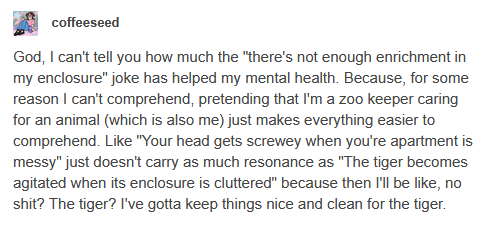
It can be hard to prioritize your own well-being and happiness over other goals. A lot of people find it easier to take care of others or encourage them to take care of themselves. By considering what advice you might give someone else in your situation, you can short-circuit this impulse. Consider the tiger in the enclosure- don’t you want the tiger to be happy?
You are always pursuing goals while you play a game, whether you realize it or not. Those goals can be unintentional and pursued ineffectively, or they can be explicit and pursued effectively.
You are always playing in Pawn Stance, whether you realize it or not. You can do so unintentionally and poorly, or you can choose to do so explicitly and pursue playing well. Make your goals explicit, use Actor Stance or Author Stance or whatever stance you like as tools for pursuing those goals when they are effective, abandon them when they are ineffective, and you will get closer to playing well.
Thus you can focus on what makes the game good for you without being weighted down by things that are not making the game good for you. Pawn Stance!7
Playing Well
Now, you may be fretting that “what makes the game good for you” is quite vague, and that it’s a lot easier for me to tell you to aim for it than for you to know what it is or how to reach it. The good news is that vagueness is the point.
In The Well-Played Game: A Player’s Philosophy, Bernie DeKoven examines what it means for a game to be “well-played.”8 He establishes immediately that it is impossible to define the Well-Played game precisely, because what it means to play well changes based “on the game, the people playing, the place, the time”. However, it is possible to point at the experience of being “at our best… fully engaged, totally present, and yet… only playing” and then consider how you arrive at it. This process involves;
Establishing the intention of playing well together, and re-establishing that intent whenever needed
A willingness to do what it takes to play well together
Feeling safe in the game you want to play well together, having considered the risks you are willing to take on
Having trust in each other to maintain that safety
Creating familiarity with the group or the game
Accepting certain conventions that allow us to extend our basis for that familiarity.
These take time and effort, and fully exploring this process is beyond the scope of this manifesto,9 but it starts with establishing common intention. DeKoven says that winning is the only common intention many adults are able to establish when playing, and that this results in the separation of players into those who achieve their intention and those who failed. This applies to many players of tabletop role playing games to varying extents, but even those who would say their common intention is not to win often fall into the trap of centering some other specific common intent- telling a good story, overcoming challenges, finding immersion, portraying characters well, or simulating a consistent/realistic fictional world.
Pawn Stance is Objectively Correct
To find the Well-Played Game, you must establish that it is your intent to play well. You need to be willing to do what it takes to play well together, and that involves a continuous process of figuring out what that means for you. If you realize that you are generally playing at your best when you focus on having justification for your actions or telling a good story, then you can use that knowledge to improve your ability to play well. But if you place another goal ahead of playing well without being open to recognizing when that goal is not meeting your needs, your pursuit of the Well-Played Game will be undermined before it can even begin.
Afterword
One could ask why I chose to make this point in a manner that could be described as hyperbolic, unreasonable, or occasionally hostile. The answer is that I enjoyed doing so, and my enjoyment is the only justification I need for making decisions. Surprise, I’ve been writing this manifesto in Pawn Stance this whole time! Checkmate, Authors/Actors/Characters.10
This manifesto was written for the Player Advice Blogwagon, which will be running from October 24th through November 7th.11 Go check it out, write your own post of player advice, and read the full index of posts when the blogwagon ends.
If you disagree with this manifesto and want to fight about it12, come find me on Bluesky, or on Discord in the Dice Exploder server.
Here’s some information on the RGFA, including the FAQ where I sourced this origin. ↵
Chapter Three in particular is focused on Stance. In the Acknowledgments, Edwards credits the RGFA discussion group for Stance, but says he has “altered just about everything very drastically.” ↵
Insert whatever “good time” means to you. If your version of a good time is a bad time, you’re my kind of sicko. ↵
Jason Morningstar has a great post about How to End Things. ↵
Sam lays these skills out in some more detail in a recent post on RPG Table Skills. ↵
Bernard Suits was a philosopher of game studies who famously defined games as “the voluntary attempt to overcome unnecessary obstacles” and referred to the specific state of affairs a player is attempting to achieve as their “prelusory goals.” Suits’ definition has flaws, but prelusory goals is a useful term. ↵
“Sera, this seems like an extremely convoluted way to say ‘You can play in other Stances if that’s what you want, as long as you’re having a good time’, why not just say that?”
I just did, in this footnote. I can have it both ways. ↵An earlier edition of this book is available on the Internet Archive and can be borrowed with a free account. ↵
It’s precisely the scope of Dekoven’s book though. Go read it! ↵
Look at that, I made a chess joke. ↵
You might notice this manifesto was released before that window. I cannot be contained. ↵
Or if you have questions and comments and want to chat politely about it, I suppose. ↵
