Filter a Map by Keys and Values Using Java Streams
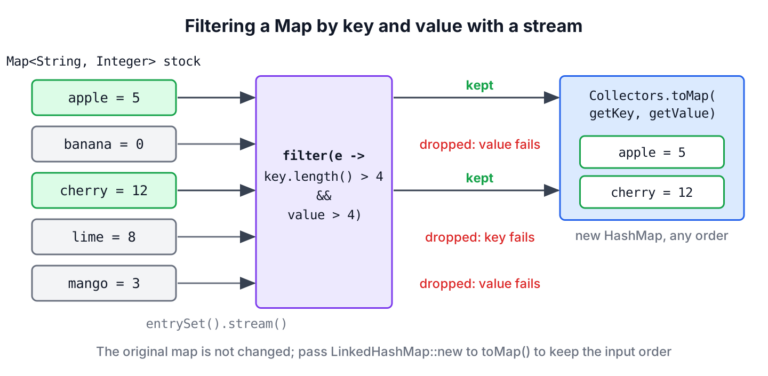
Learn to filter a map by keys and values with Java streams, plus Predicate helpers, removeIf(), order-preserving toMap() and null-safe collecting.

Java Streams are a powerful feature introduced in Java 8 for processing sequences of data in a functional and declarative style. They provide a high-level abstraction over collections, arrays, and other data sources, enabling concise and expressive operations on data.
Java Streams are part of the java.util.stream package and are designed to work seamlessly with lambda expressions, which were also introduced in Java 8.
Learn to filter a map by keys and values with Java streams, plus Predicate helpers, removeIf(), order-preserving toMap() and null-safe collecting.
Java Stream contains, containsAny and containsAll checks with anyMatch() and a Set, with empty-input rules, single-use streams and collection alternatives.
Learn to filter nested collections with Java streams using flatMap(), mapMulti() and anyMatch(), trim inner lists without mutation and handle null lists.
Learn Java Stream mapMulti() with examples, the type witness it needs, when it beats flatMap() and when it does not, primitive variants and a real case.
Learn to handle exceptions in Java streams by wrapping checked exceptions, skipping bad elements with Optional or mapMulti, or collecting errors as values.
Java stream groupingBy() examples that group a list by one or more fields and count, sum, average or sort each group with downstream collectors.
Fix the IllegalStateException stream has already been operated upon or closed in Java. See why streams are single-use and three ways to reuse the data.
Learn to iterate over a stream with indices in Java using IntStream.range(), a record, a Java 24 gatherer, AtomicInteger, Guava and StreamEx.
Learn to remove or update list elements using streams in Java with filter() and map(), or in place with removeIf() and replaceAll(), using records.
Learn to filter a map by a list of keys in Java with get() lookups, streams and retainAll(), keep the key order and report the keys that are missing.
Learn to debug Java streams with peek(), lambda breakpoints and the IntelliJ Trace Current Stream Chain action, and avoid the peek() and count() traps.
Java streams tutorial hub with every Stream API guide grouped by task, from creating and filtering streams to collectors, sorting, numbers and debugging.
Primitive type streams in Java with IntStream, LongStream and DoubleStream, covering creation, sum and average, overflow, summary statistics and boxing.
Get object with max date from a Java list with Stream.max() and Comparator.comparing(). Covers min date, empty lists, null dates, ties and max per group.
Learn how to get the last element of a stream in Java with reduce(), Guava findLast() and Java 21 getLast(), including empty and infinite streams.
Find duplicates in a Java stream with groupingBy() and counting(), list repeated elements, count each one, and remove duplicates from lists or by a field.
Convert Iterable to Stream in Java, and an Iterator too, with StreamSupport and Spliterators, a reusable helper, Guava and single-use iterators.
Java IntStream guide with range(), rangeClosed(), iterate() and chars(), loop replacements, map and filter, sum() overflow, conversions and a real example.
Collectors teeing() runs two collectors in one stream pass and merges the results. Examples for min and max, filter and count, records and nesting.
Java stream filter with multiple conditions using && and ||, chained filter() calls and Predicate and(), or(), negate(), plus dynamic search filters.
Join a stream of strings in Java with Collectors.joining() or String.join(), with a delimiter, prefix and suffix, null elements and empty streams.
Java Stream concat() merges two streams lazily. Learn to merge many streams, append or prepend items, remove duplicates and concat IntStream on Java 25.
Sort by multiple fields in a Java stream with comparing() and thenComparing(), mix ascending and descending order, handle nulls and pick keys at runtime.
Learn how to sort a stream in Java by numbers, strings, object fields, descending order and null values, plus sorting map entries and collecting results.
Convert a Java Stream to List with toList() or Collectors.toList(). Compare modifiability, null items and Java versions, plus ArrayList and IntStream.
Java Stream toArray() converts a stream to an array. Learn the String[]::new generator, int[] from primitive streams, ArrayStoreException and toList().
Collect a Java Stream to Map with Collectors.toMap(), handle duplicate keys and null values, and pick LinkedHashMap, TreeMap or an unmodifiable map.
Java stream reuse explained with Supplier, collect-once lists, reusable pipeline steps and one-pass collectors like teeing, plus one-shot sources.
Java Stream findFirst vs findAny explained. findFirst() keeps encounter order, while findAny() may return any element in parallel streams. With null rules.
Java Stream anyMatch() checks if any element matches a predicate. Learn allMatch(), noneMatch(), empty stream results and short-circuiting with examples.
Java Stream limit() keeps the first n elements and skip() drops them. Learn edge cases, infinite streams, takeWhile() and a pagination helper with code.
Java Stream peek() explained with element order, cases where count(), findFirst() and limit() skip it, peek vs map vs forEach, parallel streams and logging
map vs flatMap in Java explained with side-by-side examples, a comparison table, Optional map() vs flatMap(), mapMulti() and when to use each method.
Learn Java Stream flatMap() with examples to flatten a list of lists, split lines into words, unwrap Optional values and use flatMapToInt() in Java 25.
Learn the Java Stream map() method with examples for type conversion, field extraction, DTO mapping, mapToInt(), laziness and map() vs flatMap().
Java Stream max() examples with comparators, max by field, ties, empty streams, groups and primitive streams, plus comparators that return wrong results.
Java Stream sorted() examples that sort in natural, reverse and custom order with Comparator, records and nulls, plus how it compares with List.sort().
Learn the Java Stream filter() method with predicates, lambdas, Predicate.not(), null and map filtering, filter() vs removeIf() and real-world examples.
Java Stream forEach() runs an action on every element. See parallel order, forEachOrdered(), shared state, stopping early and checked exceptions.
If-else logic in Java streams with filter(), map() with a ternary or switch, partitioningBy(), groupingBy() and Optional, plus a bank statement example
Java Stream distinct by multiple fields with a distinctByKey() predicate, a record key, toMap() or a Gatherer, and why parallel streams change the result.
Java Stream max() and min() find the largest and smallest element with a Comparator. Covers ties, empty streams, nulls, max per group and IntStream.
Java Stream count() returns the number of elements as a long. Count matches with filter(), groups with counting(), and see when count() skips the pipeline.
Java boxed stream guide with IntStream boxed() and mapToObj(), collecting primitive streams into a List, Set, Map or array, unboxing and boxing cost.
Java Stream takeWhile and dropWhile explained with examples, the difference from filter() and limit(), unordered streams, iterate() and ofNullable().
Java Stream distinct() removes duplicates with equals() and hashCode() and keeps encounter order. Examples with strings, records, keys and parallel use.
Java Stream API examples for creating streams, filter, map, sorted, collectors and groupingBy, lazy evaluation, parallel streams and gatherers on Java 25.
Functional interface in Java explained with @FunctionalInterface, java.util.function types, composition, generic interfaces and checked exceptions.
HowToDoInJava provides tutorials and how-to guides on Java and related technologies.
It also shares the best practices, algorithms & solutions and frequently asked interview questions.
