


Helenia
The future of fashion is already in your closet. Millions of tons of textiles land in landfills every single year while global apparel production continues to consume vast economic resources. We built Helenia to break that cycle by replacing passive consumption with creation. Rework a garment you already own. Get a personalized step-by-step guide to actually make it. Preview the finished redesign on your own body before you cut anything.
Inspiration
Mending has a lineage. Sashiko in Japan. Boro. West African textile reuse. Generations of people repaired and reworked clothes as craft, honoring material quality. That tradition got lost between fast fashion and a industry that treats "worn" as "worthless."
The instinct to rework a garment is still there. What is missing is the bridge from instinct to execution: a clear plan, matched to the actual garment in your closet, and a way to see it finished before you commit a single cut. Helenia is that bridge.
Economic Impact & Market Opportunity
The global circular fashion market represents an enormous economic shift, projected to reach 120 billion dollars by 2030 as consumers move away from linear fast-fashion models. Extended producer responsibility legislation and shifting consumer demands are accelerating this transformation. By extending the average life of a garment by just nine months, overall carbon, waste, and water footprints decrease by roughly 20 to 30 percent, unlocking billions in saved consumer expenditure while creating localized economic value around repair, alteration, and upcycling ecosystems.
What it does
Upload a photo of an old garment. Gemini classifies it and proposes three rework or upcycle concepts. Pick one, then add a selfie. YouCam does the rest of the work.
YouCam Skin AI reads your actual skin tone off the selfie, and that reading feeds directly into the prompt that writes your five-step rework guide as a practical rule: if the garment's existing colors already suit you, the plan says so and spends its steps on cut and construction instead. If they do not, it prescribes one specific, buildable change, with the materials it needs added to your tools list. The palette drives a design decision, not a filter.
In parallel, YouCam Apparel Virtual Try On (VTO) builds the on-body proof. Gemini renders a clean mockup of the finished design, color-matched to your palette, and Apparel VTO composites it onto your own selfie, so you look at yourself in the redesign, not a model.
From there, two more YouCam-driven moves finish the look:
- Add a matching accessory. Gemini looks at your palette and the finished rework and proposes one accessory. Accept it, and Apparel VTO fits it onto your try-on image, then re-applies the reworked garment last so the accessory does not erase it.
- Try another fabric. Pick from a set of fabric templates and Apparel VTO re-renders the same try-on in that material, so you compare options before committing to one.
Everything lands together: a plan you can follow, and a picture, styled and re-textured, of exactly where it leads.
How we built it
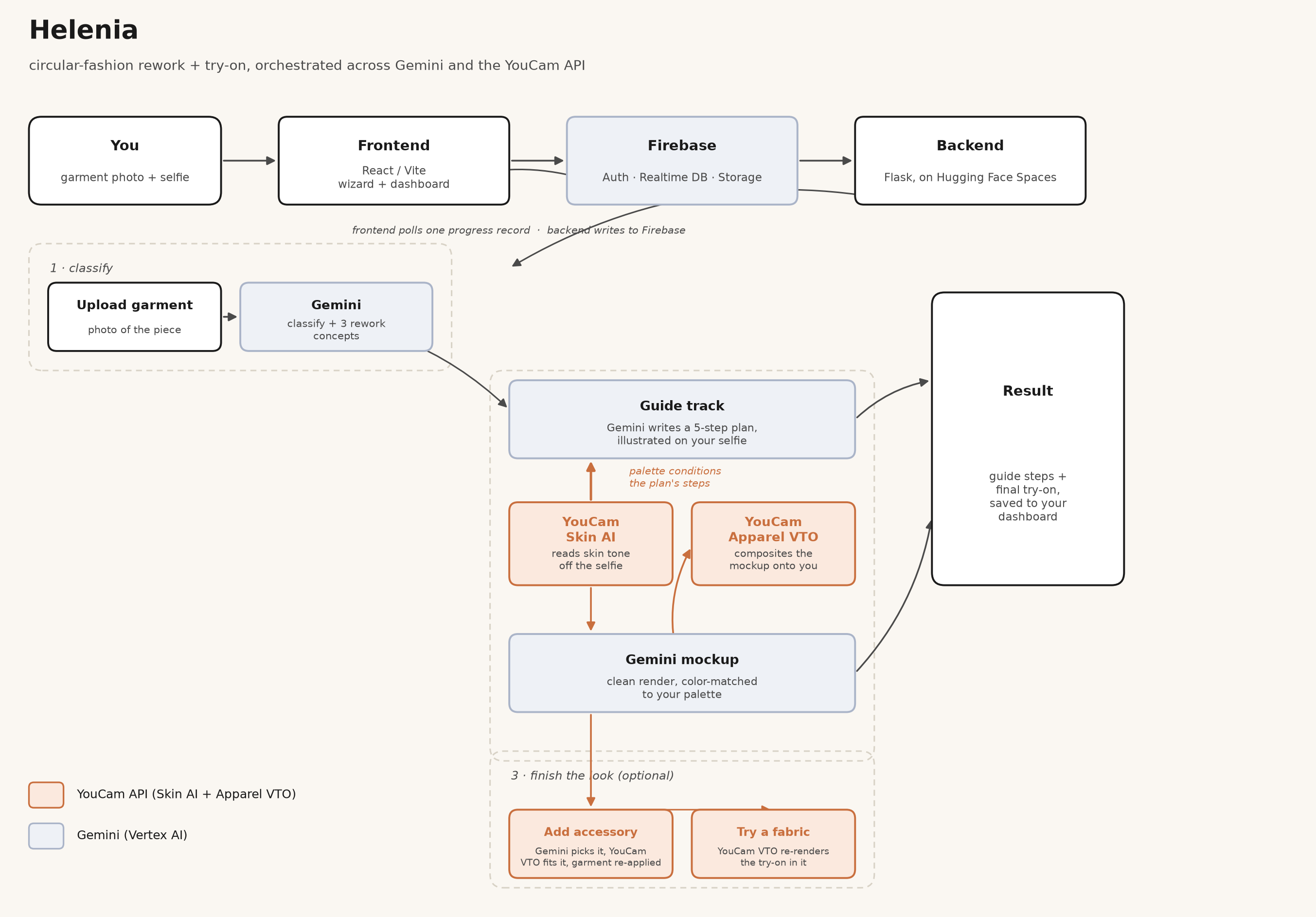
Vite, React, TypeScript, and Tailwind v4 on the frontend. Flask on the backend. Firebase for auth, Realtime Database, and storage. Gemini for classification, planning, and image generation, served through Vertex AI. YouCam carries the parts Gemini cannot: Skin AI for the palette read, and Apparel VTO for the try-on, the accessory fit, and the fabric swap, chained together so the reworked garment survives each successive pass.
The guide and the try-on run as two independent background tracks, each writing progress to its own node under one record. Neither blocks the other. The frontend polls once and renders whichever finishes first. A dashboard sits in front of the wizard: past reworks, searchable, deletable, revisitable.
The frontend and backend live in separate repositories. The frontend deploys to Netlify and Vercel straight from the repo root. The backend deploys to a Hugging Face Space as a Docker image.
Challenges we ran into
Our YouCam integration failed its first real run on three separate points: file upload is a two-step register-then-upload flow, not a direct POST; skin tone and skin concern are different endpoints; and Apparel VTO's task path is versioned, with a category enum narrower than the one the classification prompt was using. The fix was to stop patching symptoms and re-verify every endpoint against the primary reference docs and the OpenAPI schema directly.
One bug showed up by looking at the actual output: accessory try-on calls returned clean 200s and real images, but the composited result dropped the reworked garment. A 200 and a correct result are different claims.
Accomplishments that we're proud of
YouCam Skin AI does real work here. Early on it just tinted a mockup unconditionally. Now it conditionally influences the plan and design decisions: say the existing colors already work and spend the steps on cut and construction, or prescribe one specific, buildable change. That is the difference between a decorative integration and a substantive one.
The guide keeps the same person visible across all five steps, anchored on one selfie, so the tutorial reads as yours. The whole pipeline runs live, end to end, on infrastructure rebuilt under deadline pressure, and stayed up.
What we learned
A documentation summary is not the documentation. Every real integration bug traced back to building against a paraphrase instead of the primary source. Read the reference pages and the schema first.
Liveness and progress are different questions. A step that legitimately runs long looks identical to a dead thread unless something touches the timestamp independently of an actual milestone. A heartbeat fixes that; a bigger timeout just delays the same false failure.
What's next for Helenia
Make it a product that works seamlessly across global markets.
Extend the accessory try-on beyond hats, scarves, bags, and shoes. Bring the cultural framing further into the product itself, crediting the specific traditions a given rework technique draws from. Let a finished rework be shared, not just kept in a personal dashboard, because the things worth making are worth showing to the world.
Built With
- gemini
- youcam


Log in or sign up for Devpost to join the conversation.