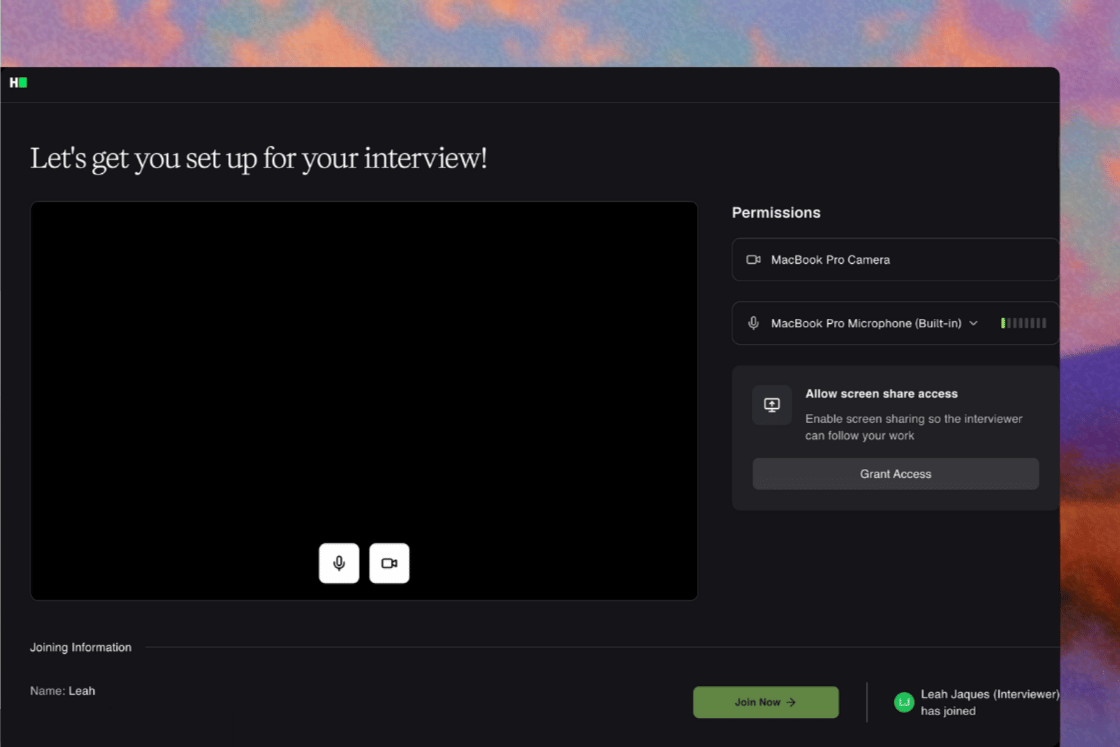
Most live interview tools were built before developers used AI to code. HackerRank Interview is built assuming they do. Candidates land in a real code repo inside an Agentic Development Environment, with the models they use every day. See how candidates plan, build, and review with AI.
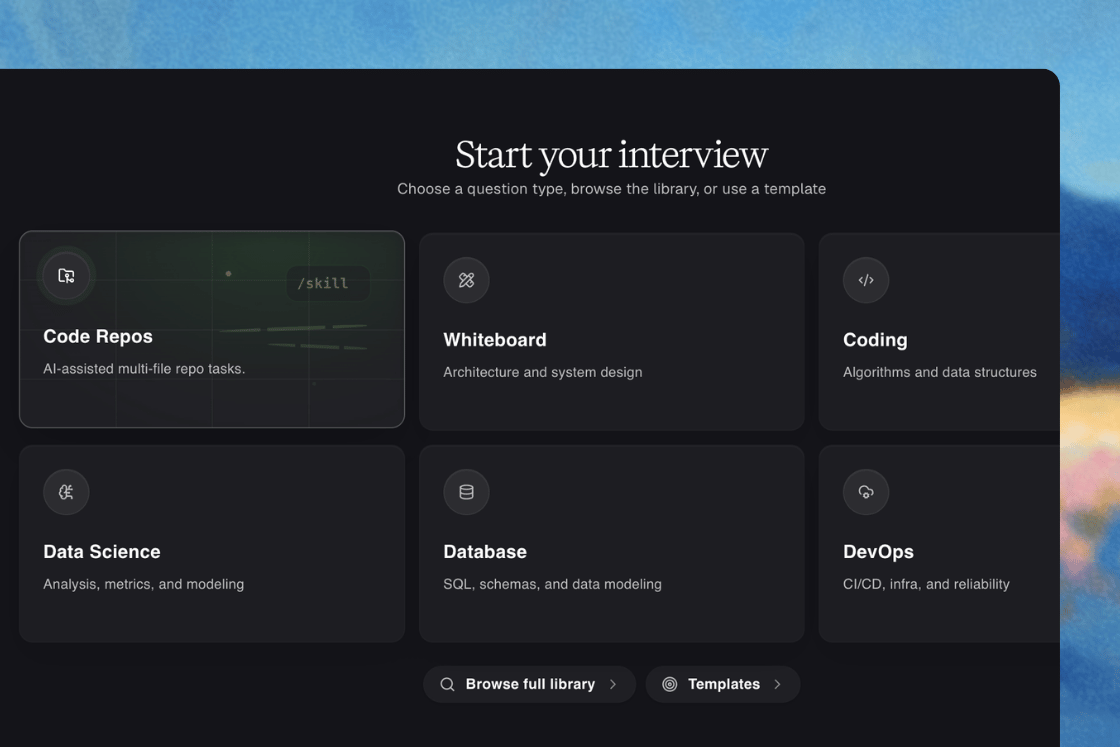
Agents can one-shot single-file puzzles, but engineers build features and fix bugs across a whole codebase. Candidates work a ticket in a multi-file repository with prebuilt starter code, the same way they would on the job. Evaluate the judgment that shows up when a problem is bigger than one file.

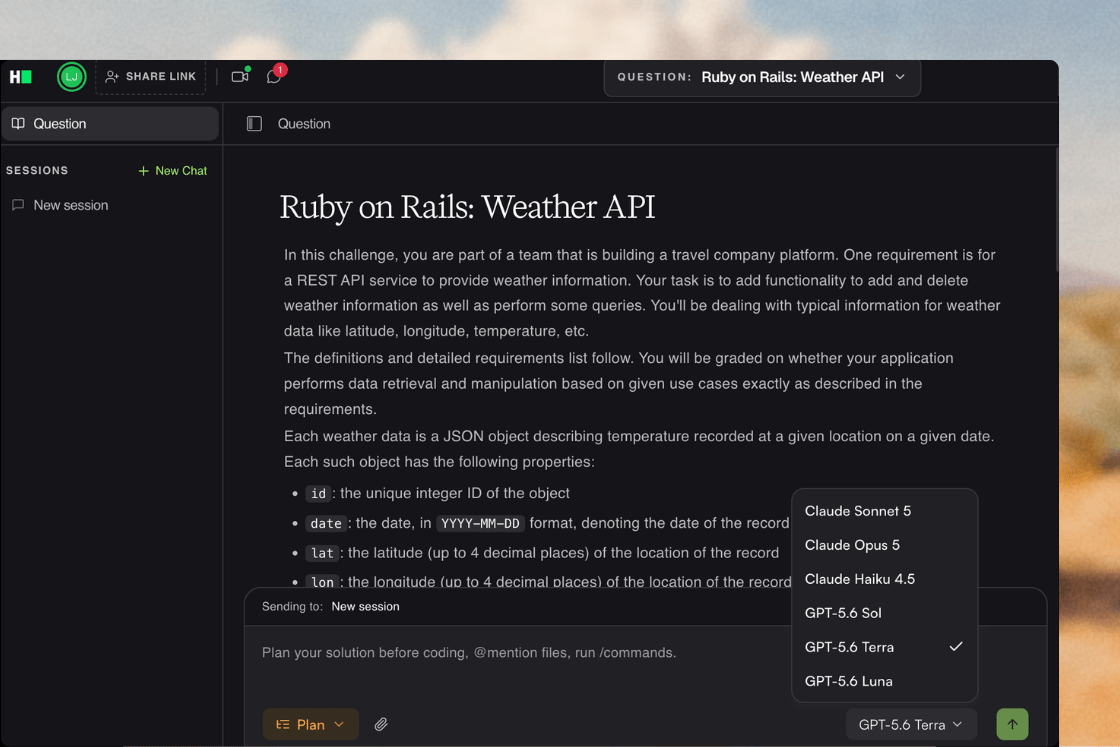
Run interviews in an Agentic Development Environment where candidates work with an AI assistant the way they would on the job. Candidates plan, prompt, and review what the agent produced, all of it visible to the interviewer as it happens and captured in the interview report afterward. Measure AI Fluency like any other engineering skill.

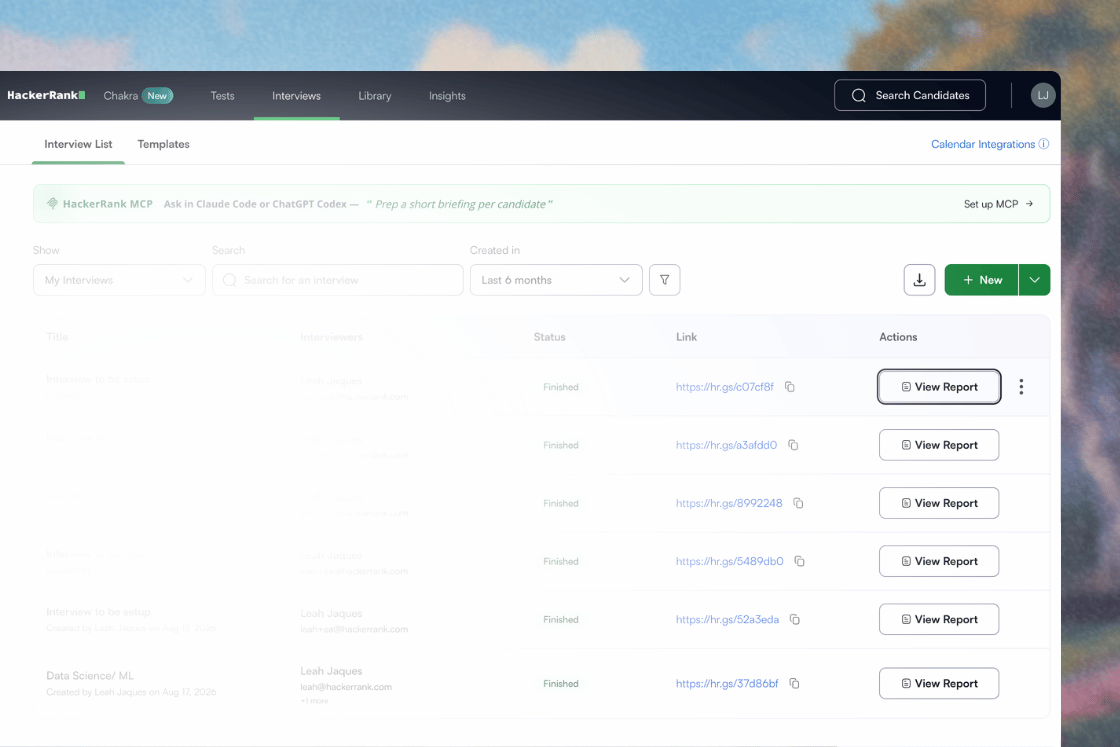
Every interview produces a complete record: a recording of the full session, the repository with every commit and change the candidate made, their conversations with the AI Assistant, and a timeline of their activity. Add interviewer notes during or after the interview, then download the report as a PDF or share it with your hiring team.

Interviewers can observe the candidate's screen at any point during the interview. Every session is recorded end to end, and the report shows a complete timeline of what the candidate did, with activity playback.

.png)
"The interview should resemble how we actually work. In the job, we have access to AI assistance, and using it well is an acquired skill."
Find answers to common questions about HackerRank Interview.
A video call with a shared screen can show you what a candidate typed. It cannot show you how they direct an agent, whether they catch it when it is confidently wrong, or what they decide to keep. HackerRank Interview is a live coding interview built around an agent rather than an editor. Candidates work in a code repo inside an agentic development environment with the models they already use, and interviewers see the prompts, the changes, and the reasoning as it happens, then get all of it back in the report.
The candidate is dropped into a fully functional environment: a code repo inside an agentic development environment, with the frontier models they already use, a full terminal, a browser for testing what they build, and a live view of every change the agent makes. From there they work on an open-ended problem: framing it, planning an approach, building with the agent, then reviewing what it produced and course-correcting. What the interviewer walks away with is a picture of how the candidate reasons and how they would work on the job.
Interviewers see the whole exchange, not just the result. They can watch how a candidate frames the problem before prompting, how carefully they review what comes back, and how they respond when the output is wrong. The report captures all of it, so evaluation covers AI Fluency, judgment, and critical reasoning alongside correctness.
Interviewers can observe the candidate's screen at any point during the session, which shows which tabs are open, which applications are running, and what is on a second monitor. Every interview is recorded end to end, and the report includes a complete timeline of the candidate's activity, so anything unclear in the moment can be reviewed afterward.
HackerRank Screen is a take-home technical assessment platform used at the top of the funnel. Candidates complete it on their own time and results are automatically scored, letting recruiting teams identify the strongest applicants before investing interview time. HackerRank Interview is the next stage: a live, collaborative coding environment where interviewers and candidates work together in real time inside a real codebase. The hiring leaders getting this right have moved from algorithm-centric tasks to real-world repository-based problems putting candidates inside actual code environments and asking them to do what they'd do on day one. Screen filters the funnel; Interview validates the finalist.
Most interview processes are still asking candidates to implement Dijkstra's algorithm on a whiteboard, testing for memorization of algorithms that AI can generate in seconds. A senior engineer on day one opens their editor with an AI assistant, picks up a vague ticket, uses it to scaffold the boilerplate, critically evaluates what it produced, identifies where it is wrong or incomplete, and writes the hard parts themselves. HackerRank Interview is built to test exactly those skills, AI Fluency, code quality, critical reasoning, and problem solving, in an environment that mirrors how developers actually work.