Customers given too many choices are 10x less likely to buy
For 10 years, Columbia professor Sheena Iyengar has been studying choice. For her research paper, “When Choice is Demotivating”, they ran a great test:
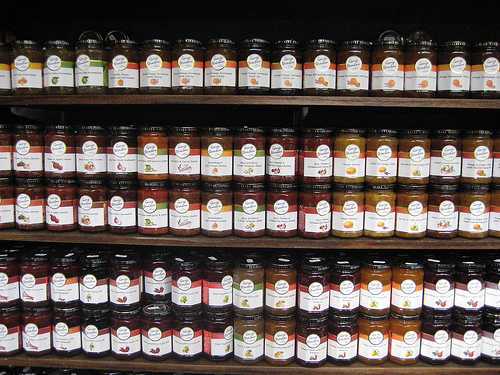
They set up a free tasting booth in a grocery store, with six different jams. 40% of the customers stopped to taste. 30% of those bought some.
A week later, they set up the same booth in the same store, but this time with twenty-four different jams. 60% of the customers stopped to taste. But only 3% bought some!
Both groups actually tasted an average of 1.5 jams. So the huge difference in buying can’t be blamed on the 24-jam customers being full.
Lessons learned:
- Having many choices seems appealing (40% vs 60% stopped to taste)
- Having many choices makes them 10 times less likely to buy (30% vs 3% actually bought)
Surgeon Atul Gawande found that 65% of people surveyed said if they were to get cancer, they’d want to choose their own treatment. Among people surveyed who really do have cancer, only 12% of patients want to choose their own treatment.
So, if you ask your customers if they want extensive choice, they will say they do — but they really don’t.
I recommend the book “The Paradox of Choice” if you’re interested in this.
Where does this not apply?
In “preference matching” contexts, where people come looking for something they already know and prefer, extensive selection increases the likelihood they’ll be successful in their search. For example: a menu at a Chinese restaurant.
Many tests have shown that when people are given some choice versus none (choosing between six possible activities versus being assigned an activity), having some choice increases motivation and enhances performance.
How do we use this info?
Online stores often offer too many choices on their front page. Lists of dozens of new arrivals, top sellers, sale items, and categories.
Artists showcasing their art (music, essays, photos) often present a giant list of everything they’ve done.
But all of us could come to these conclusions:
- Only present 3 to 6 choices at a time. No less than 3. No more than 6.
- Only show your deep selection when people are searching for something specific.
My favorite example of this is Firefox’s about:config feature. There are hundreds of intimidating options that are hidden from most people, but there for the few who need them.

I have always found too many choices to be paralyzing. Maybe what you're describing is also related to the software development concept of "analysis paralysis"? Thanks for this -- I recall reading it from you somewhere before. It was worth reading again!
When I was first learning to play guitar as a teen in the mid 80's there was an explosion of instructional materials. Hal Leonard chord books had been replaced by Hot Licks videos and Guitar For The Practicing Musician Magazine. I thought it would make things easier for a beginner like me- woodshed hard and absorb more knowledge faster, like going to an intensive course at a music school. Nope! I got competely overwhelmed, then frustrated by what I wasn't learning.
I went back to the tried-and-true method of playing along with my favorite LPs over and over, stopping to pick out important backing riffs and cool licks (not always guitar, sometimes piano or horn or vocal). I learned faster and easier this way and it was better for developing my own voice on the instrument.
i think most of us have experienced this. This is where grouping things can help the seller target specific customers...eg: a "sugar free" range of 6 jams, a "fruit loopy" range of 6 for kids, and a "traditional" range for the discerning customer. That makes 18 jams, but a customer would be more likely to identify with a group of 6 and then their choice wld be easier.
The motto? Choice is tough...more choices are even tougher
As the saying goes, "A confused mind always says no."
Look at what it did for Apple when they simplified their line of computers...
"Too much" is the problem I see with a lot of technology marketing. A techie will tell you all the wonderful things a device or program will do. The average user will say, "But I just need something that will do THIS." A good example is PhotoShop. A tutorial will often overwhelm you with stuff. Most people just need a stripped down version that will do the few things they really need.
Great! Very informative post, I'm going to use the suggestions.
Always enjoy your interesting series of posts Derek. Inspirational and educational at the same time... as it should be.
That's only true for a time period, the novice doesn't want to have to choose between 40 types of cheeses, but the chef relishes his each of options.
Being a former engineer in hi-tech, I guess I don't fit the mainstream.
The more choices, the better for me. I will go through a process to narrow down to 10>5>3>1. Out of "X" number of choice, I feel this process gives me close to the better choice. If it's close, I'll buy choice 1 & 2. Evaluate them, then next time I will buy only the one I enjoy the best.
The other thing about choices is many folks will buy on the cheaper end; some the highest price, because they think they are getting better quality and value.
One of thing I have learned is that many store brands are just as good as major brands & most of the time they are from 25-50% cheaper.
Still a great post!!
I think this is really important at the buying stage.
@kse - it doesn't matter if WE are smarter than that, but what the fans do or don't do on our site.
I've been setting up specific landing pages with one available option, and moving/hiding lots of links so that they can only do one thing on the page. (opt-in or buy)
A perfect example of this is Borders Books and Barnes And Noble. My gosh, I have actually gone in these stores, and the book lover I am, circled them aimlessley, only to walk out without touching a book as I am overwhemled by where to even begin!
I think you'd enjoy another TED Talk discussion given by Malcolm Gladwell that also discusses this concern, albeit from a slightly different angle.
Totally depends on what you're selling and what your competition is. If you're a vendor at a swap meet and you only have 4 or 5 items to sell, it better be porn or drugs, 'cause the cowboy set up next to you who just got back from his wholesaler in Amarillo with two truckloads of Hot Topic knockoff hoodies is most definitely gonna outsell you.
This confirms what I have always suspected. Great to have research to back it up. When I set out my CD table and my now 4 CDs, I then get questions like, which do you consider the best, and a bit of time wasting, but when it's focussed with 1 or just 2, great sales !
"How does this relate to selling music? What about ad-ons and choices...?" This post leaves more questions than answers. Maybe that is the answer.
Leave them wanting more and let curiosity and mystery do some of the work. What is not said can be as important as what is said. When you try overselling your act, it can actually repel. Attract the audience and let their intellect meet you half way.
Freedom of choice is what you got.
Freedom from choice is what you want.
Gotta love Devo :)
I am trying to extrapolate here - what if they didnt measure 'buying' but measured 'happiness' instead.
This study measured buying activity only - people actually taking out their wallets and buying the jam. What if people actually felt happier seeing 24 varieties of jam. Wont they feel more happy on seeing lots of choices, signifying a healthy and smooth economy, all indicating a bountiful, abundant, plentiful and prosperous nation. I would! I also found a flaw in this study - I made a post in my blog - http://mohanarun.com/the-paradox-of-choice-extrapolated
Truly good insight. It just occured to me that you could apply the same insight on your newest posts page and brake it down more(couple of pages of newest posts, 10 posts per page)
Interesting article and one that can be put to so may different uses in businesses. Hmm, fancy some Jam toast now. Thanks for the article!
Exactly what I've seen - too many choices in website templates, and people will go elsewhere. Getting rid of some choices means that people are more likely to decide. I simply get rid of all but the the most popular designs, and sometimes swap in something with potential. It's working.
Nice one, but I am having a problem with the menu example you gave. The situation there is different (Selection is immediate - not after a while from another shelf, leaving the place after sitting has its costs such as in social measures and is not always comfortable etc.. etc..) It is totally different from Jam at a store for so many reasons and factors.
Firefox's about:config feature is fab, It's really helpful when you have something silly like a default search engine locked in that you can't change. It helped me change the location settings in its auto search feature when I was looking for web design agencies in leicester.
Thanks
http://www.fdcstudio.co.uk
That's why I've fallen in love with Windows Phone. You don't have the option of changing everything from your background images to animations etc that are ubiquitous in Android. This leads to such a sense of relief once you accept that NOT being able to change the background of what is simply a tool, isn't the end of the world
To much detail makes it very difficult to make a choice I then walk away to another shelve to make a choice.
Your article is great!
I wonder if that's the same if you lined up 3 to 6 girls, against choosing from 30 girls at a time, For me I would like to taste the 30 girls then pick the juicy one?
Dear Researcher . Thank you so much because your research provided me the solution for my curiosity.To increase the probability of sale of my work I wanted to know should I start giving choices and if I should give choices than how many choices should be given to client.regards
Hi Derek, I've been thinking:
Yes, a at a certain store the staff selling neckties only lay out five ties for the customer.
Now, I'm not good at numbers. My banker talks in big multiples of a hundred, but I still have slow down to translate what he says by mentally putting in a comma every three digits.
For folks who don't picture numbers easily, is there a way to remember the three to six thingy?
Yes, for me, what I can do is remember the smallest number of Star Trek people was three: Spock, the doctor and Kirk, while the largest number the transport room could handle was six.