Log inSign up
Alexander Immer
141 posts
@a1mmer

Alexander Immer

@a1mmer
PhD student in machine learning @ETH, @MPI_IS, and student researcher @GoogleAI | Previously MSc @EPFL_en and intern @RIKEN_AIP_EN.
aleximmer.github.io
Joined April 2019
615
Following
704
Followers
RepliesRepliesRepostsRepostsMediaMedia

Log in or sign up for X

See what’s happening and join the conversation

Continue with phone
or
Log in with username or email
Terms·Privacy·Cookies·Accessibility·Ads Info·© 2026 X Corp.
  • Pinned
    @a1mmer
    Alexander Immer
    @a1mmer
    Oct 29, 2021
    In our #NeurIPS2021 paper (arxiv.org/abs/2106.14806), we introduce laplace-torch for effortless Bayesian deep learning. Despite their simplicity, we find that Laplace approximations are surprisingly competitive with more popular approaches. youtu.be/nMONiYLWWOU
    arXiv logo
    arxiv.org
    Laplace Redux -- Effortless Bayesian Deep Learning
    Bayesian formulations of deep learning have been shown to have compelling theoretical properties and offer practical functional benefits, such as improved predictive uncertainty quantification and...
    7
  • @a1mmer
    Alexander Immer
    @a1mmer
    Jul 22, 2023
    At #ICML2023, we present new stochastic marginal likelihood estimators for gradient-based optimization of hyperparameters. Using neural tangents, we derive lower bounds to the Laplace approximation that are more than 10x faster to estimate than full-batch variants. 🧵1/7
    Pareto frontier between marginal likelihood estimator
tightness and runtime. Many proposed estimators are Pareto-optimal and faster than existing full-batch estimators denoted in black.
    2
  • @a1mmer
    Alexander Immer
    @a1mmer
    Oct 14, 2022
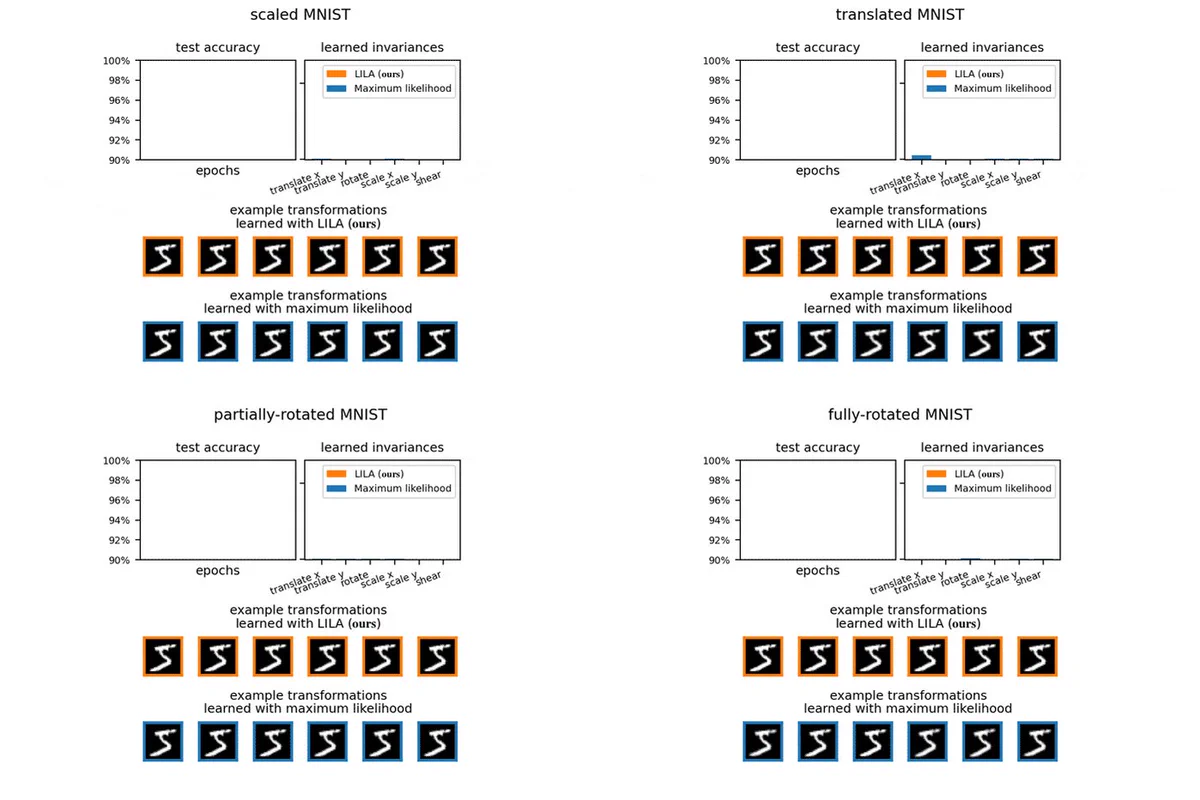
    Great thread by @tychovdo on our #NeurIPS2022 paper on learning invariances using Laplace approximations to the marginal likelihood. It works during training & without validation data. This is one of my favourite applications of Bayesian model selection for deep learning so far!
    @tychovdo
    Tycho van der Ouderaa
    @tychovdo
    Oct 14, 2022
    Deep neural nets with the right symmetries baked-in (e.g. translational equivariance in CNNs) perform better. But can we learn them from data? We can with differentiable Laplace approximations! 🌟New method: LILA🌟 with @a1mmer @vincefort, @gxr, @markvanderwilk. A thread👇 🧵1/10
    Image
    GIF
    1
  • @a1mmer
    Alexander Immer
    @a1mmer
    Jul 20, 2021
    To learn more about this work, come to our poster at #ICML2021 in ~1h. I hope the discussion at the poster will be as good as on Twitter :)
    @a1mmer
    Alexander Immer
    @a1mmer
    Jun 16, 2021
    In our #ICML2021 paper (arxiv.org/abs/2104.04975), we give a new method to select deep-learning models by using marginal likelihoods based on *training data* alone (no validation data required). The figure below shows: models with higher marginal likelihood are also more accurate.
    Image
  • @a1mmer
    Alexander Immer
    @a1mmer
    Jun 16, 2021
    In our #ICML2021 paper (arxiv.org/abs/2104.04975), we give a new method to select deep-learning models by using marginal likelihoods based on *training data* alone (no validation data required). The figure below shows: models with higher marginal likelihood are also more accurate.
    Image
    3
Advertisement
Advertisement