Summary: in this tutorial, you will learn about the queue data structure and how to implement a JavaScript queue.
Introduction to the Queue data structure #
A queue is an ordered list of elements where an element is inserted at the end of the queue and is removed from the front of the queue.
A queue works based on the first-in, first-out (FIFO) principle, which is different from a stack, which works based on the last-in, first-out (LIFO) principle.
A queue has two main operations:
- Insert a new element at the end of the queue, which is called enqueue.
- Remove an element from the front of the queue, which is called dequeue.
The following picture illustrates a queue:
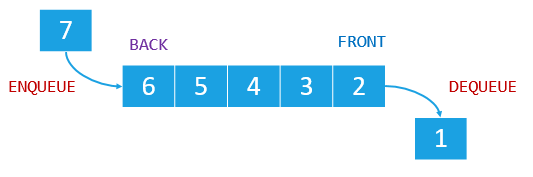
Another important operation of a queue is getting the element at the front called peek. Different from the dequeue operation, the peek operation returns the element at the front without modifying the queue.
The name queue comes from the analogy to a queue of customers at a bank. The customer who comes first will be served first, and the one who comes later is queued at the end of the queue and will be served later.

Implementing a JavaScript queue using an object #
The following shows how to implement the queue data structure using an object:
class Queue {
constructor() {
this.elements = {};
this.head = 0;
this.tail = 0;
}
enqueue(element) {
this.elements[this.tail] = element;
this.tail++;
}
dequeue() {
const item = this.elements[this.head];
delete this.elements[this.head];
this.head++;
return item;
}
peek() {
return this.elements[this.head];
}
get length() {
return this.tail - this.head;
}
get isEmpty() {
return this.length === 0;
}
}How it works.
First, initialize the object that stores the elements of the queue (elements) and two variables for tracking the head and tail in the constructor:
class Queue {
constructor() {
this.elements = {};
this.head = 0;
this.tail = 0;
}
//...
}Second, enqueue an element by adding it to the elements object to the end of the queue:
class Queue {
//...
enqueue(element) {
this.elements[this.tail] = element;
this.tail++;
}
//...
}Third, remove an element from the front of the queue:
class Queue {
// ...
dequeue() {
const item = this.elements[this.head];
delete this.elements[this.head];
this.head++;
return item;
}
//...
}Fourth, define the peek() method that accesses the element at the front of the queue:
class Queue {
//...
peek() {
return this.elements[this.head];
}
//...
}Fifth, get the length of the queue:
class Queue {
//...
get length() {
return this.tail - this.head;
}
//...
}The queue is empty when the length is zero.
Finally, define the isEmpty() method that returns true if the queue is empty:
class Queue {
// ...
get isEmpty() {
return this.tail - this.head;
}
// ...
}To create a new queue from the Queue() constructor function, you use the new keyword as follows:
let q = new Queue();To enqueue numbers from 1 to 7, you use the following code.
for (let i = 1; i <= 7; i++) {
q.enqueue(i);
}To get the number at the front of the queue, you use the peek() method.
console.log(q.peek()); // 1To get the current length of the queue, you use the length() method as in the following example.
console.log(q.length); // 7To remove the element at the front of the queue, you use the dequeue() method as follows:
// dequeue all elements
while (!q.isEmpty()) {
console.log(q.dequeue());
}Put it all together:
class Queue {
constructor() {
this.elements = {};
this.head = 0;
this.tail = 0;
}
enqueue(element) {
this.elements[this.tail] = element;
this.tail++;
}
dequeue() {
const item = this.elements[this.head];
delete this.elements[this.head];
this.head++;
return item;
}
peek() {
return this.elements[this.head];
}
get length() {
return this.tail - this.head;
}
get isEmpty() {
return this.length === 0;
}
}
let q = new Queue();
for (let i = 1; i <= 7; i++) {
q.enqueue(i);
}
// get the current item at the front of the queue
console.log(q.peek()); // 1
// get the current length of queue
console.log(q.length); // 7
// dequeue all elements
while (!q.isEmpty) {
console.log(q.dequeue());
}Summary #
- A queue is a data structure that works based on the FIFO principle.
Thank you for your feedback!
