-
-
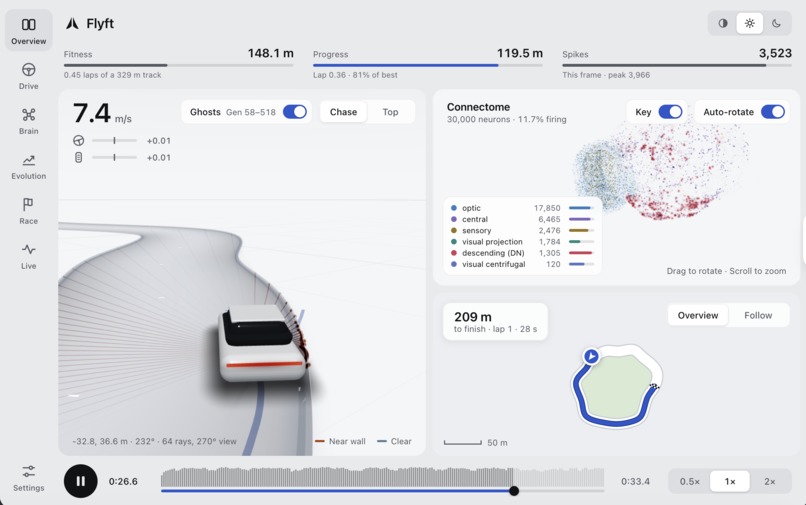
Main UI (Light)
-
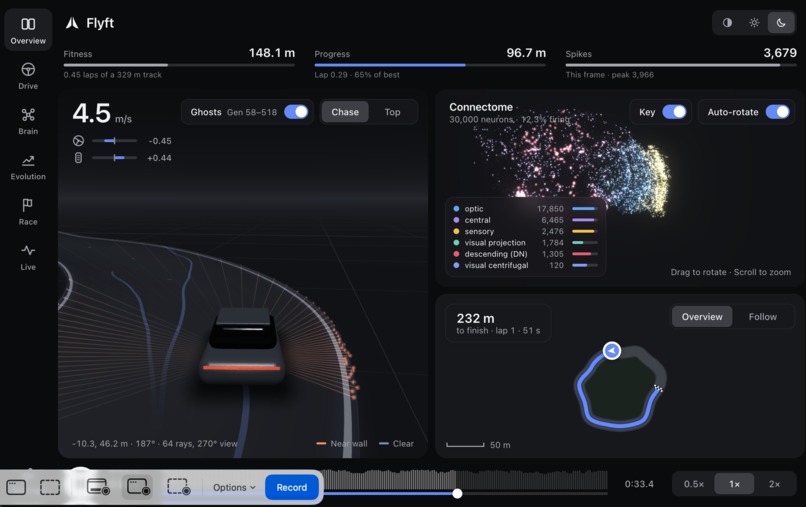
Main UI (Dark)
-
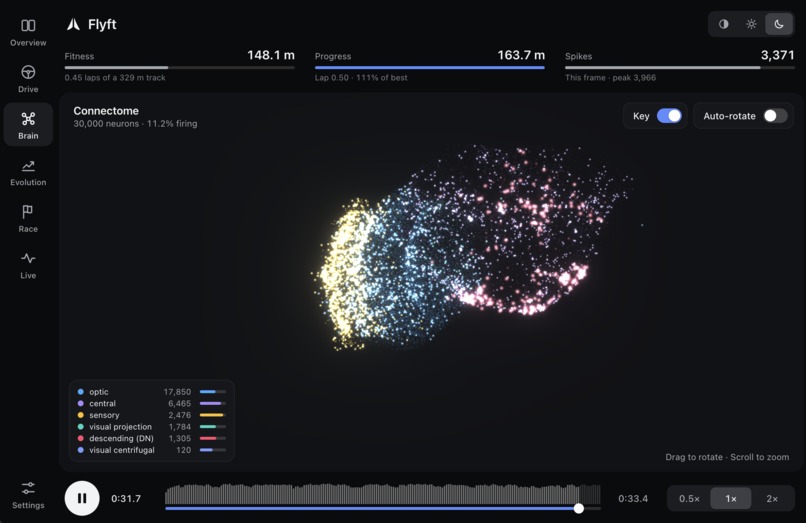
Fly Brain Neurons Firing
-
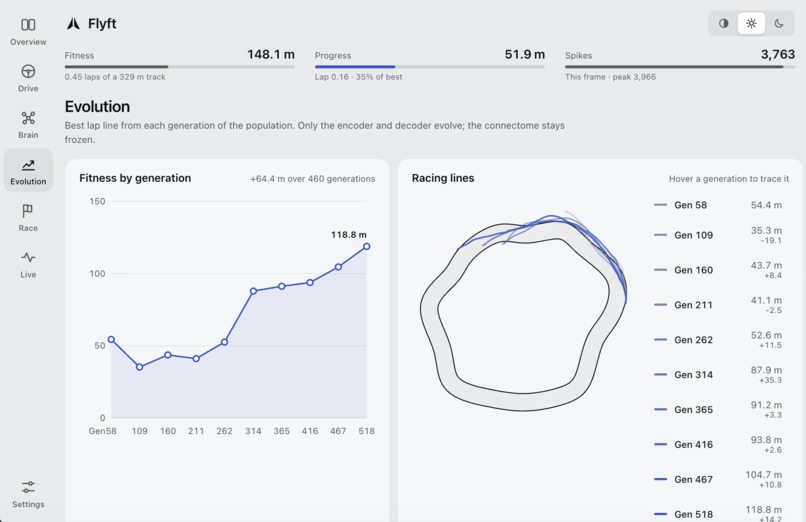
Training Results Over Time


Flyft
The complete FlyWire fruit fly connectome (139k neurons, frozen weights, real LIF dynamics) driving a car in a 2D simulator. A population of flies shares one brain; evolutionary strategies evolve only the sensory encoder (retina rays -> visual neuron currents) and motor decoder (descending neuron rates -> steering/throttle).
Inspiration
FlyWire gave the world something unprecedented: a complete synapse-level wiring diagram of an adult fruit fly brain. Most projects treat it as a map to study. We wanted to treat it as a machine to run. A fly's brain is a control system honed by hundreds of millions of years of evolution for fast visual navigation through clutter, and driving a car is, squinting a little, the same problem: look ahead, steer, manage speed. So the question became: if you keep the brain completely frozen, exactly as nature wired it, can you teach it to drive by evolving only the thin adapters that connect it to a new body?
What it does
Flyft loads the full FlyWire connectome and simulates it as a batched leaky integrate-and-fire (LIF) spiking network on the GPU, with every synaptic weight frozen. Around that fixed brain sit two small, evolvable pieces:
- an encoder that turns the car's retina rays and speed into input currents on the brain's visual neurons, and
- a decoder that reads spike counts from the descending neurons (the ones that would drive motor circuits in a real fly) into steering and throttle.
A whole population of cars shares the one brain and races around procedurally generated tracks in a vectorized 2D sim. Evolutionary strategies (OpenAI-ES, with an ARS elite variant and a (1+lambda) hillclimb mode) optimize only the encoder/decoder genome; the brain itself never learns a thing. The result: a real, unmodified fly brain completing laps.
Everything is watchable in the viz app: an HMI-style dashboard with a replay viewer, a 3D chase cam, per-generation ghost trails so you can see evolution happen, a live training dashboard, and a Race tab where you take the wheel and drive against the fly yourself.
How we built it
- Contract-first, in parallel. We froze every module interface in
docs/contracts.mdup front, then built data, brain, environment, interface, and infra on separate branches against synthetic fixtures, merging through an integration branch. - Brain:
fly/brain.pyis a batched LIF engine in PyTorch, population dimension first, running the ~139k-neuron connectome for a whole population in one set of tensor ops. A calibration pass searches for a global weight scale that lands the network in a plausible firing-rate band, so the frozen brain is neither silent nor seizing. - Body:
fly/env.pyis a fully vectorized 2D car sim with lidar-style rays, centerline progress rewards, and procedural 16-waypoint tracks. - Evolution:
fly/es.pyimplements OpenAI-ES with antithetic sampling, plus an ARS elite update, a hillclimb mode with 1/5-success sigma adaptation, and sigma pulses to hop out of basins on long stalls. Curriculum flags (--track-width,--max-speed,--episode-steps) let us start easy and anneal toward the real task. - Infra: island runs with different seeds and sigmas on an AWS GPU box
(provisioning and teardown scripts in
infra/), with champion replays and genomes banked in the repo. - Viz: a dependency-free JS app (
viz/) that renders replays, ghost trails, a WebGL 3D chase cam, live training telemetry, and the human-vs-fly race mode.
Challenges we ran into
- Waking the brain up. With naive input scaling the frozen connectome either stayed silent or blew up into runaway spiking. We had to calibrate a global synaptic scale against a target firing-rate range before any evolution could get traction.
- The fitness plateau. Vanilla ES stalled hard. We fought through it with reward shaping (crash penalties that actually cost progress, wall-graze costs, speed-scaled crash cost, lap-finish bonuses), the ARS elite update, hillclimb mode, sigma pulses on stalls, and a survival-then-speed curriculum.
- Making 139k neurons fast enough. Evolution needs thousands of rollouts, so the LIF step had to be ruthlessly batched; the whole population shares one brain simulation.
- Reproducibility. Bit-exact replay of training rollouts meant carefully decoupling the brain init seed from the ES sampling seed and threading RNG state through the recorder.
- The web being the web. Some hosts refused to serve raw binary replay files (we added a base64 fallback loader), and the 3D view had to degrade gracefully without WebGL float targets.
Accomplishments that we're proud of
- A real, complete animal connectome, weights untouched, drives a car around a track.
- The learnable surface is tiny: only the encoder and decoder evolve, and it still works.
- A GPU LIF engine that simulates the full 139k-neuron brain for an entire ES population at training speed.
- A viz suite we actually enjoy watching: ghost trails make the evolutionary progress visible generation by generation, and the Race tab makes the result tangible, because losing to a fruit fly is a memorable experience.
What we learned
- Reward shaping and curriculum beat algorithm tweaks. Most of our progress came from making dying expensive and the early task survivable, not from fancier optimizers.
- A frozen dynamical system is a usable computational reservoir: you can get meaningful control out of a brain you are not allowed to touch, if you learn the right way to talk to it.
- Spiking networks are operating-point machines. Calibration (firing-rate targets, input current clamps) mattered as much as architecture.
- Fixed interface contracts made parallel development actually work; integration was merges, not rewrites.
What's next for Flyft
- Generalization: evolve on families of tracks and test on unseen ones, and push the curriculum until the fly handles narrow, fast circuits without hand-holding.
- Better senses: richer retina models and letting evolution choose which visual neurons receive input, instead of a fixed grouping.
- Baselines: race the frozen connectome against a same-size random reservoir and a tiny trained MLP to quantify how much the fly's wiring actually helps.
- New tasks: same brain, different bodies. Parking, drone-style flight, and multi-car racing against other islands' champions.
- Public demo: host the live dashboard and race mode so anyone can lose to the fly.
Layout
fly/bundle.py- ConnectomeBundle data contractfly/config.py- all knobsfly/data.py- FlyWire download + preprocessingfly/brain.py- batched LIF engine (GPU)fly/env.py- vectorized 2D car simfly/interface.py- encoder/decoder genomefly/es.py- evolutionary strategies loopfly/record.py- best-episode replay captureviz/- replay visualizationinfra/- AWS provisioning + teardown
See docs/contracts.md for module interfaces. Planning artifacts live in the OpenSpec change
fly-brain-drives-car.


Log in or sign up for Devpost to join the conversation.