-
-
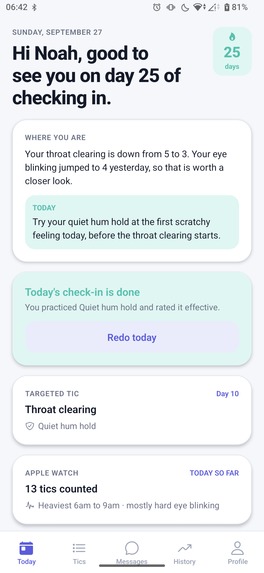
Patient home screen
-
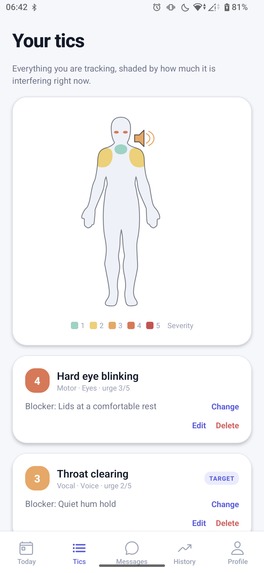
List and diagram of patient tics
-
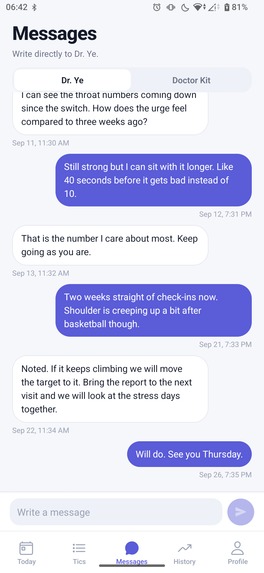
Patient-clinician messaging function
-
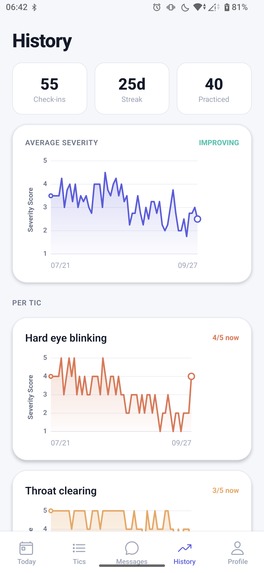
Patient history graphs
-
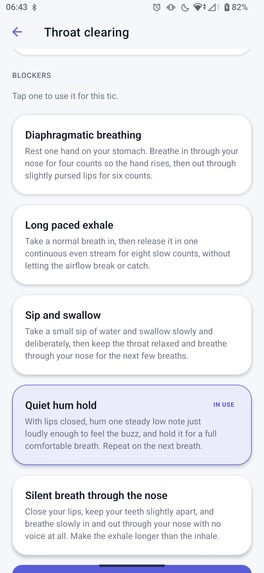
List of blockers for patient to choose
-
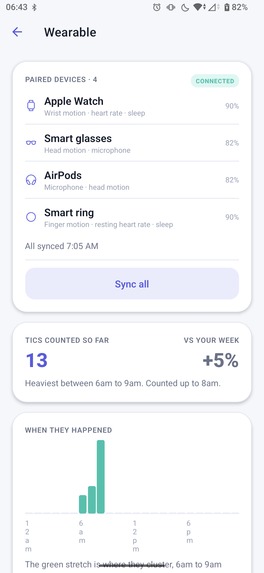
List of integrated patient wearables
-
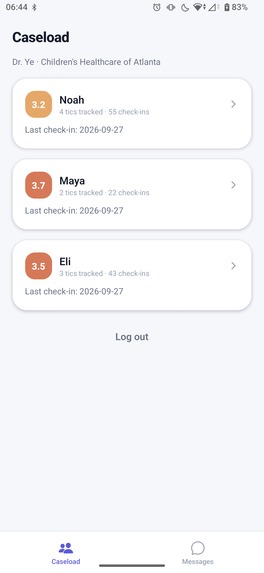
Healthcare provider patients view
-
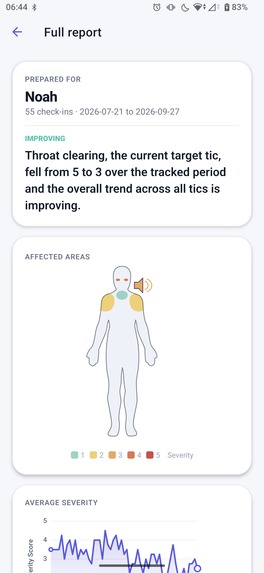
Full report for healthcare providor


Inspiration
TicTrack's primary inspiration comes from one of our team members, Noah. Noah is diagnosed with Tourette Syndrome, an incurable genetic disorder that is identified by the prolonged presence of motor and vocal tics. Tics are involuntary movements or sounds that can be highly disruptive in a person’s life, potentially causing pain, limitations in activity, or social detriments. When Noah underwent comprehensive behavior intervention for tics (CBIT, the primary treatment for tics) he experienced many limitations in current solutions. These included high costs, time-inefficiencies, and an overall low level of engagement. TicTrack seeks to improve the treatment experience and making CBIT accessible to all individuals who experience tics.
What we learned
To create a successful product, our team went deep into what makes CBIT effective. In general, CBIT identifies blockers - movements that are similar, yet less disruptive compared to tics. The patient practices acting upon the alternative movement whenever they feel an urge for the corresponding tic, reducing the detriment of Tourette Syndrome. Crucially, we noticed that effective blockers can vary greatly between different patients. Hence, we sought to create an adaptive treatment method that caters to the patient's unique, evolving needs. TicTrack leverages GLM-5 to match a patient's tics to a curated selection of personalized blockers. For each tic, the patient can choose the a treatment that fits them best. Furthermore, they can always change the description of the tic or regenerate new blockers. As the patient practices the blocker movements and provides feedback on the efficacy of the treatment, they can view their progress and streak within the app to stay motivated.
How we built it
We built TicTrack using React Native, Express, MongoDB Atlas, Expo, Android Studio, Node.js, and TypeScript. GitHub was our preferred version control and production pipeline service, and Cursor + Grok were the primary AI tools for development. We began by mapping the user journey on a whiteboard. Everything from the login pages, onboarding process, CBIT loop, and potential expansions were drawn up. Afterwards, we divided up the development of the app according to each team member's strengths. Using a research-backed lists of tics, we integrated GLM-5 to turn a user's description of their symptoms into individual tic entries while also allowing users the freedom to create their own entries if necessary. Additionally, we implemented local rule-based fallbacks to ensure that core experiences work even without API credentials or successful model requests. To make our application more accessible, we implemented voice input. Using ElevenLabs' speech recognition with their Scribe v2 model, the user can describe their symptoms in speech rather than typing everything out by hand. Every design decision we made was connected to our core missions of personalization and accessibility.
Challenges we ran into
Initially, our project only stored user data locally. This prevented the patient and healthcare provider from being able to view their progress and limited personalization. To remedy this, we created a backend server with Express and Node.js for the client React Native app to connect to. The frontend makes API calls to the backend to store the user’s data on a MongoDB database, allowing the user to sign into their account later while also allowing healthcare providers to view their patients’ progress. Additionally, we changed the way user passwords were stored. Now, a salted hash value is used instead of plaintext to better align with conventional security practices.
What it does
Broadly speaking, our app provides an accessible way to practice CBIT while allowing healthcare providers to be better informed on their patients’ condition and progress. Patients describe their symptoms, TicTrack identifies specific tics and the corresponding blockers that may combat them, then provides a daily practice loop that keeps patients engaged through concise, effective blocker trainings. Our app lets patients track their progress through beautiful visualizations, personalize their treatment plan by adding/removing tics and picking a blocker that best fits their style, and connects patients to their clinicians (or a personalized chatbot) through an integrated messaging system. Furthermore, patients can identify unhealthy or disruptive habits that worsen tics. Such habits may include caffeine usage and sleep quality.
Accomplishments that we're proud of
- Voice to text parsing allows the user to effortlessly describe and categorize their symptoms during the onboarding process.
- With a demo for fitness trackers and smart watch integration, our app allows for long-term recognition of habits that may worsen a patient’s tics.
- We provide healthcare providers an effective way to monitor and assist their patients progress.
- Engaging graphics allow users to easily synthesize their progress, motivating them to continue treatment and encouraging them to share their progress with friends and family.
What's next for TicTrack
In the future, we plan to integrate our app with fitness trackers and smart watches, allowing users to recognize correlations between sleep, exercise, and tic prevalence. Furthermore, we envision testing our product in our local Georgia Tech community to gauge interest and measure efficacy on real, human data.
Built With
- android-studio
- cursor
- elevenlabs
- expo.io
- express.js
- grok
- javascript
- mongodb
- node.js
- react-native
- typescript
- z.ai




Log in or sign up for Devpost to join the conversation.