Rainplace

1.5M ratings
277k ratings

See, that’s what the app is perfect for.

Sounds perfect Wahhhh, I don’t wanna

Insta links-

I’ve made an Insta account where I share bits of animation from my class demo, industry & personal works-

https://www.instagram.com/choochoo.animates

And this one dedicated to the production of ‘My Little WORLD’, where my heart really placed, a 2d feature that I began in 2000 and ongoing to this day (…ummm it will get there one day :D) -

https://www.instagram.com/mylittleworld.movie

(The above short was made from a run cycle in class demo, a way for me to demonstrate how expressive storytelling can be, where animation & film unite).

bears run short film class demo run cycle

Essence of a Movement ~

In the animating process, one can inadvertently take wrong turns by emphasizing too many aspects of a movement from a technical perspective. Similar to composing a painting, one takes a step back to view the overall image and adjust the various aspects from here, keeping in mind the initial intention. For animation, it is the playback during pencil-testing.

In a composition, there is an order of visual priority with emphasis to one focal point.  For movement, there is one leading force at a time, transferring from one body compartment to another with the communicating emotion as anchor point.

The animating process is a sculpting motion process.  It takes readjustments based on how movement feels.

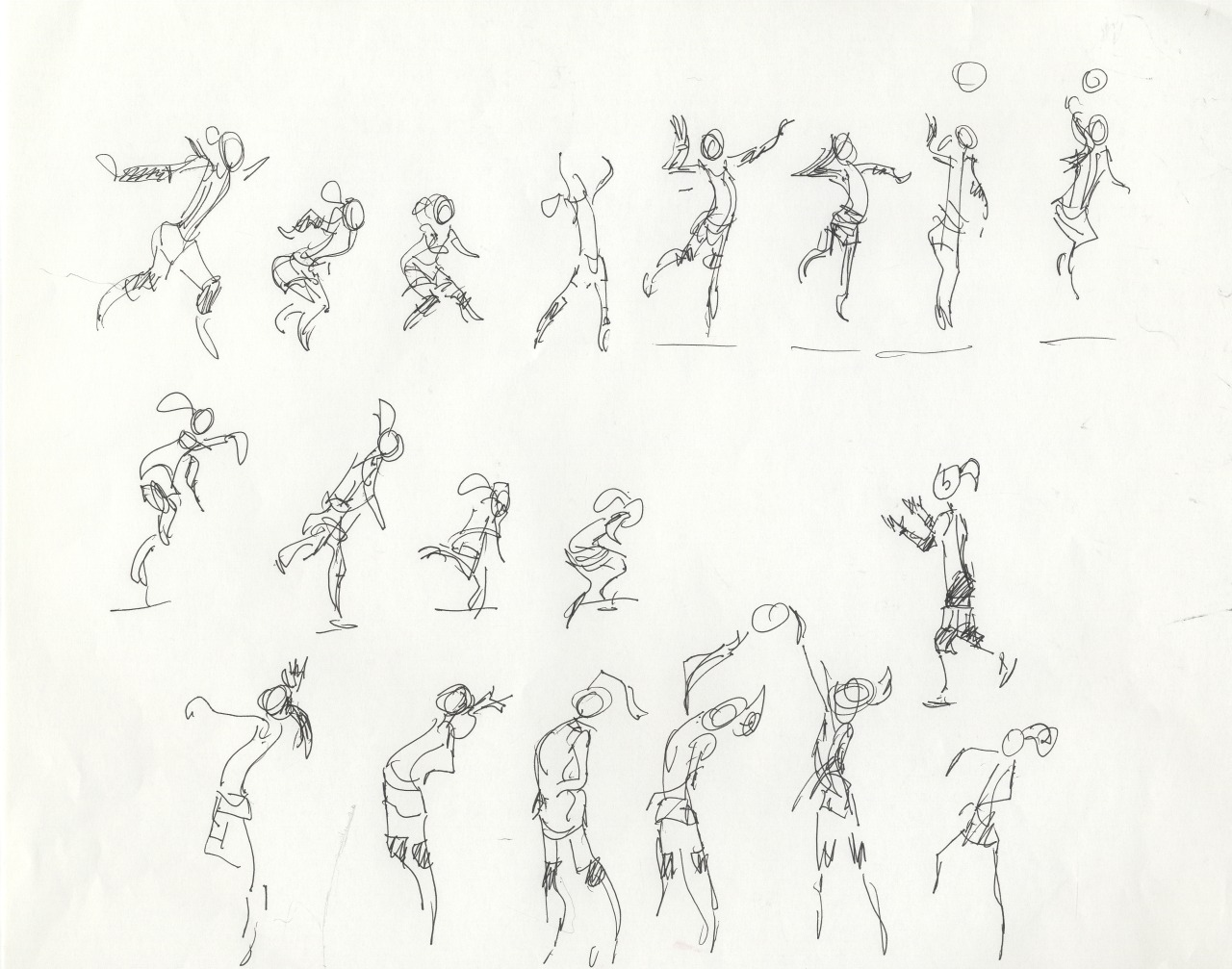
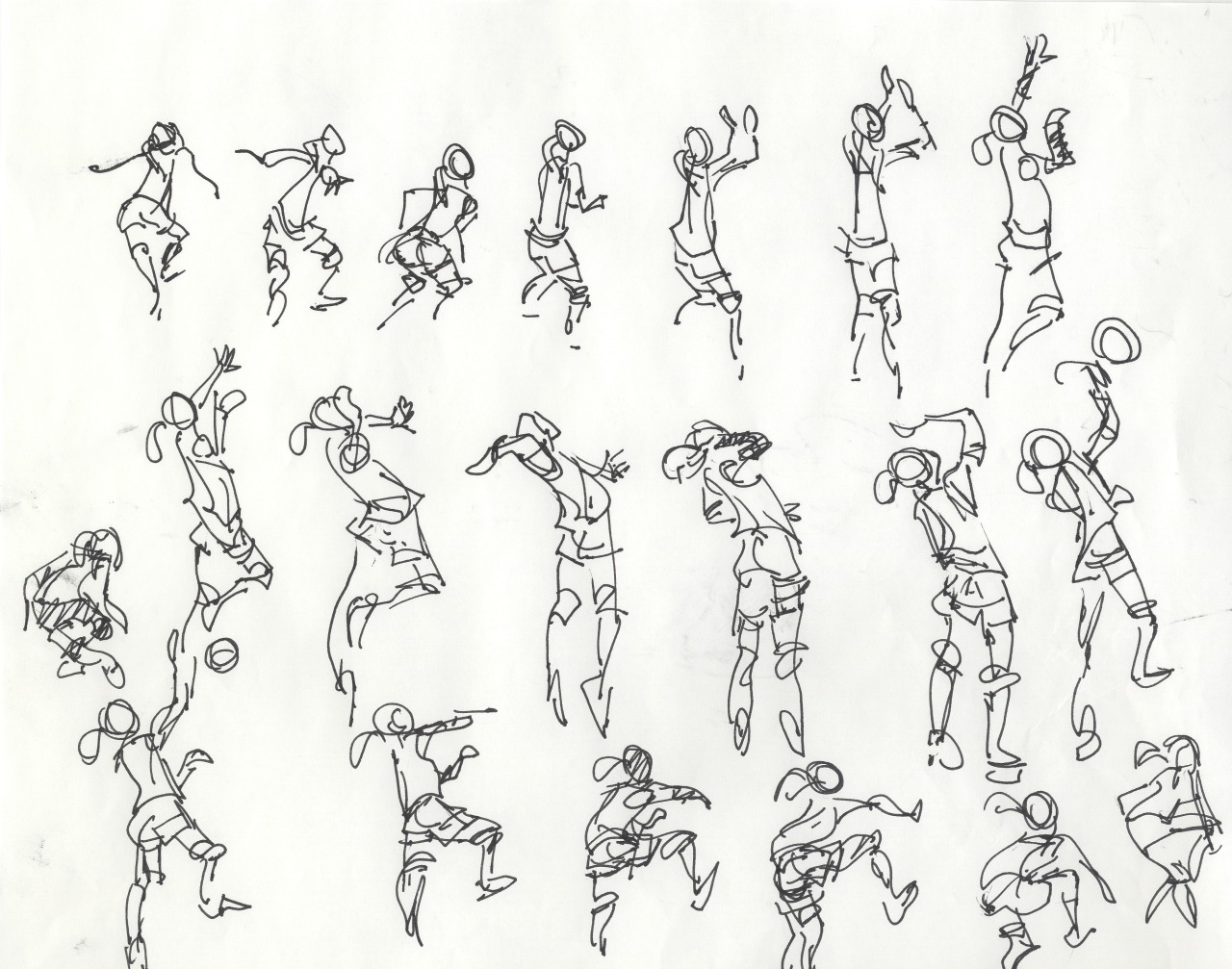
For example, I meant to communicate power & elegance in the volleyball spike.  The elegance emerged in the rough pass.  In 1st tie-down, I got carried away with emphasis to the power of the legs.  The movement now has a conflict of 2 focal points, the spiking arm and the powerful leg-jump.  Power is achieved but grace disappeared.  Adjustment is needed with toning down the graphic look of jumping legs. 

image
image

Here, Some reference study prior to animating.

rough animation leading force animation process

Rough Pass

When I was in college years, my mentors often said- ‘Keep it rough’. But a young person’s tendency is to always want to make it clean, the way it would appears finally on screen.

Life breathe even when it appears to be still. To inject this essence into an animated movement, the initial pass need to stay in ‘feel’ mode, allowing the pencil to search through non-committal lines, then gently locking into its intended positioning.  

This is why animation takes several passes, with each time becoming more focus until reaching final screen appearance.

There is a wonderful insight from Ollie Johnston- ‘Concentrate on drawing CLEAR, not clean.’

rough pass rough animation workflow

Building Repeating Patterns in Movement ^^

A single movement pattern can be built and evolve into a more complex appearance through slight variations on its unfolding with strategic placements. Movement choreography is a lot like symphonic music- how a simple set of 4 musical notes can grow into a grand symphonic movement through a series of developments.

I found this wonderful parallel from viewing Leonard Bernstein Young People’s Concerts- What Make Music Symphonic (You can find on youtube).   A phrase of music begins building by repetition, repeating itself. Then it goes into variations. The different between repetition and variation is something has to change, not repeating exactly. It repeats but changes by being louder, softer, faster, slower, backward or upside-down pattern.  It can overlay on top of each other with different starting point, multiplying its layers, building by adding but also building by subtracting.

Relating these variations to movement, a pattern can starts at different positioning & frame; through variation on timing it can unfolds faster or slower, scaling for size variations or flip direction of movement. The result if build correctly will not feel repetitious but fresh, harmonic and symphonic visually.

In younger days, if I was to animate a school of fish, I would lean to animate the entire school, feeling that each fish is its own and that would be purest of expression.  I avoided loops, cycles and would rather unfold them forward with each step its own.  I still do for the most part.  But I’ve also come to terms that nature is filled with repetitions and variations as she evolves.

Sometimes a pattern is in need to be repeating enough time to be fully appreciated. It can develop and grow into something completely different.

loop cycle fish

Generating Fluid Animation Drawings ^^

(It has been a very long time since I post anything here.  I thought the site has gone to cobweb and forgotten.  But it seems you are here and new readers as well. Thank you very much for your very kind interest; I do feel most grateful.  You inspired me to write this new post… and maybe I’ll try to be more regularly much as I can)  :D

Animation is a language that communicates through motion.  Aside from its graphics natures, animated movements include the traveling distances of space in 24 fps time.  The flow of a movement is a collection of relating single instances. The instances are made of drawings but with no individual drawing can take sole importance. All the drawings are important collectively, regardless being keys, extremes or inbetweens.  Together in their successive orders of unfolding, they are ONE movement, expressing ONE particular moment in time.

To arrive at this unison, each new drawing must be shaped by the feel of movement that has been formed by the preceding drawings.  

The feel to a flow of movement must be the KEY building point to every part of the animating process, from thumbnailing, to rough pass, tie-down, all the way to final clean-up.

To be more specific in the animating process, roll the preceding drawings, to feel the movement- then to strike each new line.

For a movement to be fluid, avoid striking a new drawing statically on its own without relating it to the preceding drawings.

(Above is an example of my tie-down process from the feature ‘My Little WORLD’ that I’ve been very busy with.  The preceding tie-down drawings are placed underneath, then the rough drawing to be tie-down, then striking its tie-down on top.)

mylittleworldmovie tie-down Animating

The Organic Speed-

The technical perfection of timing a scene including slow in & slow out doesn’t guarantee that the animation is now has sprung to life.  While mechanically perfect, the texture of the animated movement might still appear clockwork and mechanical.  For life to be invoked, the speed of movement has to feel organic and natural.

This organic texture is very personal and an essential quality that defines an animator.  There is no technique that can address this organic speed because it lies beyond the mechanical aspect of movement.  It is a ‘feel’ that the eye senses a movement.

However, there are ways to coax the organic speed into the movement by consciously ‘feel’ a designated force prior to animating, then allowing it to subconsciously come across through the animating process by constantly referring to this ‘feel’ as a anchor.

(Here, study sketches for the scene above in ‘My Little WORLD’)

image
image
image
timing mylittleWORLD animal drawings sparrow

On Slow-in & Slow-out-

In a way, slow-in & slow-out is part of the larger ‘timing’ principle, placing attention to the exhilaration and deceleration of movement.  While simple in nature, it is often overlooked especially at the earlier stages of learning to animate.  Same to the early days of animation, the spacing of drawings tend to be in equal increment, resulting in unnatural one-speed movement from start to stop.

In movement dynamics, a mass takes time to pick up speed and same to slowing down.  It is an interaction of cause and effect between force and form.

From a physical outlook, slow-in & slow-out yield information to the strength of force and gravity.  And from a deeper sense, it is an important component to performance. It brings grace to movement, carrying emotional info through the control of exhilarating and decelerating duration.  Imagine a single musical note is strike on a piano. The way a note lingers and fades away is rooted in the force that strikes it.  

It is good to keep in mind to vary and contrast the starting in relation to the stopping speed.  For example, if the action is slow to exhilarate then good to have a quicker decelerate (instead of same ratios to starting and stopping).

Most critically, slow-in & slow-out has to stay true to reflect the interplay of physical forces or its expressiveness would be hollowed.  

image
animation principles slow-in & slow-out ballet timing