





In This Article
The world of cryptocurrencies can be technical, complex, and sometimes overwhelming for those starting from scratch. In this section, we have compiled a cryptocurrency glossary with key definitions to understand this exciting technology.

Cryptocurrency Glossary
#
100x: A 100x refers to an increase in value by 100 times, representing a 10,000% increase.
1,000x: A 1,000x refers to an investment that increases in value by 1,000 times, representing a 100,000% increase.
51% Attack: A 51% attack is a vulnerability in blockchain networks where a single entity or group gains control of more than half of the network’s mining power or hash rate, allowing the attacker to manipulate the blockchain.
A
Account Abstraction: Account abstraction is a blockchain concept that allows users to manage their assets with flexible, programmable smart contract wallets instead of traditional externally owned accounts tied to a single private key.
ADX Indicator: The Average Directional Index (ADX) is a popular technical analysis tool used by both traditional and cryptocurrency traders.
Airdrop: An airdrop is a distribution of free cryptocurrency tokens or coins to wallet addresses, typically used by blockchain projects to build awareness, reward users, or decentralize token ownership.
All-Time High (ATH): In cryptocurrency, an all-time high (ATH) refers to the highest price a digital asset has ever reached in its trading history, often signaling strong market momentum and investor interest.
All-Time Low (ATL): An All-Time Low (ATL) refers to the lowest price a cryptocurrency has ever reached since it began trading on public exchanges.
Altcoin: Any cryptocurrency that is not Bitcoin.
Altcoin Season: Refers to a period in the cryptocurrency market when altcoins experience significant gains and outperform Bitcoin. A common way to measure this is if 75% of the top 50 cryptocurrencies by market cap perform better than Bitcoin over the past 90 days.
Arbitrage: Arbitrage trading is a strategy that exploits price differences of the same asset across different markets or exchanges to generate profit. Traders simultaneously buy an asset at a lower price in one market and sell it at a higher price in another, capitalizing on the temporary price discrepancy.
Atomic Swap: An atomic swap is a peer-to-peer cryptocurrency trading method that enables the direct exchange of different cryptocurrencies across separate blockchain networks without the need for intermediaries or centralized exchanges.
Avalanche: A high-performance blockchain featuring a unique tri-chain architecture (X-Chain, C-Chain, and P-Chain). Avalanche supports smart contracts, decentralized applications (dApps), and custom blockchain networks called subnets, making it versatile for various use cases in decentralized finance (DeFi) and enterprise solutions.
B
Bear Market: In cryptocurrency, a bear market refers to a prolonged period of declining prices, typically marked by a drop of 20% or more from recent highs, accompanied by negative investor sentiment and reduced market activity
Bitcoin (BTC): Bitcoin is a decentralized digital currency created in 2009 that operates on a peer-to-peer network without the need for intermediaries like banks or governments. It uses blockchain technology to record and verify transactions, ensuring security and transparency.
Bitcoin ATM: Sometimes referred to as a BTM or Crypto ATM, a Bitcoin ATM is an internet-connected kiosk resembling a traditional cash ATM, but allows users to buy or sell Bitcoin and other cryptocurrencies using cash, debit cards or crypto wallets.
Bitcoin Cash (BCH): Bitcoin Cash (BCH) is a hard fork of Bitcoin. It functions as a peer-to-peer electronic cash system with faster transactions and lower fees than Bitcoin.
Bitcoin Dominance Index: Bitcoin Dominance Index measures Bitcoin’s share of the total cryptocurrency market capitalization. It shows what percentage of the overall crypto market value is made up by Bitcoin compared to altcoins.
Bitcoin ETF: A Bitcoin ETF (Exchange-Traded Fund) is an investment vehicle that tracks the price of Bitcoin and trades on traditional stock exchanges.
Bitcoin Halving: The Bitcoin halving is a programmed event in the Bitcoin network that occurs approximately every four years, reducing the reward miners receive for validating new blocks by 50%. This process is designed to control Bitcoin’s inflation rate and maintain its scarcity.
Bitcoin Lightning Network: The Bitcoin Lightning Network is a second-layer protocol built on top of the Bitcoin blockchain that enables fast, low-cost, and scalable off-chain transactions.
BitPay: BitPay is a cryptocurrency payment service provider founded in 2011 and headquartered in Atlanta, Georgia. It offers a platform that allows merchants to accept Bitcoin and other cryptocurrencies as payment while receiving settlements in fiat currency or crypto.
Block: A block in cryptocurrency is a fundamental unit of a blockchain that contains a group of verified transactions. The “Block” in blockchain consists of data such as timestamps, unique cryptographic hashes, transaction data, and more.
Blockchain: A blockchain is a decentralized, distributed digital ledger that records transactions across a network of computers.
Blockchain Interoperability: Blockchain interoperability refers to the ability of different blockchain networks to seamlessly communicate, exchange data, and transfer assets, enabling cross-chain functionality and fostering a more connected decentralized ecosystem.
Blockchain File Storage: Utilizes a decentralized network of computers to break down, encrypt, and distribute data across multiple nodes, ensuring enhanced security, immutability, and resistance to censorship, rather than storing files directly on the blockchain itself, or centralized servers as was the traditional approach.
Blockchain Tokenization: Blockchain tokenization is the process of converting rights to an asset into a digital token on a blockchain network. This digital representation allows for fractional ownership, increased liquidity, and efficient transfer of assets.
Blockchain Trilemma: The blockchain trilemma is the challenge that blockchain networks face in trying to achieve security, scalability, and decentralization all at once, as improving one often means compromising another
Block Explorer: A block explorer is a web-based tool that allows users to search, view, and analyze data on a specific blockchain network
Block Reward: A block reward in cryptocurrency is an incentive given to miners for successfully validating and adding a new block to the blockchain.
Bollinger Bands: Bollinger Bands is a technical analysis tool consisting of three lines plotted on a price chart. The middle line is typically a 20-day simple moving average (SMA), while the upper and lower bands are set two standard deviations above and below this SMA. These bands expand and contract based on market volatility.
Bot Trading: Bot trading refers to the use of automated software programs to execute trades on behalf of users.
Brave Browser: Brave Browser is a free, open-source web browser focused on privacy and security.
Bull Market: A crypto bull market is a period when digital asset prices increase by over 20% and stay elevated, reflecting investor confidence.
C
Candlestick Chart: A candlestick chart is a visual representation of price movements for financial assets over specific time periods. Each candlestick displays four key data points: the opening price, closing price, highest price, and lowest price.
Central Bank Digital Currency (CBDC): A central bank digital currency (CBDC) is a digital form of fiat money issued and regulated by a country’s central bank. It serves as a direct liability of the central bank and functions as legal tender.
Centralized Exchange (CEX): An online platform operated by a single organization that acts as an intermediary to facilitate the buying, selling, and trading of cryptocurrencies, holding users’ funds in custody and managing transactions on their behalf.
Circle (USDC): Circle USDC (USD Coin) is a digital dollar stablecoin issued by Circle, a financial technology company.
Circulating Supply: Circulating supply is the total number of coins or tokens of a cryptocurrency that are currently available for trading and use in the market.
Cloud Mining: Cloud mining is a method of cryptocurrency mining where individuals rent computing power from remote data centers instead of owning and operating their own mining hardware. This model makes mining more accessible to a broader audience, though it comes with its own set of risks and potential drawbacks.
Coinbase: Coinbase Exchange is a leading cryptocurrency trading platform based in the United States.
Cold Storage: Cold storage refers to the practice of storing private keys offline, away from internet-connected devices. This method involves keeping the cryptographic keys that control access to digital assets in a secure, isolated environment to protect them from online threats such as hacking, malware, and phishing attacks.
Crypto Broker vs Exchange: A crypto broker acts as an intermediary, offering a simplified platform for users to buy and sell cryptocurrencies at prices set by the broker, while a crypto exchange provides a marketplace where traders can directly interact with each other, buying and selling cryptocurrencies based on current market prices.
Crypto Derivatives: Crypto derivatives are financial instruments that derive their value from underlying cryptocurrency assets. These contracts allow traders to speculate on price movements of digital currencies without owning them directly. Common types include futures, options, and perpetual contracts.
Crypto Exchange vs Crypto Wallet: A crypto exchange is a platform that facilitates the buying, selling, and trading of cryptocurrencies, acting as a marketplace for transactions, while a crypto wallet is a tool designed for securely storing, sending, and managing digital assets, giving users full control over their private keys and funds.
Crypto Staking: Crypto staking is the process of participating in a blockchain network, specifically those using a proof-of-stake (PoS) consensus mechanism, by locking up a certain amount of cryptocurrency. This locked cryptocurrency is used to validate transactions and secure the network.
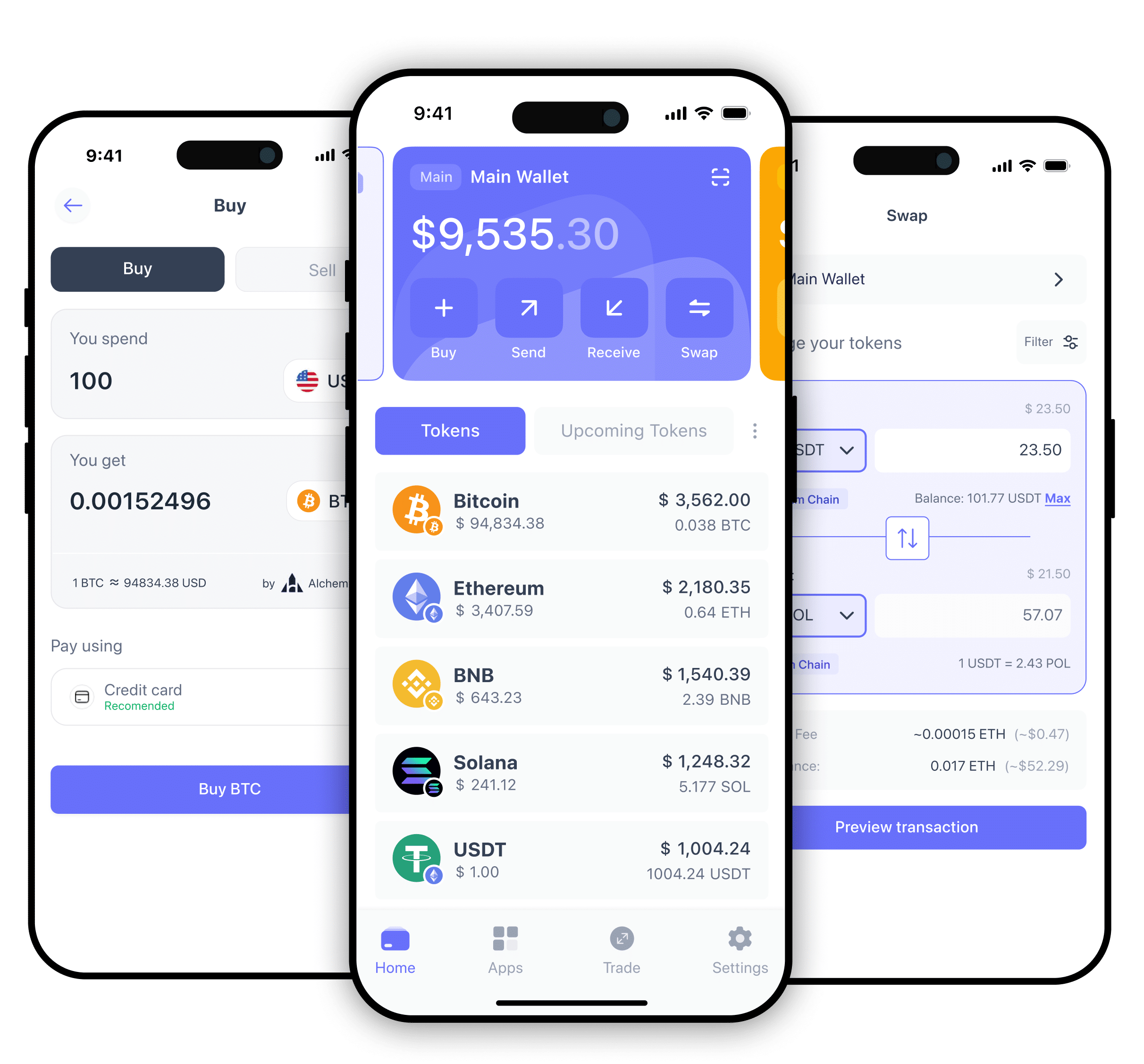
Crypto Wallet: A crypto wallet is a digital tool that allows users to interact with blockchain networks and manage their cryptocurrency holdings. It stores the public and private keys necessary to access, send, and receive digital assets.
Custodial Wallet: A custodial wallet in cryptocurrency is a type of digital wallet where a third-party service provider, such as a cryptocurrency exchange or financial institution, holds and manages the private keys on behalf of the user.
D
Decentralized Application (DApp): A software program that runs on a blockchain or peer-to-peer network, operating without a central authority and often powered by smart contracts to provide enhanced functionality, security, transparency, and user autonomy.
Decentralized Autonomous Organization (DAO): A DAO is a blockchain-based organization governed by code and smart contracts. Decisions are made collectively by its members, typically through token-based voting, rather than by a central authority.
Decentralized Finance (DeFi): Decentralized Finance (DeFi) is an innovative financial system that operates on blockchain technology to provide peer-to-peer financial services without traditional intermediaries like banks.
Decentralized Physical Infrastructure Networks (DePIN): DePIN (Decentralized Physical Infrastructure Networks) refers to blockchain-based systems that manage and operate real-world infrastructure in a decentralized manner. This can encompass technologies such as mobile networks, internet infrastructure, ride-sharing, mapping, and more.
DeFi Wallet Scam: A DeFi wallet scam is a fraudulent scheme designed to exploit users in the decentralized finance space, typically by tricking them into revealing sensitive information or interacting with malicious smart contracts, ultimately leading to the theft of cryptocurrencies or digital assets.
Dogecoin (DOGE): Dogecoin (DOGE) is a popular cryptocurrency that started the meme coin phenomenon. Starting as a joke, it features a Shiba Inu dog as its logo, based on the “Doge” internet meme. Dogecoin has gained a loyal community of supporters who often use it for online tipping and charitable donations, and it has received attention from high-profile figures like Elon Musk.
Double-Spending: Double spending in cryptocurrency refers to the fraudulent act of using the same digital coins for multiple transactions. This vulnerability arises from the ease of duplicating digital information. Bitcoin was the first digital currency to solve the double-spending problem, which aided the cryptocurrency’s success.
E
Encrypted File Sharing: The process of transmitting or storing digital files by scrambling their content into an unreadable format (ciphertext) using a cryptographic key, which ensures that only the intended, authorized recipient holding the correct key can decrypt and access the original data.
ERC- 20: The technical token standard on the Ethereum blockchain that defines a common set of rules for creating fungible tokens, ensuring they are interoperable and can interact seamlessly with wallets, exchanges, and DeFi applications.
ERC-721: The specific Ethereum standard that provides a set of rules for creating unique, non-fungible tokens (NFTs), enabling verifiable ownership and transfer of individual digital assets like art, collectibles, and in-game items.
eSports Tokenization: The process of converting assets within the eSports ecosystem, such as in-game items, fan engagement opportunities, or team ownership into digital tokens on a blockchain.
Ethereum (ETH): Ethereum is a decentralized blockchain platform that enables the creation and execution of smart contracts and decentralized applications (dApps). Founded in 2015 by Vitalik Buterin, it uses its native cryptocurrency, Ether (ETH), for transactions and network operations
Ethereum Virtual Machine (EVM): The EVM is a decentralized, Turing-complete computation engine that processes and executes smart contracts on the Ethereum blockchain, ensuring consistent and verifiable state changes across all network nodes.
F
Flash Loan: A flash loan is a type of DeFi loan that is borrowed and repaid within a single blockchain transaction, requiring no collateral. If the loan isn’t repaid instantly, the entire transaction is automatically reversed.
FUD (Fear Uncertainty & Doubt): It refers to the spread of negative or misleading information to influence emotions rather than facts. In crypto and financial markets, FUD often triggers panic selling and short-term volatility before accurate information restores confidence.
G
Grayscale Investments: Grayscale Investments is a U.S.-based digital asset manager that offers regulated investment products providing exposure to cryptocurrencies like Bitcoin and Ethereum. Founded in 2013, it allows investors to access digital assets through trusts and ETFs without directly holding or managing crypto.
H
Hashrate: The measurement of how many cryptographic calculations a blockchain network or mining device can perform per second, reflecting its computational power and mining efficiency.
Hashrate Calculator: an online tool that estimates a miner’s potential Bitcoin mining profitability by taking their hardware’s hashrate and electricity cost (per kWh), along with current network difficulty, to project net BTC returns and ROI.
Hot Wallet: A software-based cryptocurrency wallet that is connected to the internet, allowing for easy and frequent transactions.
I
Index Fund in Crypto: A crypto index fund is an investment product that tracks a group of cryptocurrencies (like the top coins by market cap), letting you invest in the overall crypto market with one single investment instead of buying each coin separately.
J
K
KYC (Know Your Customer): Know Your Customer (KYC) is a mandatory process used by financial institutions and cryptocurrency exchanges to verify the identity of their clients. It involves collecting and validating personal information such as name, address, date of birth, and government-issued identification. Its aim is to help prevent financial crimes, ensure compliance, and assess customer risk profiles.
L
Liquid Restaking Token (LRT): A secondary token issued to a user that represents their restaked assets, allowing them to earn additional rewards while keeping their capital liquid and tradeable within the DeFi ecosystem.
Liquid Staking: A process where you stake your cryptocurrency to secure a network and receive a tradeable Liquid Staking Token (LST) in return, allowing you to earn staking rewards while maintaining the ability to use your capital in other DeFi applications.
Liquid Staking Derivatives (LSD): A financial instrument, often issued as a tradeable token, that represents a user’s staked assets, providing a way to earn network rewards while maintaining the flexibility to use that capital in other DeFi applications.
M
Mempool: A Mempool is a temporary storage area within each blockchain node where unconfirmed transactions wait to be validated and added to a block.
Metaverse: A shared, immersive digital universe where people interact, socialize, work, and play using virtual and augmented reality technologies.
Multisig: Multisig, or multi-signature, is a security feature in cryptocurrency that requires approval from multiple private keys to authorize and execute a transaction.
N
Node: A Node is a computer or device that connects to a blockchain network, helping to store, verify, and share transaction data while ensuring the network’s security and decentralization.
O
P
Paper Wallet: A paper wallet is a physical document containing a cryptocurrency’s public address and private key, typically printed on paper. It serves as an offline storage method for digital assets, often including QR codes for easy scanning.
Private Key: A secret, alphanumeric code that proves ownership of a user’s cryptocurrency and allows them to authorize transactions, acting as a cryptographic password for accessing and managing their funds.
Proof of Stake (PoS): Proof of Stake (PoS) is a consensus mechanism used in blockchain networks to validate transactions and create new blocks. In this system, validators are chosen to confirm transactions and add blocks based on the amount of cryptocurrency they hold and are willing to “stake” as collateral.
Proof of Work (PoW): Proof of Work (PoW) is a consensus mechanism used in blockchain networks to validate transactions and create new blocks. In this system, miners compete to solve complex cryptographic puzzles, expending computational power and energy.
Public Key: An address, derived from a private key, that users share to receive funds and that is openly visible on the blockchain, working with the corresponding private key to enable secure transactions.
Q
R
Real-World Assets (RWAs): Real World Assets (RWAs) in crypto are digital tokens that represent ownership or rights to tangible or intangible assets existing outside the blockchain. These can include things like real estate, commodities, art, stocks, bonds, currencies, and more.
Ripple (XRP): Ripple XRP is a digital asset and cryptocurrency that operates on the XRP Ledger, a decentralized blockchain platform. XRP serves as the native token of the network, facilitating fast and low-cost cross-border transactions.
S
Scaling: Scaling, or blockchain scaling refers to various methods and technologies designed to increase a blockchain network’s capacity to process more transactions quickly and efficiently without compromising its core principals of decentralization and security.
Stablecoin: A stablecoin is a type of cryptocurrency designed to maintain a stable value relative to a specific asset, typically a fiat currency like the US dollar. Stablecoins combine the benefits of blockchain with the price stability of traditional currencies. The most popular examples are Tether (USDT) and Circle’s USDC which are pegged in value to the US Dollar and Paxos Gold (PAXG), which is pegged to the price of gold.
T
Tether (USDT): Tether (USDT) is the largest stablecoin by market cap. Pegged to the US dollar at a 1:1 ratio, each USDT is theoretically backed by one US dollar held in reserves by the issuing company. Tether aims to provide stability in the volatile cryptocurrency market, allowing users to transact without the price fluctuations typical of other cryptocurrencies.
Tron (TRX): Tron (TRX) is a decentralized blockchain platform and cryptocurrency launched in 2017. It is a layer 1 blockchain network known for its low fees, high throughput, and smart contract functionality.
U
Unspent Transaction Output (UTXO): A UTXO (Unspent Transaction Output) is a fundamental concept in blockchain technology, particularly in cryptocurrencies like Bitcoin. It represents the amount of digital currency that remains unspent after a transaction is completed. UTXOs function as discrete, indivisible units of cryptocurrency that can be used as inputs for future transactions.
V
W
Wallet: A crypto wallet is a digital tool that allows users to interact with blockchain networks and manage their cryptocurrency holdings. It stores the public and private keys necessary to access, send, and receive digital assets.
Wallet Address: A wallet address is a unique string of alphanumeric characters that serves as a public identifier for sending and receiving cryptocurrencies on a blockchain network, functioning similarly to a bank account number for digital assets.
WalletConnect: WalletConnect is an open-source protocol that serves as a secure bridge between cryptocurrency wallets and decentralized applications (dApps) in the Web3 ecosystem.
Web3: Web3 is the next version of the internet where users own their data, assets, and identity. It runs on blockchains instead of centralized companies. This lets people interact, trade, and build online without middlemen.
Whale: An individual or entity that holds a massive amount of a specific cryptocurrency, possessing enough capital to significantly influence its market price and liquidity through large buy or sell orders.
Whitepaper: a detailed document that introduces a new cryptocurrency, blockchain project, or protocol, outlining its technical architecture, economic model, and purpose.
Wrapped Bitcoin (WBTC): Wrapped Bitcoin is a tokenized version of Bitcoin that operates on the Ethereum blockchain, allowing Bitcoin holders to use their Bitcoin assets within Ethereum’s DeFi ecosystem.
X
Y
Yield-Bearing Stablecoins: A digital asset designed to maintain a stable value, typically pegged to a fiat currency like the US dollar, while automatically generating passive income for its holders by deploying its collateral into decentralized finance (DeFi) or real-world asset (RWA) strategies.
Yield Farming: Yield farming is the practice of strategically lending or staking cryptocurrency assets on a decentralized finance (DeFi) platform to earn high returns in the form of interest, fees, or new crypto tokens.
Z

Why you can trust 99Bitcoins
Established in 2013, 99Bitcoin’s team members have been crypto experts since Bitcoin’s Early days.
Weekly Research
100k+Monthly readers
Expert contributors
2000+Crypto Projects Reviewed