When I say we I mean registered US voters, but even less so citizens, and even less so again residents.
Even of the voters who did vote for the GOP candidate, who can say how many really wanted him or his policies vs they just didn’t want more of the status quo Dems.
The popular vote tallies in this graphic are out of date too, He definitely didn’t win in a landslide the way it can appear with red and blue maps. His win in the popular vote was also pretty small now that more votes have been counted. https://www.thenation.com/…/donald-trump-vote-margin…/
So, what if Biden used broad immunity SCOTUS granted to declare a crisis of democracy – That between massive disinformation campaigns by enemies both foreign and domestic, voter suppression, as well as many other factors, the will of the people can’t be discerned from our recent presidential election. That it would be a dereliction of duty both to the people and to his oath to defend the constitution to hand over power to someone whose clear and declared intent is abuse the power of the office to fundamentally reshape or demolish our republic based on this highly suspect and incomplete result (remember, most people didn’t even vote)
Here is my off the cuff proposal for what to do after that
A new election, everyone must vote. Trump and Harris on the ballot, but each major party must offer 2 candidates, and we’re using Ranked Choice Voting. 1st place gets presidency, 2nd place gets VP.
Biden almost certainly won’t do anything like this. He is clearly a coward with a stupid sense of optimism – a “things will be just fine, no need for any drastic measures” ever, mentality, and despite some rhetoric has shown no signs that he thinks there is anything to actually be concerned about from the party which has veered hard towards fascism. But, hey, a guy can dream.
My family went food dye free years ago. Initially we tried it based on a off-hand suggestion that dyes might be problematic for some kids, and seeing no harm in cutting those out for a little bit we gave it a go. We noticed some pretty clear connection to behavior issues in one of our kids. It was sort of a wild realization!
At first this dye restriction sort of forced us to eat healthier merely as a consequence of avoiding a lot of highly processed foods. In the meantime a lot more brands have moved to dye free, so we have more junk food options again these days, for better or for worse.
Interestingly, many family and friends did not believe this dye sensitivity thing was real and would subvert us by offering treats, sometime forgetting, sometimes knowingly right in front of us with some veiled side eye, sometimes under the table or behind our back so to speak. However, because the dye sensitivity was not some imagined thing this only served to pile on the evidence to us, the parents, who had to deal with the behavior issues over the next few days and draw further causal conclusions from the correlations. In contrast, because the issue would usually be resolved by the time the saboteurs observed said child again it acted as negative evidence to them, confirming, from their perspective, that we were making it up and were fallen victim to some silly conspiracy theory type thing.
Along with the realization that these dyes might not be completely inert additions to our food, came the amazement at the absurdly widespread use. Candy is colored sugar, sure, we all know that, but I think most people are not aware that cherries aren’t naturally that red, chocolate ice cream isn’t really that brown, cheese isn’t really that shade of yellow/orange, and your toothpaste isn’t green from actual real life mint leaves or whatever. A couple more absurd examples that always stuck out were pickles and marshmallows. Here I thought pickles were naturally green and marshmallows were already just white. Silly me! When we first started out going dye free these were not foods we thought we would have to forgo, but turns out most pickles at that time had blue and yellow dyes, (primary colors are the common dyes) and marshmallows had blue to … give them a brighter white, presumably?
Anyway, It is good to see some more of the movement away from dyes at a regulatory level.
Okay, I work things out by writing sometimes. My take on recent SCOTUS decisions amounts to this:
The corrupt and illegitimate court is seizing a LOT of power, the current focus is on the presidential immunity decision, but the Chevron decision and some others show a clear and worrying trend. Calling it a judicial coup is probably still a bit hyperbolic, but from what I understand so far a case could be made for that language.
With regards to the immunity decision itself, the questions to ask is, “which political party is willing to test the power the court just handed the executive branch?” This is going to come down to which party is willing to furthest push the outer-bounds of “official” acts.
I hope it’s not predictive, but a couple leading questions based on past behavior: Which party likes to pretend their hands are tied in spite of the power they’ve been given and the clear support of the majority of voters? Which party was already willing to push past legal bounds and discard well established precedent especially when it comes to punishing their rivals and following the whims of a radical minority?
This does not bode well. Not sure what normies like me can do about it other than worry and watch it play out.
But, the smallest of small actions. This is me officially and strongly appealing to anyone who might read this. Get out and vote, and do NOT vote for anyone on the GOP ticket. Given our busted ass voting system the most potent way you can vote AGAINST the GOP, and the radical far-right minority that has taken over that party, is to vote for the Democrats, even if you find that hard to stomach. Though, I’d argue this isn’t nearly as hard a pill to swallow as you might think. The Biden admin, for all it’s faults, has a pretty dang decent policy record (that the media has mostly failed to report on – probably because it is a lot of non-sensational stuff). And as much as I hate the idea of voting for a lesser evil, the Democrats in almost all cases, but especially when it comes to Biden and Trump, are MUCH less evil, and even somewhat good and decent on plenty of points.
At the same time we have to admit, any “democracy” where every election it is crucial to hold your nose and vote for an unappealing candidate in order to keeping the fascists from taking control is fundamentally not healthy, if it even deserves to be called a democracy! And as long as democrats can get away with this – With being the only viable candidate for decent people to vote for because they have to vote AGAINST the bad guys – they lack critical motivation to actually fix this shit!
Some of the solutions are well known, ending first past the post voting, increase the size of the house of representatives, proportional representation, improve voter rights, increase the size of SCOTUS and put term limits on justices, etc. How we get to those sorts of realistic reforms while just voting for democrats again and again when they have shown almost no willingness to even consider those things? I dunno. But any of them seem way farther out of reach if the GOP gets in power again – on top of all the other harms they would do. Voting for harm reduction is real and legitimate. Voting for being able to protest and advocate for democratic reforms where the worst result is you are mostly ignored vs you are jailed as a political dissident is worth considering. Sadly, that is where we seem to be at
Because we are still taking some basic precautions to not catch COVID, from some of our friends & extended family we get a mixture of disappointment, frustration, confusion, judgement and sometime also genuine questions. I have thought for a while to put our thought processes and justifications in writing somewhere – not that I owe anyone that exactly, but my wife and I have thought about this quite a lot, and we think we do have answers to most of the (usually un-asked because in the moment people seem to not want to “get into it”) questions.
Luckily I found this well written and extremely well documented “FAQ” someone else put together.
And having such a resource made the task enough less daunting that I decided to go ahead and finally do it. Even more links will be included below, and I intend to update this post as I find more relevant studies or whatever.
Seriously, though go read that link first, and at least take a glance at some of the resource lists linked to within it.
Following are a few points I might add or add-on to. Oh, You didn’t even click it and open it in another tab, you say? Welp, on with the show.
By taking all these precautions aren’t we weakening our or our kids immune systems?
This is an extension of the “immunity debt” point in that one up there; the one that you already read.
Honestly curious to look into why this mental model of the immune system is so pervasive. Does it have roots in the completely bogus eugenicist thinking that somehow European colonists immune systems were superior to the Native Americans, and therefore to some degree they deserved the genocide colonizers inflicted upon with their reckless (or even intentional) lack of sanitation? Not sure, but I have my suspicions. Did a lot of people apply half considered survival of the fittest type thinking to those who suffered or died from COVID? Sure did! Is that sort of theory well supported by the data or by experts in the field? Nope.
Anyway, our kids immune systems are mostly healthy and fine, thankfully, maybe moreso than a lot of kids who have gotten COVID half a dozen times or more by now. More on that
Aren’t you vaccinated? / is the vaccine good or not?
The vaccines we have are good at preventing one of the primary vectors of death that resulted early on from COVID, which had to do with the respiratory system. But COVID is not a respiratory disease, it is a vascular disease that presented primarily as a respiratory disease. Yes that is a simplification, but a useful and memorable one.
The vaccines we have are effective and safe, the mRNA approach is now proven in humans and that is good. At the same time, the immunity this particular vaccine gives is simply not sufficient by itself, and the reason is down to the fact that it is a non-sterilizing vaccine. In short, some vaccines prevent you from catching and spreading a disease – The COVID vaccines we have so far do not do this.
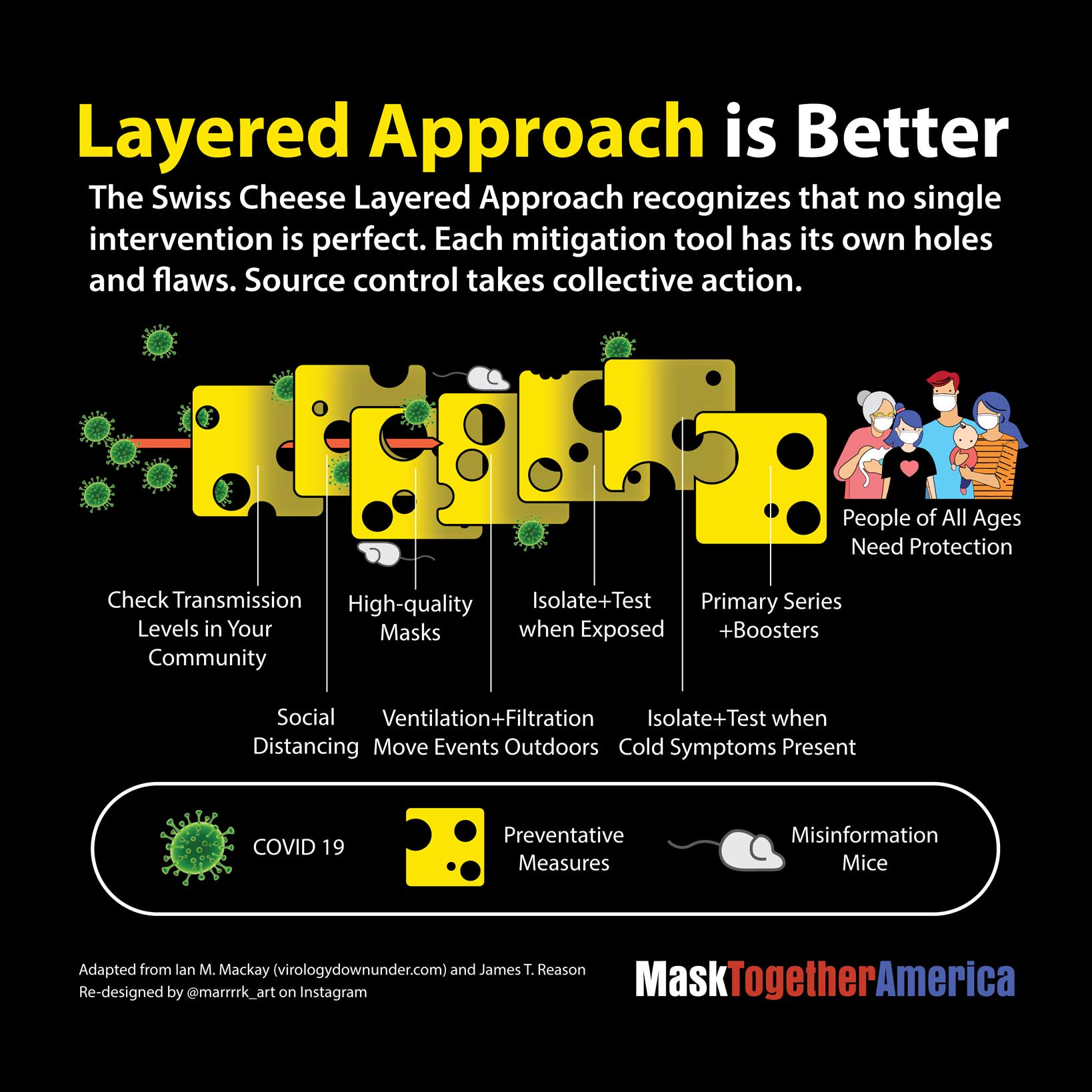
Politicians and marketers love a silver bullet, and so, no surprise, that is how the vaccines were sold to the public before they even existed. Helping that cause along, we were all longing for a signal for when “things could get back to normal”. We were already primed, but it was never guaranteed to be that, and it isn’t. Swallow sadness. We still need a multi-pronged approach. or what has come to be known as the Swiss Cheese model.
And yes, deaths that count as COVID are down, but maybe not as much as the numbers would say, with testing and tracking so limited it is easy to miss COVID deaths in the tallies, and we are not yet really trying to track the extra heart attacks, strokes and other vascular system malfunction death as specifically connected to COVID, though they very much can be.
Plus death isn’t the only thing to worry about. COVID is new on the scene relatively speaking. Though it has been a long 4 years, that is not long in the scale of a disease being present in a population. Imagine back to when HIV was new, was the first 4 years of it being around a long enough period to understand it’s impact on a person or a population? While considering HIV; it is worth pointing out that herd immunity or natural immunity are not a thing with HIV. Well, it turns out COVID doesn’t have much if any natural immunity and thus no herd immunity either. Early on that was part of the discussion and played in with vaccine mandates and such, but there hasn’t really be much in correcting some of that early thinking. It isn’t a once and done thing. We can’t just accept that we’re going to get it and get it and get it over with. That isn’t how this virus works, and we know this by now! Multiple infections can have compounding risk, and that is what the ‘let it rip’ crowd is okay with?
On top of the risks of acute infection, there are risks of chronic disease post infection. We don’t even understand well what is known as Long-Covid, we’re starting to get data on some worrying secondary diseases like lung fibrosis, but obviously we know next to nothing about issues that very well might arise years after infection – that this might even be a concern is very under-reported given the ample evidence we have of other viruses that lead to secondary disease well down road. For example, viruses that cause or increase risk for cancer, MS, Dementia, skin issues, autoimmune disorders, etc. The way long COVID is behaving leaves plenty to be concerned about on that level. Even in young people
A lot of people joked or made light of the loss of taste or smell that occurred with some COVID infections. That symptom should have be a lot more alarming. It was one of the very clear indicators that this was not merely a respiratory disease – it has some neurological factor. Loss of taste or smell is also a symptom of brain damage! And while most did recover, recovery is not always complete, and for a significant number of people that sensory loss has been permanent, so far.
So COVID minimizes are not backed up by facts. Our family gets accused of ‘living in fear’, but they are the ones being emotional – too afraid of the implications to face the facts, and/or too afraid of resisting the social pressures to pretend this is all “over”. How big of a deal it will turn out to be is TBD, but we know for sure already that it is not a small deal. It’s not “just the flu”.
Finally, taking precautions is not the same as “living in fear”. Wearing seat belts is such a sensible behavior given the risks of riding in a fast moving car that plenty of people now-a-days think you’d be pretty reckless not to! Ok, so, before seat belt wearing was common were the fools who wore them anyway just ‘living in fear”? Poppycock!
So are you just going to do this forever / when are you going to get back to normal?!
The real short answer is that there is a new normal. Parts of the old normal could come back with certain breakthroughs, but some of it is gone forever, and it’s not as big of a loss as you might think.
Also, This is where I get most tempted to loose my cool, so maybe just skip the next few paragraphs if you’re not up for me getting a little rant-y. Because what do people think, that we fucking like all this?! That we enjoy often being the only ones wearing masks in a group, that we revel in the odd looks we get as we go to put one on as we enter a building, or that we’re happy about missing out on social events and get-togethers? Perhaps we get some perverse kick out of having to second guess every decision that no-body else even bothered to think once about?! What absurd assumption or lack of empathy is going on when people are thinking this?
And to top it off, half the reason we still have to take the precautions that we do, or that the precautions we do take are a bother, is because so many won’t do even a little bit, let alone consider why we would be doing all this. The general attitude seems to be on the same wavelength of “we’ve tried nothing and we’re all out of ideas” at times. Better ventilation, air filtering, doing a lot more outdoors and masking in a few more of the situations where those other approaches can’t cover it is absolutely within reach, but for reasons, I guess, those things are not really on the table, and I am not sure if this is worse, but a lot of people have never even really thought about much of any of those ideas even after living through a pandemic that literally killed millions of people. If I am granting benefit of the doubt, for some maybe it is merely hard to feel that making any efforts at this point would have any real benefit when everyone else has already collectively given up. Like, “what difference would it make”. Of course, I think, “enough to matter”, but I try not to fault them to hard for not thinking so.
/end rant
So are we just doing this forever? Well, hopefully not!! Hopefully we get better vaccines, better ventilation, better social consideration and education, or maybe some new rapid tests that have high enough detection rates on new variants again. Hopefully some of those breakthroughs are just around the corner, but plenty could just be a matter of enough people caring, yet they don’t and realistically probably won’t, and that is a bit maddening, to be frank! So mostly I hope for the technical breakthrough sort of stuff, but in the meantime for some of those who decide to read this hopefully it helps impart a better understanding of what kinds of relatively low sacrifice precautions are in play to lower the risk equation enough to make hanging out with us a lot less of a “whole thing”, but until then, yeah, I guess we’re doing this.
But aren’t you miserable / don’t you want to get back to living your life?
Not miserable, and we have gotten back to most of what matters.
Unlike a surprising amount of people, I guess, a large part of my identity was not wrapped up in eating inside a restaurant.
Raw dogging the air in Walmart, it turns out, was not something I was particularly attached to.
There are a few things we miss. hotel pools Indoor waterparks, I guess, a little. But outdoor ones are honestly a pretty good modern alternative that have started to pop up in a few places 🤪. Saunas maybe? I haven’t pulled the trigger on a home one, I miss being able to go to the sauna at the gym, the rest of the gym I don’t miss, and have replaced with home or outdoor exercise. Treadmill show rooms can cease to exist for all I care.
Watching a movie in a theater with a mask on is, not ideal, if I am being honest, but also really, and I mean this from the sincere deepness of my non-COVID infected heart, it’s just not a big deal at all. I don’t wear glasses (yet…), but I kind of imagine it is similar; you often forget they are there, but also often half-remember to adjust them or whatever. It feels a bit silly to describe this, but I guess I assume a lot of people have forgotten what wearing masks was like, it’s been a while since the pandemic, of course.
The point is, we do lots of stuff! our COVID cautiousness, or whatever label it ought to have, is not the limiting factor in us living our lives, and sure, we could do a lot more, but so could of lot of people who are taking zero precautions – what’s stopping them?!
The irony of people wondering this question is that a lot of the actual meaningful limitations, ie being excluded from social gatherings (read as some mix of not-invited, unconsidered, and having to turn down due to to-risky), are down to other people not wanting to compromise in order to make gathering less risky. One of the simplest things that could feel the least like a compromise at all is to move away from a very indoor mindset. A party in the basement, but why not on the patio? Kids having a sleepover? Well, could it be a camp out in the backyard? Meet up with a friend? A chat in the garden or a walk in the park don’t sound so bad, right?!
Sure, a bit more outdoors or with fresh air flowing through, and of course, then, adjustments for seasons and weather, but that isn’t really a major sacrifice, somewhat the loss of a modern luxury, but how much is this sort of immunity to seasons and weather just a very modern laziness luxury? Being aware of weather and flexible to accommodate plans is a little bit of effort, sure, but usually it’s not actual hard work.
Humans are pretty adaptable creatures when we want to be, we may have adapted a bit to well to indoor climate control, and need to break free of that a bit, but the good news is that (for now at least) we live on a fairly habitable planet! Maybe modern people are just a little too accustomed to going from their completely climate controlled homes to their dual zone climate controlled SUVs to their overly air conditioned office-or-whatever. We live in Iowa, not a place known for it’s idyllic climate, so “perfect” days are fairly limited, but tolerable days, or at least days that have a rather tolerable period, are quite plentiful, actually. I think this is true in most places where lots of people live.
Really, I feel like people think this is crazy, but outside is mostly fine, we have winter gear, we have bug spray, and cooling towels, and sunscreen. Fans, portable canopies, sun hats, all sorts of things like chairs, blenders, and even TVs and wifi work out in the plain ol’ open air. It’s bonkers when you stop and think about it. House windows usually have screens on them and car windows have special open and close motors built right in! Heck, even the oversized emotional support trucks you guys! Our bodies have built in cooling systems which you can even hack it into overdrive with some spicy food, if that is your jam?!
Now, would it be nice if we had more people who were onboard with all that and it wasn’t some awkward stare off thing where others might get confused, annoyed, or occasionally even angry, that we would be so imposing with our hatred for their unfiltered nose air. The absurdity of suggesting staying outside or to open the windows if they want to invite us in… I mean, it’s not as severe as injecting bleach, right, but why does it feel like I am suggesting something on that level?! Anyway, if people were more chill about it that would be nice, yeah! But, ya know, apart from that, we’re doing pretty okay.
Side note: I do appreciate this question because of the totally authentic concern it shows for our mental well-being. /s
Are you saying we should mask too / are you judging us for not being a paranoid as you?!
Mostly no, but also, yeah. If you’ve already read this far hopefully you’ll stick with me as I try to unpack the nuance of that neither/both answer.
The audacity that I would suggest or even imply what behavior others should adopt really seems to trigger some interesting range of psychological reactions, from a “don’t tread on me” type of personal rights imposition, to a how dare you judge me – you think I am not taking good care of my kids or my family because we’re not making the same decisions as you? This is complicated. We live in a very individualistic society. “you do you” literally became a popular slogan regarding COVID precautions, and when it comes to policy on infectious disease spread it is actually hard to describe to people who are not immersed on this topic how ridiculously bleak “you do you” as an officially endorsed slogan is… just, I can’t dig into that. This is already way to long.
So do I think you should you mask more? Absolutely! Yes, I admit it, Okay! You got me! I do think it would be good for you, and your kids, and for our society if more people masked in certain contexts. It is a important slice in that Swiss cheese model. But it’s both worse and better than that too. Masking isn’t sufficient by itself, better air filtration, more air cycling, more fresh air, UV treatments, higher vaccination frequency until we get better / longer-lasting vaccines, and maybe with all that, then in some contexts masks feel a lot less crucial, Plus just the more outdoor stuff where masks really aren’t needed so much. All of imperfect layers combined is what I would advocate for! And altogether maybe not so terrible at all.
An alarming number of scientists and doctors are saying that all these repeated COVID infections we have decided are “inevitable” are going to add up to be a monumental problem down the road. Now, if they are right or not remains to be seen, but in my mind it is similar to this one climate change cartoon I often think about. “What if we made a better world for nothing?”. Here is the thing, many of these precautions could have dramatic improvements for our public health regardless of COVID!
Anecdotally I can say they have for our family already! The near lack of ANY sickness we’ve had to deal with since the pandemic began is dramatically notable. The way the flu almost disappeared in 2020 I believe will be a watershed event epidemiologists will point to.
There was this period where humanity realized having open sewers and untreated waste all over was this huge vector allowing for endemic diseases in our societies, like typhoid, cholera, the plague, etc. And we all ignored that and said there is nothing we can do put indoor plumbing in and built a ton of infrastructure to pipe in clean water and treat waste water. And true, now we have antibiotics that make those things even less of a concern, but it would be batshit crazy to give up all the progress on water sanitation and rely on just antibiotics – just so we could get back to living our lives where we got to throw pails of shit out of the window and drink poo water. So here is the thing, we have enough data now to make a very strong case that masks and improving indoor air quality can do A LOT to reduce endemic airborne disease. I think that we should act on that. Call me crazy.
Now, do I actually think it is reasonable to expect you to do what we’re doing given our society has collectively decided to pretend the pandemic is over, and have pretended moving from pandemic phase to endemic phase is not a thing? No. And on top of the “it’s over” social situation, your personal circumstance is likely different than ours. My wife and I are able to work from home. Plenty of folks can’t. Our kids also naturally have less exposure from not going to public school, while statistically, home school is probably not your situation. A lot of kids have to go outside the home for child care – and what low risk / exposure options even exist for that? And for those without kids, where largely the main people you are putting at risk by forgoing precautions, is well, just yourselves, yeah, I might make different calls if I were in that boat too – unsure.
Point being, we are very aware that we have a fairly privileged and unique position to be able to take the precautions we do without a crazy amount of effort. Do we wish more people had that privilege/opportunity, 100%! It would be unreasonable and unkind not to want something for others that you view as a privilege/opportunity, right? Do we expect them to act the same without it? Nope. That too would be unreasonable.
Do we wish people were more upset about the lousy lose-lose choices they have to make, and were willing to see that for what it is while advocating for better options? Yeah. Yeah we do.
Do we wish more people realized how within reach better indoor air quality at home, and in public buildings is? How a lot more people COULD be working from home, or doing school remote, or doing telehelth, etc.? Of course!
Also, it does seem that some number of people assume the type of precautions we might be wishing for are the sorts of grasping in the dark stuff that happened very early on where folks were washing their groceries. No, There is a lot of data on this. The science on airborne transmission is pretty clear. The old tactics of keeping 6 feet apart, religious bathing in sanitizer, standing behind Plexiglas dividers, and donning homemade cloth masks with your favorite sports team logo on it [just in case that added a bit of luck], were never personally ones I had much faith in anyway, but no, just to be clear, we’re not longing for a return to any of that. Many suspected that so much of that precautionary stuff was just pointless theater, and it turns out they were largely right, without necessarily being right about the motivations of the theatrics, of course1.
What is it you want others to do, exactly?
Apart from “people” big picture scale, and down to the people who want to get together with us in particular; We don’t expect everyone to meet us at to our level of precaution, and though we do have some boundaries as far as risks we’re willing to take on, we see room for mutual compromise. But as mentioned earlier, one of the least compromise feeling options is to just do a lot more outside, it is inherently less risky, and logistically a lot simpler than other options! So the base level ask is to just get on board with that, to stop seeing it as an annoying or tiresome burden, and embrace all the options for gathering outdoors. This really is the main thing.
Beyond that, we are willing to take on some risk by venturing indoors for the sake of spending time with people we value, but we need people to reduce how much risk they pose too. I think part of where this gets tricky is that many people are not accustomed to very much risk assessment and risk management strategies when it comes to pathogens. This is one of those new normal things I think people should just get more used to, but if you want to defer to our judgement I can live with that.
If we have a spontaneous thing, or a short get-together planned, and one of us needs to go inside the others home, just be okay with us wearing a good mask, or wearing one yourself while inside, and accept that eating or drinking while wearing a mask is not happening. It doesn’t have to be a big thing.
Indoor dining at restaurants or other public indoor places where masks just aren’t an option are out for now. Just assume that we’ll let you know if this changes. Take-out, picnics, outdoor seating at restaurants, all good options, however!
For planned things inside a home where we want the option to go without mask here are a few things to cover to put the risk levels in the acceptable realm for us:
for those attending, adopting our level of exposure cautiousness for > ~4 days before a gathering.
Basically masks in any shared air space plus limited exposure.
eg. mask inside stores & keep visits short.
Spouse or kids or whoever you live with would need to do the same even if they are not attending, as they could be a transmission vector to you.
Plus had no symptoms/sickness in that time
If symptoms that could be airborne disease (esp COVID obvi) they are disclosed,
symptoms gone, and/or a negative PCR test may be warranted, but practically speaking, probably a good signal to just postpone.
if not at our house
Can you get or could we bring some HEPA level portable air filters?
Lets talk about options for opening some windows or getting increased fresh air exchange somehow
If at our house where we have ample filters, and ventilation options, we’d still prefer our guests to adopt a precautionary period before inviting you in, but might be willing to make exceptions depending on other factors.
Note 4 days is sort of a minimum, and longer with less exposure risk is better, but maybe worth noting we’re not talking a full early-pandemic style stay inside for 2 weeks quarantine type thing at all! Because, for better or worse, the virus has mutated a LOT since the early days, with much shorter gestation periods and more known potential asymptomatic contagious periods, 8 days max of quarantine is all that would be needed these day even if one was going to the quarantine extreme which, again because the virus is endemic now, is not really all that beneficial. Unless you actively have symptoms or test positive that is, isolating in that case is still valuable, of course. But in terms of curtailing asymptomatic spread, just the main precaution of not sharing unfiltered indoor air for while before a gathering goes a LONG WAY to reduce the risk of passing infection. That plus air filtering/cycling and things are getting to be pretty low risk already.
BTW, it doesn’t all have to be super planned out, incidental isolation counts! Sometimes you’re just home for a stretch anyway, right? Might be a good excuse to move your errands run to a day or two later if it helps enable a visit!
You moved the goalposts so much in the past few years, how can you expect others to compromise with you?
Most people agree it is rather legitimate for new info to modify decisions. It doesn’t, however, make it any less annoying. COVID was new. New info shouldn’t have been unexpected. A new wave of cases, new reports about the efficacy of vaccines, about the risks of long-COVID, about the vectors of transmissions, etc. It came in spurts, and often the science mixed with politics. The goalposts moved. They danced a jig. They were disappointingly unstable.
The channels for new trustworthy info were fuzzy. Intentionally scrambled even. It sucked!
We cancelled plans last minute, or hemmed and hawed on even making plans. Disappointment and frustration took a toll.
Because of special situations or a general unwillingness to compromise towards more precautions, there were also times we made decisions to forgo precautions or do with fewer of them. This often felt not great to us. It probably sent confusing signals. However, rather than being a change in our underlying thinking it was more of a temporary capitulation which could have come from multiple factors, including us being exhausted about always being seen as the ‘difficult’ ones with regards to making plans, or the weird hypochondriacs or whatever, or from an assessment of the efficacy of vaccines as we knew them to be at the time, or maybe there was a low point in a wave of cases or hospitalizations.
A lot of that uncertainty and variability is past, and we are feeling more confident in the boundaries we want to set and keep. And to reference the Swiss Cheese info-graphic above we are no longer willing to go down to just the one level of protection, that being that the only precaution in place is that everybody would be vaccinated and boosted.
The data coming in is settling down a lot, but we are less than 4 years into a disease that has some not well understood long-term effects, so still learning too. On the other hand, deeply untrustworthy and crackpot sources have been mostly filtered out. Horse dewormer is pretty much off the table at this point as far as I know.
Waves of infections are still a thing, even though tracking data is more limited, but for us at least they play less of a role in changing plans if the plans involved low risk stuff anyway because what the risks of a setting are tend to be a lot less clouded now then it used to be, and what risk mitigation options are available or acceptable is more established.
For example, we initially thought cloth masks were better than nothing, Now we basically know that a well fitting N95 mask is pretty much the minimum to be protected over a meaningful length of exposure, anything less is basically as good as nothing. That being established it’s hard to imagine it flipping back again, right?
We thought the vaccines might fix it all, and get everything “back to normal”. They didn’t. It’s past, and we’ll probably be a fair bit less optimistic about the “back to normal” potential of any new vaccine. Boosters now do give a temporary boost to immunity, but probably not enough of one to significantly impact our families risk management strategies much.
For our friends and family who felt they were being accommodating to us in the past, but felt frustrated or unappreciated, maybe reading some of this helps towards excusing some of what might otherwise have been perceived as us being inconsistent. Going forward, I hope this might help clarify a level of consistency that was always mostly there even if it wasn’t evident in how our decisions played out, but even if none of this is making a ton of sense to you, we are settling in to a period where a lot of the unpredictability of new info is over, and so goalposts are relatively solid at this point.
Bonus Lightning Round
“Questions” that are more often made as statements lobbed dismissively that deserve only a terse reply
I never got COVID and we never took / gave up on any precautions
Occam’s razor applied; I’d say you’re wrong. The level of contagiousness, plus the fact that you probably didn’t bother testing means any number of “colds” you did have were probably COVID, or you got lucky and had no significant symptoms.
I had COVID, it was NBD
a) So far…
b) 5 out of 6 people will walk away from a round of Russian Roulette. That doesn’t mean it is a worthwhile risk. You might be either bad at statistics or are applying anecdotal evidence irrationally.
I can’t wear a mask because of my glasses
You need masks that fit to have decent protection anyway, so try one of those.
You’re not old, so you’re not at risk
Well I’m older than your info on this subject, but…
Footnotes:
Look, we got a glimpse of a world that prioritized public heath, and people’s well being over the status quo of capital dominance. But a certain segment of world, the ones sit atop our economic hierarchy, who mostly pull the strings of politicians, that have massive marketing budgets, with portfolios of office buildings that can’t just go unused, they felt returning to the old status quo where they were the ones prioritized was vital. Of course they did! Nothing new here. This “economy” talk is so often the mechanism to justify the sacrifices imposed on the lower classes, this whole scheme has and always will drive a lot of bad behavior and bad thinking.
That anti-capitalism stuff might feel like a tangent, but If you’ve had a reactive impulse to some of what you have read here, either about my suggestions for a new normal, or if you’ve been raising mental objections at every turn, then I’d urge you to examine how much of that is from you and your actual best interest, and how much of it comes from a) the relative comfort and safety of the familiar status quo, or b) the pervasive messaging on “the economy” which is so often characterized by a severe lack of imagination – where nothing other than what used to work could ever work. ↩︎
Carbon capture may well end up as good or necessary, but for now, at any kind of scale that matters, it is mostly hope and dreams material, and so long as it is merely that it worries me. People want to look for things to place hope in, and I get that. Climate doomer-ism is to be avoided, for sure. But what we put our hope in matters because that is where the action happens. This particular idea along with certain other geoengineering prospects isn’t harmless even if it turns out to be legit. They can be actively dangerous!
The risk in a nutshell is that it makes emissions now seem less costly and thus runs headlong into https://en.wikipedia.org/wiki/Jevons_paradox, which in the case of emissions, means it would tend to actually increase them, or at least reduce the reduction rates. Will the carbon capture reality then, if it even materializes, end up being enough to account for the increase [or lack of decreases] that happen now?
Does talking serious about future carbon capture schemes needs to always go hand in hand with emphasizing additional things to further increase the cost, or perceived cost, of current emissions — be that carbon tax or whatever? Without that counterbalance could we be unintentionally promoting something that could be a net loss in terms of battling climate change?
With climate change we often hear about tipping points in the negative sense; warming causes permafrost to melt releasing massive amounts of c02 and such. Of course not all tipping points are a bad thing, and this article got me thinking about positive tipping points.
The number I saw in there that blew my mind a little was that 40% of ocean shipping is just moving around fossil fuels.
And I thought about as that number comes down, which it must and will as more and more renewables are built out, the economies of scale that kept that amount of transport of fossil fuels cheap enough to justify start to fall apart, and it sort of causes a tipping point where moving oil and coal gets more and more expensive. Also at some threshold of demand reduction you hit a point where it multiplies in impact because not only do you not burn it, but you don’t move it, you don’t refine it, you don’t store it, you don’t go searching for more and build new deep ocean rigs, etc.
Then with rail transport in the US in particular, if all the trains moving coal – we see a lot of these crossing Iowa, so maybe that skews my perception of how many of those exist – if those are out of the way, does passenger rail suddenly have a new opportunity on those lines? could this function to reduce demand for air, car, and long haul semis and does this becomes a tipping point for demand for the fuels those transport would have used? Given general disdain for trains in the US this is probably overly optimistic, but doesn’t seem out of the realm of possibility either.
The article has some great links at the end that are all climate related too. Go read!
A characteristic that natural tipping points like glaciers and permafrost have which economic tipping points do not is they cannot be artificially suspended. On this note it worth pointing out that it seems coal for power generation crossed a tipping point a while ago, but something is not letting it “tip”. Inertia? Political corruption? Lack of awareness? I don’t know. Maybe it is in this report but in any case this blurb in the summary is .
“99 percent of all U.S. coal plants (209 out of 210) are now more expensive to run than replacement by new local solar, wind, or energy storage.”
Thinking about local taxes and private vehicles. A few points to expand upon
Registration fees and gas taxes are far to low
The current infrastructure maintenance burden is much to high given the revenue from these sources
Registration fees should be based on the burden the vehicle imposes on roads and society, so things like weight, size, utility, efficiency, loudness, etc. As is registration fees are primarily based on age or monetary value of the vehicle
the U in SUV supposedly stands for utility but these vehicles often have no more utility than a compact car while being a much larger danger and bigger burden on the environment. They should be heavily taxed. Large emotional support trucks too. They aren’t work trucks and everyone knows it.
Sales taxes on vehicles provide perverse incentives
New car sales taxes are a big revenue source for municipalities. This creates incentives for cities to enshrine car dependency and to measure local economic health by the sale of the very thing which guarantees to choke cities with traffic, pollution, and the need for subsidized parking
Trading an old inefficient behemoth for a newer much more efficient model is disincentivized by the current structure. Trading vehicles merely to get a better fit for current use should be encouraged, but with sales tax the way it is, it may not be worth it monetarily to trade for a economy commuter if your situation has changed and a work truck or minivan is no longer what you need on a regular basis.
Casinos and other institutions with known, clear negative affects on society are taxed in such a way that their proliferation is intentionally limited or offset – assuming lack of corruption of course – not so with cars. It is time to end the political favoritism towards car dealerships.
Public transit funding should come from private vehicle users until balance between public transit and private transit is achieved
Roads are public space that should primarily be for people not cars. If cars are going to displace the public they should foot the bill to enable the public to exist and transit safely again.
This would include protected bike lanes & free public transit. Think about it, If cars didn’t exist we wouldn’t need the protected bike lanes, and public transit ridership would be so high fares could be minimal or likely without the need to build and maintain insane amounts of infrastructure solely for cars it could be easily funded by all the state and local property taxes used currently to fund that along with the massively car oriented state DOTs.
obviously drivers will object, but one way to market it in a positive light would be to label it as a traffic reduction fee. The car infrastructure isn’t going anywhere in the short term, so essentially paying to move people into public transit or biking is going to reduce congestion which should make driving a fair bit more pleasant.
“Most humans on the planet now breathe air made unhealthy by fossil fuels, and many die early deaths as a result — my early death by fossil fuel reflects what we are doing to ourselves.” – Wynn Bruce
A couple days ago this man set himself on fire in front of the Supreme Court building. Initially there was very little anything about it in the mainstream media, and what did exist failed to emphasize – if they even mentioned – this was an act of climate activism.
In the movie “Don’t Look Up” I feel one aspect they got pretty right was the role of major media outlets. The movie didn’t really get into the ‘why’ of it as that is a much harder question, but i felt they had their finger on the what/how anyway. So what is the why? Frankly I am not sure, if I had to guess it is something like complicitness mixed with a bizarre apathy on top of a either a profound ignorance of the moral role of journalism in society or a deep corruption stemming from their late stage capitalist dependent business model .
I think a lot of us sense this, even if we wouldn’t articulate it in those sorts of terms, and social media, and platforms like YouTube and podcasts etc have filled a gap for a lot of people to at least supplement the information we get from the world. To let us bypass the largely corporate controlled channels and sort of democratically decide what we feel is important or worth knowing about. But, these forums and platforms haven’t proven especially robust to abuse, corruption, misinformation, or inappropriate censorship either.
Another billionaire moving to take over one of the better – i wouldn’t say great – platforms that in effect function as a public forum doesn’t bode well in my mind. Twitter limited political adds, and showed willingness to ban notable people – to little to late thought it may have been – so they have taken better steps than many others, but Musk most likely would be aiming to undo a lot of that.
So, now what, back to Facebook? Was OrangeMan right, will his shit social network be vindicated?
Well, at least for me, no.
Rather, I have been putting more energy back into things like this blog. Microblogging has its place, but plain ol blogs are good too and IMO have been getting neglected in favor of things like twitter threads more than they should have, I for one plan to re-curate my RSS feed reader, and do a bit more reading there.
I have been finding sources, journalists, channels, and platforms that are worth supporting financially and pitching in towards their funding via Patreon and OpenCollective
I am sharing what I am doing with you, dear reader. I guess that is something.
For social media itself there are very promising alternatives. Decentralized/federated options exist and are viable, but mostly under utilized. NextCloud, Mastodon, PeerTube, Element/Matrix, and so on. Ironically one of the most concise cases for Mastodon was made on the ol bird app very recently.
At Mastodon, we present a vision of social media that cannot be bought and owned by any billionaire. Your ability to communicate online should not be at the whims of a single commercial company!
Similarly to this blog, this isn’t something all new to me I have had a Mastodon account for years now, and have played around with Element, and Nextcloud too, but now is certainly as good a time as any to renew my push in a good direction. Find me over on Mastodon via https://mastodon.social/invite/acHW86uF
This got some traction on social media and I had thoughts sort of all over the place…
“You are required by western propaganda to treat these as fundamentally different. Indeed, huge numbers of people in the West denounce the former while applauding the latter.”
Glenn Greenwald
It’s an important point to contemplate for sure. The power to restrict the freedom to do economic transactions is a big deal, as that freedom underpins so many others, but to imply all such exercises of that power are fundamentally equivalent is also a mistake. The motivation matters a lot, and to sort of imply that government should never use this tool is – well, beside being unrealistic – may leave governments and society notably susceptible to the tyranny of the few, or especially the tyranny of the wealthy.
1/ There are no other constitutional rights in substance without freedom to transact
Being meaning to write this for 6 months, but the Canadian response to the trucker protests is illustrating this so vividly, that today is the day.
This twitter thread articulates a similar line of reasoning re the Canada situation, but I think makes a similar conclusion as Glenn that these actions in the headlines are fundamentally the same. I think the thread makes a lot of good points but I also think it gets a bit myopic
With the rapid deterioration of the Russia/Ukraine situation, you’re going to hear a lot about SWIFT in the coming days…
Here’s a quick breakdown of what it is and why it matters:
Then there is the Ukraine situation and sanctions. The whole SWIFT thing, and how Russians may be tempted to end around that with cryptocurrencies… My prediction is that when the Russians aren’t meaningfully able to avoid sanctions with crypto that may open a lot of (willfully blind) eyes. We’ll see I guess.
So economic censorship is definitely a double edged sword. Maintaining the availability of cash as a means of economic transaction is an important check on that. Crypto *might* also fill that rile someday, but not in most of its current permutations that I know of mostly because most crypto currencies don’t actually meet the criteria of money
In 1912 Iowa had 11 Districts, and 11 US Representatives in the US Legislature Plus 2 Senators makes an electoral collage vote count of 13 with a population of ~2.25 million1.
In 2022 Iowa will have 4 Districts, and 4 Reps2. An electoral college vote count of 6. And a population of ~3.2 million3.
Do you see the problem?! Just by population growth within Iowa itself your voting power as an Iowan to elect your congressional representatives has been reduced by between 1/3 and 1/2. AND, because the rest of the country has grown more than Iowa, our representatives voting power within congress has ALSO been reduced by about 2/3. AND because where we live has also shifted “urban” voters influence have diminished even more4!
The power of your vote is diminishing, even more-so if you live in a city! My figures here are very fuzzy, but your vote it is something like 1/6 as potent as an Iowan citizen in 1912! None of this is the fault of minorities, or women voting, it is a result of our representative democracy not adjusting to a growing population a shifting demographic! Is it any wonder people feel their vote doesn’t matter when it has literally lost more than 80% of its ability to affect political change at a federal level?!
435 members in the “peoples house” is way to small! Especially in large states with not so large populations, such as Iowa. It leaves us with districts that are way to large. Overly large districts are very susceptible to favoring rural citizens over urban citizens5, gerrymandering, and the influence of big money donors6. With that, the balance the electoral college was (ostensibly) intended to serve, becomes just yet another anti-democratic tool for minority rule.
Voter suppression is a really real thing, and there should absolutely be federal rules to combat that very undemocratic activity at the state levels, but voter dilution is also very undemocratic, and isn’t being talked about enough. If we can’t get a vote on voter suppression issues – new voting rights acts should have been a top priority for democrats early in Biden’s tenure, but any such efforts are dead and buried at this point I think – we should at least raise awareness that increasing the size of the house is pretty damn important, and all the more so given how accessible this reform is. ie. There is no need for constitutional amendments or new states like would be required to re-balance the senate.
In 1912 only maybe ~750,000 were eligible to vote. Women’s suffrage happened in 1920, and higher percentage of kids back then – population has shifted older since advent of antibiotics etc. If we just assume as many women would have voted as men we could have a voter turnout of double that of the actual number 492,356. so roughly 1 million ↩︎
The Senate (simplistically speaking) was meant to be a check on more dense/less agricultural/urban states overriding the less dense/more agricultural/rural states. The house was meant to be something closer to representation the people! They definitely weren’t BOTH supposed to give preference to land over people! What’s more, even the Senate wasn’t intended to favor rural population states with such a severe distortion as it does today. The founders did not anticipate the number of relatively empty states in the west. The size of the senate has grown by less than 4x since while the population grew by almost 100x, and while the first states varied a lot in size, they were (relatively speaking) rather close in population totals. The 5 least populous states had ~2% each of the national population, and each held 7.7% of the senate seats, meaning ~10% of the population had control over nearly 40% of the senate. A distorted system, but it made some sort of sense because of the demographic & economic realities of the day. Today the 5 least populous states have about 0.2% each of the national population and each controls 2% of the senate – meaning 1% of the population holds 10% of the senate. So, the distortion present in the original senate compromise is at least 2.5 times worse today, and the economic & demographic situation has shifted such that the justification for the original distortion makes dramatically less sense too! ↩︎
A lot more time & money is needed to campaign to so many people and this is amplified further if they are somewhat spread out in a large district; travel costs go up, obviously, but it also tends to force a reliance on mass media ads ↩︎




 .
.

 A Mind Running Wild
