Cables meet knit-weaving

In progress

Although I claim a lack of fondness for cables, reviewing the links listed in the category in the blog index, I found that this present one can is #30!
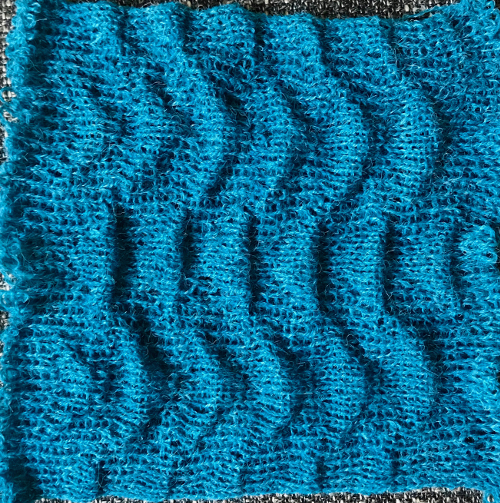
The goal here is to combine knit-weaving with cable crossings.
When working with hand techniques, clues can help maintain accuracy, especially when knitting long pieces.
To enable the movement of the stitch groups, the tension for the knitting yarn, also used in the lace/ knit weaving samples, required changing the tension from 7 to 9.
Movement happened within groups of 5 stitches to maintain continuous vertical lines of color.
Personal preferences inform our choices in spreading out the hand technique, and for the presence or amount of aids in maintaining correct patterning.
More on similar planning may be seen in the post on Cables meet fair isle. ImageImageI tend to program a repeat that takes into consideration the number of needles in work on the machine.
In testing, in this series, the choice was made to bring groups of 3 stitches to the front of the piece consistently to maintain the vertical color line placements.
All transfers were first made in the same direction, but can be planned with other variations.
The columns of blank cells result in floats of the weaving yarn on the purl side.
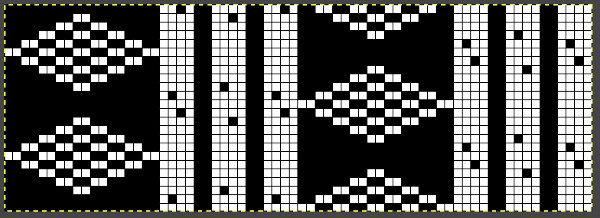
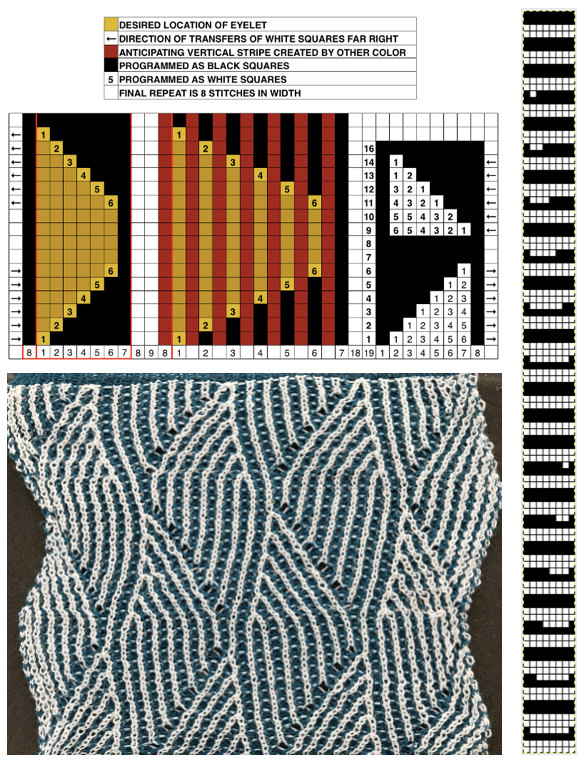
The added borders in the spreadsheet plan below add a beaded edging catching the weaving yarn; end needle selection is canceled to maintain patterning on the edges. ImageThe program for the swatch, 41X18Image1. A partial repeat is shown; the printed needle tape was marked with magenta columns where the stitches remain manually undisturbed during knitting.
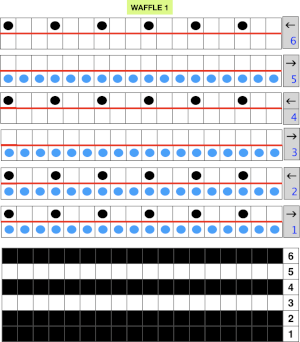
The blue cells mark the alternate areas where cable crossings will occur,
the black dots, the fixed needle preselection that needs to be restored/ maintained after moving stitches.
2. The segments with non-selected needles programmed in each pattern group, blue on the needle tape, are the areas for cable crossings.
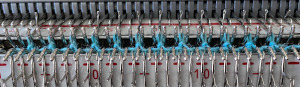
3. The first two stitches on the left of each group are removed and held on a tool, which can be temporarily rested on needle hooks to the left, followed by the removal of the group of three stitches
4. The three stitches are returned to the needle bed on the left, and the group of two stitches is returned to the bed on the right
5. Needle preselection is restored manually before knitting the next row
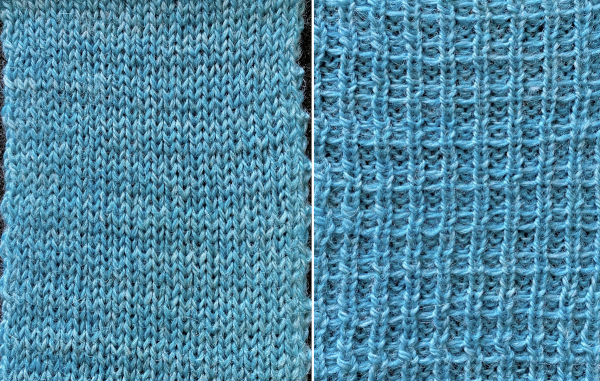
ImageThe proof of concept swatch: ImageIt is easy to crop swatch photos to visualize the designs in wider repeats or with other changes or additions before amending the original repeat and pursuing the technique further. ImageImageVarying the concept, testing crossings were made alternating in opposite directions. They and the number of rows between them can be adjusted in DIY.
The new design repeat, 18X22Image was planned for use on 41 stitches, a multiple of 18X2+5.Image ImageThe corresponding needle tape markings, groups of three stitches were again consistently moved toward the center of each non selected group, the pairs were then brought behind them and placed on the pairs of emptied needles. Preselection for the weaving pattern needs to be restored after the crossings and before knitting the next row. ImageMarkings on needle tapes can be made as preferred, here magenta cells again indicate groups of stitches that are left undisturbed, the blue and cyan, groups of unselected needles with opposing directions cable crossings.ImageThe relates swatch:ImageLastly, a test of placing multiple cables along single rows: the new design repeat, 7X18.ImageImageMagenta cells represent columns of stitches that are left undisturbed, the cyan, pairs of stitches that are removed first, to allow the group of three beside them to be removed and moved over to the front of the knit by two needles. Cyan pairs are then returned to the needle bed.
The next row of knit weaving is likely hard to push, merits knitting slowly.ImageThe swatch was knit on 40 stitches, with undisturbed borders on each side,
Image

Imageand imagined with crop, copy, and paste, in a different rendition.ImageUntested at present: an added repeat variation that retains the manipulation in groups of 5 vertical columns, found in the FI post, 20X18, followed by an amended design. ImageImageImage

ImageThe smallest design repeat, 20X12, ImageImageplanned tiled X2 in width, with added borders, matching the spreadsheet chart Image33X12Imagemirrored horizontally if required by the machine model or download softwareImage

More on combining lace patterning with knit weaving

Brother Punch Card Pattern Volume 5 is a great tool for learning about the various technique possibilities on any machine.
The accompanying swatch images are guides to visualizing the results and the relationship between punched holes and stitch structures and textures.
Some designs may be used as published on electronic models, while others need some adjustments.
When 2 carriages are used to select needles from opposite sides, punch card machines do not advance the card with the first pass of the second carriage from the opposite side, repeating the selection in the previous row, while electronic models advance a design row with each carriage pass.
When traveling between machine models and developing DIY variations, test the lace portion of the design first; depending on the machine type or the software used to download to the machine, the PNGs provided may need to be mirrored horizontally. The big clue pointing to mirroring being required in testing is if there are two empty needles side by side after any of the transfers.
Electronic models can do that with the selection of a button. Keep good notes for future reference of the specific patterns.
This series began with a ready-to-knit repeat for the technique.
End needle selection is canceled; the goal is to maintain the weaving pattern along the side edges.
The smallest repeat segment in the card #275 is isolated, in this instance, to 12X28. The image on the far right shows areas where selection rows are repeated with the change of the carriages.
ImageThe chart for the repeat was plotted first in a spreadsheet, 12 columns X 36 rows, with arrows indicating the direction of the carriage moves, and the knit-woven rows were also noted with red cells. ImageImageThe sample was drawn in repeat X3 to 36X36, and a border column was added to each side, adjusted for an evenly distributed woven floats, used as is on the 930, no mirroring required, 38X36, ImageImageUsing a random card design for transfer lace, #623, with the smallest repeat isolated to 8X18,ImageImage8X24Imagedoubled in height, altered to maintain the weaving pattern repeat,Image8X48Imagetiling checked on 96X96Imageknit tested on 33X48, Imagemirrored horizontally on the 930ImageChoosing a pattern from a published design for electronic Brother models, repeating the process with #182Image Drawing the initial 13X66 file drawin in repeatX 2 in width revealed areas with double cells in the weaving rows, shown edited on the rightImagethe new PNG, 26X66, with tested tiling ImageImageknit on 44X66 to accommodate edge transfers and with pixels added to maintain weaving pattern Image Imagerequired mirroring on the 930
The weaving yarn used is the same space dyed wool worsted, and the lace yarn thickness matches the 2/18 yellow. ImageA larger motif, still using comparable weight yarns, #161, 24X48.ImageThe process, summarized, Imagethe knittable 24X72 BW PNG, and its tiling alignmentImageImage

The tested repeat, 50X72, Imagerequired mirroring on the 930Image

A spreadsheet offers easy editing of cell groups and rows. The concept applies to any available and familiar tools that allow for planning the sequences.
The steps in my process using Tables and Mac Numbers in summary:
begin with a published design with 2 knit rows occurring after each series of LC carriage passes, filling the corresponding cells with an easy-to-see color. It is useful to have a symbol or shape to add to any column, indicating Lace Carriage movements.  ImageSelecting either of the 2 yellow rows, expand the chart by consistently choosing either the top or bottom row, adding a row below the top or above the bottom one X2, yielding 4 yellow rows.
The red cells in the column on the right indicate planned knit carriage passes.  ImageAdding BW cells indicates the placement of alternating pairs of weaving patterns.   ImageWhen programming repeats for the number of needles used in the piece,
verify that the direction of the transfers works so as not to produce side-by-side empty needles. Some machines and download software require horizontal mirroring of lace patterns; electronic models have buttons that will perform the mirroring without added programming.
Tile the weaving design in height, isolated in this sequence, Imageand illustrated simply as a BW file, 24X16, with correct tiling in height. ImageCheck that it is maintained with the full “final” LC, and the weave repeat is doubled in height; look for any same row repetitions. In those instances, adjustments will need to be made in the top half of the design by shifting and redrawing cells. Image Add needles in work on either or both sides if needed to avoid side edge stitch transfers.
For better finishes on side edges, maintain the weaving pattern repeat, filling in cells in the PNG, or pulling needles out by hand if needed.
Returning to my episodic leaf lace obsession, #576. ImageThe 24X56 startImageImageTwo-stitch side borders were added, marked with magenta cells in the corresponding chart, resulting in a multiple of 24X2=48+4=52 stitch width repeat, no mirroring required on 930ImageImageSampling was planned using a 2/8 green wool for the lace, which test-knit fairly easily at tension 9.
Then the fun began: the yellow, thicker yarn was a loose, three-stranded variety, and began to separate and skip getting caught. The second shade of green worked fine after a tension adjustment, until I forgot I was weaving, almost transferred a whole EON selection row, got a lovely LC carriage jam, and was not happy at the degree of contrast between the two greens. ImageThought I had sailed through this sample, and then, when steaming it, I found the many dropped stitches that had gotten away from me and my eyeballs.
May consider regrouping and a third try, but not today!Image

Knit-weaving methods and associated swatches
Knit weaving 5: manipulated floats 8/24
Knit weaving 4: combining stitch types 7/24
Knit weaving 3  5/24
Knit weaving 2: swatches, experiments 2/21
Knit weaving 1 2/21

More on combining lace patterning with added stitch types

Far older posts:  Combining tuck stitches with lace 1,knit swatch Combining tuck stitches with lace 2 (automating them), the arrow points to operator error, both from 2015
mylar_purl1
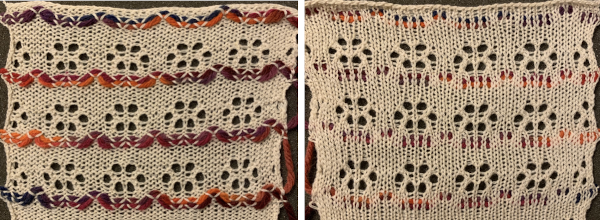
Lace meets weaving on Brother Machines 1, 2020 ImageLace meets weaving on Brother Machines 2, 2020ImageLace meets FI on Brother machines 2020 ImageImageLace meets tuck on Brother machines , 2020
Punchcard volumes offer many variations for this technique.
Both the knit and the lace carriages select needles in pattern.
It is necessary to keep in mind when planning to attempt using the published card repeats on electronic models that they advance the design with every carriage pass, while the punch card models repeat the same needle selection when the alternate carriage makes its first pass from the opposite side. To match results, the electronic repeat would need to be edited.
A sample knit on the 930:Image
ImageImage2025
Combining automated tuck patterning with hand transfers to form eyelets in vertical columns on a tuck stitch ground
For working on the single bed, the spreadsheet plan includes markings for transfers, magenta cells to the right, cyan to the left.
The repeat is 16 stitches wide, knit on a multiple of 16 needles +5.
The grey columns represent needles that are emptied and pushed back to the A position; ladders will be formed in those spaces.
The first and last stitches in each group of 5, marked with blue cells, remain undisturbed throughout.
ImageThough the repeat could be shorter, it was tested in a 40 row height, 16X40Imageon 56 sts, mirrored horizontally for use on the 930, Imageair knitting the preselection row: Image as hand transfers are made, emptied needles and the remainder of each group of 5 must be in or returned to the work D, or E position to form eyelets amid kit stitches on the next pass. Watch that empty needles are not accidentally brought back into work. ImageVertical lace columns and rib:
End needle selection is cancelled, as in any case where not every needle is used on the knit bed
The knit carriage may be set to select, but no cam buttons are pushed in, knitting every stitch
Needle preselection guides the transfers, as with tuck lace, proper needles need to be taken out of work, and while hand transfers are being made, watch for needles being accidentally pushed out of work, or out of work needles being accidentally pushed back into work.
A vertical column is added on each side for a knit row, aside eyelets formed by transfers, the full repeat width remains a multiple of 5. ImageProgrammed repeat, 38X12ImageThe swatch needle setup with added needles in work for more knit stitches, first and last needles on the top bed: ImageAll transfers were made toward the center stitch, beginning consistently with the stitch on the left. The yarn used initially was a 2/20 silk/wool blend, which lost surface texture and flattened permanently with steaming and light pressing. ImageThe same proved true with a slightly different design using the same needle setup but with transfers on alternating sides. ImageUsing 100% wool yarn produced designs with a more defined texture. These knits narrow considerably when off the machine, and wool has spring back that may be diminished but not eliminated with blocking.
The programmed repeat used was the same 38X12 as in the first sample in the series.
The needle setup, first and last on the ribberImage

ImageThe repeat for the second test was changed to bring the eyelets a row closer together,
programmed on 38X18Image

Image

Revisiting patterns inspired by waffle weaves

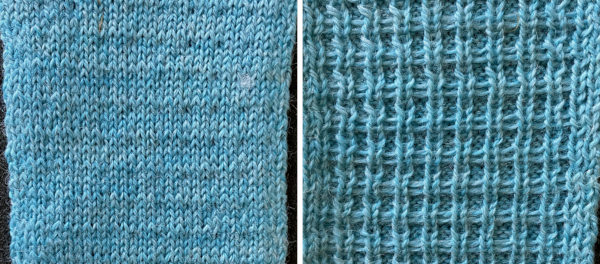
Waffle weaves Imagehave a structure that is not duplicable on home knitting machines.
Interlock explorations 2; adding needles out of work 
introduced efforts using circular slip settings got Milano waffle knitting in asingle color
4 passes are made with every needle knitting on both beds, followed by 4 passes tubular slip stitch.Image The main bed is programmed, set to slip both ways after the first preselection row.
After 2 rows are knit on both beds, the ribber is then switched to slip in one direction, knit in the other in response to needle selection on the top bed.
Main bed needles out ribber slips, main bed needles in B, ribber knits.
After 4 circular passes, the ribber is again set to knit for 2 rows.
The appearance during knit rows,Imagefollowed by float formation when only the top bed knits ImageThe number of needles in work on the main bed remains fixed.
ImageThe resulting grid may be used as a guide for hand techniques off the machine in isolated areas or all over. ImageRepeating the experiment with  2 knit vertical stitch columns on each edge, this time disengaging the ribber and knitting 2 rows only on the top bed rather than knitting circular rows and changing ribber settings.
The floats are brought closer together, and the fabric is far quicker to knit. ImageNeedle arrangements may be varied to accommodate thicker yarns or alter the texture by varying both the number of knit rows and circular ones.   ImageThe new, added variation:
The main bed is programmed for every needle, allowing spacing variations for vertical knit columns to number preferred
The knit carriage is set to knit while also selecting needles,
end needle selection is canceled.
Every needle remains in work on the ribber throughout.
When needles are selected on the top bed the ribber is set to knit in both directions, while when there are no needles selected on the top bed, it is manually set to slip in both directions.
While the ribber does not knit, ladders are formed on the top bed between the needles in work for as many rows as planned until needle selection returns and the ribber is set to knit again.
Automating the function: a 16X16 PNG that can be programmed across the bed using the electronic built in selection has a 6 double bed to 2 single bed rows ratio,Image the full repeat chart usable on punch card machines,Imagethe needle set up used in the swatch: ImageImage

A review of brioche patterning

Nearing the end of another year, reviewing previous drafts, I find myself coming across posts that were never quite completed or published.
This content began to be brought together in 2022.

The term brioche in knitting is used loosely at times in any references to tuck stitches. Designs may be worked in single colors, or with more complicated planning, they may be executed in 2 colors.
Some patterns are fully automated, with the knit carriage set to tuck in both directions, the ribber set to knit in both, others are worked as a tubular tuck, and lastly, some require frequent changes in cam settings in either or both beds.
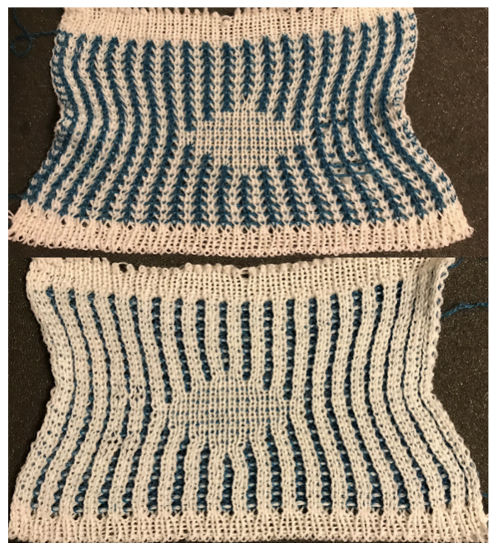
My explorations for the use of tuck stitch settings in double bed every needle rib fabrics began with attempting to create a solid color shape on a vertically striped ground in Geometric shapes on ribber fabrics with tuck stitches 1.
The arrow marks the spot where both colors used were picked up from the changer. C1 and 2 show indicate cam setting changes used in the last part of the swatch.
ImageImage ImageHere, a simple shape was programmed, and varied carriage settings on either or both beds were explored Geometric shapes on ribber fabrics with tuck stitches 2; knitting with 4 carriages. ImageGeometric shapes on ribber fabrics with tuck stitches 3  explores self-drawn repeats in multiple colors. ImageAdded samples and files in the subsequent post New double bed swatches based on published sources of inspiration 2 ImageImage
Lace transfers meet fisherman rib in 2 colors on Brother KM 1Image
Lace transfers meet fisherman rib, 2 color ribbed brioche on Brother machines 2 ImageImageThese are advanced, complex fabrics. The repeats for 2 colors can grow exponentially in length.
Returning to designing suitable repeats, beginning in a spreadsheet: grey vertical lines represent stitches on the ribber, which will force apart stitches created on the top bed, creating the more familiar tuck rib surface.
Mac Numbers offers the opportunity to hide both columns and rows. In this instance, with the 10 grey columns hidden, one begins to get the sense of shapes and movements needed on the top bed   ImageWorking toward a repeat for knitting the shapes in a single color, imagining the location of eyelets resulting from stitch transfers, ImageI used two repeats, adjusting the first repeat to vary the resulting shape slightly ImageA 11X30 repeat mirrored horizontally for use on my 930, tiled twice horizontally before programming and downloading, used as a 23X30 single motif to obtain a matching border on each side, ImageImageA 9X28 repeat, my second try, programmed as a 20X28 single motif, ImageImageWhen knitting using only one color, the machine is set with the main bed tucking on every needle in one direction, followed by knitting on every needle as it returns to the starting side, the ribber does the same but in the opposite direction. It is a circular tuck, also referred to as fisherman’s rib.
A slight shift in patterning may change the outline of the desired shape, introducing or removing stray lines or secondary shapes.
The possible cam setting options: ImageImageIn two-color brioche combined with hand-transferred stitches, the main bed is set to tuck in both directions, white cells tuck, black cells knit.
Brother machines preselect needles for the next row with each pass of the carriage, so on even-numbered design rows, as the carriage moves to the opposite side, all needles will form tuck loops on the main bed. The next row will be preselected, with some needles now back in B rather than D position.
With an appropriate transfer tool, move the stitches on the non-selected needles to the adjacent selected needle to their right after pushing it back to the B position. After each transfer, push all worked needles and their stitches, as well as the now-empty needle, to the E position.
As the carriage returns to the opposite side, an all-knit row will be completed. Several tension adjustments may be needed to ensure loops do not get hung up on gate pegs as stitches move across the bed, while still being loose enough to knit off properly.

Planning a fully automated design, reducing the ground, and staggering the color of the shapes. In these knits, the colors in the background form clear vertical lines:
24X44
Imagebrick repeat 24X88Imagetiled. Image

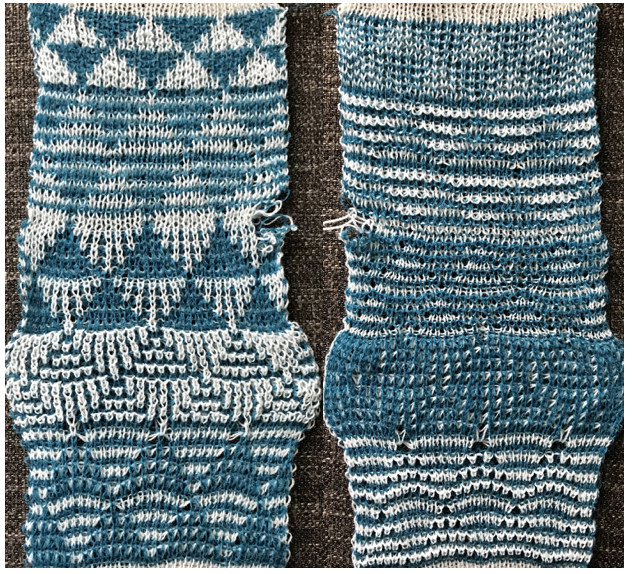
A half-drop tiling error was revealed,  Imageand the file was reduced to 23X44. Image The half drop repeat 46X44 ImageImageUsing the 24 stitch repeat executable on a punchcard machine as well, planning to knit the test swatch on 72 stitches, Imageanticipating what will happen with color of the alternating pairs of rows forming the shapes, noting that the total number of rows is an odd multiple of 4:ImageImageadjusting the repeat to 48X40with the total rows an even multiple of 4, Imagetiling check, 72X80Imagethe stitches composing the all the shapes will knit in the same color ImageThe pattern, tested in thin yarns reveals the stitch structure even more. That said, the dark color was 2 thin yarns threaded on the same side of the mast. At one point, one of the 2 began to loop around needles, causing a carriage jam and a bent needle hook, hence the short height of the sample. ImagePassap to Brother 6, exploring a possible tuck stitch design ImageImage
More shapes on ribber fabrics with tuck patterning, fantasy fair isle Image

More designs worked on the double bed using tuck cam settings on either or both beds:
Ribber fabrics with main bed tuck patterning 1/ pick rib 
Fisherman and English tuck stitch rib 1_ checks patterns_ Brother, Passap

Knitting with more than 2 carriages
Pintucks 1 vs shadow pleats
Geometric shapes on ribber fabrics with tuck stitches 2; knitting with 4 carriages
Interlock explorations 1

Modifying a sinker plate for use with double bed knits
Knitting with “unusual” fibers/ elastic 2
Ribber fabrics with stitch transfers between beds 2
Ribber fabrics produced with 2 knit carriages selecting needles
Multiple color drop stitch lace using img2track and more

New double bed swatches based on published sources of inspiration 2

Published a few months ago: New double bed swatches based on published sources of inspiration

At year’s end, I commonly find myself reviewing earlier blog posts and am drawn to testing previously developed repeats in new or different ways.

Many publications, whether for electronic machines or punchcard models, group patterns in separate categories, not offering many clues as to whether each design may be used for other knit structures.
Some punchcard manuals do offer a page with limited guidance, such as this in the 860 manual. ImageTruchet tiling design inspiration 1 and Truchet/Smith inspired designs 2 meet ArahPaint, introduced resources and methods for developing DIY knittable designs inspired by them.
Blistered DBJ 2 and technique variations on a single repeat. used this tiling Imagein several ways, followed up on the previous post, Blistered stitches DBJ
Revisiting both posts, developing some new pattern variations.
The starting repeat, 74X74, Imagedrawn in repeat to test tiling alignment, 148X148ImageArahPaint, Tools > Layer -> Brush saved Imagethe 74X74 picture is loaded
the white palette color is locked Imagewith filled rectangle, using the brush and bucket fill on whole image, the new 74X74 file ImageImagewas test knit on the 930, which automatically mirrors the image horizontally,  centered on 60 stitches.
End needle selection on the knit carriage was canceled.
The slip setting in both directions was selected after the first preselection row.
First and last needles were in work on the ribber, with the carriage set to N.
If large groups of stitches were not selected on the sides, an end stitch was brought out to E manually before knitting the next row.
Slipped stitches elongate, as seen in the image on the right. ImageThe elongated X2 design did not work on the Brother,  with too many rows knitting only on one bed; they start jumping off, and the length of the slipped stitches is a potential added problem, with too many rows knitting only on one bed, they will start jumping off and the length of the slipped stitches are potential added problems.
Blistered DBJ 3 began with a punchcard design Imageuntested at the time, modified for use in knitting a patterned half fisherman rib,  24X112.Image ImageThe knit carriage is set to tuck in both directions, the ribber carriage to knit in both. The resulting knit has subtle textures on both sides, lies flat. ImageRelated stitch structures and samples in Geometric shapes on ribber fabrics formed with tuck stitches 4
The same design, 24X112, color inverted, has applications as well, ImageImageamong them, pile knitting, best knit on Studio machines, and single color drop stitch lace.
The first of several blog posts on the technique, Geometric shapes in drop stitch lace 1, Brother KM.
To knit, cast on EON, transfer all knit bed stitches to the ribber, except for the first and last.
Cancel end needle selection.
On rows where no needles are selected, drop the stitches formed on the main bed. Return all the same needles to the B position, checking that no extra needles are accidentally pushed in or out of work.
The knit grows quickly. The yarn used is a 2/10 W/LYO, a wool and lyocell blend. Lyocell is a versatile, semi-synthetic fiber made from wood pulp, particularly eucalyptus trees, and was originally trademarked as Tencel in 1992.
A thinner yarn would highlight the open areas more.
The swatch, knit on 48 stitches for 90 rows of the pattern, measures 9 X 11.75 inches.
ImageReturning to the inspiration, 24X32Image
using double height, 24X64 Imagecolor invert every other row, double height, 24X128
Imagerenders the color separation that, when knit as DBJ, produces the elongated design version where each color in each design row knits twice.
Preselection for the first row is from the right. Using the tubular tuck setting, either pair of opposite cams, Imagethe result is evocative of illusion knits; the texture is more 3D than in the images. ImageThere are distinct changes in appearance if one is willing to invest in manually changing cam settings as often as every two rows.
The latter is more feasible using two pairs of carriages operating from opposite sides.
The knit is compressed in height and quite wide, with 48 stitches and 150 rows of pattern measuring 14.75X8.25 inches.ImageImage

More to explore:
Tuck stitch meets thread lace repeats and vice versa 
Using punchcards (3) or electronics to track small cables in pattern
Using  punchcards to track cables and twists in pattern 2
Unconventional uses for punchcards 1: tracking racking positions in ribbed fabric Unconventional uses for punchcards 2: thread lace cards for “filet” mesh

Using punchcards to track small cables in pattern (1) 
Punch cards to electronics: book symbols and samples 12/17

An army of frogs, some DBJ tips

A tale of crustaceans and critters ,
introduced an army of frogs that began with a border chart  Imagethe 27X83 PNG  Image

in half drop, 81X83Image Image

There is often a resistance to swatching. One of the benefits of large enough tests, even when gauge is not a factor, is to find that, as in this case, color separated for DBJ, knit in birdseye backing, well, look at this!Image

The color reversal seen at the top of the repeat, as return is made to the first row of the design, can be caused by making an error in changing colors appropriately. There is no evidence of that on the reverse; striping would be wider in areas where either color was carried for 4 rows.
If the planned design is to be used as a continuous pattern, with a return to row 1 after reaching its top, when knitting DBJ, the designs must be an even number of rows in height to start with. 
Tools or built-in functions that automate conversions do not always provide error warnings.
Another go at the frogs: 27X84
Imagein half drop, 54X84
ImageThe GIMP script color separation, 54X168ImageColor, and technique choices, and whether they are deemed successful or not, are determined by personal preference. Here, a space dyed thin cotton was plied with a white yarn as the light color.
The frog at the top of the repeat is no longer beheaded.
There is a snag around that area, however, that causes slight distortion, noticeable on both sides. ImageSome notes on machine knitting color changers review their use.
The snags in the swatch were from the space dyed yarn getting picked up with the green/ dark ground.
That can happen from the ribber arm needing a minor adjustment, not clearing the color changer far enough (there is an audible click at that time), or, in this case, the thin yarn was snagging around the guide for the adjacent #2 dark color and getting picked up with it. ImageHistorical blog posts on DBJ can be found in the blog index
Keeping machines clean and oiled, along with balancing the ribber, aids in error-free stitch formation.
Always something new to learn, lili buttons will not rotate if the carriage is set with the slip levers in the up position.


More play with triangles

This post adds to my design repeat collections. Most of the files provided are intended as inspiration for DIY.
From Truchet/Smith inspired designs 2 meet ArahPaint
Quilters are familiar with block designs easily found in print and online that technically may be broken down into triangular blocks joined and meeting to form sharp points. ImageTruchet, in his publication, used half-square triangles Imageand assigned letters to the segments,   Imageand a PNG to explore,   Imagethat when magnified shows the inevitable doubling of some same color pixels side by side or in sequential rows when drawing in random repeats; it becomes unavoidable. ImageA DBJ test knitImage
Exploring how shapes meet and can be combined to make new shapes: this is a 12X10 file, Imageshown in repeat,

Imageand in multiple colors  Imagemakes it easier to identify intersections and secondary shapesImageImage

A 12X12 start,ImageImagewith added colors  ImageImage

Imagetiled in an adjusted colorwayImage

18X18ImageImage24X24Imagedifferent palette tilingImageBW versionImageImageWhen you want to knit no more than 2 colors per row, and large repeats with open spaces are appealing, in this 38X18 file, some same color pixels touching soon become evident, Imagein progress 57X58Image57X58 BW.

ImageImageTriangles and blocks forming broken ribbons, 36X34ImageImageTired of horizontal and vertical  movement, returning to diagonals, recognizing component shapes with clean edges , ImageImage

BW 16X48Image

Image

knit as single bed fair isleImageIf broken shape edges are OK, this 24X48 repeat with underlying 8X8 blocks, is usable in punchcard models. Triangles are broken along the diagonal  solid lines.ImageImageImageImageImageIn electronic machines without the capacity of knit from screen or added storage, non repetitive image PNGs may need to be programmed in sequential segments.
When producing items such as scarves, there is an opportunity to play with extending the idea further.
Wolfram world is an online reference explaining the rules for building automata.
Cellular automata charts for knitting, etc. was written by me at a time when I produced a series of pieces inspired by their patterning such as this, knit on the Brother 930, Imagewith images of earlier automata samples knit on my E6000 shared in My new knitting projects

Triangles can be easily recognized forms when testing designing and related techniques and how textures and aspect scale can vary in machine knitting.
From Geometric shapes on ribber fabrics with tuck stitches 2; knitting with 4 carriagesImageImageImageTranslating Passap model book pattern/use on Brother 1
ImageImageEarly posts:
A simple shape, an exercise in DBJ, Brother KM
Double jacquard using punchcard machines


Modified hexagons meet stars

This site is maintained as a living document, retaining starting points for ideas followed by their proofs of concept and evolution over time.
The following links share historical references to my descriptions of using miters and spirals in shaping knits.
My earlier posts tended to be brief; the first in the series below dates back to more than a decade ago.
Miters and spirals: visualizing, charting (and more) 1
Miters and spirals: visualizing, charting (and more) 2
Miters and spirals: visualizing, charting (and more) 3
From Revisiting miters, spirals, going square, round, and more
For miter with shaping and resulting eyelets at the center of the triangle: begin with all knit row(s) (red line) at the start.
To shape a full wedge: *green segment is worked, bringing stitches into hold opposite the carriage at the determined rate until all the needles are in hold. Shaping is next reversed with the yellow segment, pushing needles back at the determined rate until all needles are returned to work.
End with all knit row(s) (red line) *. The sides of this miter are all knit rows, an easier place to seam/ graft joins if needed.
Shaping with resulting eyelets at the center of the triangle: the final shape working with starts with COR (Carriage On the Right).eyelet at center2The knitting sequences for when shaping from the left and from the right. final at centerIf the color changer comes into play, then the design repeats, and their starting sides may need to be adjusted accordingly.
Pursuing the six-pointed star/ snowflake challenge, the first test in this series was executed with hand selection, and the knit carriage set for hold.
To get points, not curves, sequential miter shapes are used, and for the easiest counting of segments and seaming/ grafting at the end of each piece, the eyelets are planned to occur at the center of each miter and are retained as design features.
In the photograph:
1: 2/8 wool, random color, casually planned holding sequencesImage2: using the formula for hexagons planning for 4 stitches being held every six rows, using a 1, 1, 2 sequence ImageThe repeat, 14X38, as a BW PNG planned for use with the knit carriage set to slip in both directions Imageto knit on the 930 as it is drawn, it needs to be reversed ImageThe first preselection row is made from right to left, picking up the yarn for the star on the left, knitting the first row back to the right, and then repeating selections for pairs of rows until the last segment has been knit, ending with one last row knit across all the stitches.
On punchcard machines the shapes are punched as provided, consider that the punched holes in the card represent what happens on the purl side, and is automatically reversed. One way to correct for that is to insert the card flipped over, thus losing numbering sequences in many cases, or to mark up and punch the card on its back side,  then insert it in the usual orientation when ready to knit.
Punching need not be centered, air knit to double check proper needle placement for the first all knit row.
On any machine, end needle selection is canceled.
3: when you don’t have enough light on to notice the yarn you you just pulled from the yarn mast you are about to use is not the same, even in color, as you plan a slightly smaller repeat, the repeat is 12X34

ImageVisualizing some of the differences in shaping between the 2 sizes
Image4: the same repeat, trying out a softly spun rayon to perhaps render a flatter item, it measures 6 inches across the diagonals. ImageA tempting cone of an unknown fiber spun combined with a strand of sparkly  led to one last try with the 14 stitch design repeat, the result measures seven inches along its diagonals. The swatch was folded, steamed, and lightly pressed on the knit side along eyelets, measures 7 inches on its diagonal.
The center hole is inevitable in these techniques.ImageWith practice gathering to close it can be improved, here it is performed casually.ImageHow small can one pursue the shape? 10X18
ImageImageThe result diagonals measure 2.75 inches. ImageThe best intentions for grafting the join were met with tiny stitches and stiff yarn not wanting any part of it, so the closure was with a latch tool again.
If the latch tool bind off is used, the work can be removed and turned over to have it appear on the purl face rather than the knt.
Groups of swatches may be layered, exploring their relationships in different ways.
ImageIncreasing the number of rows at the center edge of each segment repeat may create a sharper point.
More seaming ideas including including grafting on both the knit or the purl side in  Seaming, joining, picking up stitches on knits 1 .
There are always beads or crochet edgings to ponder adding, then deciding when more is less.
Stiffening knits for sculptural effects can be achieved using any mixtures described as suitable for stiffening crochet doilies. Video and written directions are easy to find online.
The formulas include mixtures using:
sugar, 2 parts sugar to 1 water
white glue, 1 part glue to 1 part water
commercial products such as Mod Podge Stiffy and Aleen’s Stiffen Quick.
A fellow student back in my textile degree days wove yardage for a tryptic that was intended to be displayed on a wall, was draped over life size forms after being dipped in wall paper glue as stiffener, something that worked well, though it was summer and fans were used to speed up drying. Not sure if at the time that was a necessity or out of need for meeting a critique deadline.
If symmetry matters for flat images consider a template drawn on a non permeable surface and patting the item in place.
Felting yields stiffening of a different sort.
As for stiffening felt itself, acrylic medium mixed with water, gelatin sizing used in millinery, PVA glue, and a range of bad for your lungs or melt in the rain concoctions have been mentioned, and then there is the simple, “beat it vigorously” approach, which may not be the best for retaining 3D or sculptural forms.
There are always more rabbit holes to explore.

Color separations meet Gimp rows color invert and custom scripts

This will be another work-in-progress post, a rough draft.
It is released early and will receive frequent edits and additions.
I have just begun to exchange information with two individuals, with the intended possible outcome resulting in providing Vibe coded scripts for GIMP or free online generators to automate the desired separations.
“Vibe codingis an approach where an AI generates code from natural language prompts.

The goal is to include and consider punchcard machine users, meeting the limitations of stitch width where motifs must fit together within the 24-stitch limit, so individually they must be composed of factors of that number: 1, 2, 3, 4, 6, 8, 12, and 24.
Each card height, to feed properly,  requires a minimum of 36 rows punched for continuous designs. Cards not on rolls are a standard 60 rows in height, multiple cards may be joined together if needed.
Needle selection is centered and fixed on the needle bed.
Added info is found in  Brother KMs: punchcards and their use.

I learned about machine knitting from what others presented during international and local seminars at the height of the craft, or published in magazines and hardbound editions. Stitch Painter with BitKnitter and DAK were at their inception.
Susanna Lewis has always been a personal favorite and a huge influence.
As time went on, I became interested in processing much larger files using whatever tools I became aware of in image processing or paint programs to generate patterns for producing the fabric I wanted to knit.
As a machine knitter, any charts or files I shared often began with numbering on the right and from the bottom up in Excel.
Row numbering on the right was a convention in blank punchcards and published charts; transfer lace passes added numbers and symbols on the left.
An added consideration in charting: while in 2-needle hand knitting, the work is turned over upon completion of each row, so charts are read in turn from the right and then from the left when purl rows are included in the chart. Knitting on the machine is fixed unless there is hand manipulation, ie, with a garter bar, and the knitter’s view is only of the purl side. In automated punched or downloadable patterns, every row is commonly represented, including punched holes with blank squares or black and white pixels.
Electronic models have a double-height button; in punchcard models, the card lock lever can be pushed back to the long triangle position.
I avoid elongation in long pieces, finding it easier to track unraveled rows to return to the proper program row and color when any errors or stitch mishaps occur.
Although the majority of my designing is now using ArahPaint, Gimp became my early go-to as a companion to spreadsheet programs, first Excel, then Mac Numbers.
Presently I have returned to using Gimp 2.10, finding the later 2 updates unpredictable when working with 8-bit images.
There are added baseline considerations in color separations, for example, the initial file must contain an even number of rows.
Experiments are beginning with black and white indexed images, and the goal is to conclude the process with PNGs in that same mode.

Mosaic color separations are different from those for DBJ.
The knit, also known as floatless fair isle to machine knitters, aims to have floats usually no wider than 2 stitches and for only one color, as opposed to 2 with each pass of the carriage in fair isle.
It is executed with color changes every two rows and cam buttons set to the tuck or slip stitch setting in both directions.
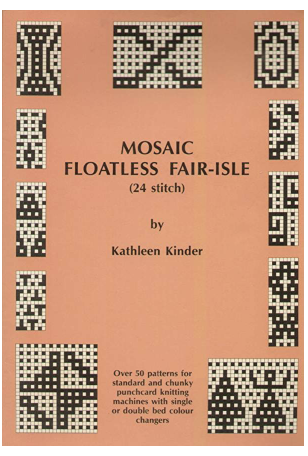
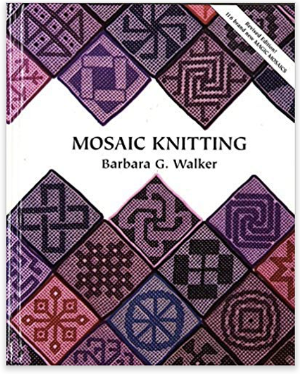
Two classic references: hand knitting Imagefor 24 and 40 stitch machines. ImageIn mosaics and maze conversion, the original file is not rendered double height before being separated. In other knit structures, the original file is commonly doubled in height before the separation, solving by default the even # row requirement.
Aside from the automatic color separation and what comprises the original file input, ie, indexed BW mode and an even number of rows, depending on the manual separation, the actual file on completion of the separation may need to be altered again before knitting, doubled in height.
The last double height can be achieved by altering the separated PNG before downloading it to electronic models. Symbols for that vary depending on machine or model year, in this case, 910 houses and trees, #4. ImageThe 950i  uses ships, but the button placements are in the same positions, and perform the same tasks, Imageor the placement of the card lock lever in punchcard machines. ImageI prefer punching or programming repeats that do not require the built-in elongation selections. Returning to specific rows after interruptions in knitting or correcting patterning errors during it are easier to track.
Whether the color separations are performed manually or with automated tools, the prerequisite is that the input file aligns properly when tiled. Often, published designs have added rows that will double when drawn in repeat, solved by cropping rows at the top and at one side, as addressed in other blog posts.

Using Gimp color invert.
A starting file,  used repeatedly in previous posts on mosaic knitting, 12X18.ImageA brief review of DIY steps involved, taken for granted when performed unseen by software, follows.
The expected results can be visualized by tiling the repeat in Gimp using Filters> Map> Tile, and entering a multiple of the design, accepting the default ratio 120X180, or breaking the chain and entering a second number, ie, 126. ImageImageThe view of a magnified segment.  ImageWhen working with Gimp, rectangle select, the aspect ratio can be set to the width of the repeat, 12, and 1 for the height of the selection.
Hold down the shift key to process the whole image beginning at the top left and continuing on every odd-numbered row.
The handles and dotted lines appear as one moves down toward the bottom. If a selection error is made moving down, while still pressing on the shift key, select edit, undo to remove the selection. ImageThe reversal takes place by choosing Colors > Invert only on selected rows after release of the shift key. ImageWith every other odd-numbered row selected and inverted,  the 3 images on the left show the separation, and the last on the right shows the separated file scaled to double height, which is actually needed to knit the mosaic successfully. ImageWhen selectively scaling, ie, only for height, check that the chain is broken, and interpolation is selected/ changed to None. The change can be made permanent by altering the Tool Options default interpolation in program settings. ImageThe 12X36 file is ready to knit and is also shared in repeat. The first preselection row is from right to left, and the color changer. ImageImage

ImageThis repeat for a larger design, 38X34, ImageImagewas separated using the custom filter, with the knit-ready result, 38X68, obtained in a single step

Image ImageImageA design that combines the mosaic grid work with the straight horizontal design found in mazes began with a 26X26 repeat, ImageImage followed by rotations and additions of a 26X20 partial repeatImageresulted in a 66X24 PNG   Imagethat, when viewed tiled on the screen, looked OK   Image the single repeat, separated using the script,66X48, was swatched using the slip stitch setting. Image

ImageBoth tuck and slip shorten the end knit along the all knit stitches beside them, which in this case form wide horizontal stripes. Those stripes in turn become distorted, seen here at the top and bottom of the swatch; the degree of 3D effect depends on the ratio of slip or tuck counts to knit stitches.
The repeat adjusted to a slightly different alignment if I were to personally use it in a final piece, 66X26, ImageImageseparated to 66X52ImageThe question then becomes whether more is less.
The original 26X26 design, separated to 26X52, Imageshown drawn in repeat X3, 78X52, Imagewas test-knit using the tuck setting. The yarns used are Silk City wool crepe purchased as seasonal remnants decades ago. Its fiber content is typically 80% wool and 20% manufactured fiber like rayon or viscose. The surface of the swatch is far more 3D than its slip stitch relative. ImageReturning to a 2015 post on working with online generated mazes, and the selection Imagewith the isolated repeat, 14X34ImageImagerendered in BW Imagethe script “mosaic” separation,  14X68Imagecolor inverted for knitting using either tuck or slip stitch setting. ImageImageThe sample, knit in tuck stitch for 134 rows, measures 9.25 inches in height.Image

DOUBLE JACQUARD
The abridged view of the same steps in the separation for knitting the original 12X18 row design as DBJ, where each color in each design row knits twice.  

ImageThe final file is composed of pairs of identical rows.
The process begins with the original image doubled in height, in this instance,  to 12X36.  ImageImageEvery alternate row is color-inverted, and then doubled in height for knitting to 12X72

Image12X72ImageThe first preselection row is from right to left, toward the color changer in Japanese KM models.
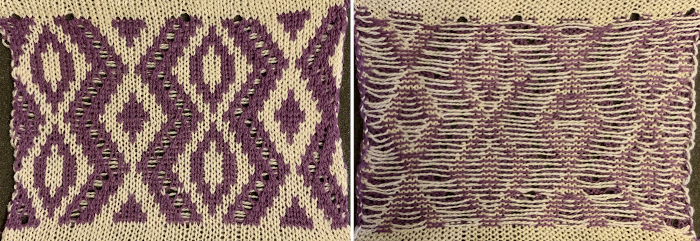
Because each color in each design row knits twice, the design is very elongated, even when knit with birdseye backing. The random color choice was not the best in the related sample. ImageIf the goal then becomes to have each color knit only once to reduce aspect ratio distortion, or if other knit stitch structures and combinations are planned, additional processing is required.
For strictly 2-color knitting, with BW starting images, electronic knitting machines automate each pixelated BW row for knitting each color only once per row with the flick of a button, generally labeled KRC.
The starting side for the preselection row is from left to right.
The 2 rows for the first color are split between the top and bottom of the programmed repeat.
The actions performed automatically: ImageIn the post ArahPaint in knit design 6: color separation,  this suggested method proved faulty when tested here. ImageImageThe result shows the dramatic difference in scale when each color in each row knits only once, but there are noticeable white stitches that are breaking vertical red lines, not intended and not the result of a programming error. ImageAnalyzing the result: the first and last row of the design are unaffected by the separation, and when knitting lengths, that same design row will repeat twice.
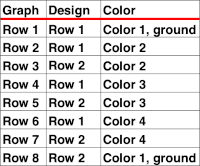
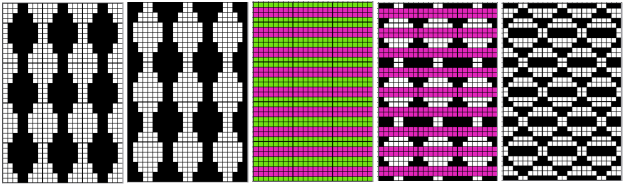
This proposed method shifts the first design row to the top, maintaining the 12X36 dimensions, and is then color-inverted, rendering a 12X36 file that is ready to knit. The first preselection row is from right to left toward the color changer.
regrouping, 12X36 Imagewith the bottom row shifted to the top, Imagethe separation, also 12X36ImageThe steps in the separation
1: the original image, 12X18
2: the original doubled in height, 12X36
3: move the bottom row to the top of the repeat, still 12X36
4: as an optional guide, a column was added on the right, increasing the width to 13 pixels, marking pairs of rows to be inverted. The added pixels were originally red; when color inversion was used, they were also converted to blue pixels
5: number 4 with the blue and white pixel column removed, the ready-to-knit repeat, also 12X36. Image The swatch is knit using birdseye backing, an added technique that helps to maintain the aspect ratio of the original design.
The visible extra white loops on the side are due to yarn feeds in mast issues that have gotten added to my list of “well, I have not run into this before!”  
Image

Duplicating the KRC model, with added changes, but the same result: the hand-selection method to illustrate the color invert steps, from left to right: the 8X8 PNG start,
rendered double height to 8X16,
with the bottom row moved to the top,
the separation illustrated with marks for the placement of the inverted rows in blue,
and the knittable final repeat, 8X16ImageImageSample color separated using a Vibe-Coded script to obtain the 8X16 result:
the goal is to knit each color in each design row only once, matching the electronic automated electronic KRC selection, with a critical difference: the preselection row is from the right, followed by color changes every 2 rows. ImageImageTesting a larger design repeat, 43X44ImageImagecolor separated to 43X88Imageknit with birdseye backing, with preselection starting from the right Image

More to ponder: the method used to have each design row knit twice produces files that can be altered again in double bed work for other stitch structures, or used as they are in single bed slip stitch that knits carrying one color at a time for 2 rows.

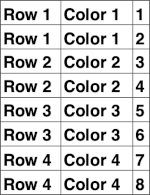
Reviewing charts for different separations, including use of more than 2 colors: depending on the published source, sometimes letters are assigned, others numbers, and they sometimes differ in identification sequences.
Continuing with Double bed separations, the longest to execute manually, while considering different stitch structures:
 

Image