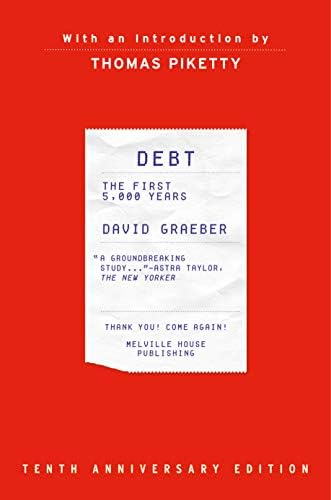





















Graeber's book is a long, slow read, yet it is a fascinating page-turner for which I enjoyed EVERY SINGLE PAGE. I would highly recommend this five-star book to anyone who enjoys investigating the mysteries of economics in our modern world and to anyone who enjoys history, sociology, anthropology, or looking for major historical trends which tie together and explain world events.
I saw a few critical reviews while reading this book, and now that I have finished, my opinion is that anyone who negatively reviews this book only read a portion of it. Most of the critical reviews are dismissive of his "point-of-view" as being "wrong." However, anyone who has actually read the whole book realizes that he has stepped back and looked at these issues from multiple perspectives and through the lens of multiple disciplines. People who are upset by this book (or by the introductory chapters) are upset because today's economics teaching focuses only on a small piece of the "economics thought pie" (my term) which is out there. Graeber steps out into discussing pieces which are less covered (or not covered at all) in typical economics classes in the West of today. So, rather than reading through his arguments, and seeing where they wind up by reading the whole book, I am certain these people gave up only part-way into the book, and then wrote a negative review because the ideas are different (much wider and more complicated) than they have been taught, and they find it "out of their paradigm" and just can't accept reading further. Yet, anyone should be able to read alternative ideas that challenge traditional ideas in order to see if their beliefs really stand up under scrutiny.
So much information is packed into Debt: The First 5,000 Years, that it could easily have been written as five separate stand-alone books. As an anthropologist at the London School of Economics, Graeber wrote a massive, sprawling history of debt, credit, and the development of markets and money; he ties it to war, slavery, taxes, tribute, government bureaucracy, religious thought, and both local and international trade, by looking at societies from ancient Mesopotamia, to India, to China, to ancient Greece and Rome, to Latin America, to the Middle Ages, and to the Modern Ages.
Why did he do it this way? Several reasons. First, as an anthropologist, he felt he was in a unique position to help us completely rethink our sense of the rhythms of economic history. Economists and historians, he points out, normally come at history in opposite directions. "Economists tend to come at history with their mathematical models--and the assumptions about human nature that come along with them--already in place: it's largely a matter of arranging the data around equations. Historians .....often refuse to extrapolate at all; in the absence of direct evidence.....they will not ask whether it is reasonable to make (certain) assumptions....this is why we have so many "histories of money" that are actually histories of coinage....Anthropologists, in contrast, are empirical--they don't just apply preset models--but they also have such a wealth of comparative material at their disposal they CAN actually speculate about what village assemblies in Bronze Age Europe or credit systems in ancient China were likely to be like. And they can reexamine the evidence to see if it confirms or contradicts their assessment." Second, as a admirer of French anthropologist Marcel Mauss, by writing this book, Graeber feels he has put to rest the real "pet peeve" of anthropologists everywhere--the myth of barter. I found this a shocking idea when introduced to it at the beginning of the book, but he has really convinced me as a reader through his extensive and comprehensive looks at every possible facet of this question.
I will try to summarize in one paragraph the large sweeping ideas covered in this book. What is money, really? What determines what gets used as money, and why? Certain historical ages operated on mutual credit systems, with practically no coinage at all in circulations (for hundreds or even thousands of years at a time); other ages operated with coin made out of various precious metals. What were the differences between the types of ages when these different types of systems occurred in societies around-the-world, and what were the causes of these differences? Historically, when did these various ages occur, and why? What is happening now, and is the current situation in the world changing? We seem to have recently entered a new age of credit, but in many ways, completely unlike past ages of credit, with historical trends now completely reversed between creditors and debtors compared to past credit ages. How does war and slavery factor into all of this? What is capitalism and how did it come about? Does it really work as it claims to? What are the problems and myths associated with capitalism? What does faith and credit in government and society mean, and what has it meant throughout all historical ages around-the-world? These are just a few of the book's largest questions.
Now I will touch on what this book meant to me personally. As an American living overseas in North Africa, I really enjoyed his discussion of how credit was handled during the Middle Ages in Europe, with most people living on credit in regards to each other. It reminded me of the system we even continue to use in North Africa, even in cities, with the merchants at the corner stores (which are our societal equivalents of 7-11 stores). Each family has a notebook which they bring with them to the store each time they want to purchase something. The merchant notes it in the book, and accounts are settled up at the end of the month. Without cash or coin available to most of the populace in the European Middle Ages, everyone operated on such bases with their neighbors, everyone kept accounts, and accounts were settled up in the whole village once or twice a year, usually at specific times or festivals. I found this really interesting. Many such examples from the book meant something to me in my own life, but they would be too numerous to list here.
The price of this paperback was one for which I got more than my money's worth, many times over, for the many pleasurable hours of reading, and all I learned, in a highly-enjoyable and extremely well-written text. I wish I could sit in on David Graeber's class. Be prepared--you will want to discuss this book with friends, so try to get a friend or a book club group to read it with you.

$16.99 with 37 percent savings
Print List Price: $26.99 
The Print List Price is the lowest suggested retail price provided by a publisher for a print book format of this title, available on Amazon (e.g. hardcover, paperback, mass market paperback).
Learn more
Learn more

Download the free Kindle app and start reading Kindle books instantly on your smartphone, tablet, or computer - no Kindle device required.
Read instantly on your browser with Kindle for Web.
Using your mobile phone camera - scan the code below and download the Kindle app.

Follow the author
Get new release updates & improved recommendations
Something went wrong. Please try your request again later.
Great on Kindle
Great Experience. Great Value.

Putting our best book forward
Each Great on Kindle book offers a great reading experience, at a better value than print to keep your wallet happy.
Explore your book, then jump right back to where you left off with Page Flip.
View high quality images that let you zoom in to take a closer look.
Enjoy features only possible in digital – start reading right away, carry your library with you, adjust the font, create shareable notes and highlights, and more.
Discover additional details about the events, people, and places in your book, with Wikipedia integration.
Get the free Kindle app: 

Enjoy a great reading experience when you buy the Kindle edition of this book. Learn more about Great on Kindle, available in select categories.
Products related to this item
Page 1 of 1Start over
About the author

Products related to this item
Page 1 of 1Start over
Customers say
Customers find the book scholarly and enlightening, particularly praising its comprehensive exploration of the historical basis of debt. The information is detailed and well-researched, with one customer noting how it makes sense of both micro- and macroeconomics. Customers describe it as an interesting and engaging read, with one review highlighting how it busts economic fairy tales. The book's readability receives mixed feedback, with some finding it quite readable while others find it insanely hard to read.
AI Generated from the text of customer reviews
Select to learn more
34 customers mention scholarly content, 33 positive, 1 negative
A far, far better book than the silly title would suggest. Scholarly and polemical study of some basic concepts that rule our economic lives....Read more
...recent passing of David Graeber is a loss to both thorough and insightful analysis and commentary....Read more
...as a non-academic, but read the entire book due to the thought provoking questions and historical evidence provided throughout.Read more
Groundbreaking, deep, rigorous, and thought-provoking. Read this, along with everything else this man ever wrote.Read more
26 customers mention history, 24 positive, 2 negative
...This is not an accounting textbook. This is a World History!Read more
...But what a phenomenal book. The history, detail, explanations, and writing are all details and digestible....Read more
A good history of money, but it gets liberal and preachy at the end.Read more
...exploration of moral, religious, philosophical, and anthropological history this book explains how that happened and how it could be different.Read more
24 customers mention information quality, 21 positive, 3 negative
Groundbreaking, deep, rigorous, and thought-provoking. Read this, along with everything else this man ever wrote.Read more
This is one of the better researched and written books on how people think about and manage exchange through history....Read more
...lots of great examples and interesting tidbits make this a fun read.Read more
The book is very informative if a litt wonkish. The topic was very broad. It's not at all a light read. Very thorough.Read more
24 customers mention reading quality, 22 positive, 2 negative
...lots of great examples and interesting tidbits make this a fun read.Read more
The scope of this book is huge, and fascinating. Who knew that money didn't really start from barter but as a way to quantify obligations?...Read more
Graeber's book is one of the most intriguing books I have read in a long time. The accolades that accompany this book are not exaggerations.Read more
Astonishingly good book. Really, really interesting. Packed with lots off new ideas. High recommended.Read more
19 customers mention book content, 18 positive, 1 negative
Very poignant considering the global economic issues of today....Read more
Quite simply, this book changed my life. Nothing I have ever read has transformed my understanding of human history in the same way....Read more
One of the most important books of our time. Buy it and Read. It is our future. Zakat?Read more
Very profound book. One of the best I ever read and I read hundredsRead more
7 customers mention debt, 6 positive, 1 negative
...The book challenged and changed my thinking about debt, credit and how we think about exchange.Read more
...this is a totally fascinating dive into the origins and function of debt and credit in the ancient world to the present, getting granular at times...Read more
...Keeping track of debt relationships in such a group is easy enough, and Mr. Graeber adduces lots of evidence of such groups utilizing debt systems...Read more
...He certainly throws debt into a different light. I recommend this book for anyone who has read Dawn of Everything and wants more....Read more
7 customers mention narrative quality, 5 positive, 2 negative
...Lots of irrelevant but curious stories about the sexual practices of obscure cultures. Not much illumination of debt....Read more
...it combines fieldwork, theory, and history in a comprehensive, readable argument that challenges assumptions and suggests future avenues for...Read more
Not really a convincing argument. Makes sweeping generalizations and changes the ground of the argument in his favor when his position gets weak.Read more
...Even when Graeber's arguments aren't perfect, the central premise of this book is so refreshing, so necessary, that you can forgive Graeber's...Read more
9 customers mention readability, 3 positive, 6 negative
...: The First 5,000 Years by David Graeber was interesting, but read like a text book....Read more
Graeber's book is a long, slow read, yet it is a fascinating page-turner for which I enjoyed EVERY SINGLE PAGE....Read more
Tedious at times but forces you to think and rethink your relationship with moneyRead more
...examples can be found in the text, though it is a bit choppy and hard to read.Read more

Solid scholarly work on the topic and an essential piece of literature
It took me several months to read through it because I was simultaneously reading through/referencing a number of relevant economics works, but it was well worth the time to read it carefully. Solid 9/10 or better scholarly work on the topic with just a handful of typographical errors. The physical book quality (I got the hardcover) is also a solid 9/10: it gets the job done without compromise or ostentatiousness. Debt: the First 5,000 Years is an essential piece of literature for anyone thinking through the present circumstances, the forces that led to them, and potential ways to escape their deleterious grasp.
Top reviews from the United States
There was a problem filtering reviews. Please reload the page.
- Reviewed in the United States on December 22, 2025Format: HardcoverVerified Purchase
It took me several months to read through it because I was simultaneously reading through/referencing a number of relevant economics works, but it was well worth the time to read it carefully. Solid 9/10 or better scholarly work on the topic with just a handful of typographical errors. The physical book quality (I got the hardcover) is also a solid 9/10: it gets the job done without compromise or ostentatiousness. Debt: the First 5,000 Years is an essential piece of literature for anyone thinking through the present circumstances, the forces that led to them, and potential ways to escape their deleterious grasp.
Solid scholarly work on the topic and an essential piece of literature
Reviewed in the United States on December 22, 2025
Images in this review

Top reviews from other countries
- qhbReviewed in France on February 3, 2019
Thank God someone actually wrote the whole story!
Format: KindleVerified Purchase -
Amazon CustomerReviewed in Turkey on January 29, 2026
günümüz paradigmasına karşı güçlü bir argüman
Format: HardcoverVerified Purchase - AlunReviewed in Canada on May 24, 2025
A thought-provoking idea that it was credit that sired money, and not the other way
Format: PaperbackVerified Purchase - Amazon CustomerReviewed in the United Kingdom on May 20, 2015
Hard to read but worth the effort
Format: PaperbackVerified Purchase