Learn more
These promotions will be applied to this item:
Some promotions may be combined; others are not eligible to be combined with other offers. For details, please see the Terms & Conditions associated with these promotions.
Your Memberships & Subscriptions
Download the free Kindle app and start reading Kindle books instantly on your smartphone, tablet, or computer - no Kindle device required.
Read instantly on your browser with Kindle for Web.
Using your mobile phone camera - scan the code below and download the Kindle app.
Follow the author
OK
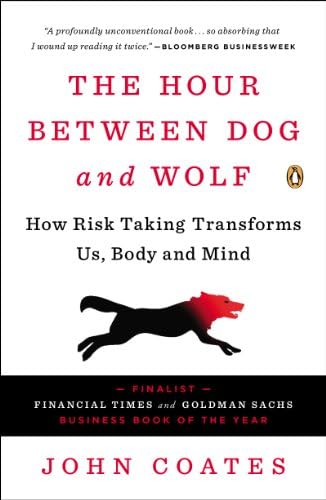
The Hour Between Dog and Wolf: How Risk Taking Transforms Us, Body and Mind Kindle Edition
“A profoundly unconventional book . . . So absorbing that I wound up reading it twice.” —Bloomberg
Finalist for the Financial Times and Goldman Sachs Business Book of the Year
What happens to your body when you take risks? What happens to it when you make or lose a lot of money?
In this startling book, physiologist and former Wall Street trader John Coates vividly illustrates what happens to your body when you engage in risk taking. You transform into a different person, a change Coates refers to as "the hour between dog and wolf." He tells a gripping story of a group of traders caught in a bull market and then a crash. As the excitement builds he takes us inside the traders' bodies to see the biology of risk taking at work, a biology shared by athletes, politicians, soldiers - anyone who ventures beyond their safety zone.
Coates also discusses how men and women excel at different types of risk; how the stress of failure damages our health; and how we can train our bodies so that they help rather than hinder our risk taking. Revealing the biology behind bubbles and crashes, The Hour Between Dog and Wolf sheds new and surprising light on issues that affect us all.
- LanguageEnglish
- PublisherPenguin Books
- Publication dateJune 14, 2012
- File size2.3 MB
Products related to this item
Customers also bought or read
- Thinking in Bets: Making Smarter Decisions When You Don't Have All the Facts
Kindle Edition$9.99$9.99 - One Good Trade: Inside the Highly Competitive World of Proprietary Trading (Wiley Trading Book 454)
Kindle Edition$40.00$40.00 - The Zen Trader: How ancient wisdom can help you master your mind and the markets
Kindle Edition$14.99$14.99 - Mind Over Markets: Power Trading with Market Generated Information, Updated Edition (Wiley Trading)
Kindle Edition$44.00$44.00 - Alpha Trader: The Mindset, Methodology and Mathematics of Professional Trading
Kindle Edition$36.36$36.36 - Market Mind Games: A Radical Psychology of Investing, Trading and Risk (DIGITAL AUDIO)
Kindle Edition$16.88$16.88 - A Complete Guide To Volume Price Analysis: Read the book then read the market
Kindle Edition$4.99$4.99 - The All Weather Trader: Mr. Serenity’s Thoughts on Trading Come Rain or Shine
Kindle Edition$14.99$14.99 - The Laws of Trading: A Trader's Guide to Better Decision-Making for Everyone (Wiley Trading)
Kindle Edition$19.00$19.00 - Fooled by Randomness: The Hidden Role of Chance in Life and in the Markets (Incerto Book 1)
Kindle Edition$15.99$15.99
Editorial Reviews
Review
“If anyone is qualified to unify the seemingly disparate subjects of financial markets and neurology, it’s John Coates…The Hour Between Dog and Wolf is a powerful distillation of his work—and an important step in the ongoing struggle to free economics from rational-actor theory.”—The Daily Beast
“[I]t makes intuitive sense that biological responses inform the mood of the markets. This book puts flesh on that idea.”—The Economist
“Compelling.”—New Scientist
“[A] scintillating treatise on the neurobiology of the business cycle. Coates… draws an intimate portrait of life on a trading floor …The result is a provocative and entertaining take on the irrational exuberance—and anxiety—of the modern economy.”—Publishers Weekly
“A provocative challenger to rational choice views of high finance, Coates makes an exceptionally clear, readable presentation that is bound to influence arguments about the regulation of Wall Street.”—Booklist
“An in-depth look at how financial risk-taking is linked to human biology, especially to the testosterone levels of young male traders, and the implications of this phenomenon for financial markets and the wider economy.”—Kirkus
About the Author
Excerpt. © Reprinted by permission. All rights reserved.
WHEN YOU TAKE RISKS, YOU ARE REMINDED IN THE MOST insistent manner that you have a body. For risk by its very nature threatens to hurt you. A driver speeding along a winding road, a surfer riding a monster wave as it crests over a coral reef, a mountain climber continuing his ascent despite an approaching blizzard, a soldier sprinting across noman’s land—each of these people faces a high chance of injury, even death. And that very possibility sharpens the mind and calls forth an overwhelming biological reaction known as the “fight-or-flight” response. In fact, so sensitive is your body to the taking of risk that you can be caught up in this visceral turmoil when death poses no immediate threat. Anyone who plays a sport or watches from the stands knows that even when it is “just a game,” risk engages our entire being. Winston Churchill, a hardened campaigner from the most deadly wars, recognized this power of nonlethal risk to grip us, body and mind. When writing of his early years, he tells of a regimental polo match played in southern India that went to a tie-break in the final chukka: “Rarely have I seen such strained faces on both sides,” he recalls. “You would not have thought it was a game at all, but a matter of life and death. Far graver crises cause less keen emotion.”
Similar strong emotions and biological reactions can be triggered by another form of nonlethal risk—financial risk taking. With the exception of the occasional broker suicide (and these may be more myth than reality), professional traders, asset managers and individuals investing from home rarely face death in their dealings. But the bets they place can threaten their job, house, marriage, reputation and social class. In this way money holds a special significance in our lives. It acts as a powerful token distilling many of the threats and opportunities we have faced over eons of evolutionary time, so making and losing it can activate an ancient and powerful physiological response.
In one important respect, financial risk carries even graver consequences than brief physical risk. A change in income or social rank tends to linger, so when we take risks in the financial markets we carry with us for months, even years after our bets have settled, an inner biological storm. We are not built to handle such long-term disturbances to our biochemistry. Our defense reactions were designed to switch on in an emergency and then switch off after a matter of minutes or hours, a few days at the most. But an above-average win or loss in the markets, or an ongoing series of wins or losses, can change us, Jekyll-and-Hyde-like, beyond all recognition. On a winning streak we can become euphoric, and our appetite for risk expands so much that we turn manic, foolhardy and puffed up with self-importance. On a losing streak we struggle with fear, reliving the bad moments over and over, so that stress hormones linger in our brains, promoting a pathological risk aversion, even depression, and circulate in our blood, contributing to recurrent viral infections, high blood pressure, abdominal fat build-up and gastric ulcers. Financial risk taking is as much a biological activity, with as many medical consequences, as facing down a grizzly bear.
This statement about biology and the financial markets may sound strange to ears accustomed to the teachings of economics. Economists tend to view the assessment of financial risk as a purely intellectual affair— requiring the calculation of asset returns, probabilities and the optimal allocation of capital—carried on for the most part rationally. But to this bloodless account of decision making I want to add some guts. For recent advances in neuroscience and physiology have shown that when we take risks, including financial risk, we do a lot more than just think about it. We prepare for it physically. Our bodies, expecting action, switch on an emergency network of physiological circuitry, and the resulting surge in electrical and chemical activity feeds back on the brain, affecting the way it thinks. In this way body and brain twine as a single entity, united in the face of challenge. Normally this fusion of body and brain provides us with the fast reactions and gut feelings we need for successful risk taking. But under some circumstances the chemical surges can overwhelm us; and when this happens to traders and investors they come to suffer an irrational exuberance or pessimism that can destabilize the financial markets and wreak havoc on the wider economy.
To give you a mere inkling of how this physiology works, I am going to take you onto the trading floor of a Wall Street investment bank. Here we will observe a high-stakes world where young bankers can step up or down a full social class in the space of a single bonus season, one year buying a beach house in the Hamptons, the next pulling their kids out of private school. So consider if you will the following scenario, in which an unanticipated and important piece of news impacts an unsuspecting trading floor.
INCOMING!
It has been said of war that it consists of long stretches of boredom punctuated by brief periods of terror, and much the same can be said of trading. There are long stretches of time when little more than a trickle of business flows in through the sales desks, perhaps just enough to keep the restless traders occupied and to pay the bills. With no news of any importance coming across the wire, the market slows, the inertia feeding on itself until price movement grinds to a halt. Then, people on a trading fl oor disappear into their private lives: salespeople chat aimlessly with clients who have become friends; traders use the lull to pay bills, plan their next ski trip or talk to headhunters, curious to know their value on the open market. Two traders, Logan, who trades mortgage-backed bonds, and Scott, who works down the aisle on the arbitrage desk, toss a tennis ball back and forth, taking care not to hit any salespeople.
This afternoon the Federal Reserve is holding a meeting of its Board of Governors, and normally these events are accompanied by market turbulence. It is at these meetings that the Fed decides whether to raise or lower interest rates, and should it do so it announces its decision at 2:15 p.m. Even though the economy has been growing at a healthy clip and the stock market has been unseasonably, even irrationally, strong, the Fed has dropped few hints of an increase. So today it is widely expected to leave rates unchanged, and by late morning most people across the trading fl oor haven’t a worry on their minds, and think of little else but whether to order sushi or pasta for lunch.
But just before noon there comes the merest breath of change, rippling the surface of prices. Most people on the floor do not consciously notice it, but the slight tremor registers nonetheless. Maybe their breathing quickens, maybe muscles tense just a bit, maybe arterial blood pressure increases ever so slightly. And the sound of the floor shifts, from the quiet buzz of desultory conversation to a mildly excited chatter. A trading floor acts as a large parabolic reflector, and through the bodies of its thousand odd traders and salespeople it gathers information from faraway places and registers early signals from events that have yet to happen. The head of the trading floor looks up from his papers and steps out of his office, surveying the floor like a hunting dog sniffing the air. An experienced manager can sense a change in the market, tell how the floor is doing, just from the sight and sound of it.
Logan stops in midthrow and looks over his shoulder at the screens. Scott has already wheeled his chair back to his desk. Their monitors display thousands of prices and flowing news feeds, blinking and disappearing. To outsiders the vast matrix of numbers seems chaotic, overwhelming, and finding the significant bit of information in the mess of prices and irrelevant news items seems as impossible as picking out a single star in the Milky Way. But a good trader can do just that. Call it a hunch, call it gut feeling, call it tradecraft, but this morning Scott and Logan have sensed a kaleidoscopic shift in price patterns well before they can say why.
One of the brain regions responsible for this early warning system is the locus ceruleus (pronounced ser-u-leus), so called because its cells are cerulean, or deep blue. Situated in the brain stem, the most primitive part of the brain, sitting atop the spine, the locus ceruleus responds to novelty and promotes a state of arousal. When a correlation between events breaks down or a new pattern emerges, when something is just not right, this primitive part of the brain registers the change long before conscious awareness. By doing so it places the brain on high alert, galvanizing us into a state of heightened vigilance, and lowering our sensory thresholds so that we hear the faintest sound, notice the slightest movement. Athletes experiencing this effect have said that when caught up in the fl ow of a game they can pick out every voice in the stadium, see every blade of grass. And today when the stable correlations between asset prices broke down the locus ceruleus tripped an alarm, causing Scott and Logan to orient to the disturbing information.
Moments after Scott and Logan have preconsciously registered the change, they learn that one or two people on the Street have heard, or suspected, that the Fed will raise interest rates this afternoon. Such a decision announced to an unprepared financial community would send a tidal wave of volatility through the markets. As the news and its implications sink in, Wall Street, only a short while ago looking forward to calling it an early day, roils with activity. At hastily organized meetings traders consider the possible Fed moves—will it leave rates unchanged? Raise them a quarter of a percentage point? Half a percent? What will bonds do under each scenario? What will stocks do? Having formed their views, traders then jostle to set their positions, some selling bonds in anticipation of a rate hike, which pushes the market down almost 2 percent, others buying them at the new lower levels, convinced the market is oversold.
Markets feed on information, and the Fed announcement will be a feast. It will bring volatility to the market, and volatility to a trader means a chance to make money. So this afternoon most traders exude excitement, and many of them will make their entire week’s profit in the next few hours. Around the world bankers stay up to hear the news, and trading floors now buzz with a ludic atmosphere more commonly found at a fair or sporting event. Logan warms to the challenge and with a rebel yell dives into the seething market, selling $200 million mortgage bonds, anticipating an exciting ride down.
By 2:10, trading on the screen dwindles. The floor goes quiet. Across the world traders have placed their bets, and now wait. Scott and Logan have readied their positions and feel intellectually prepared. But the challenge they face is more than an intellectual puzzle. It is also a physical task, and to perform it successfully they require a lot more than cognitive skills. They also need fast reactions, and stamina enough to support their efforts for the hours ahead when volatility spikes. What their bodies need, therefore, is fuel, lots of it, in the form of glucose, and they need oxygen to burn this fuel, and they need an increased fl ow of blood to deliver this fuel and oxygen to gas-guzzling cells throughout the body, and they need an expanded exhaust pipe, in the form of dilated bronchial tubes and throat, to vent the carbon dioxide waste once the fuel is burned.
Consequently Scott and Logan’s bodies, largely unbeknownst to them, have also prepared for the event. Their metabolism speeds up, ready to break down existing energy stores in liver, muscle and fat cells should the situation demand it. Breathing accelerates, drawing in more oxygen, and their heart rates speed up. Cells of the immune system take up position, like firefighters, at vulnerable points of their bodies, such as the skin, and stand ready to deal with injury and infection. And their nervous system, extending from the brain down into the abdomen, has begun to redistribute blood throughout their bodies, constricting blood flow to the gut, giving them the butterflies, and to the reproductive organs—since this is no time for sex—and shunting it to major muscle groups in the arms and thighs as well as to the lungs, heart and brain.
As the sheer potential for profit looms in their imagination, Scott and Logan feel an unmistakable surge of energy as steroid hormones begin to turbocharge the big engines of their bodies. These hormones take time to kick in, but once synthesized by their respective glands and injected into the bloodstream, they begin to change almost every detail of Scott’s and Logan’s body and brain—their metabolism, growth rate, lean-muscle mass, mood, cognitive performance, even the memories they recall. Steroids are powerful, dangerous chemicals, and for that reason their use is tightly regulated by law, by the medical profession, by the International Olympic Committee, and by the hypothalamus, the brain’s “drug enforcement agency”; for if steroid production is not turned off quickly it can transform us, body and mind.
From the moment the rumor first spread, and over the past couple of hours, Scott’s and Logan’s testosterone levels have been steadily climbing. This steroid hormone, naturally produced by the testes, primes them for the challenge ahead, just as it does athletes preparing to compete and animals steeling for a fight. Rising levels of testosterone increase Scott’s and Logan’s hemoglobin, and consequently their blood’s capacity to carry oxygen; the testosterone also increases their state of confidence and, crucially, their appetite for risk. For Scott and Logan, this is a moment of transformation, what the French since the Middle Ages have called “the hour between dog and wolf.”
Another hormone, adrenaline, produced by the core of the adrenal glands located on top of the kidneys, surges into their blood. Adrenaline quickens physical reactions and speeds up the body’s metabolism, tapping into glucose deposits, mostly in the liver, and flushing them into the blood so that Scott and Logan have back-up fuel supplies to support them in whatever trouble their testosterone gets them into. A third hormone, the steroid cortisol, commonly known as the stress hormone, trickles out of the rim of the adrenal glands and travels to the brain, where it stimulates the release of dopamine, a chemical operating along neural circuits known as the pleasure pathways. Normally stress is a nasty experience, but not at low levels. At low levels it thrills. A nonthreatening stressor or challenge, like a sporting match, a fast drive, or an exciting market, releases cortisol, and in combination with dopamine, one of the most addictive drugs known to the human brain, it delivers a narcotic hit, a rush, a flow that convinces traders there is no other job in the world.
Now, at 2:14, Scott and Logan lean into their screens, gazes steady, pupils dilated; heart rates drop to a slow idle; their breathing rhythmic and deep; muscles coiled; body and brain fused for the impending action. An expectant hush descends on global markets.
Product details
- ASIN : B0074VTH0W
- Publisher : Penguin Books
- Accessibility : Learn more
- Publication date : June 14, 2012
- Edition : 1st
- Language : English
- File size : 2.3 MB
- Screen Reader : Supported
- Enhanced typesetting : Enabled
- X-Ray : Enabled
- Word Wise : Enabled
- Print length : 348 pages
- ISBN-13 : 978-1101583630
- Page Flip : Enabled
- Best Sellers Rank: #136,976 in Kindle Store (See Top 100 in Kindle Store)
- #80 in Neuroscience (Kindle Store)
- #98 in Decision-Making & Problem Solving
- #114 in Business Decision-Making
- Customer Reviews:
About the author

Discover more of the author’s books, see similar authors, read book recommendations and more.
Products related to this item
Customer reviews
Customer Reviews, including Product Star Ratings help customers to learn more about the product and decide whether it is the right product for them.
To calculate the overall star rating and percentage breakdown by star, we don’t use a simple average. Instead, our system considers things like how recent a review is and if the reviewer bought the item on Amazon. It also analyzed reviews to verify trustworthiness.
Learn more how customers reviews work on AmazonCustomers say
Generated from the text of customer reviewsSelect to learn more
Reviews with images
Damaged cover but good book to read
Top reviews from the United States
There was a problem filtering reviews. Please reload the page.
- Reviewed in the United States on June 16, 2023Format: KindleVerified PurchaseWhat an amazing read. The first time I have seen someone connect biology and trading, and make such amazing and convincing arguments and observations in the process.
I think this is a must have in any traders bookshelf. When you want to take a break from charts and financial analysis, pick this one up and you will learn important information.
The book is all about explaining what is happening in our body when we trade. A behind the scenes look that shows how our nervous system combined with hormones interact with our body and what happens when we trade.
What happens when we take on risk, when we manage the positions, take on more risk, etc. What happens when we succeed wildly and also when we crash badly.
The book ends with some high level policy advice that I agree: markets would benefit from increasing the number of women and older men participating in them. It also has much advice at an individual level, how to condition yourself to become better at handling stress.
All in all, loved this book!
- Reviewed in the United States on October 14, 2012Format: HardcoverVerified PurchaseThe Hour between the Dog and the Wolf is about risk taking, the nervous system and our biochemistry and how they all relate to each other in various feedback mechanisms. The book is both a combination of a scientific introduction to the way the nervous system and body work together and a fictional narrative of the trading floor in a bank. The narrative is used to describe the real time emotional changes felt by traders in response to their changing risk and profit environments. The book is informative and readable and I came out of it better understanding myself. The book is split into 4 distinct parts.
The first section is titled Mind and Body in the Financial Markets. The backdrop is the internet bubble and questions of exuberance in markets is pondered. The author introduces testosterone and cortisol as potential active molecules in impacting decision. Basic concepts of mind body separation are included. The author then goes on to describe the mind as facilitating the body. He discusses how if one view our purpose in life as to move, then the mind is just an elaborate mechanism to facilitate that movement more productively. This helps give the platform to understand us as being always being a vehicle for movement and that we should not deny the signals our body sends us.
The second section - Gut Thinking discusses the way our instincts can propogate through the nervous system. He discusses how our body's instincts operate on a much faster speed than our computational thought. This subject matter is similar to that of many behavioural scientists and is akin to Kahneman in fast and slow thinking. The value of relying on instincts is studied and our instincts are shown to be very good at pattern recognition which can fail when we are faced with randomness. The inclusion of our muscle responses to our nervous system and our internal feedbacks helps give an overall view of our various mind body relationships.
The 3rd section Seasons of the Market discusses various market regimes and how our body chemistry in each of those regimes is different. Searching for opportunity, riding waves of profit or enduring catastrophic losses are all discussed via narratives of characters the author uses. It helps make sense of real life situations and how we are all biased agents when it comes down to it. This section is where the author really weaves in the impact on financial decision making.
The author concludes with discussing the difference between various types of people and how environment and activity can affect our instincts and our feedback mechanisms. We all have some plasticity and though we inevitably are impacted by the stresses around us we can handle them differently and experience matters. The author then goes on to give partial solutions to dampening the positive and negative feedback loops our body creates in risk taking behaviour to improve our financial system.
All in all The Hour Between the Dog and the Wolf is a very informative account of the way we work in stressful environments and how those environments affect the way we think and act in an active fashion. I much preferred the scientific explanation instead of the specific impact on trading as the lessons are very broad and are relevant to much more than trading. One does not come out of reading the book having a clear path to more robust financial management as that is extremely challenging but one does come through it with more insight about how we work.
- Reviewed in the United States on September 21, 2012Format: HardcoverVerified PurchaseInvestors are well served by studying behaviorial and decision-making psychology broadly and then selectively transferring that knowledge to financial markets. Arguably, the most influential readings come from authors who are not directly involved in financial markets. For example, the Psychology of Intelligence Analysis by former CIA staffer Richard Heuer captures the pitfalls of making decisions when faced with incomplete information. Stepping back further, to readings about the emerging discipline of neuroeconomics, requires a basic understanding of brain science and physiology. There are some useful layman's guides to these subjects, such as Brain Rules by John Medina but what's been missing is a book that ties together a cohesive explanation of why your brain and physiology drive your behavior and how this collective impact can translate into a greater understanding of market behavior. The Hour Between Dog and Wolf succeeds in this objective. Using both plain language and vivid trading room stories, author John Coates has written an important book for finance industry professionals who want to expand their understanding of the biological underpinnings of behaviorial finance.
The book's fictitious examples of trading floor scenarios are particularly effective. Science always becomes more interesting when its explained with personalized situations. Coates has succeeded in connecting the neuroscience with the behaviorial / cognitive psychology that's most relevant to investors. Finally, the 'suggested reading' section is excellent, a primer for further study that's accessible to non-scientists.
- Reviewed in the United States on September 7, 2012If you have ever wondered why very intelligent people seem to take inordinate risks, often against the prevailing evidence, then this book is a must read. Much of this risk taking has resulted in the current economic melt down since 2008.
Not only does John Coates deal with the practicalities of risk taking on the Wall Street dealing floor but also deals in detail with the biology that drives and is instrumental in risk in human and animal behaviour.
I have just written and placed on Kindle and Amazon, my own fictional crime and mystery book (Death At The Titanic), which also deals with risk as well as other themes.
The Hour between the Dog and the Wolf is an excellent exposition of the subject and it is dealt with in an informative and often amusing manner. It changed my mind about the concept of `gut feelings.'
An informative, well written and good read on a complex topic.
- Reviewed in the United States on July 5, 2025Format: PaperbackVerified PurchaseThe cover was damaged when we received them
3.0 out of 5 starsThe cover was damaged when we received themDamaged cover but good book to read
Reviewed in the United States on July 5, 2025
Images in this review
Top reviews from other countries
Janina DeReviewed in Germany on April 24, 20235.0 out of 5 stars Fun to read
Greatly written book about the biology of trading with lots of background information. I enjoyed reading this because I went through the trader's blues from bust to boom a couple of times myself and books like this help to understand what's happening to me when I run into problems.
GuyReviewed in the United Kingdom on October 1, 20255.0 out of 5 stars Neuroscience concepts brought to life
Great book. The author is a neuroscientist who was a trader, I am interested in both these things and the book combines them to give readers insight into both worlds. Enjoyed the fact it brought to life concepts that may be more dryly presented elsewhere.
yellowfishReviewed in Canada on January 31, 20135.0 out of 5 stars Eureka!
For all the books I have ever read about behavioral economics, psychology and trading, hoping to become a better trader ( I spent about 4 years as a pro prop trader) none of them combined comes close to this in giving me what I was looking for. And I'm not exaggerating. While most traders, or would be traders, go into the profession thinking they can beat the market if they learn more, or learn to control their emotions and discipline, Coates gets to the heart of the matter, which is...decision making behavior is principally a product of things we do not control, and more specifically, it is due to hormones. It's not that simple, or simplistic of course but Coates writes in an entertaining way that is both academically valid, completely compelling and thoroughly entertaining! Understanding how and why we act is something rarely addressed by most writers in trading psychology. Yet it is without question, the most crucial step to improvement. I can't give the book enough praise.
SuryakantReviewed in India on June 24, 20255.0 out of 5 stars Wonderful book!
Beautiful confluence of biology and finance. Your understanding of roles that brain and body play will be challenged. Must read!
-
Lector ecológicoReviewed in Spain on September 28, 20145.0 out of 5 stars Muy Bueno
El libro describe los principales tipos de hormonas que afectan a nuestro cuerpo y a nuestro comportamiento, con un enfoque centrado en actividades competitivas como deportes y trading. También explica cómo dichas hormonas afectan positiva o negativamente a nuestra salud a largo plazo y cómo el estado de nuestro cuerpo también influye en nuestro comportamiento, modificando nuestras decisiones conscientes sin que nos demos cuenta.