Save on pre-loved laptops
$5.99 with 67 percent savings
Print List Price: $18.00 Image

These promotions will be applied to this item:

Some promotions may be combined; others are not eligible to be combined with other offers. For details, please see the Terms & Conditions associated with these promotions.

You've subscribed to ! We will preorder your items within 24 hours of when they become available. When new books are released, we'll charge your default payment method for the lowest price available during the pre-order period.
Update your device or payment method, cancel individual pre-orders or your subscription at
Your Memberships & Subscriptions

Buy for others

Give as a gift or purchase for a team or group.
Learn more

How it works

  1. Choose your delivery method
  2. Send now or schedule for later
  3. Add your personal message
  4. Recipients can read on any device

These ebooks can only be redeemed by recipients in the US. Redemption links and eBooks cannot be resold.

Added to

Sorry, there was a problem.

There was an error retrieving your Wish Lists. Please try again.

Sorry, there was a problem.

List unavailable.
Kindle app logo image

Download the free Kindle app and start reading Kindle books instantly on your smartphone, tablet, or computer - no Kindle device required.

Read instantly on your browser with Kindle for Web.

Using your mobile phone camera - scan the code below and download the Kindle app.

QR code to download the Kindle App

Sponsored
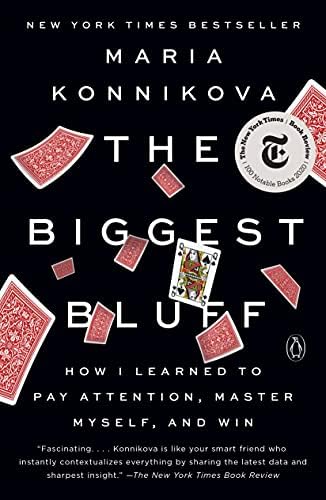
The Biggest Bluff: How I Learned to Pay Attention, Master Myself, and WinAmazon Videos
  • VIDEO

Follow the author

Get new release updates & improved recommendations
Something went wrong. Please try your request again later.

The Biggest Bluff: How I Learned to Pay Attention, Master Myself, and Win Kindle Edition

4.5 out of 5 stars (4,214)

A New York Times bestseller • A New York Times Notable Book

“The tale of how Konnikova followed a story about poker players and wound up becoming a story herself will have you riveted, first as you learn about her big winnings, and then as she conveys the lessons she learned both about human nature and herself.” —
The Washington Post

It's true that Maria Konnikova had never actually played poker before and didn't even know the rules when she approached Erik Seidel, Poker Hall of Fame inductee and winner of tens of millions of dollars in earnings, and convinced him to be her mentor. But she knew her man: a famously thoughtful and broad-minded player, he was intrigued by her pitch that she wasn't interested in making money so much as learning about life. She had faced a stretch of personal bad luck, and her reflections on the role of chance had led her to a giant of game theory, who pointed her to poker as the ultimate master class in learning to distinguish between what can be controlled and what can't. And she certainly brought something to the table, including a Ph.D. in psychology and an acclaimed and growing body of work on human behavior and how to hack it. So Seidel was in, and soon she was down the rabbit hole with him, into the wild, fiercely competitive, overwhelmingly masculine world of high-stakes Texas Hold'em, their initial end point the following year's World Series of Poker.

But then something extraordinary happened. Under Seidel's guidance, Konnikova did have many epiphanies about life that derived from her new pursuit, including how to better read, not just her opponents but far more importantly herself; how to identify what tilted her into an emotional state that got in the way of good decisions; and how to get to a place where she could accept luck for what it was, and what it wasn't. But she also began to win. And win. In a little over a year, she began making earnest money from tournaments, ultimately totaling hundreds of thousands of dollars.  She won a major title, got a sponsor, and got used to being on television, and to headlines like "How one writer's book deal turned her into a professional poker player." She even learned to like Las Vegas.

But in the end, Maria Konnikova is a writer and student of human behavior, and ultimately the point was to render her incredible journey into a container for its invaluable lessons. The biggest bluff of all, she learned, is that skill is enough. Bad cards will come our way, but keeping our focus on how we play them and not on the outcome will keep us moving through many a dark patch, until the luck once again breaks our way.

Great on Kindle
Great Experience. Great Value.
iphone with kindle app
Putting our best book forward
Each Great on Kindle book offers a great reading experience, at a better value than print to keep your wallet happy.

Explore your book, then jump right back to where you left off with Page Flip.

View high quality images that let you zoom in to take a closer look.

Enjoy features only possible in digital – start reading right away, carry your library with you, adjust the font, create shareable notes and highlights, and more.

Discover additional details about the events, people, and places in your book, with Wikipedia integration.

Get the free Kindle app: Link to the kindle app page Link to the kindle app page
Enjoy a great reading experience when you buy the Kindle edition of this book. Learn more about Great on Kindle, available in select categories.

Customers also bought or read

Loading...

Editorial Reviews

Review

“Fascinating. . . . Konnikova is like your smart friend who instantly contextualizes everything by sharing the latest data and sharpest insight, whom you come to quote too often. . . . Konnikova keeps the lines so clean and even, so steady and unshowy that she might be the Charlie Watts of prose: While the backbeat never ceases and the narrative propels along, it’s her curiosity that proliferates. In fact, one of the biggest bluffs of The Biggest Bluff may be that Konnikova hasn’t written a book about her success with cards and chips exactly, but bet the house on the power of her mind to synthesize big philosophical ideas and psychological insights at a time when we, too, find ourselves questioning our fortunes, hoping to master our fates and playing much bigger odds than ever before.” New York Times Book Review

“There has never been a more pressing need for digestible and coherent literature on rational decision-making. Enter
The Biggest Bluff, psychologist Maria Konnikova’s depiction of her journey into professional poker. What at first seems a light-hearted story about a curious academic dipping her toe into shark-infested waters delivers a crucial lesson in how to thrive in an increasingly misleading world. . . . As someone who has read almost every piece of literature on poker, I can say that The Biggest Bluff is the best depiction yet of the game I love, and the invaluable thinking skills it teaches. . . . Konnikova’s is an uplifting zero-to-hero journey that will raise a smile in these trying times.” Nature
 
“The Biggest Bluff is a great read if you play poker. But it's also a great read for those, like me, who don't play poker. For us, the game provides the backdrop for a fascinating look at human nature, at attention and focus, at game theory (applied much more broadly than just to games), and at making better decisions. And how to better deal with the outcomes of those decisions -- and not just learn, but keep moving forward. . . . [A] must-read for most entrepreneurs.” —Inc.

“The tale of how Konnikova followed a story about poker players and wound up becoming a story herself will have you riveted, first as you learn about her big winnings, and then as she conveys the lessons she learned both about human nature and herself.”
The Washington Post

The Biggest Bluff is a brilliant book mostly because Konnikova is a brilliant writer, but also because she is a brilliant observer of the weird world she has immersed herself into . . . The most enthralling parts of the book are when she takes the reader inside the cockpit and talks through some of the high-stakes plays she finds herself involved in.” The Daily Telegraph

The Biggest Bluff feels particularly timely in the current pandemic. As governments design policies based on limited data, and individuals are forced to grapple with the probabilities of contagion – we could all do with the greater understanding of uncertainty, and how to think about it under pressure, that comes with the game.” —BBC

“Konnikova seeks to explore the fine line between skill and luck, 'to learn what I could control and what I couldn’t.' If ever there were a game to illustrate those categories, poker is it. . . . She traveled to all the right places—Macau, Las Vegas, Monte Carlo—and even made some money along the way. The payoffs for readers are more cerebral, including Konnikova’s observation that we think we have much more control over our lives than we really do. . . . A smart and subtle delight—highly recommended for fans of cards and brain-hacking alike.”
—Kirkus (starred review)

“I absolutely love this book. The story is fantastically gripping, and offers lessons about decision-making, luck, risk—and, most important, how to play at life like a cool-headed pro. This is one of my favorite books of the year.”
—Charles Duhigg, author of bestsellers The Power of Habit and Smarter Faster Better

The Biggest Bluff is an exhilarating and often hilarious personal journey. What’s most exciting, though, is the probing sociological analysis by the brilliant and eternally-curious Maria Konnikova.” —Jesse Eisenberg, author of Bream Gives Me Hiccups
 
“The narrative is so gripping that you might get halfway through The Biggest Bluff before you even notice that you’re getting a master class in learning, focus, and decision-making. I tore through it in two sittings, and haven’t stopped thinking about it since.”
—David Epstein, author of Range

“One of the most extraordinary outcomes of any experiment in participatory journalism. This is a book not just about the game of poker, but about the meaning of luck, the science of skill, and the psychology of outsmarting your competitors.” —Joshua Foer, author of Moonwalking with Einstein and founder of Atlas Obscura

“This book probably won’t turn you into an international poker champ overnight, and it definitely won’t make you as smart as Maria Konnikova. But it will do something just as valuable: it will teach you to think more like her. It’s rare enough to find a memoir this transfixing or a behavioral science book this insightful. To have them combined in one place—by a psychologist who mastered one of the most competitive games on earth—is a real treat.”
—Adam Grant, New York Times bestselling author of Originals and Give and Take, and host of the chart-topping TED podcast WorkLife

“Maria Konnikova has penned a page-turning memoir about going from journalist-curious- about-poker to professional gambler raking in hundreds of thousands. The fascinating portrait of her Buddha, Erik Seidel--the ultimate poker studmuffin & all around Renaissance man--puts this whole tale on a par with the best nonfiction by that czar of the form John McPhee. A must read!” 
—Mary Karr, author Liars' Club, Lit, and The Art of Memoir

“I love it. Not only did The Biggest Bluff lead me into a complex and charismatic new world, it made me think about my own life and my own self-deceptions about control—and taught me to pay more attention to my own opponents, mine being of the tennis sort. The narrative is deftly crafted, and the journey—the self-examination, the oddball characters, the awful misogyny, the Aggros, the notion of tilt—accumulates in a seamless and satisfying way. I read this in what for me was record time.”
—Erik Larson, #1 New York Times bestselling author of The Splendid and the Vile

The Biggest Bluff is a flat out classic. It’s a ripping good story—with an underdog heroine, a Yoda-like mentor, and a cast of wild characters. It’s a sophisticated meditation on the relative importance of deep skill and dumb luck. And it’s a primer on how to pay attention, think objectively, and make better decisions. Reading this book is like drawing a straight flush. You won’t believe your good fortune—and you’ll remember it for a long, long time.” —Daniel H. Pink, #1 New York Times bestselling author of When, Drive, and To Sell is Human

“We’re all searching for greater self-knowledge—and Maria Konnikova found it through poker. She set out to make herself a champion, and along the way, she learned far more than the game. In lessons we can use ourselves, poker taught her greater emotional and physical regulation, tolerance for risk and uncertainty, more intelligent decision-making, a grasp of the intertwined roles of chance and skill, and sheer confidence. As she explains, ‘This book isn’t about how to play poker. It’s about how to play the world.’”
—Gretchen Rubin, author of The Happiness Project and Better Than Before
 
“There are a lot of great books about psychology. And there are even
 some great books about poker. There isn’t any book like The Biggest Bluff. Maria’s journey from a novice into a world-class poker player is a page-turning adventure that you’ll enjoy whether you’re a seasoned pro or someone who doesn’t know a busted draw from a full house. 
 But what makes
The Biggest Bluff so unique is its honesty and humility. It understands the importance of luck and uncertainty in our lives—and how different they can look when we’re suddenly facing high-stakes, life-altering decisions. I can’t think of a better guide for navigating these subjects than Maria and I highly recommend this book.” —Nate Silver, founder and editor-in-chief, FiveThirtyEight

About the Author

Maria Konnikova is the author of Mastermind and The Confidence Game. She is a regular contributing writer for The New Yorker, and has written for The Atlantic, The New York Times, SlateThe New RepublicThe Paris ReviewThe Wall Street Journal, SalonThe Boston Globe,  Scientific American, Wired, and Smithsonian, among many other publications. Her writing has won numerous awards, including the 2019 Excellence in Science Journalism Award from the Society of Personality and Social Psychology. While researching The Biggest Bluff, Maria became an international poker champion and the winner of over $300,000 in tournament earnings. Maria also hosts the podcast The Grift from Panoply Media and is currently a visiting fellow at NYU’s School of Journalism. Her podcasting work earned her a National Magazine Award nomination in 2019. Maria graduated from Harvard University and received her PhD in Psychology from Columbia University.

Product details

  • ASIN ‏ : ‎ B082ZQYGSL
  • Publisher ‏ : ‎ Penguin Books
  • Accessibility ‏ : ‎ Learn more
  • Publication date ‏ : ‎ June 23, 2020
  • Language ‏ : ‎ English
  • File size ‏ : ‎ 1.8 MB
  • Screen Reader ‏ : ‎ Supported
  • Enhanced typesetting ‏ : ‎ Enabled
  • X-Ray ‏ : ‎ Enabled
  • Word Wise ‏ : ‎ Enabled
  • Print length ‏ : ‎ 368 pages
  • ISBN-13 ‏ : ‎ 978-0525522638
  • Page Flip ‏ : ‎ Enabled
  • Best Sellers Rank: #64,093 in Kindle Store (See Top 100 in Kindle Store)
  • Customer Reviews:
    4.5 out of 5 stars (4,214)

About the author

Follow authors to get new release updates, plus improved recommendations.
Maria Konnikova
Brief content visible, double tap to read full content.
Full content visible, double tap to read brief content.

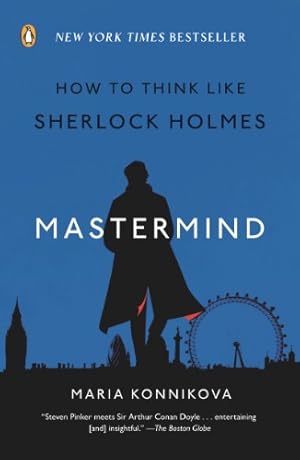
Maria Konnikova is the author, most recently, of The Biggest Bluff, a New York Times bestseller, one of the Times’ 100 Notable Books of 2020, and a finalist for the Telegraph Best Sports Writing Awards for 2021. Her previous books are the bestsellers The Confidence Game, winner of the 2016 Robert P. Balles Prize in Critical Thinking, and Mastermind: How to Think Like Sherlock Holmes, an Anthony and Agatha Award finalist. Maria is a regularly contributing writer for The New Yorker whose writing has won numerous awards, including the 2019 Excellence in Science Journalism Award from the Society of Personality and Social Psychology. While researching The Biggest Bluff, Maria became an international poker champion and the winner of over $300,000 in tournament earnings—and inadvertently turned into a professional poker player. Maria’s writing has been featured in Best American Science and Nature Writing and has been translated into over twenty languages. Maria also hosts the podcast The Grift from Panoply Media, a show that explores con artists and the lives they ruin. Her podcasting work earned her a National Magazine Award nomination in 2019. She graduated from Harvard University and received her PhD in psychology from Columbia University.

Customer reviews

4.5 out of 5 stars
4,214 global ratings
Sponsored

Customers say

Customers find the book reads like a novel and appreciate its perfect balance of storytelling and research. Moreover, the writing quality is excellent, and customers value its insights into psychology and decision-making processes. Additionally, the pacing is fast and engaging, with one customer mentioning they finished it in two days. However, the book receives mixed feedback regarding its poker content, with some customers noting it's not focused on deep strategy.
AI Generated from the text of customer reviews

Select to learn more

72 customers mention readability, 65 positive, 7 negative
Customers find the book highly readable, describing it as a fascinating and entertaining read that reads like a novel.
A great read! Would easily recommend to anyone that has wanted to learn something, but was too afraid to.Read more
...At the end of the book, which is a fast and enjoyable read, I was left with the question: Why did she do it?...Read more
...a Columbia alum event and was so impressed with how engaging and entertaining she was that I immediately ordered the book, despite knowing nothing...Read more
I just finished reading this "poker" book. While it was an easy read and well written, I don't think it would help anyone become a better poker...Read more
66 customers mention insight, 62 positive, 4 negative
Customers find the book insightful, with multiple reviews highlighting its life lessons and benefits of understanding psychology.
...She is both informative and entertaining, and knows how to play readers as well as she knows how to play poker....Read more
It's not a poker strategy book but still was insightful and interesting to read about her poker journey and how it tied into luck, psychology, and...Read more
Nuisanced and yet wide-ranging in its depth: psychology, philosophy, mathematics, and physics all available in the game of poker....Read more
Caveat Emptor -very mixed agendas. Maria's previous book was very insightful and useful for understanding how cons operate....Read more
39 customers mention storytelling, 31 positive, 8 negative
Customers praise the book's storytelling, describing it as a compelling tale with a perfect balance of research and narrative.
Excellent writing, good story, useful informationRead more
...I learned a few new things from this book, but most of all enjoyed the story. Believe me I've had men threaten me a few times at the table....Read more
...She's an excellent story teller and jumps in and out of various players' backgrounds while moving the sotry along, We get to know her mentor Erik...Read more
Lots of bragging and life story. Not a real poker book.Read more
37 customers mention poker knowledge, 36 positive, 1 negative
Customers appreciate the poker knowledge in the book, describing it as a great journey through the game and a tremendous resource for both players and non-players alike.
...An easy and informative read about the world of Texas Hold’em.Read more
...This book is a great example of how what you learn in the ivory tower of academia is not the whole story: in practice, psychology is way more...Read more
Excellent writing, good story, useful informationRead more
This book is a must read for poker players and the strategically minded....Read more
29 customers mention writing quality, 27 positive, 2 negative
Customers praise the writing quality of the book, with one customer noting it is written to be accessible.
...While it was an easy read and well written, I don't think it would help anyone become a better poker player....Read more
Very well written and fascinating. Maria is a terrific writer that captures the reader's attention, making it very hard to put the book down.Read more
Well written story of the authors journey into observation and decision making. An easy and informative read about the world of Texas Hold’em.Read more
...A well-written book that would give almost anyone a lot to think about.Read more
16 customers mention influence, 16 positive, 0 negative
Customers appreciate the book's psychological insights and relevant behaviors, finding it inspirational. One customer notes how the author presents her thoughts effectively, while another mentions its spiritual warmth.
...The book is inspiring....Read more
...Konnikova describes her grandma, and her disapproval of poker, it is poignant and perfect. The rest is dead fish. I did not enjoy this book.Read more
...Friendship, compassion, health and generosity and their opposite are explored through the lens of the poker table.Read more
...It is a gradual, introspective journey. Everyone can win with good cards....Read more
14 customers mention pacing, 12 positive, 2 negative
Customers appreciate the book's pacing, describing it as fast and provocative, with one customer mentioning they finished it in two days.
...Very insightful and provocative. I have purchased this book twice more, for friends.Read more
I really loved this book and read it in two days....Read more
...Friendship, compassion, health and generosity and their opposite are explored through the lens of the poker table.Read more
...it also surveys gender-studies, philosophy, mathematics/probability, sociology, with some food science and meditation thrown in for good measure....Read more
19 customers mention poker book, 11 positive, 8 negative
Customers have mixed opinions about the poker content of the book, with several noting it is not a book on deep strategy.
...highly intelligent and an accomplished writer, researcher, and now poker player!...Read more
Lots of bragging and life story. Not a real poker book.Read more
...Note to Kindle readers:. There's a glossary of poker terms in the back.Read more
It's not a poker strategy book but still was insightful and interesting to read about her poker journey and how it tied into luck, psychology, and...Read more
This book keeps your attention from  start to finish!
5 out of 5 stars
This book keeps your attention from start to finish!
I liked the book because it takes a very common game that can turn into an addiction and makes it leadership helpful. Many people would discount card playing as just a game. Maria keeps us engaged the entire way through by providing insights she experienced and helpful tips we can implement in our day-to-day lives for decisions we make all the time. I began to relate each aspect of the book to myself and how can I make more informed decisions with actions I need to take every day. She took the concept and actions of poker playing and made it a leadership experience for everyone.
Thank you for your feedback
Sorry, there was an error
Sorry we couldn't load the review

Top reviews from the United States

  • Reviewed in the United States on June 23, 2020
    Format: KindleVerified Purchase
    In April, I read somewhere that Maria Konnikova had become a poker pro and won over $200k in prize money. Huh?! Same social psychology PhD Konnikova who wrote for The New Yorker? And 'The Confidence Game' and 'Mastermind: How to Think Like Sherlock Holmes'? This seemed so farfetched that I just had to find out more. Especially since I'm a social psych aficionado and once was a semipro player myself. How did she train up to play well enough to win a big tourney in less than a year? Who taught her? Could a psych PhD trained in cognitive biases by the great Walter Mischel of marshmallow-test fame apply her knowledge to the game, or will she be a fumbling mortal like the rest of us? And, of all the pain one could inflict upon oneself in the name of journalism, why poker?! Does she enjoy sitting at a table for days on end with guys who frankly smell funny? So many questions. I had no choice but to pre-order the book to find out more.

    When the ebook arrived last night, I consumed it one sitting. The tale of Konnikova going from 100% poker-naïve novice to sponsored pro in a year is crackingly compelling. No triumphalist tale here. She's candid about the painful process of improving via trial and error and error and error: impatience, misplaced pride, susceptibility to the biases she has written whole books about, and incomplete self-knowledge. But she also has the insight and humility to ask for help from a mindset coach, who apparently makes some difference (even though he quotes Freud, and it's not exactly clear *how* he changes mindset -- this here coach is curious to know). She endures enough crap -- crippling self-doubt, insomnia, sexism, vicious migraines, perfidious allies, crude propositions by creepy dudes -- that when she describes her first big tournament win, I threw my hands in the air and audibly woo-hooed. Her victory is every smart, hard-working underdog's victory.

    The heart of the book is her relationship with her poker coach, Erik Seidel, one of the game's all-time greats. A deeply wise and caring mentor, he dispenses advice that is not just timeless but omni-applicable: "Telling bad beat stories is like dumping trash on your neighbor's lawn: it just stinks. The goal of poker is not to win pots or chips but to make good decisions. Defeat teaches you more than victory. Don't play a tournament if you don't feel at your best." We all wish we could have a mentor this good.

    I also picked up on a lot of useful resources to improve my own game: the PioSOLVER software for game-theory optimized play; SnapShove; Phil Galfond's Run It Once coaching site; and live streaming of real hands played by pros. These alone were easily worth the cover price.

    What delighted me was Maria's interweaving of the scientific literature into her narrative of training and tournament play: The description-experience gap will make our gut feelings trump numerical rules. Only a third of tournament hands go to showdown, and the best hand only wins 12% of the time. Facial tells are worse than useless; look at hand motions instead. Her long digression into the science and lore of superstition was particularly fun. If you have a lucky shirt or necklace, Konnikova makes a persuasive case for getting rid of it.

    This is also a book about entrepreneurship: setting a goal, assembling a team, getting some funding, and executing on the plan. That funding part is pretty essential, because hey, world-class poker training don't come cheap. Poker coaches can charge hundreds of dollars an hour, well beyond the reach of mere mortals without a substantial bankroll or publisher's advance. This is a detail I wish the book shared more about.

    Finally, there's much dishy poker lore here. Konnikova has met some greats of the game - Paul Magriel, LuckyChewy, Ike Haxton, Patrik Antonius, and my personal hero "Action Dan" Harrington - and retells stories from legends like Doyle Brunson, Antonio Esfandiari and Phil Laak. Thanks to Maria, our home games will probably soon feature the silly but fun sides bets of the Lodden Game.

    Even though the bits of poker strategy Konnikova shares are incidental to the storytelling and not the book's main show, I learned more about the psychology of my own game from this book than dozens of pure strategy books I've read. Besides being a compelling tale, 'The Biggest Bluff' is about how seemingly unlikely results can come within reach through persistence, planning, systematic training, and mindset management. Konnikova has earned every bit of her results, one of them being this book. How about you? May the book serve as rocket fuel for your own farfetched daydreams, or that of your favorite budding entrepreneur.
    -- Ali Binazir, M.D., M.Phil., Happiness Engineer, poker therapist, executive coach and author of The Tao of Dating: The Smart Woman's Guide to Being Absolutely Irresistible, the most-highlighted book in Amazon Kindle Store, and Should I Go to Medical School?: An Irreverent Guide to the Pros and Cons of a Career in Medicine

    PS: Lest you think that this review is an endorsement of a career in poker, be forewarned: do not try this at home. First off, you can’t get someone like Erik Seidel to coach you in poker – they’re just not available. And if you did get him, to afford him you’d need be so rich that you wouldn’t need to play poker in the first place. You do not have a supremely supportive spouse who will totally understand your need to travel to tournaments for 9 months out of the year. And you probably aren’t as smart and hardworking as Maria.

    Most important, poker is no way to make a living. Spoiler alert: Maria did well in her first year, but went negative in her second year. Have you ever had a job where you worked 40 hrs a week, and made *negative* money? Well, in poker, that happens all the time. Even the best of the best go dead flat broke, regularly.

    But beyond the financial swings, it’s the emotional swings that crush. Every time you have a seemingly lock hand and get some chump to call you, only to see him hit two perfect cards to beat you: you will remember those forever. Your brain will become a Hall of Pain of micro-PTSD episodes of bad beats and cosmically unfair tournament eliminations. And after every tourney you lose, which is pretty much all of them, you’ll be no fun to be around for a day or two. I love the game, too, but poker is hard on the soul.

    Ultimately, here’s the reason why you should not become a poker pro: even if you do spectacularly well, you will have only done one thing -- won at poker. Sure, the money can be nice. But you will not have discovered a new drug to cure a child, composed a poem that people will recite 200 years hence, planted a forest, or led a movement of social progress. Getting really good at poker requires your complete devotion, to the exclusion of almost all else. So if you’re smart enough to be good at poker, perhaps you have other options to make a more meaningful contribution to humankind instead.

    276 people found this helpful
    Report
  • Reviewed in the United States on September 2, 2020
    Format: KindleVerified Purchase
    I really enjoyed the entire premise of this book and the exploration of luck and skill, and I couldn't agree more that poker is a great game for such a study. The author does a wonderful job explaining in detail the various bad beats, lucky draws, and skillful decisions that lead to critical lows and brilliant highs in her poker journey. Some critical reviewers seemed to have either wanted a deeply academic book or a pure poker book. Don't count on either reading this work. Instead, expect a story of an individual's endeavor into a true scientific question via an old boys game of high stakes. My only critique was the ending. Perhaps it was the authors intention to not have a neat and tidy completion. She does say as much in the chapter on her first major tournament win in the Bahamas. But something about the ending didn't quite encapsulate the grand adventure and experience I read about. It seemed hasty, and the philosophical bits quoting Dawkins, I could have done without. Either way, I would highly recommend this book for anyone looking for a thrilling adventure and interested in how the human mind deals with the unknown.
    2 people found this helpful
    Report
  • Reviewed in the United States on August 12, 2023
    Format: HardcoverVerified Purchase
    This book is deceiving. It's not so much a manual on playing poker than it is a book about how to succeed in most aspects of life. This book is about the power of observation. Ms. Konnikova circles around this concept throughout the book. Practice is good, having talent is good, but neither is enough to power you to the top without unrelenting discipline given to observation.

    Ms. Konnikova gives an honest account of her quest to become a successful poker player under the mentorship of Erik Seidel. It's a nice dynamic, one that would make for a fine movie in the right director's hands. You have the young (and highly intelligent Konnikova) presenting herself to the accomplished, sel-effacing (but no less dangerous and serious about his craft) Seidel. Seidel is portrayed largely as incredibly easy-going and not unlike the stereotypical sensei master who maintains calm while dispensing cryptic messages to his young student. Some of the best moments come when Konnikova shares small bumps in the relationship, such as when she wants to explain to him a bad bit of luck she had with one hand of play and Erik shuts her down rather gruffly. It's not in character for him or their relationship but eventually Erik divulges why he ripped her one.

    You do not need to know much about poker to read this book as Konnikova explains well her process of learning the activity. You'll learn as she learns. It's a good account of how we learn and how we learn best. You have to be intelligent. I mean this partly in the IQ sense of it but more so in the I'm-willing-to-really-listen-look-and-learn from mistakes sense of intelligence. Konnikova under Seidel learns to become ruthless about avoiding the excuse trap. You make a decision, some things happen from that decision (good, bad or neutral) and you accept the consequences and move to the next decision. For those of us who're old enough it's the nirvana Spoke and his Vulcan ancestors lived for: pure logic.

    Honestly, the book is (as the title suggests) more about being rationale and understanding the world and yourself than poker. Poker is more the vehicle for getting to this life-truths. I've played poker for decades and love it. I don't play for serious money as it runs counter to my hyper-vigilant conservative ways with money. But there's no doubt that the activity has taught me a lot about people and how to make decisions. Konnakova's book helped me to understand why that is.

    A worthy read.
    12 people found this helpful
    Report

Top reviews from other countries

  • Bahaa
    4.0 out of 5 stars Very interesting and enjoyable
    Reviewed in the United Arab Emirates on November 18, 2021
    Very enjoyable
  • Neihhaa K Singh
    5.0 out of 5 stars Beautifully articulated life lessons !
    Reviewed in India on June 9, 2021
    Excellent narrative on life uncertainties, decision making , anxieties and learning and patience.
    I was completely riveted from page to one the last.
    Beautifully articulated life lessons which we all know but sometimes when told from different perspective , make more impact in our minds and gets etched in our memory more deeply. The kind of lessons which would really help improving our odds.
    Few of my favourite quotes from the book are :
    - Do we see ourselves as victims or victors? A victim: The cards went against me. Things are being done to me, things are happening around me, and I am neither to blame nor in control. A victor: I made the correct decision. Sure, the outcome didn’t go my way, but I thought correctly under pressure. And that’s the skill I can control
    - People failed to see what the world was telling them when that message wasn’t one they wanted to hear.
    - And while probabilities do even out in the long term, in the short term, who the hell knows. Anything is possible
    - If you don’t have an objective evaluation of what’s going on, you’re a loser.
    - The benefit of failure is an objectivity that success simply can’t offer.
  • Antoine
    5.0 out of 5 stars Great on poker, better even on personal insight
    Reviewed in France on August 10, 2020
    How does one know he/she is about to take a decision ? How is this decision likely to conclude ? What if this goes wrong ? What if this goes well ?..
    A page turner on how to parallel the game of bluff and life.
  • Tam Pham
    5.0 out of 5 stars The Art of Learning and Moonwalking with Einstein meets Poker
    Reviewed in Canada on July 5, 2020
    Format: HardcoverVerified Purchase
    I have never heard of Maria before reading this and was pleasantly surprised to devour the book, aggressively circling passages and underlining quotes that I resonated with. The journey that she goes from is not only incredibly inspiring, but is filled with so many life lessons to take away, and just how important poker is on and off the table.

    Obviously, the zero to hero story is cool, and can make anyone want to go through a similar journey. One thing I especially loved about her writing is how she left her ego at the door and dived into a whole new field. Sure, she had a master's in psychology and has written essays and papers on the mental game, etc. But repeatedly throughout the book, she would admit how she didn't know any better than the average person (her mistakes also proved that she has not internalized them fully yet) and do her best to unlearn, in order to learn.

    I relate a lot to Maria because I am an amateur poker player myself. I've followed Erik Sidel, read Jared Tendler's book, bought Blake Eastman course on poker tells... but I too have made so many of the same mistakes that Maria had early on in the book. Even though I intellectually knew what to do, it's a whole different game to actually put the knowledge into action, consistently.

    I love how she had access to the greatest poker minds in the modern era like Phil Galfond and more, to simply have dinner and learn through conversation. I'm happy she put in work in all areas of life (not just poker) to ultimately thrive in the wild success that she has had on the felt.

    I admired how she didn't stop the story at finning 1st at a big tournament, but instead, doubled down and continued to challenge herself in Macau. It really inspires me to channel my inner Erik Sidel and make the best decisions I can and most importantly, pay attention.

    Last but not least, the book was simply fun to read for a chess/poker enthusiast like myself. I saw a negative review that it read sort of like a diary. While there is some truth to that, I really enjoyed this format. It was like you are going through this emotional roller coaster with the main character. And while you can read this book and think you can crush your next home game, Maria's early journey of getting deliberate practice, failing... a lot, and having to adjust is more realistic and grounding to hear.

    Thanks for writing this awesome book. This will be the read I give to players interested in poker to see how truly beautiful the game can be.
    Customer image
    Tam Pham
    5.0 out of 5 stars
    The Art of Learning and Moonwalking with Einstein meets Poker

    Reviewed in Canada on July 5, 2020
    I have never heard of Maria before reading this and was pleasantly surprised to devour the book, aggressively circling passages and underlining quotes that I resonated with. The journey that she goes from is not only incredibly inspiring, but is filled with so many life lessons to take away, and just how important poker is on and off the table.

    Obviously, the zero to hero story is cool, and can make anyone want to go through a similar journey. One thing I especially loved about her writing is how she left her ego at the door and dived into a whole new field. Sure, she had a master's in psychology and has written essays and papers on the mental game, etc. But repeatedly throughout the book, she would admit how she didn't know any better than the average person (her mistakes also proved that she has not internalized them fully yet) and do her best to unlearn, in order to learn.

    I relate a lot to Maria because I am an amateur poker player myself. I've followed Erik Sidel, read Jared Tendler's book, bought Blake Eastman course on poker tells... but I too have made so many of the same mistakes that Maria had early on in the book. Even though I intellectually knew what to do, it's a whole different game to actually put the knowledge into action, consistently.

    I love how she had access to the greatest poker minds in the modern era like Phil Galfond and more, to simply have dinner and learn through conversation. I'm happy she put in work in all areas of life (not just poker) to ultimately thrive in the wild success that she has had on the felt.

    I admired how she didn't stop the story at finning 1st at a big tournament, but instead, doubled down and continued to challenge herself in Macau. It really inspires me to channel my inner Erik Sidel and make the best decisions I can and most importantly, pay attention.

    Last but not least, the book was simply fun to read for a chess/poker enthusiast like myself. I saw a negative review that it read sort of like a diary. While there is some truth to that, I really enjoyed this format. It was like you are going through this emotional roller coaster with the main character. And while you can read this book and think you can crush your next home game, Maria's early journey of getting deliberate practice, failing... a lot, and having to adjust is more realistic and grounding to hear.

    Thanks for writing this awesome book. This will be the read I give to players interested in poker to see how truly beautiful the game can be.
    Images in this review
    Customer image
  • Jon
    4.0 out of 5 stars Great book
    Reviewed in Mexico on January 6, 2025
    Format: KindleVerified Purchase
    Entertaining way to explain luck and uncertainty in a storyteller way. A great point of view to deal with the unknown and gaming applied to poker.

Report an issue


Does this item contain inappropriate content?
Do you believe that this item violates a copyright?
Does this item contain quality or formatting issues?