Monday, December 31, 2012

Maymont, Richmond

Image
Richmond is full of historic house museums as you've seen in my previous posts.  One last museum I'll share with you is Maymont.
Image
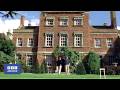
Built in Romanesque style by architect Edgerton Stewart Rogers in 1893 high above the banks of the James River, the mansion and 100 acre estate was home to James and Sallie Dooley.
Image
The house and grounds have been a public museum and park since 1925 when Mrs. Dooley passed away.
Image
 The imposing stone facade hides a rather giddy and over the top Victorian interior.
Image
 The grounds are beautiful with stunning views down to the river.
Image
The original outbuildings of the estate survive and are used to this day in the maintenance of the house and park.
Image
 I especially loved this carriage barn with service court. Wouldn't this make a charming house?
Image
 The water tower is located right behind the carriage house.
Image
The Dooleys are buried together on the estate on a bluff overlooking the James river in a beautiful mausoleum designed by William Churchill Noland.
Image

Thursday, December 27, 2012

Virginia House, Richmond

Image
After my trip to Richmond I had one regret; I didn't schedule an appointment to tour Virginia House!
Image
Located next door, literally, to Agecroft Hall, the house was also built of ancient materials imported from an old house in England as part of Thomas William's original plan to build an authentic Tudor Village in Richmond.
Image
Virginia House was built by Alexander and Virginia (hence the name) Weddells but began life as a priory in 1109 built by Earl Warwick which was later remodeled in the 17th century.
Image
 Much like their neighbor, Agecroft Hall, the house was purchased at a demolition sale.
Image
The Weddells built their new old house in anticipation of it eventually becoming the headquarters and museum for the Virginia Historical Society.
Image
Despite that plan, the house was built as a modern home albeit one of historical materials and importance.
Image
While the materials began to arrive in 1926 via ship they were so waterlogged that they had to sit to dry out for 6 months before building could procede. The Weddells finally moved into their new old house in 1929.
Image
If you didn't know this modern history of the structure you'd assume it was a 17th century house that had been well preserved for hundreds of years. Of course, nothing this grand was constructed in the New World at this time, particularly in Richmond!
Image
Through the drive and to the back of the house you see the modern house emerge. A 3 car garage currently operates as the shed and workroom for the extensive gardens.
Image
Henry Grant Morse was again the architect responsible for the reconstruction of the structure which was based on many different houses found throughout England.
Image
Noted landscape architect Charles Gillette designed the gardens which are to this day spectacular, even in the middle of winter!
Image
The land slopes steeply down to the James River so the gardens are terraced with the house rising high above the many garden rooms.
Image
William Lawrence Bottomley was brought on by Mrs. Wenddells to design an outdoor garden loggia connected to the house from some more building remnants.
Image
This is probably my favorite part of the house.
Image
The ceiling of the Loggia came from a house on the grounds of Knole in England while the columns were salvaged from Spain.
Image
The roof of the loggia is a patio to view the gardens and river from above.
Image
The loggia shelters this private water garden from the rear gardens.
Image
From the rear terrace one looks down upon the formal gardens as art and towards the James River beyond.
Image
The structure of the gardens shows more clearly in their dormant period.
Image
The springtime shows the gardens to their best advantage I'm told.
Image
The grounds are dotted with lots of interesting sculpture such as this Egyptian frieze fragment found within a garden wall.
Image
The Weddells used Gillette over a period of many years to design these extensive gardens which appear to have taken generations to compose.
Image
My favorite sculptures however are these 2 funny little men standing about 5'-0" tall. Does anyone know anything about them?
Image
Don't forget to book a tour before your visit to Richmond. I'll just have to go back to Richmond to tour Virginia House!
Image

Monday, December 17, 2012

When is it a collection?

Image
This past weekend I attended an estate sale where I picked up yet ANOTHER cookie jar in the shape of an extant building. This is the Jackson Brewery in the French Quarter of New Orleans.
Image
The workmanship is incredibly detailed and I just thought it was so fascinating and well done I had to have it even though I wasn't familiar with the building (let alone for $5). Ignore the kitchen wall behind which has had the wallpaper peeled from it but hasn't been sanded or painted!
Image
So my question to you is this; now that I have 3 of these cookie jars when does it become a collection?!

Thursday, December 13, 2012

Agecroft Hall, Richmond

Image
While in Richmond I toured a thoroughly unusual house museum, Agecroft Hall.  The house began life in 15th century Lancashire, England, as the home to the Langley and Dauntesey families.  Not many structures in Richmond can boast that (except for their next door neighbor, Virginia House, but more on that later).
Image
By 1925 the house was on the verge of ruin thanks to rampant coal mining on the property which had undermined the structure.   The building was auctioned off to Thomas C. Williams of Richmond. Williams had the dream of creating an ancient tudor village (of grand country houses of course) in Richmond, Virginia of all places.  This plan would become Windsor Farms.
Image
The house was in such poor condition it could not be constructed as it stood in England but rather rooms were imported and all of the building pieces put back together in a general sense but in a way better suited to modern living (bathrooms, closets, etc).  Think of it as a sort of ancient lego system.
Image
This architectural work was devised by architect Henry G Morse and the delightful gardens were designed by Charles Gillette.
Image
Williams only lived to see his dream barely completed but his wife inhabited the house for many years. He had left the house to his wife in trust and always intended it to become a house museum. However Mrs. Williams had very strong ideas on the subject herself to add to the house's legacy.
Image
When she became too elderly to care for the house, she moved out and began to transform it into a period piece of Tudor England (in Richmond, Virginia?). 
Image
Personally I would have found the house more interesting and 'honest' if it had been left in its 1920s state. Only one room was left as such, the library. 
Image
The garage courtyard became the new visitors entrance with the garage itself becoming a lobby and theater for a short film that is shown before tours.
Image
As you can see in these photos, Williams selected the prime property for his own house on a tall hill overlooking the James River.
Image
These herb and vegetable gardens have delightful views down to the river. 
Image
Below is the modern approach to the house through what was once a service court with many garage and kitchen doors opening onto it. 
Image
 The reconstruction in this area is such that you would never know this wasn't the original front door.
Image
 These beautiful entry gates are in Latin and say "Virtus Sola Invicta" or bravery alone is invincible.
Image
These are 2 of the remaining garage doors.
Image
This beautiful old oak stair leads you from the original entry court to the library.
Image
This intricate wattle and daub was from an addition when the Langleys were doing well financially. The parts of the house with simpler woodwork would have been needed additions when they weren't as flush.
Image
I loved the way the Williams's incorporated this tree into the roof structure of a gardening shed on the service court.
Image
This Oriel window is one of the oldest in the house and is located in the original entry court above the pass through for cars to the service courtyard.
Image
This is the current visitor entrance in what was originally (well, in the 1920s original) a garage door bay.
Image
The great hall was immediately off the original front door and was the first thing a guest would see. The 2 story space was not original to Agecroft but constructed in the 1920s version to help deal with the Virginia heat.
Image
The linenfold paneling dates from the 1920s but incorporates panels dating to the middle ages. This wood screen blocks the great hall from the original entry hall.
Image
A parlor off the great hall faces the James River and receives amazing light. I love these old leaded glass windows. All of the windows were from the original Agecroft and were shipped across the ocean. Not a single pane of glass was broken the guide said!
Image
The dining hall was set for a medieval feast.
Image
Above is the beautiful library, probably my favorite room.  This room is decorated as it was left by Mrs. Williams and has not been altered to reflect the 16th century like the rest of the house.
Image
The stunning plasterwork on the ceiling was also a 1920s invention, originally Agecroft was a simple country house and would have had plain ceilings.
Image
I loved these sconces found throughout the visitors entry.
Image
Many pieces were 'leftover' from the original Agecroft such as this leaded glass bay which are on display in a small exhibit. The current house is 1/4 the size of the original house in England.
Image
I hope you enjoyed this visit to Agecroft.  It certainly is an anomaly to find a piece of merry olde England nestled into a Richmond neighborhood!