Web site: www.application-systems.de/magic/
Origin: Germany
Category: Desktop
Desktop environment: GUI
Architecture: x86
Based on: Independent
Wikipedia:
Media: Install
The last version | Released: unknown
MagiC – an operating system which fulfills all the tasks expected of an operating system. It manages the data on the hard drive, handles communication with peripherals, takes care of screen output, and so on. We’ll now take a closer look at a few highlights. Describing all the functions of an operating system within this context is simply impossible.
This system completely replaces the original TOS system. It is much more convenient and efficient. Since it is essentially a completely independent system, implementations for Windows (MagiCPC) and MacOS (MagiCMac and MacOSX) (MagiCMacOsX) have been developed, offering a cross between an emulator and a standalone system.
Version 6.x also includes a special version for Milan with support for the PCI architecture and the 68040 processor. Patches are also available that enable MagiC to run on non-standard configurations such as Centurbo 2, CT60, or Afterburner.
The latest existing version, version 6.20, is available as a free update for users of version 6.10. In the announced version 7, one of the key features was to be expanded to include a network environment.
Many extensions and improvements were created for MagiC, including dedicated desktops.
All programs run at full 32-bit width. There are no different access modes and no unusual memory segmentation in 640 KB increments or anything like that.
MagiC has a preemptive multitasking kernel. What’s the benefit of that? Well, it allows the user to start and use multiple programs simultaneously. Unlike cooperative multitasking, preemptive multitasking means that the operating system allocates processing time to the programs, rather than the other way around, where programs can simply access the system’s resources. This has the advantage of a much smoother distribution of resources, preventing one application from completely blocking another.
MagiC supports threads. This means that not only can individual programs run in parallel, but programs can also execute individual functions in parallel. For example, a database can sort data in one thread while simultaneously printing labels in another, while the user can still manually search for addresses.
To ensure that TOS programs without a graphical user interface (e.g., compressors) are compatible with MagiC’s multitasking capabilities, their output is redirected to a VT52 terminal window. The TOS programs then run neatly in a window without interfering with MagiC’s operation.
MagiC has a modular file system. By installing an additional module, you can use a different file system. For example, you can use a FAT file system on one disk partition, just like in the old TOS or MS-DOS, where filenames can be 8+3 characters long. At the same time, you can assign a Windows 95 file system to another partition, giving you the same file management as in Windows 95.
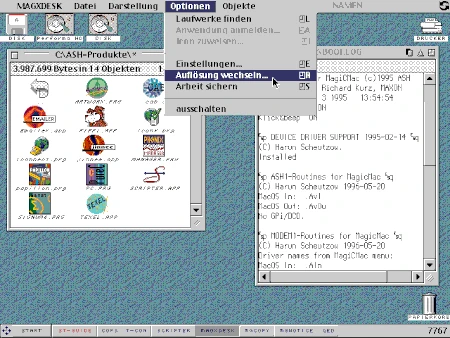
MagiC-Desk desktop environment is included with MagiC. MagiC-Desk is designed to use as little memory as possible for the desktop application, as it typically remains in memory at all times.
In 2018, Andreas Kromke published the source code of MagiC and the AtariX emulator.