Gun Control Fails Again

Four men, two pairs of brothers, came to Florida to enjoy the state. One returned home, and the other three were standing in the yard of their rental home, preparing to head to the airport, when the man who lived next door shot and killed all three of them. Witnesses and police say that this was a random attack, and there had been no altercation before the shots were fired.

The man who did the killings was known to police. Ahmad Bojeh was arrested in 2021 for randomly firing a gun at people and traffic. He was acquitted due to insanity and released. He was charged with felony drug charges in 2015, and resisting an officer with violence in 2020, but again, charges were dropped. The Osceola County Sheriff’s Office was asked whether there were any requirements or safeguards in place, given that he remained in the community and is now accused in a triple homicide. The sheriff’s office referred questions to the State Attorney’s Office, which released a statement saying it cannot comment beyond what has already been made public but will release information when it becomes pertinent.

In other words, the cops and courts didn’t do shit. Again. Our so-called justice system isn’t. It has become a jobs program for useless bureaucrats, and a green light for criminals.

The state claimed we needed red flag laws to stop people from having guns after they fell through the cracks. In other words, people just like this murderer are still killing people, even though the state now has the power to strip everyone else of their rights. It’s not a bug, it’s a feature.

My Plan

Sorry for all of the personal stuff. It’s a bit hard to keep posting on political topics when there is so much personal garbage going on. This one is on my plans for the future. If you want to move on, I get it. There will be other posts coming soon.

The collapse of my emergency room’s culture had spawned me to begin looking for a job back in November. The ED where I work has changed from a patient-centered model to a financially based throughput model. This new model stresses maximum output and numbers, while ignoring patient care and safety. If anything goes wrong, as it inevitably will, the nurse is the one who bears the brunt of the consequences. I just can’t do that. Time to go. I don’t want to leave this ED, just to take another position that is just like this one. That gets me nowhere. Besides, I have a master’s degree now. Why would I take a bedside nursing spot alongside 20-somethings with my credentials?

I have landed interviews with every major hospital chain in Central Florida. Each time I have applied, my strong credentials and excellent resume, combined with the fact that I don’t mention any jobs I’ve held before 1999, get me into the door for an interview. I’ve had more than a dozen job interviews in the past three months. That’s where the story ends. I get the interview, they get a look at me, they tell me I will get another interview, then nothing. Silence. My emails go unanswered. I believe that this is because they can plainly see that I am not a young man any longer, even if they can’t say so. This plan isn’t working.

So I need to find another path forward. I got to thinking:

  • what was the best thing about being a teacher? The copious time off.
  • What is the worst thing about being a teacher? The low pay
  • I also hated dealing with unruly kids and their asshole parents.
  • The best thing about being a nurse is that I like the job itself, but I would like more time off and less asshole bosses

I really do miss the days when my wife and I could travel all summer. Besides, now that my house is paid off, all I need money for is savings and money to do cool things like travel, as well as buying guns and other toys.

My house payment is gone, all that remains of that monthly payment is taxes and insurance. The $3400 a month that was principal and interest are gone. Pretax, I can make $50,000 less per year than I was making and still have the same disposable income that I had when I was still making house payments. Why, that house was stealing away nearly half of the income I was earning as a nurse.

Then it hit me- I could work half of a year and still be doing pretty well. I looked into PRN (as needed) nursing. Nope. They require that you come to work every week, just for fewer hours. That was when I looked into travel/contract nursing. Travel and contract nursing agencies don’t care how old you are, because they only care about the next 13 weeks. My current plan is to work August through October, when my wife works every day anyhow. Then I can work some other period in the January through May period.

That would leave November, December, and all of the summer for me to not work. If I hate the boss at any particular contract, it’s OK because in three months or less, they won’t be my boss any longer. I would be taking home the equivalent of $60k a year, but only working 26 weeks. I could supplement that with pickup contracts (they are very short term) or I can teach at a local community college. Either way, I can be semi-retired. Our bills are fine. We don’t owe anyone any money (except my car payment, which I pay out of my fire pension) and we will make a combined $185k a year if I take two travel contracts during the year.

Now that I had the outline of a plan, I talked about it with my wife. She is on board, with a few conditions:

  • During the periods that I am not working and she is, keeping the house clean, cooking, and maintenance will be my job. She says it isn’t fair for her to work and still expect her to keep house. That’s cool. I would get bored with nothing to do all day, so cleaning is cool. It’s not like the two of us make a huge mess, anyhow.
  • My pension remains mine to spend as I see fit, but she will control the money from my contract work, so she can pay the bills and manage our investments. Meh. My pension is more than $3500 a month. I don’t need to spend more than that. She does a good job of picking investments, better than I do. I’m OK with that.
  • She will continue to do her laundry, and I will do mine. I suck at laundry, especially women’s things.
  • I have to work full time until at least the end of February, because budget.

So having come to an agreement, I have a plan. I will be tendering my resignation during the week of February 14, so I can give my 2 weeks’ notice. Company policy says that they won’t pay you for your PTO if you don’t give notice. I have 100 hours of PTO, so trying to get paid for that is the goal there.

With that being said, I don’t want a termination in my history, because they are difficult to explain to future employers. If I get any formal discipline at all, during that discipline meeting, I will say: “Thank you for the information and discussion. This makes things quite clear for me. Our goals and outlook are clearly no longer in alignment. For that reason, please consider this to be my resignation, effective at the end of today’s shift. I wish you luck.”

In the meantime, I am working with the recruiters for two travel nursing companies to secure some contracts. I want my first contract to begin some time in April, and end no later than the 6th of July. I will begin my second contract during the first half of August.

That will allow me to take a month off before beginning my first contract, a couple of weeks during the summer, then the last two months of the year off. So that’s the plan. By the end of next month, I will be semi-retired and working less than 1,000 hours per year.

There are those who say that I should take jobs out of state, but that is complicated by the longer commute. What would be a three hour round trip becomes a day at each end if you leave the state to take jobs in California, Oregon, or Rhode Island. Now instead of three days a week, I am away from home 4 or 5 days a week. All of a sudden I don’t feel retired anymore, and the numbers aren’t as good when you have airfare, parking at the airport, Uber rides to and from the hotel and airport, and more overnight hotel stays.

Others suggest a motor home. I don’t think those numbers make sense. At 26 weeks per year, I would need a hotel 52 nights per year if the three days working are consecutive. At $150 per night to stay in a budget Hilton brand (think Embassy Suites, Doubletree, Hampton Inn, and the like), that will cost me $7800 per year. Even a small used motorhome would cost in the neighborhood of $40,000, and that is before insuring it, fueling it, and making repairs to a 10 year old motorhome with 70,000 miles on it. It just isn’t worth the cost. It would take me a decade or more to recoup that expense.

What could make sense would be a camping trailer like this one. At $15,000, it would cost just over 2 years to recoup the cost. I could tow it to the travel location and leave it there for the duration of the contract before hauling it back when the contract ends. That’s something to consider.

Replaced

So an apology when I am wrong. I posted a couple of months ago my estimate for the illegal immigrant population. I said that I believed it was 16 million. There were those in comments who claimed it was as many 30 million. All of us may have been low.

News came out this week, many of the non-domiciled (in other words out of state residents) CDLs are issued illegally to illegal immigrants. North Carolina has 53%, New York 52%, and California claiming 29%, but not allowing the Feds to check. In all, there are 100,000 KNOWN illegal immigrants with CDLs in the US.

One in five construction workers are illegals. As many as 4 million. Of course, the pro-illegal lobby says those illegals built 400,000 houses (non-hosted PDF alert). Unless they are all living 10 to a house, that’s a net loss.

During the third Obama term Biden administration, as many as 3 million people a year illegally entered the US, so there is another 12 million. In fact, 52 million people (1 in 6 of us) are not born in this nation, that we know of. Half of them have been here for over 10 years, a quarter of them more than 20.

Anecdotally, there are dozens of counties in this state where more than half of the residents do not speak English. Before anyone accuses me of having this opinion out of racism: I say the same shit when people move here from New York, so don’t go there. Your race card won’t work here.

The Center for Migrant Studies of New York, a liberal, pro-illegal immigration lobbying group, claims that there are 8.4 million illegal immigrant workers in the US. as of 2024. The data above suggests that the number is far, far higher. Looking at these numbers, 30 million illegals seems low. While there are no accurate counts, all evidence points to there being a much larger illegal immigrant population than anyone is estimating. There are perhaps as many as 45 million illegals at this point- one out of every 7 residents.

We have been overrun. There is no way the US can possibly get rid of the illegals at this point. They are entering at multiples of what can be deported, especially considering the resistance coming from the left.

Contract Work

Hospitals all over the country fill in gaps in their nurse staffing by bringing in nurses on contract. Pay varies widely from state to state. Here are a few samples of pay rates available for nurses on contract:

  • California $10,500 a week.
  • Reno, NV $2600 per week
  • Rhode Island, $3300 per week
  • Nantucket, $3375 per week
  • Lansing, MI $3175 per week
  • Boston, MA $3100 per week
  • Albuquerque $3000 per week

However, I am currently looking for something near my house because I want to be home on the 4 days per week that I am not working, and flying back and forth will eat into any extra money I might make. Here are some that are showing:

  • Lake Placid, FL $1900/week
  • Davenport $1800/week
  • Fort Meyers, $2200/week

So it looks like Florida is somewhere around $2000 per week. The costs would be gas and tolls to and from one day per week, plus the cost of a 2 night hotel stay, so call my costs about $300 per week, plus the fuel to get there. As a contracted nurse, I have a lot more control over my work conditions than I do when I am tied to an employer. My conditions for accepting any given contract are:

  • the 3 days each week must be consecutive. Some hospitals like to have you work Monday, Wednesday, and Thursday one week, then Saturday, Monday, and Thursday the next week. I won’t accept a contract like that, unless I get more money.
  • No mandatory meetings or training, unless it is during my contracted work days. Most hospitals actually like this condition, because they don’t want to invest money in a contract nurse who isn’t staying.
  • No mandatory overtime. If I do decide to take overtime, it must be mutually agreed upon, and my overtime rate is going to cost enough that I can compensate for the extra costs. Somewhere around $100 per hour.

My recruiter says all of this is doable, but some hospitals won’t agree to consecutive workdays. That’s fine, I told her, I don’t need to take those contracts. However, if they offer enough extra money, I might. Taking non-consecutive days increases my costs and my time commitment in driving time, so I pass them along to the hospital. If they don’t want to do that, that’s OK. They can hire someone else.

Let’s say that I take a job that is a 2 hour drive from here. I drive there, work my three shifts, and drive home. Total time working and driving is 40 hours. If you break those days into complete non-consecutive, I have to drive there and back three times. That adds 8 hours to my work week, so it’s going to cost you an extra $1200 a week. Don’t want to pay that? OK, no problem. Just find someone else. I would take a job that required me to fly up to Rhode Island every week before I will spend 12 hours a week in a car for no extra money.

Like Liam Neeson, I have a particular set of skills, honed over decades of learning my craft. Those skills are specialized and difficult. I can now dictate the terms under which I will work, and I don’t NEED to work full time. In fact, I don’t WANT to work full time. That puts me in charge of when and how I will work.

After all, how many nurses are there that are certified for critical care, emergency nursing, pediatrics, and trauma? The answer is not enough to cover demand.

Contract nursing has variable terms. Most contracts are for 13 weeks at a time, but there are agencies that have contracts that vary between 8 and 24 weeks. There are even agencies that offer one day contracts, but those don’t come with stipends, meaning that you can take those even if they are within 50 miles of your house. Say a hospital in the area has a need for a nurse two days from now, but only needs that position filled for two days. Your agency will offer you the contract for two days for $1800, but it would be 100% taxable.

I’m really liking the idea of being self employed.

Oops

It looks like at least one frequent reader has figured out who my current employer is and sent me an email about it. I recently posted something that apparently had too many details in it, and that someone was able to figure out which hospital I was talking about. For that reason, I had to take the post down, as I don’t want to risk that someone who matters can get me in trouble. Sorry for the inconvenience.

Gold

I read Peter and Aesop’s pieces on gold and inflation. Peter asks, as have many, what happened to the audit of Fort Knox’s gold stores? If you’ll remember, Trump and Musk promised to audit the gold in Fort Knox, then the issue quietly went away, never to be mentioned again.

The nation’s gold is stored in Fort Knox, West Point, and the Denver mint. All of the gold is controlled by the US military. Fort Knox and West Point are military bases. No one who isn’t a Treasury employee has laid eyes on that gold in 50 years, and even precious few Treasury employees have seen it.

Trump and Musk insisted they were going to audit the gold. Trump took office January 20th, but suddenly the entire issue was dropped. After February 26th, Trump never mentioned it again. Musk stopped talking about it on April 6th. Three weeks later, Elon stepped back from his duties with DOGE.

It’s my theory that Musk left DOGE and dropped the subject because he discovered the gold was missing. I asked Chatgpt what Musk would do if he found out the gold was gone. This was the answer:

If someone learned that U.S. gold reserves were gone:

  • Talking publicly would:
    • Crash markets
    • Trigger bank runs
    • Collapse trust in the dollar
    • Make the messenger a global liability

So the first move would be:

  • No public statements
  • No hints
  • No jokes
  • No “cryptic tweets”
  • Compartmentalize the knowledge tightly

Silence is safety.

He would quietly reduce exposure to assets that depend on:

  • Dollar stability
  • U.S. Treasury credibility
  • Financial system trust

That means shifting toward:

  • Real assets: land, energy, minerals, infrastructure
  • Global assets: not all wealth in one country
  • Productive assets: things that make money regardless of currency regime

Not in a dramatic crash move — but slow, boring, and hard to trace.

That means:

  • Assets in multiple countries
  • Residencies, citizenships, or legal footholds in more than one nation
  • Control over:
    • Food supply
    • Energy access
    • Transportation
    • Communications

Not “doomsday bunker” behavior — more like:

“If one system breaks, I’m already living in the next one.”

He Would Avoid Trades That Look Like Insider Moves

If he suddenly:

  • Dumped dollars
  • Bought tons of gold or crypto
  • Shorted Treasuries

…it would look like:

  • Insider knowledge
  • Market manipulation
  • National security threat

So protection would look indirect:

  • Investing in companies that benefit from volatility
  • Owning things that work in any currency regime
  • Funding technology that reduces dependence on legacy systems

If you hold a civilization-level secret, you don’t want:

  • Fame for it
  • Credit for it
  • Blame for it

You want:

  • Influence over outcomes
  • Seats at decision tables
  • Control of key systems (energy, transport, comms, finance alternatives)

That way, if collapse comes:

  • You’re shaping the transition
  • Not being crushed by it

The most dangerous thing wouldn’t be “the truth” — it would be:

  • Being early
  • Being alone
  • Being blamed for the panic

So protection would center on:

  • Waiting until systems are already changing
  • Letting structural cracks appear first
  • Moving only when the world is ready to believe

Food for thought.

FBI Reenters the Caliber Wars

Listen to the below video:

There are 9mm projectiles out there that are doing the same thing the forties are doing, but we can take the full power nines that are still less recoil impulse, high magazine capacity…

I own handguns in all of the major self defense calibers, including a few .40S&W and about three times as many 9 millimeters. I can’t tell you the last time I carried, or even shot, a forty caliber. When the FBI decided to use that caliber, they did so by neutering the 10mm. Why? Because female and limp wristed beta male Federal officers can’t handle the recoil of full power handguns.

I’m just going to say this: The 9mm has been a go to carry piece for me because of capacity and ease of concealment. If I were a Fed and could carry what I wanted without fear of printing or accidentally flashing, I would carry a full sized handgun.

He says it, but in a roundabout way:

I asked the guy at Hornady, why are we seeing huge gains in 9mm performance, but not in the other calibers? His answer was “you allowed us to increase velocity.”

This is a fundamentally misleading statement. The 10mm had plenty of velocity, but you forced the industry to slow it down and called it a .40. That’s why the “S&W” at the end is said to stand for “slow and weak.” The heart of the issue is at 12:45 (paraphrased just a bit):

10mm was fine for some agents, but you can’t hand that to a “Fleet” of 13,000 agents. The 180 grain bullet generates too much recoil, so let’s slow it down. Well, if you slow it down, you might as well go to a 40.

The other issue was the handgun chosen for the 10mm: The model 1076. He says half of the guns bought had to go back to the Performance center to be reworked because the gun didn’t function correctly. That’s a firearm, not a caliber problem. Still, recoil was and remains an issue.

All handguns are tradeoffs. Still, let’s be honest here- the FBI went back to the 9mm because women and soyboys are recoil sensitive, and the 1076 was just a crappy gun.

Agents

There are all sorts of businesses and careers that should have been retired to the dustbin of history by now. Let me illustrate:

The only real advantage that realtors had was being the sole arbiters of access to the MLS. The Internet has completely destroyed that. I have bought and sold 7 different houses during my lifetime. I did it in a few different ways: Using an agent, doing it myself, and buying from the builder. Here is my take:

In a good real estate market, houses are easy to sell yourself. Put them on Zillow, fill out the papers, get the title company to do the rest. In a bad market, it takes some effort to sell a house. The one we recently sold took six months to sell. The agent had to hold a dozen open houses. She did them on weekend mornings for about 2 hours each. So call it about 25 hours of sales work. She also had to do some work once the seller contacted us. Call it about 10 more hours of work. So I essentially used up a week of that woman’s time. For that, she and the buyer’s agent charged me a total of more than $16,000, or nearly $200 an hour. I don’t think the services I got were worth that much.

Don’t get me wrong, she did her job well and I don’t blame her for the price- that price is just what it costs. I like the woman, and I would hire her again, but I have a problem with the expectation that 5% of the sale price of the home is just pissed away for a job that is essentially obsolete in these days of the Internet.

Many businesses have been changed or eliminated by e-commerce: The recording industry, video rentals, movie theaters, retail stores, I’m sure you can think of others. There are other industries that have also been rendered obsolete or should no longer exist in their current form, mostly because the Internet has changed the landscape.

There are some industries that have adapted by offering things that you can’t get online- SCUBA shops offer diving lessons and tank refills, pool supply stores that offer to test your pool water for free, then make money by selling the needed chemicals.

The other way to survive is through government regulation, for example: gun stores and insurance companies both rely on government regulations to eliminated much of their competition. If an online company like Amazon sold guns, most gun stores would go under unless they could offer something other than access to guns. That’s why so many gun stores secretly (and sometimes not so secretly) support gun controls like prohibiting online sales.

The point of this post, which has taken me a bit to get to is this: The science nerds like Elon Musk like to claim technology, AI, and robotics will eliminate the need for people to work. That will never happen. If the Internet didn’t destroy retail, AI and robotics certainly won’t destroy employment to the point where UBI is needed.

Why People Are Poor

Check out my comment and all of the retarded comments to it.

Ignoring that the lottery is a poor investment plan to start with:

If this girl had taken the million, she would have gotten about $680k to invest, even considering taxes. The first year, she would likely earn at least $60,000 in an index fund. That would mean with an average rate of return, she would have $1.6 million by age 30. By age 35, it would be worth $2.4 million, and her annual earnings would be $220,000 a year. By age 40, it would be worth $3.8 million. Her annual return would be $343,000.

Contrast that with the $1,000 per week plan. This plan means $52,000 per year for the rest of her life. She, and the idiots who are arguing against me, arrived at this plan by saying “52k times 40 years is 2 million. She gets more by taking the 52k,” and they are morons.

When you take the payout over years, the lottery commission invests that million dollars. The investment is assumed to earn 7% per year, and the commission then pays you 70% of that. So you are actually getting 5.2% and the commission pockets the rest.

The smartest thing for her to have done would be to take the $1 million, pay the taxes, keep perhaps 5% of it as “fun money” and invest the rest. By age 35, place the $2 million or so in a lower risk fund earning 5%, she would be retired and would never need to work again. Time is on her side, she can afford to wait a bit in exchange for a huge reward later.

Most index funds based on a broad market earn 9-10% per year, ignoring inflation. (You have to ignore inflation, because that $1000 per week payout doesn’t change, let’s make the comparison fair) Either way, you are getting a million, but in the case of the “thousand per week” payout, the commission is keeping most of the returns.

Arguing so strongly against investment and not understanding the math behind the decision is why so many people stay poor. Here are a few index funds, and the average returns they have earned over the past:

Fund5 year annual return30 year annual return
SPY21.9%9.15%
QQQ26.7%10% *
VTI21.39%8.16%*

The 30 year return for QQQ is actually 26 years. The fund didn’t exist 30 years ago. The 30 year return for VTI is actually 23 years. That fund was established in 2002.

What people get tied up in, is that the market occasionally has a bad year. If you look at the prices for the funds above, you will see that there are two dips-

  • 2001-2002 The index funds all lost about half of their value over that period, caused by 9/11. However, if you held on and didn’t sell in a panic, by 2005 all of your value had returned.
  • 2007-2008 The funds again lost value, due to the mortgage collapse. Within 3 years, the market again recovered and gains resumed.

The important thing to remember is that a loss of stock value (or gain) only exists on paper, unless you sell, thereby making it a real loss (or gain). It’s important to stay in the game when dips occur.

Or you can let someone else earn a profit using your money because you are a retard.

Credit Card Followup

In a follow up to the credit card post, let’s look at the math of credit card rates. Interest rates on credit cards only matter if you carry a balance on them. Nearly half of credit card holders (47%) carry a month to month balance. Who carries this balance?

  • more than half of Gen Xers (ages 46-61; 53%)
  • millennials (ages 30-45; 53%),
  • 2 in 5 boomers (ages 62-80; 43%)
  • Gen Zers (ages 18-29; 40%)

The average balance for credit cards where the owner does carry a balance is $6700.

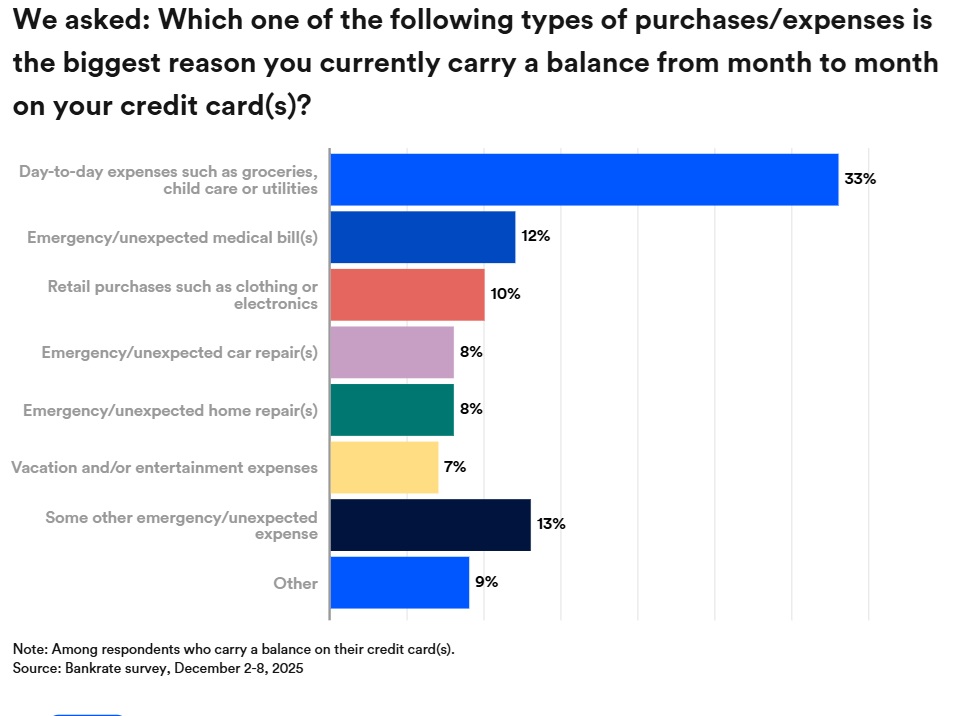
Why do the users carry a balance? The largest single reason is they aren’t properly managing cash flow and spending beyond their means, which forces them to use credit cards for everyday expenses.

Image

According to the Federal Reserve, 82% of American adults have at least one credit card. However, it’s common to have several cards in your wallet. On average, people have 3.9 cards.

My wife and I are super prime users, and we spend about $40,000 per year on credit cards. We use them for everything: utility bills, groceries, you name it. Once, I even made a $20,000 down payment on a car with a credit card. The difference is that we pay the balance off every month. Why do I do that? Rewards.

My Amazon card pays 5% cash back. Our joint card that we use for daily expenses? 5% cash back on fuel and restaurants, and another card gives us 7% credit for use on vacations. It’s all about maximizing our cash back returns. It’s like giving yourself a raise. As for us, that $40,000 a year in card use gets us about $1500 a year in rewards and freebies.

You just have to make sure you don’t carry a balance. That means spending within your means and not carrying a balance. The nationwide average APR on general-use credit cards is 21.91%, which means interest adds up quickly.

Among those who carry a balance, more than 7% of them are more than 90 days past due. So do the math from the other post- people with lower credit scores (below 700) spend the least, but are the most likely to carry a balance and most likely to become seriously delinquent and default.

So Trump’s rule of requiring credit card rates to be capped at 10% will cause credit card limits and availability to be greatly restricted. People will move back to cash, and will have to use debit cards for online transactions. This will in turn do three things:

  • It will force people like me to stop taking advantage of rewards, because they will no longer be available. I, and other prime and super prime users, will have to switch back to cash.
  • Prime users with scores between 700 and 749 will have restricted access to cards, and even then, those cards will have very low spending limits, likely $1000 or less.
  • Credit cards will simply not be available to those with a credit score below 700. This will force these subprime borrowers into more expensive payday loans, which carry interest rates of more than 300%.

The hit to online vendors and shopping will be enormous. Amazon, as the world’s largest online retailer with $400 billion in annual online sales, will be especially hard hit as people lose access to easy digital funding sources.

Likely, this will eventually settle into digital currency becoming more popular. At that point, I will have to reevaluate my opinion of things like bitcoin.

Just remember- price controls NEVER work as intended. Where there is market demand, the market will find a way to supply that demand.