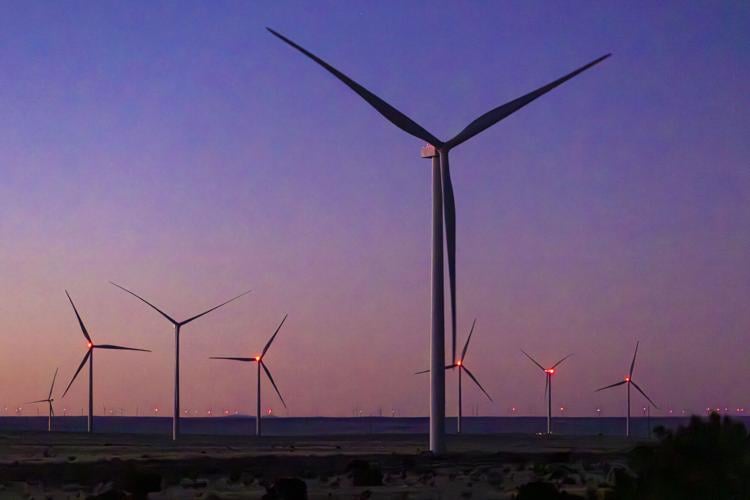
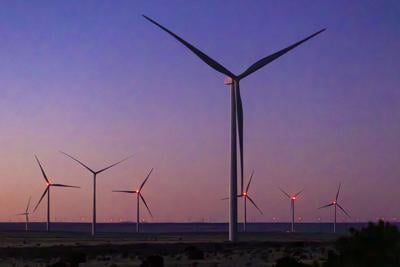
Wind turbines that are part of the SunZia Wind project stand silhouetted against the dusk sky on Tuesday in Torrance County near the town of Corona. SunZia Wind will be a 3.5-gigawatt wind farm that consists of over 900 wind turbines and a 550-mile transmission line that will use New Mexico’s high winds to produce enough electricity to power 3 million homes, carried via the transmission line to Arizona and California. The project is estimated to cost $11 billion.
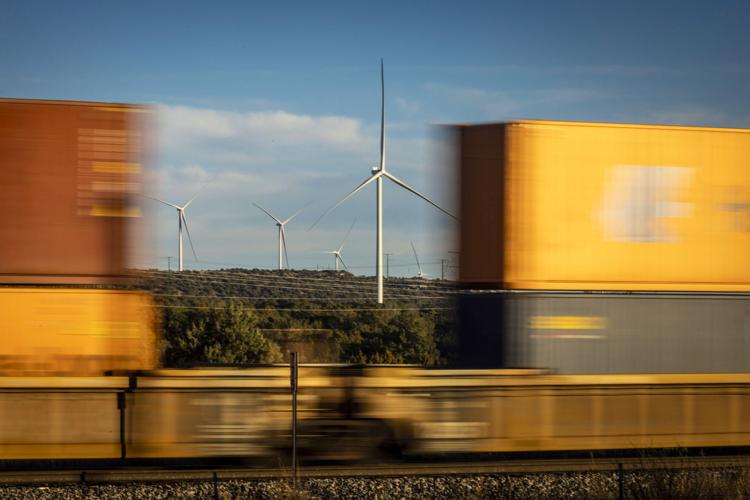
A freight train regularly chugs through the sleepy town of Corona, where the nation’s largest clean-energy infrastructure project; SunZia Wind, is being built. SunZia Wind will be a 3.5 gigawatt wind farm that consists of over 900 wind turbines and a 550-mile transmission line that will use New Mexico’s high winds to produce enough electricity to power 3 million homes, carried via the transmission line to Arizona and California. The project is estimated to cost $11 billion.
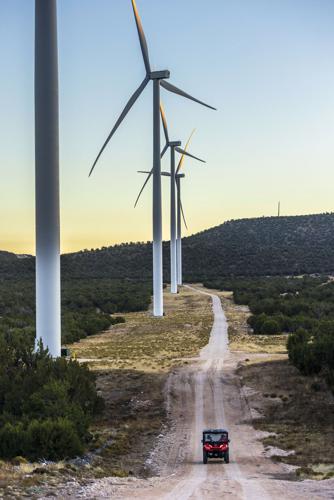
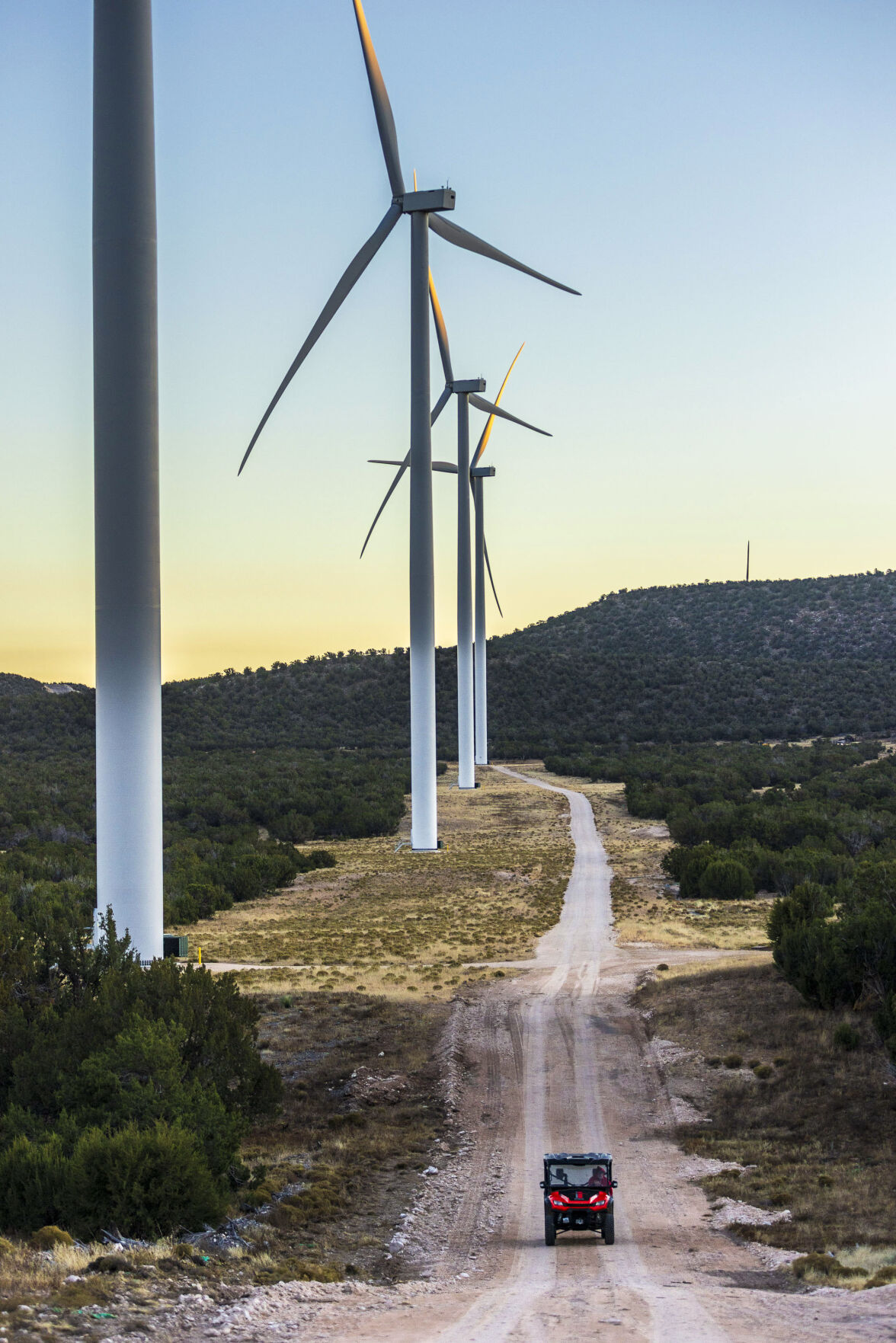
Nathan Burton/The New MexicanCorona rancher and business owner Ricky Huey drives a side-by-side utility terrain vehicle underneath towering wind turbines that have been built and installed on his land as part of the SunZia Wind and Transmission project Nov. 22.
Wind turbines that are part of the SunZia Wind project stand silhouetted against the dusk sky on Tuesday in Torrance County near the town of Corona. SunZia Wind will be a 3.5-gigawatt wind farm that consists of over 900 wind turbines and a 550-mile transmission line that will use New Mexico’s high winds to produce enough electricity to power 3 million homes, carried via the transmission line to Arizona and California. The project is estimated to cost $11 billion.
CEDARVALE — Look out from this Torrance County ghost town largely abandoned during the Great Depression, and there they are — a city of turbines fanning out across the arid landscape of mesquite, cholla cactus and scrub brush.
They tower over the graveyards of ancient ranching equipment.
The walls of a long-neglected New Deal-era schoolhouse in Cedarvale, an unincorporated community along N.M. 42, are sunken and sun-stained. It is a dizzying contrast — the sky-high presence of wind turbines, with their long shadows, just beyond the ruins of the old school.
The turbines are part of San Francisco-based Pattern Energy’s massive SunZia Wind and Transmission project under development in Central New Mexico, often described as the largest renewable energy project in the Western Hemisphere, with over 900 wind turbines spread out across multiple windswept counties and a 550-mile transmission line that will carry up to 3,500 megawatts of power to about a million homes across the Southwest.
The stunning $11 billion development, described as a major boost for the state’s clean energy outlook and profile, is expected to come fully online in 2026. Some say it will pump more power into the Southwest’s energy grid than the Hoover Dam. In many ways, SunZia is a crown jewel for a state that has adopted strong renewable energy policies.
But in the larger clean-energy picture, data from the U.S. Energy Information Administration shows, New Mexico, which produces 11 times more energy than it consumes, still ranks seventh in the nation in wind energy generation.
In 2024, it was the nation’s second-largest oil-producing state, with Texas taking the top spot. About 15% of the nation’s total crude oil production came from New Mexico that year; at the same time, 37% of its total net power generation came from wind, according to the Energy Information Administration, and 29% from natural gas.
Erik Schlenker-Goodrich, executive director of the Western Environmental Law Center, believes New Mexico is well positioned to be a global leader in renewable energy development, whether wind and solar or geothermal. But he sees numerous challenges, too.
“The state’s political and economic direction remains far too beholden to fossil fuels, namely oil and gas,” Schlenker-Goodrich said in a statement. “This dependence is creating massive headaches relative to orphaned and abandoned oil and gas infrastructure, toxic oil and gas wastewater, and sustained impacts to land, air, and water.”
Of renewable energy, he added, “We frankly do not see political leadership making those investments. Instead, they appear keen to double-down on fossil fuels on the presumption they can keep that aging golden goose kicking forever.”
‘Countless hurdles’ for project
With turbines in Torrance, Lincoln and San Miguel counties, the long-planned SunZia is now being built now under a Republican presidential administration with a radically different view of clean energy projects than former President Joe Biden, the Democrat under whom construction began in 2023, after nearly two decades of planning. Substantial federal land was leveraged to move the project forward following something of a Herculean effort to get the development approved.
It’s been a colossal undertaking: Helicopters tapped to roll out the construction; thousands of workers; a new look for certain corridors in Central New Mexico.
A two-state transmission line would route power from New Mexico to Arizona and then, potentially, California, a notion that has roiled some residents who live near the turbines.
Matt Dallas, a spokesperson for Pattern Energy, wrote in an email, “The energy will be delivered to a converter station in Pinal County, Ariz., where it will flow into the existing grid and be available for the southwestern United States.”
The project, constructed on federal, state and private lands, was approved by the U.S. Bureau of Land Management in 2023 following about 17 years of planning and negotiations. The project was first proposed by Southwestern Power Group in 2006, and the permitting process began in 2008. It received the green light from the Arizona Corporation Commission and the New Mexico Public Regulation Commission in 2022 — the same year Pattern Energy purchased the project.
The New Mexico PRC initially rejected the plan in 2018 over concerns the application was not detailed enough.
“After more than a decade of work and countless hurdles, seeing SunZia near completion is proof that America can still build big things,” U.S. Sen. Martin Heinrich, long an outspoken advocate for SunZia, said in a statement. “I’m proud that New Mexico will be home to the largest renewable energy project in the Western Hemisphere.”
He continued, “SunZia will generate more clean, affordable energy than the Hoover Dam, and its construction has already had a major economic impact in New Mexico, creating thousands of good-paying union jobs and spurring manufacturing in communities like Belen.”
The New Mexico State Land Office also has supported the project. According to a June report from the agency, Pattern Energy has at least 150,000 acres of long-term wind energy leases on state trust in Central New Mexico — out of 319,606 total acres of such leases.
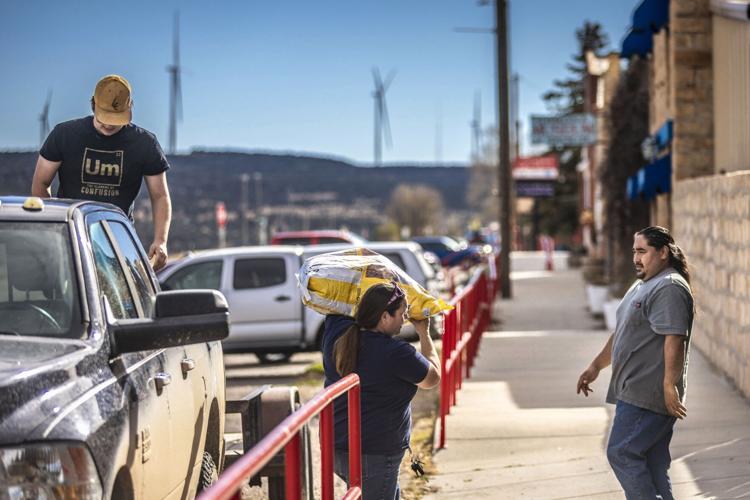
John Lucero, right, and wife Marilee Lucero-Martinez, owners of Corona Hardware and Ranch Supply unload bags of beet pulp on Tuesday in Corona.
Pattern Energy has said federal land makes up over 30% of the total project route and includes BLM, Bureau of Reclamation and U.S. Fish and Wildlife Service lands.
Dallas, the Pattern Energy spokesperson, said construction of the SunZia transmission line, about 350 miles of it in New Mexico, is complete and under testing. The wind farms supporting the project are about 75% built.
The company estimates the project’s overall economic benefit at around $20.5 billion, with more than 2,000 construction jobs and more than 100 permanent jobs. Those economic benefits are being felt far from the state Capitol, in some Republican Party strongholds.
Every county the transmission line passes through in the Land of Enchantment is solidly red.
Maps from Pattern Energy indicate a route from southern Torrance County down through Socorro County and Sierra County before heading west through Luna County, Grant County and Hidalgo County, and then into Arizona. The transmission line’s path through that state traces the border of Graham and Cochise counties before terminating at a converter station in central Pinal County.
The project has faced a federal legal challenge from the Tohono O’odham Nation, the San Carlos Apache Tribe, the Center for Biological Diversity and Archaeology Southwest, which filed a lawsuit last year in an effort to halt the project, alleging not enough work had been done to identify culturally significant sites in the San Pedro River Valley in Arizona along the transmission line’s route.
But the 32-page lawsuit was dismissed by federal Judge Jennifer Zipps, The Associated Press reported, arguing the plaintiffs were years too late in bringing their challenge.
The controversy over the transmission line came as Deb Haaland, now considered a front-runner in New Mexico’s 2026 gubernatorial race, was serving as interior secretary. She expressed support for the project.
“As the Secretary of Interior, we cut the red tape to break ground and get the SunZia project across the finish line,” Haaland said in a statement. “SunZia delivered jobs to our state and when complete will produce more home-grown New Mexico energy.”
The statement continued, “I have always and will always bring Tribes and impacted groups to the table. That’s what we did for SunZia as well. I am hopeful that a mutually beneficial solution will keep the project moving forward.”
‘Leadership in clean energy’
New Mexico has an ambitious timeline of renewable energy goals for the state’s power grid, laid out in the 2019 Energy Transition Act. The law requires electric utilities to generate at least 50% of their power from renewable sources by 2030 and 80% by 2040. Investor-owned utilities must reach 100% renewable source generation by 2045 and rural electric cooperatives by 2050.
But climate and environmental advocates have been critical of the state’s slow progress in developing renewables while increasing oil and gas production.
“We are certainly not doing enough to shift away from oil and gas, and certainly not fast enough,” said Lucas Herndon, the energy and policy director at ProgressNow New Mexico, an advocacy organization.
He added, “We have serious concerns about the state’s reliance economically on the oil and gas industry, especially as we see that we are reaching peak oil at an international level.”
A freight train regularly chugs through the sleepy town of Corona, where the nation’s largest clean-energy infrastructure project; SunZia Wind, is being built. SunZia Wind will be a 3.5 gigawatt wind farm that consists of over 900 wind turbines and a 550-mile transmission line that will use New Mexico’s high winds to produce enough electricity to power 3 million homes, carried via the transmission line to Arizona and California. The project is estimated to cost $11 billion.
How much money does the state get from renewables? The contrast with oil and gas revenues is stark.
State Land Office reports show oil and gas revenues dwarf the money brought in by wind and solar combined. The agency reported a balance of $1.05 million from wind energy at the beginning of fiscal year 2026, compared with more than $430 million from oil and gas interest and leases.
The state also has created incentives to increase development of renewable energy projects, such as exempting SunZia’s transmission line and equipment from property taxes.
A co-developer on the New Mexico portion of the SunZia project is the New Mexico Renewable Energy Transmission Authority, known as RETA, a quasi-governmental organization intended to develop, plan and acquire high-voltage transmission lines to help boost the development of renewable energy resources in the state.
Sponsored by state Rep. Nathan Small, D-Las Cruces, legislation signed into law this year by Gov. Michelle Lujan Grisham confirmed “transmission lines owned by [RETA] is property tax exempt ... even though the transmission line and ancillary equipment are or will be constructed and leased to and operated by non-exempt entities, including Pattern Energy,” according to a bill analysis by the Legislative Finance Committee.
Small said when he was first elected to the Legislature in 2016, the state did not rank in the top 10 when it came to developing renewable energy. He feels the state has made considerable strides since then.
“We have reestablished our leadership in clean energy, and we are seeing benefits, most importantly for New Mexico residents and families that range from the availability of electricity to new economic development,” said Small, who chairs the powerful House Appropriations and Finance Committee.
“To go in just a few years from being outside the top 10 to now being number 6 — getting most of our electricity from renewable resources — it’s really remarkable, even as we continue to grow our oil and natural gas,” he said.
Not everyone agrees the state should be investing so heavily in a shift to renewables.
“I don’t think it’s fair to the taxpayers that we subsidize this industry as heavily as we do at their expense,” said state Rep. Jim Townsend, R-Artesia. “It’s crazy that we do this,” he added, noting the power generated from projects may be sent outside the state.
‘Slow and tedious process’
There are a number of other wind projects of scale under development in New Mexico — and advocates say there are plenty of untapped areas across the largely rural state.
Home to about 35 million acres of public lands, New Mexico ranks among the least populated states per capita in the U.S. In the desert state, at least eight counties have a population of under 5,000 people. Energy companies often look to rural areas for wind farm development.
But the federal subsidies for clean energy projects enacted under Biden have since been cut by President Donald Trump’s administration. The extent of the impact of these cuts on renewable projects remains to be seen.
“One thing I will say is it’s created a lot of uncertainty, and uncertainty is the enemy of business,” Jim DesJardins, the executive director of the Renewable Energy Industries Association of New Mexico, said of Trump’s rollback of clean energy initiatives. “It’s the enemy of investment.”
Some substantial wind projects in the state are already up and running.
Spanish energy giant Iberdrola has broken ground on the El Cabo project in Torrance County. The project spans 80,000 acres, including 39,600 acres of state trust land, and ultimately could generate 1,000 megawatts of electricity — enough power up to 400,000 homes, according to the State Land Office.
Nathan Burton/The New MexicanCorona rancher and business owner Ricky Huey drives a side-by-side utility terrain vehicle underneath towering wind turbines that have been built and installed on his land as part of the SunZia Wind and Transmission project Nov. 22.
Southwestern Public Service Co.’s Sagamore Wind project near Roosevelt, south of Clovis in the eastern part of the state, has a total capacity of 522 megawatts of power and was completed November 2020, according to Cleanview, a market intelligence platform that tracks clean energy projects.
East of Estancia, the La Joya project carries about 75 turbines, according to The Wind Power, an online database of wind projects. The developer is Avangrid Renewables.
DesJardins noted one of the lessons he feels emerges from the SunZia saga, two decades in the making, is the U.S. needs to figure out how to speed up the approval process for large-scale clean energy projects.
“It is just a very slow and tedious process, and that helps make things not only take longer but more expensive,” DesJardins said. “And our counterparts, whether they are in Australia or Germany, seem to be able to do this stuff faster and less expensive.”