Filling Out My First Hall of Fame Ballot

Image
Eric Hartline and Kim Klement-Imagn Images

Last year was my 10th year as a member of the Baseball Writers’ Association of America, so while I’ve voted regularly in the end-of-year awards — nine times out of 10, in fact — this was my first opportunity to cast a ballot for a Hall of Fame election. I’m a huge believer in transparency when it comes to the voting for awards; every time I cast a ballot, I discuss my underlying reasoning at length. Because there is a lot of leeway and wiggle room in the official Hall of Fame election rules, votes come down to the interpretation and philosophy of the individual voters. For that reason, I wanted to take some space to discuss the philosophical decisions I made to determine who ended up with checkmarks on my submitted ballot. This isn’t really an analysis of the individual candidates; for that, you should consult Jay Jaffe’s extensive series, where he goes deep into each player’s career and legacy.
Image

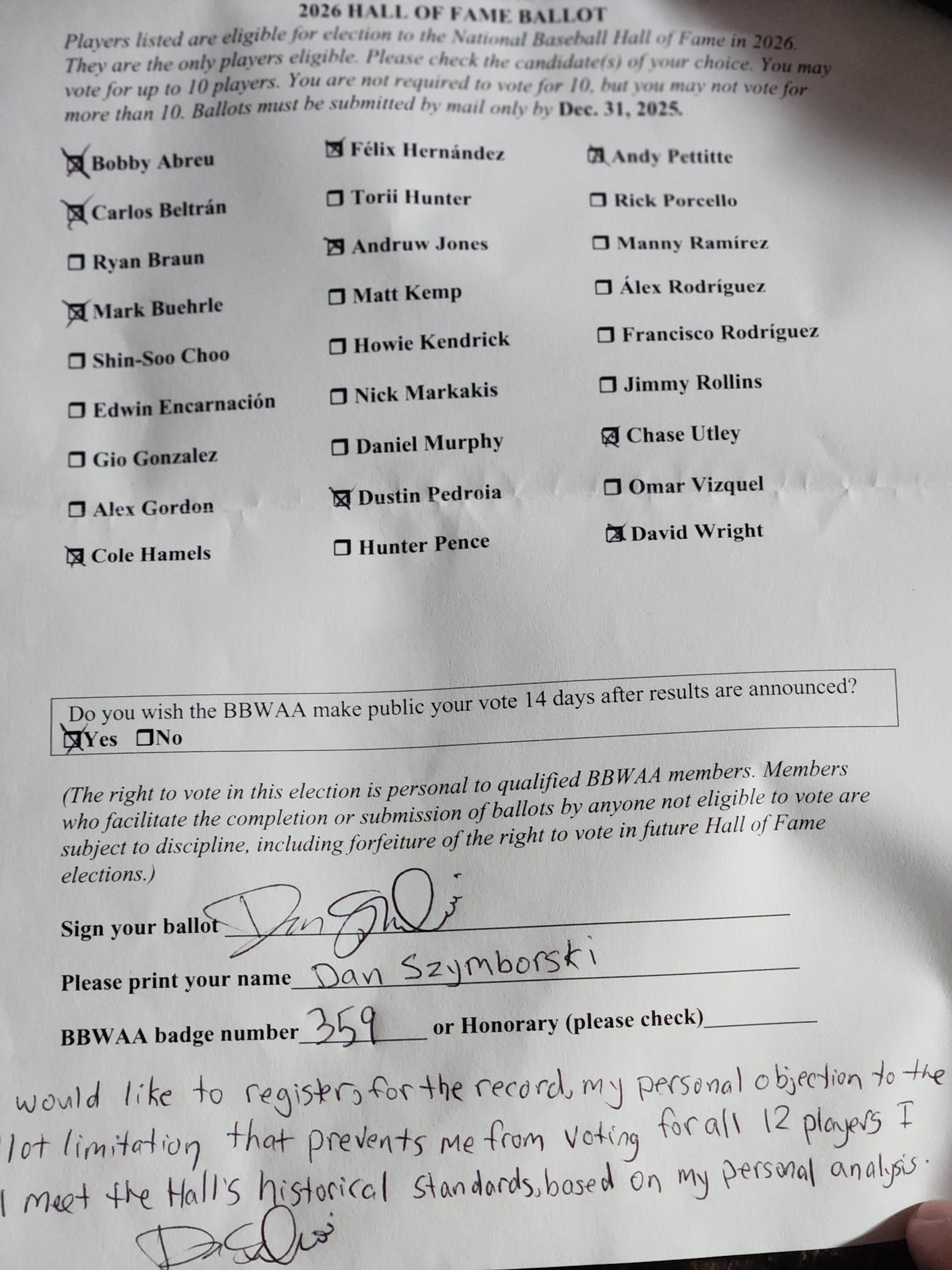
I’ve attached a picture of my ballot. Not the best one in the world since I cut off a few words of my obnoxious, meaningless “signing statement,” but since I sent my ballot off a month ago, there won’t be a better photo forthcoming! Unlike the year-end awards, which are conducted through Google forms, the Hall of Fame balloting process is old school. You physically open an envelope that contains a sheet of paper — made of these things called “trees” — and check boxes yourself before returning the whole thing through the good ol’ U.S. Mail. Thankfully, the whole exercise came with a pre-addressed, postage-paid envelope, as I don’t physically appear to be the owner of any envelopes or stamps. I will also note that I am aware that I have the penmanship of a seven-year-old. My handwriting has always been atrocious.

Anyway, you’ll notice that I voted for the maximum 10 players, and from the signing statement, you’ll see that I would have voted for 12 players if given the opportunity. In recent years, the BBWAA has issued proposals to the Hall of Fame to expand the number of players we’re allowed to vote for and to make all ballots public, but those requests have been turned down.

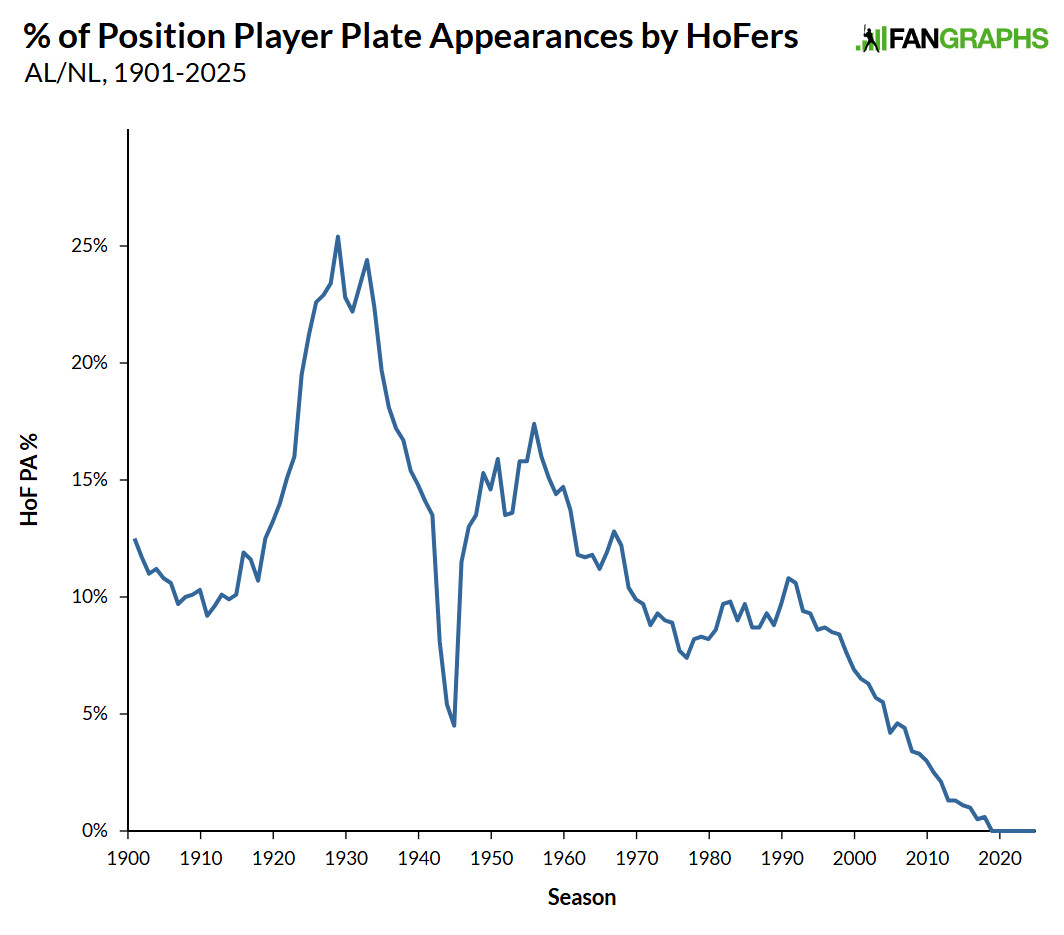
I’m not necessarily a Small Hall or Big Hall guy, but I do think it is important to keep the Hall consistent. What a Hall of Famer is is determined by who the Hall of Famers are. The obvious, inner circle players like Henry Aaron and Lefty Grove are a small minority of the Hall of Fame. What the Hall of Fame does have is a ton of guys like Ted Lyons and Waite Hoyt and Pee Wee Reese and Goose Goslin, those mid-range Hall of Famers who, if they were on today’s ballots, would be derided as Hall of Very Good Candidates by the extreme section of the Small Hall crowd. There’s this idea that modern inductees have watered down the Hall of Fame when, in fact, what the Hall is drowning in is endless inductees from baseball’s supposed Golden Age. Here’s my updated chart of the yearly percentage of position player plate appearances by future Hall of Famers:
Image

Now, the final ruling hasn’t yet been handed down on those 1990s players, but just because the Veterans Committee exists to catch players who fall through the cracks doesn’t strike me as a good reason to let players fall through those cracks. I find the moral value of a great honor is diminished if the honoree has to wait an indefinite amount of time, or even worse, does not live long enough to receive it. It’s an absolute shame that Ron Santo and Dick Allen died without knowing that their careers would ultimately be recognized with baseball’s most prestigious honor. And with baseball’s increasingly illogically designed Eras Committees, it’s going to be harder to catch the BBWAA’s misses.

Even so, I don’t think that all of the players who are better than the worst Hall of Famers should be in the Hall. There are lots of pitchers better than Jack Morris and Rube Marquard who still would not get a Hall of Fame vote from me. If we voted in everyone better than Tommy McCarthy, who was essentially the 19th Century Juan Pierre, the Hall would have quite the influx of outfielders. But all 12 players I wanted to vote for in this election were players I felt were better than the bottom quartile of Hall of Fame inductees, meaning that if they were inducted, they would at least be part of the Hall’s large middle class.

One of the most convincing arguments Bill James ever made about the Hall of Fame came when he introduced the concepts of career value and peak value as different kinds of greatness. The Hall’s record of recognizing peak value is very spotty, and while Sandy Koufax, one of the best examples of peak value, was given his due, players like Johan Santana have frequently gotten the shaft. But when we talk about greatness, how good a player was at his best seems to be very important information. Miguel Cabrera would not have attained the 3,000-hit or 500-homer career milestones if he had retired after the 2016 season at age 33, but did anything that happened after 2016 really enhance his greatness on an abstract level? After 2016, he was mostly a DH who hit .262/.329/.381 and averaged nine home runs a year. Cabrera’s peak is what makes his career great, after all.

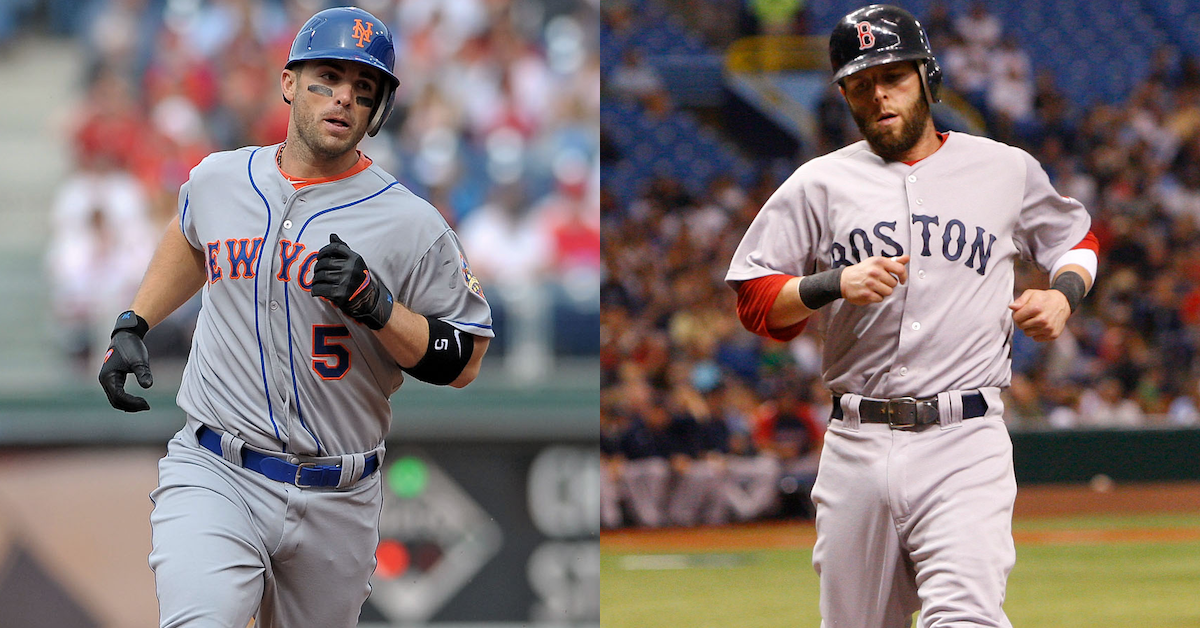
And that is why I checked the boxes for David Wright and Dustin Pedroia. Wright was healthy enough for about a decade to play full time, and over that period, he was perhaps the top third baseman in the majors.

Top MLB Third Basemen, 2005-2014
Name PA HR AVG OBP SLG wRC+ WAR WAR/600 PA
Miguel Cabrera 6780 345 .326 .403 .574 157 57.8 5.1
David Wright 6248 216 .298 .379 .492 134 48.1 4.6
Adrian Beltré 6183 248 .291 .341 .489 119 45.1 4.4
Alex Rodriguez 4959 273 .291 .387 .538 144 43.5 5.3
Evan Longoria 4119 184 .271 .351 .494 130 37.8 5.5
Ryan Zimmerman 5183 184 .286 .352 .476 120 34.1 4.0
Chipper Jones 3980 158 .303 .402 .517 142 32.0 4.8
Aramis Ramirez 5356 242 .292 .355 .514 126 29.7 3.3
José Bautista 4880 246 .259 .369 .498 133 29.2 3.6
Kevin Youkilis 4188 143 .282 .383 .482 129 28.7 4.1
Alex Gordon 4396 121 .268 .345 .435 111 26.0 3.5
Placido Polanco 4861 54 .298 .345 .390 97 24.5 3.0
Scott Rolen 3396 90 .274 .344 .447 108 22.0 3.9
Chase Headley 3944 93 .265 .347 .409 114 21.8 3.3
Pablo Sandoval 3533 106 .294 .346 .465 122 20.3 3.5
Edwin Encarnación 4885 229 .265 .349 .487 122 19.7 2.4
Michael Young 6096 129 .305 .353 .444 109 18.9 1.9
Casey Blake 3677 120 .264 .338 .442 108 17.3 2.8
Juan Uribe 4262 131 .253 .299 .415 89 17.1 2.4
Chone Figgins 4440 30 .272 .350 .355 94 17.0 2.3

Cabrera has the edge in WAR, and he had a better postseason record, but he also wasn’t a full-time a third baseman during this period. (He’s second among first basemen in the same years). It’s worth mentioning that Wright received more playing time during his 10-year peak than a lot of the competition, but he also had one of the highest WAR rates over that decade. He’s not the undisputed best third baseman during that span, but he certainly has a strong case for that title. That peak is enough for me. The case for Pedroia is similar.

Top MLB Second Basemen, 2007-2016
Name PA HR AVG OBP SLG wRC+ WAR
Robinson Canó 6786 249 .305 .357 .499 129 48.0
Dustin Pedroia 6182 131 .303 .368 .447 118 45.0
Chase Utley 5517 175 .275 .361 .460 120 44.7
Ian Kinsler 6397 198 .276 .344 .450 112 42.0
Ben Zobrist 5446 143 .268 .362 .437 122 40.4
Brandon Phillips 6312 174 .280 .325 .429 99 28.8
Howie Kendrick 5174 91 .289 .333 .417 107 25.9
Matt Carpenter 3016 74 .284 .376 .462 133 21.3
Jose Altuve 3649 60 .311 .354 .437 118 19.5
Dan Uggla 4826 208 .236 .335 .442 109 19.0
Jason Kipnis 3364 76 .272 .345 .423 111 18.5
Daniel Murphy 4201 87 .296 .339 .447 115 18.3
Placido Polanco 3815 41 .294 .342 .385 95 18.2
Rickie Weeks Jr. 4159 138 .245 .344 .427 109 17.8
Neil Walker 3884 116 .273 .339 .436 115 17.8
Aaron Hill 5124 152 .264 .319 .426 98 17.1
Marco Scutaro 4034 53 .284 .350 .387 100 17.1
Kelly Johnson 4805 146 .252 .329 .423 102 16.8
Brian Dozier 3065 117 .246 .320 .442 107 16.7
Mark Ellis 3716 66 .259 .320 .373 89 15.8

Neither Wright or Pedroia is a slam-dunk candidate, but each is just over my foggy line.

I’m probably not going to get out of here without discussing how I consider performance-enhancing drug use or general rulebreaking/bending. Even more so than performance, there’s a lot of room for philosophical differences here, so let me emphasize that even though I personally feel that my stance is the best one — after all, why would I not go with what I think is best? — I certainly can’t objectively claim that it’s the right one. Let’s start with the text of the Hall’s so-called character clause, which is actually only just one sliver of a sentence:

Voting shall be based upon the player’s record, playing ability, integrity, sportsmanship, character and contributions to the team(s) on which the player played.

Based on my knowledge of baseball and the Hall of Fame’s history, both in practice and when the rules were being discussed, I function under the belief that we’re talking sportsmanship and character related to their baseball-related life, not so much as a person on a wider level. The rules of the game are pretty important, and so I consider breaking baseball’s rules to be a demerit on a player’s permanent record. In this case, I believe PED rulebreaking to be something I am dutybound to consider after the summer of 2004, when steroid testing was first implemented. I don’t have the same feeling about pre-2004 PED use. Some people cite former commissioner Fay Vincent’s early 1990s memo about steroids as a reason not to vote for PED users in the pre-testing era, but as Vincent himself noted in an interview with Bernie Miklasz, he issued the memo only to make a statement. He pointed out that he didn’t have the power to implement any such rules against PED use without MLBPA approval.

“I sent it out because I believed it was important to take the position that steroids were dangerous, as were other illegal drugs,” Vincent said. “As you know, the union would not bargain with us, would not discuss, would not agree to any form of a coherent drug plan. So my memo really applied to all the people who were not players.”

In other words, Fay Vincent banned Pat Gillick and Dan Duquette from using steroids.

So I consider Barry Bondstesting positive for amphetamines in 2006 as a black mark on his résumé, as I do with Alex Rodriguez and Manny Ramirez for failing PED tests. But I also view each black mark as merely a factor to be weighed in a Hall of Fame case, not as a binary “they cheated, so they’re out” scenario. In my eyes, Bonds, A-Rod, and Manny are all worthy Hall of Famers, and a little bit of dirt in their story doesn’t tarnish the tale.

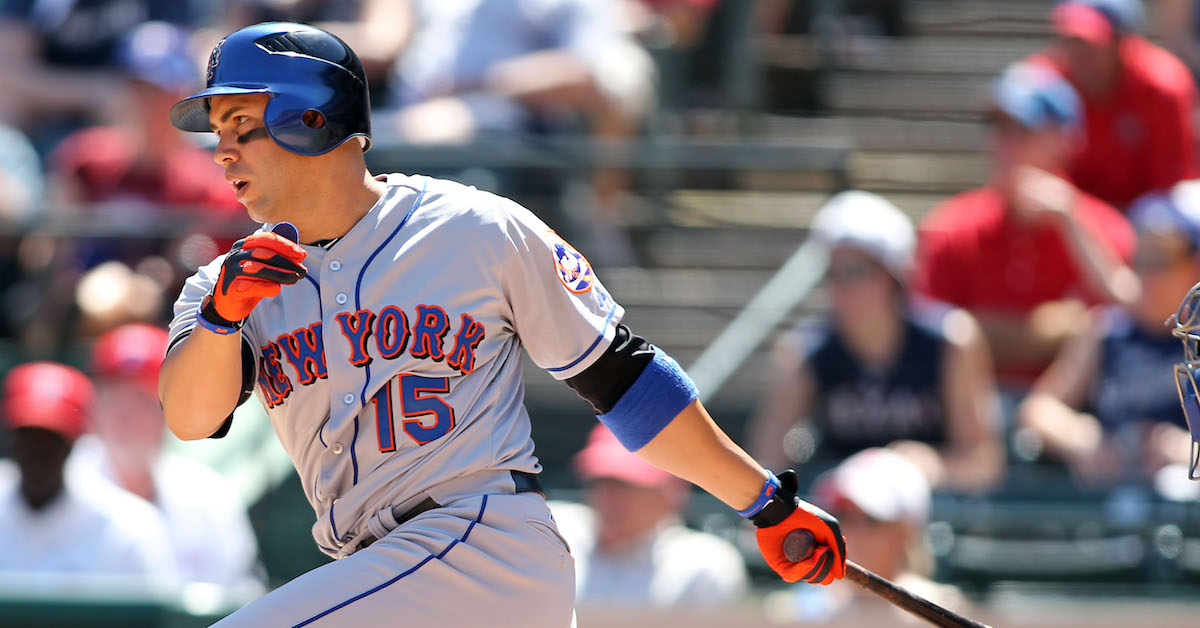
On the other hand, I would not have voted for Pedroia or Wright if they had been found to have broken those rules. I did not vote for Ryan Braun, because I think his performance was on the wrong side of the dividing line, but even if he had a slightly longer peak, I still would not have checked his box because of his situation. I don’t really care about the efficacy of the cheating when it comes to a player’s Hall of Fame case; it makes no difference to me if Carlos Beltrán and the other members of the 2017 Astros actually benefited from their electronic sign-stealing operation. Rather, what matters is that banging on a trash can to relay signs that were stolen in real time via a video camera is a blatant form of cheating. Yet, once again, when considering the totality of Beltrán’s career, he easily belongs in the Hall of Fame, even with the banging-scheme demerit.

Now, I wanted to vote for 12 players, but I could only vote for 10. So, I asked myself: What is the purpose of the checkmarks on a Hall of Fame ballot? I view it as getting deserving players into the Hall of Fame. There are three ways that a single voter can impact a player’s chances of making it to Cooperstown: 1) if a vote helps a player reach the 75% threshold required for induction, 2) if a vote allows a player to exceed the 5% mark necessary to remain eligible for future BBWAA elections, and 3) if a vote adds to the percentage of ballots cast in favor of a player from the previous year, thereby building that player’s momentum of support. The last one is kind of weird, but it does seem to be the case that a number of voters wait for the bandwagon to be rolling behind a player before they get on for the ride, so I have to take that into consideration, too.

Ultimately, my final decision came down to the following question: Which two votes of my desired 12 would be the least impactful at getting a deserving player in the Hall of Fame? I concluded those to be for Manny Ramirez and Alex Rodriguez. There was no chance that my vote would get either of them over 75%, keep them over 5%, or build enough momentum for them to eventually get elected. Most baseball writers have already made up their minds about how they will vote for players who used or likely used PEDs, and there aren’t enough new voters in any given year to make a difference. A-Rod and Manny are not Hall of Famers right now because they used steroids, not because writers are unsure about their baseball merit.

So, that’s my ballot, right or wrong. It’s OK to disagree with me — this would be a boring job if everyone agreed with me — but as I said at the top, I feel it’s my responsibility to you, the readers, to explain why I vote the way I do.
Brendan Gawlowski Prospects Chat: 1/20/26

2:02
Brendan Gawlowski: Hello everybody. Blue Jays list went live today, Guardians list went live last week. If you haven’t seen ’em, take a look.

2:02
Brendan Gawlowski: Away we go

2:02
Potato: Great Job with the Jays system! Any rough order for the next few to come out?

2:03
Brendan Gawlowski: Angels for me next week. Eric is working on Phillies, then Detroit. James will have Houston or St. Louis sometime before prospect week, I don’t recall which.

2:03
Brendan Gawlowski: We’re also balancing these lists with other Prospect Week content, so… much to come

2:03
Nick: How does a prospect’s organization impact your evaluation (if at all)? For example, Ethan Holliday with the Rockies (haven’t developed bats well recently) vs Ethan Holliday with the Dodgers/Brewers/etc?

Read the rest of this entry »


Twins Sign Victor Caratini, Fail in the Art of Deception

Image
Troy Taormina-Imagn Images

“I’ve talked to Byron [Buxton] and other players through this offseason already about ways we can get better as a team,” Twins President of Baseball Operations Derek Falvey told reporters back in November at the GM meetings. The answer was in response to a report that Buxton’s loyalty to the Twins may waiver if he felt they were entering a rebuild, as Minnesota’s behavior during last season’s trade deadline suggested. Falvey went on to insist that the team intends to add, not subtract, and it seems the term rebuild is taboo among Twins spokespeople.

Falvey is lying. I say this with no inside information, malice, or even judgement. MLB organizations operate within a system where this particular lie is not only acceptable, but also encouraged. Because “we’re not rebuilding; we’re trying to get better” is a corollary to a larger lie — that all teams are trying their hardest to win.

What is the truth, but a lie agreed upon? — Friedrich Nietzsche

Though this quote is often attributed to him, Nietzsche never actually said it. However, it does seem to offer a reasonably accurate distillation of his beliefs. And if we all agree that he did say it, then by his own logic, it must be true. Likewise, teams have decided to hold to the line that they’re all trying to win, and since they’ve all agreed, it falls to fans to take the lie as truth, along with all the subsequent lies necessary to support the original lie. Read the rest of this entry »


The Envelope Please: Our 2026 Hall of Fame Crowdsource Ballot Results and a Preview of Election Day

Image
Tim Heitman-USA TODAY Sports

The following article is part of Jay Jaffe’s ongoing look at the candidates on the BBWAA 2026 Hall of Fame ballot. For a detailed introduction to this year’s ballot, and other candidates in the series, use the tool above; an introduction to JAWS can be found here. For a tentative schedule, see here. All WAR figures refer to the Baseball Reference version unless otherwise indicated.

On Tuesday evening, the National Baseball Hall of Fame will announce the results of this year’s BBWAA balloting. In this age of ballot tracking, we have only a mild bit of suspense on our hands, something less than a true cliffhanger. Based on the published ballots in Ryan Thibodaux’s Tracker (which unfortunately has been experiencing outages due to traffic throttling), both Carlos Beltrán and Andruw Jones are likely to be elected, though there’s still a bit of uncertainty for the latter. If the FanGraphs readers who participated in this year’s crowdsource ballot had their way, Beltrán would be the only one who would make the cut. Read the rest of this entry »


Reds, Rays, and Angels Link Up In Three-Team Swap

Image
Eric Canha, Katie Stratman, Troy Taormina-Imagn Images

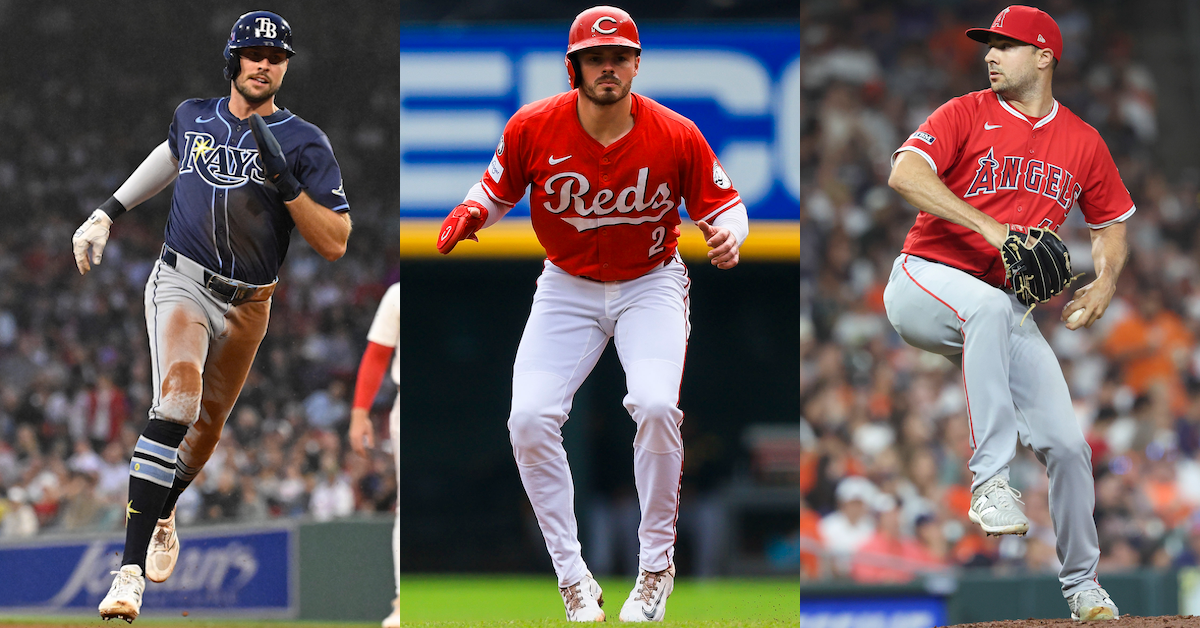
Last week was one of the busiest of the offseason so far, with Kyle Tucker taking his talents to Chavez Ravine and Bo Bichette heading to the Mets. Given those glitzy headlines, it was easy to miss an annual rite of winter: a weird, zero-sum-feeling trade that didn’t need to be a three-teamer but was anyway because the Rays got involved. The particulars: The Rays sent Josh Lowe to the Angels, the Angels sent Brock Burke to the Reds, and Tampa Bay got Gavin Lux from Cincinnati and prospect Chris Clark from the Halos.

The first thing that drew my eye in this trade is that the two hitters are at least superficially similar: lefties with enormous platoon splits and no real defensive home. Lux has a career 99 wRC+; Lowe 101. They get to those marks in extremely different ways, though, and I think that’s as good of an entry point into analyzing this swap as any.

Lowe is an archetypical lefty power bat, and the Angels simply don’t have anyone like that. Last year was easily Lowe’s worst as a pro on a rate basis, and he also spent a month and a half on the IL. But his 11 homers would have been the second-most by an Angels lefty, behind Nolan Schanuel’s 12 in 150-ish more plate appearances (Yoán Moncada also hit 12 lefty homers, but he left in free agency). Overall, the Angels were 29th in baseball in home runs hit by lefties, with 34 for the entire team put together. Read the rest of this entry »


They Don’t Make Pitch Models Like They Used To

Image
Paul Rutherford-Imagn Images

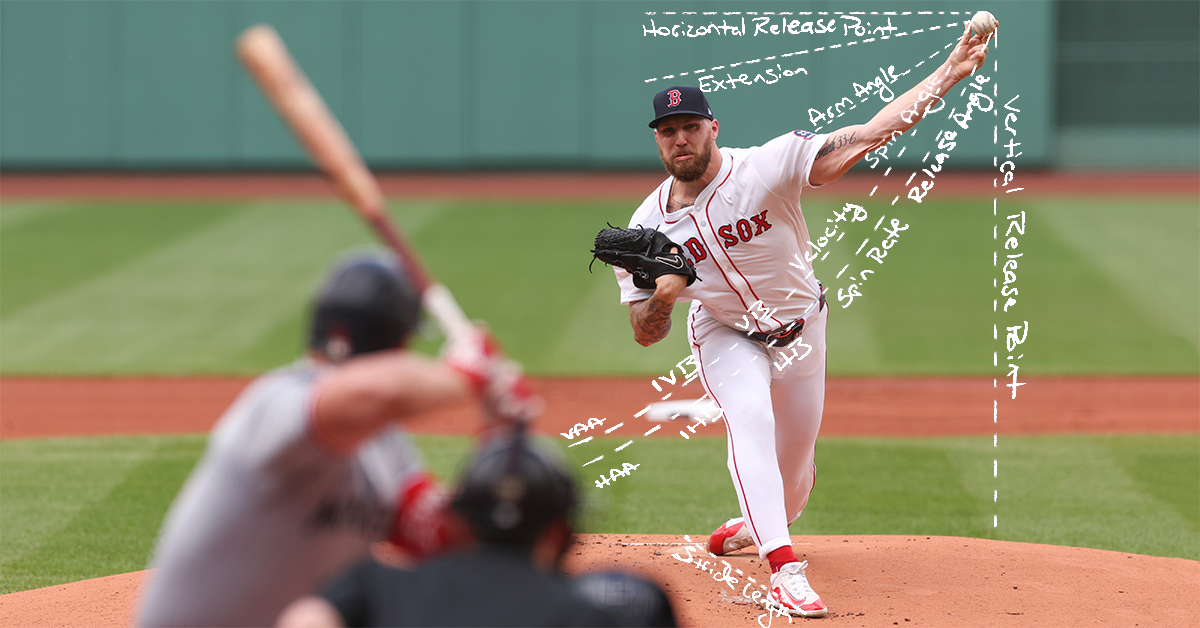
Before we get started, I need you to promise to hold on until the end here. I have buried the lede. The crux of this article is in the last two graphs, all the way at the bottom. I put them there on purpose because I want the data to tell you a story, so I need you to see this story through to the end. I think it’s worth it.

Last Tuesday, Ben Clemens wrote an article titled, “They Don’t Make Barrels Like They Used To.” Sadly, it was not a scathing takedown aimed at the shoddy craftsmanship of modern-day coopers. It documented the steady decrease in the value of barrels over the course of the Statcast era. In 2025, barrels were worth roughly 250 fewer points of wOBA than they were in 2015. That’s a staggering loss – the entire career wOBA of Pepe Frias up in smoke – and Ben broke down several culprits for the theft, along with one other factor: intention. “Tell hitters that barrels get them paid,” Ben wrote, “and they might start to change their behavior in a way that produces less valuable barrels, squared up to center field or in other ways that are easier to produce but less likely to land safely.” He attributed this to Goodhart’s Law: “When a measure becomes a target, it ceases to become a good measure.”

This law has a sports-specific corollary that you’re probably familiar with. I’ve previously referred to it as the Competitive Advantage Life Cycle in the context of catcher framing:

  • Teams realize the immense value of a skill.
  • An arms race ensues as they scramble to cultivate it.
  • The skill becomes widespread across the league.
  • Since the skill is more evenly distributed, it loses much of its value.

The second we gained the ability to calculate the value of catcher framing, everybody started working on it. The terrible framers either got better or got run out of the sport. Players who were excellent at framing but worse at other parts of the game suddenly found more playing time because their skills were appreciated. Lastly, as the average framing level rose, the rest of the league started catching up to the very best framers. This graph is three years old now, but it shows that convergence very clearly.

Image

The terrible framers are gone, and the great framers don’t stand out as much as they used to. Everybody’s a bit closer to the new, tougher standard, so framing is more important than it’s ever been, but also less valuable. All this got me thinking about one of the oddest measurement tools we have these days: pitch modeling. Read the rest of this entry »


Toronto Blue Jays Top 40 Prospects

Image
Kiyoshi Mio-Imagn Images

Below is an analysis of the prospects in the farm system of the Toronto Blue Jays. Scouting reports were compiled with information provided by industry sources as well as my own observations. This is the sixth year we’re delineating between two anticipated relief roles, the abbreviations for which you’ll see in the “position” column below: MIRP for multi-inning relief pitchers, and SIRP for single-inning relief pitchers. The ETAs listed generally correspond to the year a player has to be added to the 40-man roster to avoid being made eligible for the Rule 5 draft. Manual adjustments are made where they seem appropriate, but we use that as a rule of thumb.

A quick overview of what FV (Future Value) means can be found here. A much deeper overview can be found here.

All of the ranked prospects below also appear on The Board, a resource the site offers featuring sortable scouting information for every organization. It has more details (and updated TrackMan data from various sources) than this article and integrates every team’s list so readers can compare prospects across farm systems. It can be found here. Read the rest of this entry »


JAWS and the 2026 Hall of Fame Ballot: Nick Markakis

Image
Rick Osentoski-USA TODAY Sports

The following article is part of Jay Jaffe’s ongoing look at the candidates on the BBWAA 2026 Hall of Fame ballot. For a detailed introduction to this year’s ballot, and other candidates in the series, use the tool above; an introduction to JAWS can be found here. For a tentative schedule, see here. All WAR figures refer to the Baseball Reference version unless otherwise indicated.

2026 BBWAA Candidate: Nick Markakis
Player Pos Career WAR Peak WAR JAWS H HR SB AVG/OBP/SLG OPS+
Nick Markakis RF 33.7 24.6 29.2 2,388 189 66 .288/.357/.423 109
Source: Baseball-Reference

Early in his career, Nick Markakis appeared to be a star in the making. In his second and third seasons in the majors (2007 and ’08), the former first-round pick topped 40 doubles, 20 homers, and a .300 batting average while slugging nearly .500. He led the AL in WAR in 2008, his age-24 campaign — not that anyone was aware of it at the time, which helps to explain his omission from that year’s AL All-Star team.

It would take another decade before Markakis finally became an All-Star, and during that stretch, his performances leveled off. He became better known for his durability, his defense (he won three Gold Gloves), and above all, the example he set for younger players while enduring lean years both in Baltimore and Atlanta. He stuck around long enough to help both teams’ rebuilding efforts come to fruition with playoff appearances, racking up so many hits that he generated discussion regarding his potential Hall-worthiness if he persisted long enough to reach the magic 3,000-hit milestone.

Markakis’ retirement after his age-36 season rendered that question moot. He didn’t generate a Hall-caliber résumé or gaudy statistics during his 15-year career, but he received considerable praise for his impact on his teammates. From Braves manager Brian Snitker, who managed him from 2016–20:

“One of the most consistent, professional pros that I’ve ever been around. I’m glad I had the honor to manage him in his last years, because he’s a special player… How consistent he was, how professional he was, the way he played the game, how he grinded every at-bat. He never took a pitch off. And to see what he did late in his career, winning that Gold Glove, and the stabilizing force that he was for our club while I was here. You don’t appreciate a guy like Nick until you manage him. What a great career he had.”

Read the rest of this entry »


Sunday Notes: Red Sox Prospect Franklin Arias Aspires To Out-Power Luis Arraez

Franklin Arias has a bright future in Boston. Signed out of Venezuela in 2023, the 20-year-old shortstop is the top position-player prospect in the Red Sox system thanks to plus tools on both sides of the ball. A slick-fielder — Eric Longenhagen has described him as an incredibly polished defender for his age” — Arias possesses a line-drive stroke that produced a 109 wRC+ across three levels last season. And while that number may not jump off the page, it stands out when put into context: the Caracas native not only played the entire year as a teenager, he finished it in Double-A.

The degree to which he can boost his power profile will go a long way toward determining his ceiling. Currently more contact than pop, Arias went deep just eight times in 526 plate appearances. At a listed 5-foot-11, 170 pounds, he is by no means built like a bopper.

Red Sox farm director Brian Abraham brought up that aspect of Arias’s game when I asked him about the young infielder earlier this week.

“He’s a guy who makes really good swing decisions,” Abraham said of Arias, who posted a 10.1% strikeout rate and a 5.3% swinging-strike rate in 2025. “He puts the bat on the ball and can drive it to all fields. We’re looking to see him add size and strength so that he can really impact the ball pull-side in the air.

“It’s definitely in there,” added Abraham. “We’ve seen flashes of it, it’s just a matter of him being able to do that on a consistent basis. As a young player who is continuing to grow and get bigger, I think it will come out the more he is able to hit the ball out front and drive it to the pull side. Right now I would say that he is a contact hitter with occasional power, and that the power can be more consistent than it has been.”

Not surprisingly, Arias echoed Abraham’s thoughts when addressing his near-term development goals. Read the rest of this entry »


FanGraphs Weekly Mailbag: January 17, 2026

Image
Patrick Gorski and Troy Taormina-Imagn Images

Never let anyone tell you that there are no rebounds in baseball. That’s utter nonsense, and it is our responsibility to say so. If you need evidence to support your rebuttal, just look at what happened this past week in free agency.

Since our last mailbag ran, Alex Bregman signed a five-year, $175 million contract to play for the Cubs after opting out of the deal he signed last February with the Red Sox. The Cubs knew they weren’t in the running to re-sign Bregman’s former Astros teammate, Kyle Tucker, so they instead beefed up their lineup with the third baseman. In response to missing out on Bregman, Boston bounced back with someone completely different, agreeing to a five-year, $130 million deal with left-handed starting pitcher Ranger Suárez, phormerly of the Phillies, who had spent much of the first half of January courting Bo Bichette, whose long-time team, the Blue Jays, had their sights set on Tucker, the top-ranked free agent of the offseason. It seemed that Tucker was choosing between Toronto and the Mets, and was nearing a decision, when at the last minute the Dodgers swooped in with a four-year, $240 million offer that Tucker simply couldn’t turn down. Spurned by Tucker, the Mets splurged on Friday, snatching up Bichette for at least one season (the deal can max out at three years and $126 million) before Philadelphia could do it. Not long after, the Phillies phinally phigured they should stop playing the phield and instead rekindle an old phlame; they re-signed catcher J.T. Realmuto to a three-year, $45 million contract.

For those of you keeping score at home, the Cubs rebounded from Tucker with Bregman; the Red Sox rebounded from Bregman with Suárez; the Phillies rebounded from Suárez and Bichette with Realmuto; and the Mets rebounded from their failed pursuit of Tucker with Bichette. That leaves the Blue Jays as the one team still looking for a rebound. Tune in next week to find out if they turned to Cody Bellinger to help them get over Tucker. We won’t be covering baseball’s newest hit Realmutality TV series for the remainder of today’s mailbag. If you want to go behind the scenes of all the drama, all the tea is linked in the quick recap above, or you can go deeper by reading Jon Becker’s latest Matrix Reloaded column. Instead, we’ll be answering your questions about the most exciting potential World Baseball Classic matchups, the WAR value of Edwin Encarnación’s parrot, and an alternative universe in which the PCL teams joined Major League Baseball back in the late 1950s. But first, I’d like to remind you that this mailbag is exclusive to FanGraphs Members. If you aren’t yet a Member and would like to keep reading, you can sign up for a Membership here. It’s the best way to both experience the site and support our staff, and it comes with a bunch of other great benefits. Also, if you’d like to ask a question for an upcoming mailbag, send me an email at mailbag@fangraphs.com. Read the rest of this entry »