Healthcare organizations are managing many challenges at once: consumers expect digital experiences that feel as personalized as other industries, fragmented data in silos slows strategic decision-making, and AI and advanced technologies must integrate seamlessly into existing care models.
Meeting these demands requires more than incremental change—it calls for digital solutions that unify access to care, trusted data, and advanced technologies to deliver transformative outcomes and operational efficiency.
IDC Market Glance: Healthcare Ecosystem, 4Q25
We’re proud to share that Perficient has been included in the “IT Services” category in the IDC Market Glance: Healthcare Ecosystem, 4Q25 report (Doc# US54010025, December 2025). This segment includes systems integration organizations providing advisory, consulting, development, and implementation services, as well as products or solutions.
We believe this inclusion reinforces our expertise in leveraging AI, data, and technology to deliver intelligent tools and intuitive, compliant care experiences that drive measurable value across the health journey.
We believe this commitment aligns with critical shifts IDC Market Glance highlights in its latest report, which emphasizes how healthcare organizations are activating advanced technology and AI. IDC Market Glance shares, “Health systems and payers are moving more revenue into value-based care and capitated risk, pushing tech buyers to favor solutions that improve quality metrics, lower total cost of care, and help hit incentive thresholds.”
As the industry evolves, IDC predicts: “Technology buyers will likely favor vendors that align revenue models to customer risk arrangements, plug seamlessly into large platforms, and demonstrate human-centered design that supports clinicians rather than replacing them.”
To us, this inclusion validates our ability to help healthcare organizations maximize technology and AI to drive transformative outcomes, power enterprise agility, and create seamless, consumer-centric experiences that build lasting trust.
Intelligent Solutions for Transformative Outcomes
These shifts are actively transforming the healthcare ecosystem, challenging leaders to rethink how they deliver care and create value. Our partnerships with leading organizations show what’s possible: moving AI from pilot to production, building interoperable data foundations that accelerate insights, and designing human-centered solutions that empower care teams and improve the cost, quality, and equity of care.
Easing Access to Care With a Commerce-Like Experience
We helped Rochester Regional Health reimagine its digital front door to triage like a clinician, personalize like a concierge, and convert like a commerce platform—creating a seamless experience that improves access, trust, and outcomes. The mobile-first redesign introduced smart search, dynamic filters, and real-time booking, driving a 26% increase in appointment scheduling and saving $79K+ monthly in call center costs. As a result, this transformative work earned three industry awards, recognizing the solution’s innovation in accessibility, engagement, and measurable impact on patient care.
Consumers expect frictionless access to care, personalized experiences, and real-time engagement. Our recent Access to Care Report reveals more than 45% of consumers aged 18–64 have used digital-first care instead of their regular provider—and 92% of them believe the quality is equal or better. To deliver on consumers’ expectations, leaders need a unified digital strategy that connects systems, streamlines workflows, and gives consumers simple, reliable ways to find and schedule care.
Explore how our Access to Care research continues to earn industry awards or learn more about our strategic position on find care experiences.
Empowering Care Ecosystems Through Interoperable Data Foundations
We helped a healthcare insurance leader build a single, interoperable source of truth that turns healthcare data into a true strategic asset. Our FHIR‑enabled solution ingests, normalizes, and validates data from internal and external systems and shares a consolidated, reliable dataset through API connectors, gateways, and extracts, grounded in data governance. Ultimately, this interoperable data foundation accelerates time to market, minimizes downtime through EDI and API modernization, and ensures the right data reaches the right hands at the right time to power consumer‑grade experiences, while confidently meeting interoperability standards.
Discover our platform modernization and data management capabilities.
Accelerating Member Support With Human-Centered GenAI Innovation
We helped a leading Blue Cross Blue Shield health insurer transform CSR support by deploying a natural language Generative AI benefits assistant powered by AWS’s AI foundation models and APIs. The intelligent assistant mines a library of ingested documents to deliver tailored, member-specific answers in real time, eliminating cumbersome manual processes and PDF downloads that previously slowed resolution times. Beyond faster answers, this human-centered solution accelerates benefits education, equips agents to provide relevant information with greater speed and accuracy, and demonstrates how generative AI can move from pilots into core infrastructure to support staff rather than replace them.
Read more about our AI expertise or explore our human-centered design services.
Build Your Scalable, Data-Driven Future
From insight to impact, our healthcare expertise equips leaders to modernize, personalize, and scale care. We drive resilient, AI-powered transformation to shape the experiences and engagement of healthcare consumers, streamline operations, and improve the cost, quality, and equity of care.
We have been trusted by the 10 largest health systems and the 10 largest health insurers in the U.S., and Modern Healthcare consistently ranks us as one of the largest healthcare consulting firms.
Our strategic partnerships with industry-leading technology innovators—including AWS, Microsoft, Salesforce, Adobe, and more—accelerate healthcare organizations’ ability to modernize infrastructure, integrate data, and deliver intelligent experiences. Together, we shatter boundaries so you have the AI-native solutions you need to boldly advance business.
Ready to Turn Fragmentation Into Strategic Advantage?
We’re here to help you move beyond disconnected systems and toward a unified, data-driven future—one that delivers better experiences for patients, caregivers, and communities. Let’s connect and explore how you can lead with empathy, intelligence, and impact.
]]>When building modern SharePoint Framework (SPFx) solutions, reusable UI components play a crucial role in keeping your code clean, scalable, and maintainable. In particular, interactive components help improve the user experience without cluttering the interface.
Among these components, the Accordion is a commonly used UI element. It allows users to expand and collapse sections, making it easier to display large amounts of information in a compact and organized layout. In this blog, we’ll walk through how to create a custom accordion component in SPFx using React.
Create the Accordion Wrapper Component
To begin with, we’ll create a wrapper component that acts as a container for multiple accordion items. At a high level, this component’s responsibility is intentionally simple: it renders child accordion items while keeping styling and layout consistent across the entire accordion.This approach allows individual accordion items to remain focused on their own behavior, while the wrapper handles structure and reusability.
Accordion.tsx
import * as React from 'react';
import styles from './Accordion.module.scss';
import classNames from 'classnames';
import { IAccordionItemProps } from './subcomponents/AccordionItem';

import { ReactElement } from 'react';

export interface IAccordionProps {
  children?:
    | ReactElement<IAccordionItemProps>
    | ReactElement<IAccordionItemProps>[];
  className?: string;
}


const Accordion: React.FunctionComponent<
  React.PropsWithChildren<IAccordionProps>
> = (props) => {
  const { children, className } = props;
  return (
    <div className={classNames(styles.accordionSubcomponent, className)}>
      {children}
    </div>
  );
};

export default Accordion;
Styling with SCSS Modules
Next, let’s focus on styling. SPFx supports SCSS modules, which is ideal for avoiding global CSS conflicts and keeping styles scoped to individual components. Let’s see styling for accordion and accordion items.
Accordion.module.scss
.accordionSubcomponent {
    margin-bottom: 12px;
    .accordionTitleRow {
        display: flex;
        flex-direction: row;
        align-items: center;
        padding: 5px;
        font-size: 18px;
        font-weight: 600;
        cursor: pointer;
        -webkit-touch-callout: none;
        -webkit-user-select: none;
        -khtml-user-select: none;
        -moz-user-select: none;
        -ms-user-select: none;
        user-select: none;
        border-bottom: 1px solid;
        border-color: "[theme: neutralQuaternaryAlt]";
        background: "[theme: neutralLighter]";
    }
    .accordionTitleRow:hover {
        opacity: .8;
    }
    .accordionIconCol {
        padding: 0px 5px;
    }
    .accordionHeaderCol {
        display: inline-block;
        width: 100%;
    }
    .iconExpandCollapse {
        margin-top: -4px;
        font-weight: 600;
        vertical-align: middle;
    }
    .accordionContent {
        margin-left: 12px;
        display: grid;
        grid-template-rows: 0fr;
        overflow: hidden;
        transition: grid-template-rows 200ms;
        &.expanded {
          grid-template-rows: 1fr;
        }
        .expandableContent {
          min-height: 0;
        }
    }
}
Styling Highlights
- Grid‑based animation for expand/collapse
- SharePoint theme tokens
- Hover effects for better UX
Creating Accordion Item Component
Each expandable section is managed by AccordionItem.tsx.
import * as React from 'react';
import styles from '../Accordion.module.scss';
import classNames from 'classnames';
import { Icon } from '@fluentui/react';
import { useState } from 'react';


export interface IAccordionItemProps {
  iconCollapsed?: string;
  iconExpanded?: string;
  headerText?: string;
  headerClassName?: string;
  bodyClassName?: string;
  isExpandedByDefault?: boolean;
}
const AccordionItem: React.FunctionComponent<React.PropsWithChildren<IAccordionItemProps>> = (props: React.PropsWithChildren<IAccordionItemProps>) => {
  const {
    iconCollapsed,
    iconExpanded,
    headerText,
    headerClassName,
    bodyClassName,
    isExpandedByDefault,
    children
  } = props;
  const [isExpanded, setIsExpanded] = useState<boolean>(!!isExpandedByDefault);
  const _toggleAccordion = (): void => {
    setIsExpanded((prevIsExpanded) => !prevIsExpanded);
  }
  return (
    <Stack>
    <div className={styles.accordionTitleRow} onClick={_toggleAccordion}>
        <div className={styles.accordionIconCol}>
            <Icon
                iconName={isExpanded ? iconExpanded : iconCollapsed}
                className={styles.iconExpandCollapse}
            />
        </div>
        <div className={classNames(styles.accordionHeaderCol, headerClassName)}>
            {headerText}
        </div>
    </div>
    <div className={classNames(styles.accordionContent, bodyClassName, {[styles.expanded]: isExpanded})}>
      <div className={styles.expandableContent}>
        {children}
      </div>
    </div>
    </Stack>
  )
}
AccordionItem.defaultProps = {
  iconExpanded: 'ChevronDown',
  iconCollapsed: 'ChevronUp'
};
export default AccordionItem;
Example Usage in SPFx Web Part
<Accordion>
  <AccordionItem headerText="What is SPFx?">
    <p>SPFx is a development model for SharePoint customizations.</p>

  </AccordionItem>

  <AccordionItem
    headerText="Why use custom controls?"
    isExpandedByDefault={true}
  >
    <p>Custom controls improve reusability and UI consistency.</p>
  </AccordionItem>
</Accordion>
Conclusion
By building a custom accordion component in SPFx using React, you gain:
- Full control over UI behavior
- Lightweight and reusable code
- Native SharePoint theming
This pattern is perfect for:
- FAQ sections
- Configuration panels
- Dashboard summaries
We’re excited to announce that Perficient has officially attained SS&C Blue Prism Implementation Partner Certification at the Silver level. As we begin 2026, this achievement reflects our commitment to delivering world-class intelligent automation solutions and driving measurable value for our clients.
What This Certification Means
The SS&C Blue Prism Silver Implementation Partner Certification is a hallmark of quality, expertise, and consistency. It recognizes partners who meet rigorous standards across personnel, support, and delivery requirements. By earning this certification, Perficient has demonstrated its ability to implement intelligent RPA solutions that set a benchmark for customer success.
About the SS&C Partner Program
The SS&C Partner Program is designed to give customers access to the best partners and technology in the rapidly evolving world of intelligent automation and AI. As part of this program, Perficient joins a global ecosystem focused on helping businesses:
- Deliver end-to-end transformation through full-stack automation.
- Implement strategic governance tools for deployment success.
- Expand into high-growth markets where demand for automation is accelerating.
This recognition positions Perficient at the forefront of intelligent automation, enabling us to help clients streamline processes, reduce complexity, and unlock new efficiencies.
A Testament to Teamwork and Vision
This achievement underscores Perficient’s commitment to excellence and innovation in intelligent automation. It reflects not only the technical expertise required to meet SS&C Blue Prism’s rigorous standards but also our strategic focus on helping clients accelerate transformation.
“This milestone reflects the hard work and dedication of our team,” said Mwandama Mutanuka, Vice President of AI Platforms. “We see this partnership as a key in our AI Platforms go-to-market this year.”
Driving Intelligent Automation Forward
As a Silver Implementation Partner, Perficient is proud to be part of SS&C Blue Prism’s 5-star rated Partner Program. This recognition strengthens our ability to help organizations become more intelligently connected through agentic automation, enabling businesses to scale responsibly and deliver meaningful outcomes.
Learn More
Explore how Perficient’s AI Automation expertise can help your organization embrace next-generation automation solutions. Visit https://www.perficient.com/contact to start your transformation journey.
]]>OmniStudio Expression Set Action is a powerful feature in Salesforce Industries. It lets you make changes and make decisions based on rules in guided processes, like OmniScripts and Integration Procedures. Instead of writing rules in many places, you can define your business rules once in an Expression Set and use them wherever you need them. This improves consistency, reduces errors, and simplifies maintenance.
What Is an Expression Set Action?
An Expression Set Action acts as a bridge between:
- OmniScripts / Integration Procedures, and
- Expression Sets, which are part of the Business Rules Engine (BRE)
In simple terms:
- Your OmniScript or Integration Procedure sends inputs (like OrderValue or DeliveryType).
- The Expression Set processes this data using calculations, conditions, or lookups.
- The result is returned as a structured JSON output, which you can display or use for further logic.
What Can Expression Sets Do?
Expression Sets are Designed to Handle:
- Mathematical calculations
- Conditional logic (if/else situations)
- Lookups using decision matrices
- Data transformations
Common Real‑World Use Cases
- Calculating shipping or delivery charges.
- Determining customer eligibility.
- Applying discounts or fees.
- Computing taxes or surcharges
Because Expression Sets work with JSON, they are lightweight, fast, and ideal for complex rule processing.
Creating an Expression Set – Step by Step
Step 1: Navigate to Expression Sets
- Go to Salesforce Setup
- Search for Expression Sets (under OmniStudio / Industries features)
- Click New
Step 2: Basic Setup
- Name: Example – ShippingChargesExp
- Usage Type: Select Default
- Save the record
This automatically creates Version 1 of the Expression Set.
Building Logic Using Expression Set Builder
After saving, open the Expression Set Builder, which provides a visual canvas for designing logic.
Step 3: Define Variables (Resource Manager)
Variables represent the data your Expression Set uses and produces.
Example Variables:
- DeliveryType – Input (e.g., Standard or Express)
- OrderValue – Input (order amount)
- ExpectedDeliveryCharges – Intermediate result
- TotalCharges – Final output
Each Variable Should Have:
- A clear name
- Data type (number, text, boolean, etc.)
- Input or Output configuration
Step 4: Use Decision Matrices (Optional but Powerful)
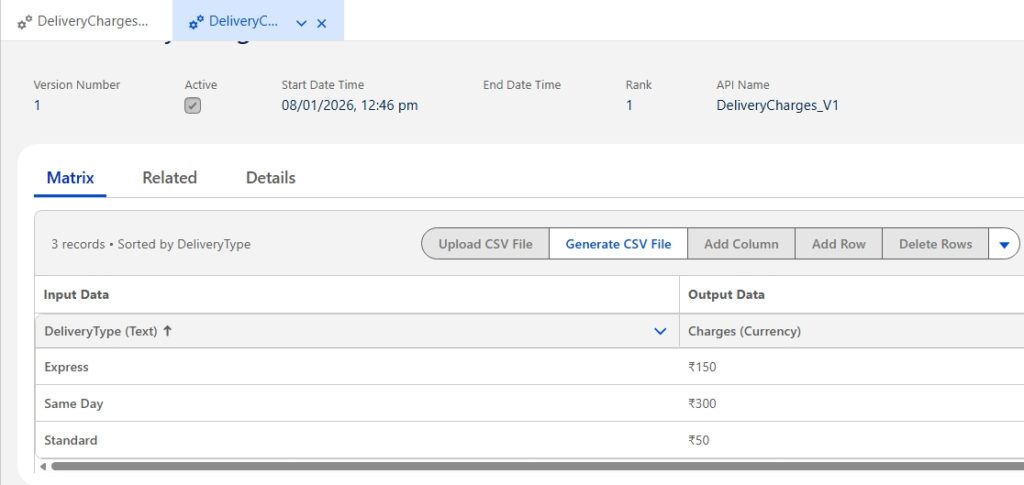
If your charges depend on predefined rules (for example, deliveryType), you can use a Decision Matrix.
- Drag the Lookup Table element onto the canvas
- Associate it with an existing Decision Matrix, such as DeliveryCharges
- Use inputs like DeliveryType to return ExpectedDeliveryCharges
This keeps your logic external and easy to update without modifying the code.
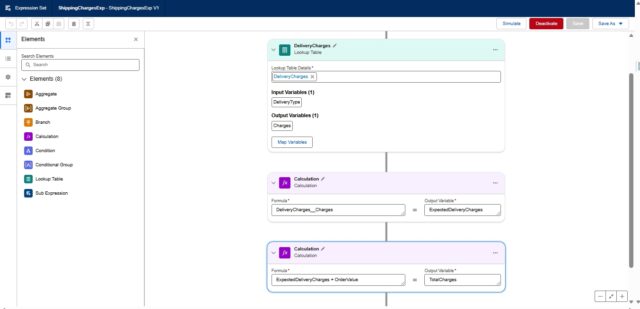
Step 5: Add Calculations
To perform arithmetic operations:
- Drag the Calculation element from the Elements panel
- Define a formula such as:
TotalCharges = ExpectedDeliveryCharges + OrderValue
This element performs the actual math and stores the result in a variable.
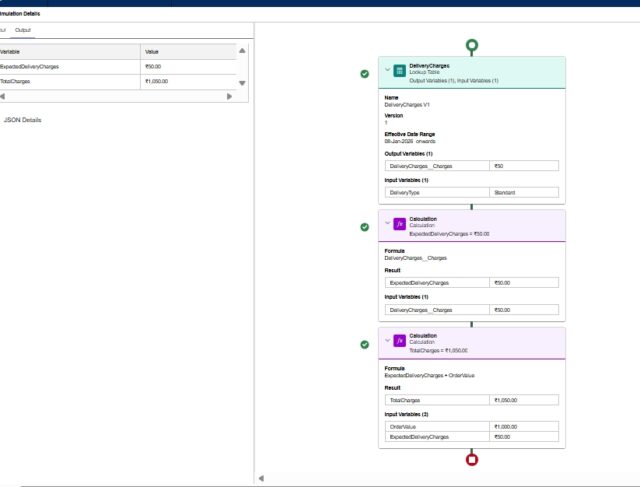
Step 6: Sequence and Test
- Arrange elements on the canvas in logical order
- Use the Simulate option to test with a sample JSON input:
Step 7: Activate the Expression Set
Before using it:
- Set Active Start Date
- Define Rank (for rule priority)
- Select Output Variables
- Click Activate
Your Expression Set is now ready for use.
Using Expression Set Action in an OmniScript
OmniScripts are user-facing guided flows, and Expression Set Actions allow logic to run automatically in the background.
Step 1: Prepare Inputs
In the OmniScript:
- Create fields such as DeliveryType and OrderValue
- Capture values from user input or previous steps
Step 2: Add Expression Set Action
- Open OmniScript Designer
- Drag Expression Set Action between steps
- Select your Expression Set (ShippingChargesExp)
Step 3: Configure Input Mapping
Map inputs using JSON paths, for example:
- %Step:CustomerDetails:DeliveryType%
- %Step:CustomerDetails:OderValue%
Step 4: Use Output Values
In the next step:
- Use Set Values or Display Text elements
- Reference returned outputs like TotalCharges
Step 5: Test
Preview the OmniScript with different inputs to ensure calculations work correctly.
Using Expression Set Action in an Integration Procedure
Integration Procedures handle server-side processing and are ideal for performance-heavy logic.
Step 1: Create Integration Procedure
- Go to Integration Procedures
- Click New
- Add an Expression Set Action from the Actions palette
Step 2: Configure the Action
- Select the Expression Set
- Map inputs such as DeliveryType and OrderValue
Step 3: Return Outputs
- Add a Response Action
- Include output variables
- Save and execute to validate results
Step 4: Call from OmniScript
Use an Integration Procedure Action inside OmniScript to invoke this logic.
This approach improves scalability and keeps OmniScripts lightweight.
Key Learning Resources
If you’re new to OmniStudio, these resources are highly recommended:
In my last blog post I addressed how to prepare your team for a unique experience and have them primed and ready for brainstorming.
Now I want to cover what actually happens INSIDE the brainstorming session itself. What activities should be included? How do you keep the energy up throughout the session?
Here’s a detailed brainstorming framework and agenda you can follow to generate real results. It works whether you have 90 minutes or a full day; whether you are tackling product innovation, process improvement, strategic planning, or problem solving; and whether you have 4 people on the team or 12 (try not to do more than that). Feel free to pick and choose what you like and adjust to fit your team and desired depth.
Pre-Session Checklist
- Room Setup: Seating arranged to encourage collaboration (avoid traditional conference setups), background music playing softly, be free to move around. Being offsite is best!
- Materials: Whiteboards, sticky notes, markers, small and large paper pads, dot stickers for voting, projector/screen.
- Helpers: Enlist volunteers to capture ideas, manage breakout groups, and tally votes. Ensure they know their roles ahead of time.
- Technology: If you’re using digital tools, screen sharing, or virtual whiteboards, test everything before the team arrives.
- Breaks: Make sure you plan for breaks. People need mental and physical break periods.
- Food: Have snacks and beverages ready. If you have a session over 3 hours, plan lunch and/or supper.
1. Welcome the Team (5-20 minutes)
As people arrive, keep things light to set the tone. Try to keep a casual conversation going, laughs are ideal! This isn’t another meeting, it’s a space for creative thinking.
If anyone participated in personal disruptions ahead of the meeting, (with no pressure) see if they’ll share. As the facilitator, have your own ready to share and also explain the room disruptions you’ve set up.
2. Mental Warmups (5-20 minutes)
The personal disruptions mentioned in my other post are meant to break people out of their mental ruts. This period of warm up is meant to achieve the same thing.
Many facilitators do this with ice breakers. I personally don’t like them and have had better luck with other approaches. Consider sharing some optical illusions or brain teasers that stretch their minds rather than putting them on the spot with forced socialization.
That said, ice breakers that get people up and building something together can work too, if you have one you like. Things like small teams building the tallest tower out of toothpicks and mini-marshmallows is a common one that works well.
3. Cover the Brainstorming Ground Rules (2-10 minutes)
- No Bad Ideas: Save negativity for later. Right now, we’re generating not judging.
- Quantity Over Quality: More ideas mean more chances for success. Aim for volume.
- Wild Ideas Welcome: Suspend reality temporarily. One impossible idea can spark a feasible one.
- No Ownership Battles: Ideas belong to the team. Collaboration beats competition.
- Build on Others: Use “Yes, and…” thinking. Evolve, merge, and improve ideas together.
- Stay Present: No emails, no phones. Even during breaks, don’t get distracted.
These rules should be available throughout the session. Consider hanging a poster with them or sharing an attendee packet that includes it. If anyone is attending remotely, share these in the chat area.
As the facilitator, you should be prepared to enforce these rules!
4. Frame the Challenge (5-20 minutes)
Why are we here today? What’s the goal of this brainstorming session? What do we hope to achieve after spending hours together?
This is a critical time to ensure everyone’s head is in the right place before diving into the actual brainstorming. We’re not here just to have fun, we’re here to solve a business problem. Use whatever information you have to enlighten the team on current state, desired state, competition, business data, customer feedback…whatever you have.
Now that we have everyone mentally prepared, consider a short break after this.
5.A. Individual Ideation (5-15 minutes)
This time is well spent whether you had your team generate ideas ahead of time or not. Even if you asked them to, you cannot expect everyone to have devoted time to think about your business objective ahead of time. You will end up with more diverse ideas if you keep this individual time in the agenda.
Here, we want to provide your attendees with paper, pens, and/or sticky notes, and set a timer. Remind them that quantity of ideas is the goal.
Ask the team on their own to come up with 10+ ideas in 5 minutes. They can compete to see who comes up with the most. Keep some soft background music playing (instrumental music). Consider dropping a “crazy bomb of an idea” as an example… something completely unrealistic and surprising, just to jar their minds one last time before they start. Show them that it’s OK to be wild in their suggestions.
When the round is done, optionally, you can take the next 5-10 minutes hearing some of the team’s favorites. Not all, just the favorites. Write them on a board, or post the sticky notes up.
5.B. Second Round of Individual Ideation (10-20 minutes)
If you have time, do a second round of individual idea creation, but this time introduce lateral thinking. Using random entry to show them that ideas can be triggered through associations. Have snippets of paper with random words for each person to draw from a bowl or hat. Give them an additional 5 or 10 minutes to come up with another set of ideas that relates to the word they selected.
For this second round you should be prepared to help anyone who struggles. You can suggest connections to their selected word, or push them to explore synonyms, antonyms, or other associations. For instance, if they draw “tiger”, you can associate animal, cat, jungle, teeth, claws, stripes, fur, orange, black, white, predator, aggression, primal, mascot, camouflage, frosted flakes, breakfast, sports, Detroit, baseball, Cincinnati, football, apparel, clothing, costume, Halloween, and more!
The associations are endless. They draw “tiger”, associate “stripe”, and relate that to the objective in how “striping” could mean updating parts of a system, and not all of it. Or they associate “baseball” and relate that to the objective in how a “bunt” is a strategic move that averts expectations and gets you on base.
6. Idea Sharing (10-60 minutes)
This portion of brainstorming is where ideas start to come together. When people start sharing their initial ideas, others get inspired. Remind everyone that we’re not after ownership, we’re collectively trying to solve the business problem. Your helpers can take notes on who was involved in an idea, so they can later be tagged for additional input or the project team.
This step can be nerve-wracking. Professionals may be uncertain about sharing half-baked ideas, but this is what we need! Don’t pressure anyone, so you, as the facilitator, can offer to share ideas on their behalf if they would like that.
As part of this step, begin identifying patterns and themes. People’s first ideas are generally the easy ones that multiple people will have (including your competitors). There will be similarities. Group those ideas now and try to give the groupings easy to reference names.
The bulk of the ideas are now in everyone’s heads, consider a short break after this.
7. Idea Expansion (20-60 minutes)
As the team comes back from a break, do a round of dot voting. Your ideas are pasted up and grouped, and the team has had some time to let those ideas settle in their minds. Now we’re ready to start driving the focus of the rest of this session.
There should be a set of concepts that are most intriguing to the team. Now, you will encourage pushing some further, spin-off ideas, and cross-pollination. Even flipping ideas to their opposite is still welcome. SCAMPER is an acronym that applies to creative thinking, and you might print it out and display it for your session today.
Like comedy improv, we still do not want to be negative about any idea. Use “yes, and…” to elaborate on someone’s idea. “I really like this idea, now imagine if we spin it as…” Make sure these expansions are being written down and captured.
8. Wild Card Rounds (10-60 minutes)
If you have a larger group, this time is ideal for break-out sessions. If your group is small, it can be another individual ideation round.
Take the top contending themes and divvy them out to groups or individuals. Then you can run 1-3 speed rounds, rotating themes between rounds.
- Role Play: Ask them to expand on their theme as if they were Steve Jobs, Jeff Bezzos, Einstein, your competitor, or SpongeBob. This makes them think differently.
- Constraints: Consider how they would have to change the idea if they were limited by budget, time, quality, or approach. Poetry is beautiful because of its constraints.
- Wishful Thinking: What could you do if all constraints were lifted? If you were writing a fictional book, how would you make this happen?
- Exaggeration: Take the idea to the extreme. If the idea as stated is 10%, what does 100% look like? What does 10-times look like?
This level of pushing creativity can be exhausting, consider a break after this.
9. Bring it Together (10-60 minutes)
Update your board with the latest ideas and iterations, if you haven’t already. Give the attendees a few minutes to peruse the posted ideas and reflect. Refresh the favorites list with another round of dot voting.
If time allows, move on from all this divergent thinking, and ask the attendees to list some constraints or areas that need to be investigated for these favorite ideas to work. Keep in mind this is still a “no bad ideas” session, so this effort should be a means to identify next steps for the idea and how to ensure it is successful if it is selected to move forward.
If you still have more time available, start some discussion that could help create a priority matrix after the meeting (like How/Now/Wow). Venture into identifying the following for each of the favorite ideas. We’re just looking for broad strokes and wide ranges today. On a scale of 1-10, where do these fall?
- Impact: How much would this change the story for the business?
- Effort: How much effort from business resources might be required?
- Timeline: What would the timeline look like?
- Cost: Would there be outside costs?
10. Next Steps (5-10 minutes)
This is the last step of this brainstorming session, but this is not the end. Now we fill the team in on what happens next and give them confidence that today’s effort will be useful. Start by asking the team what excited or surprised them the most today, and what they’d like to do again sometime.
Explain to the team how these ideas will be documented and shared out. The team should already be excited about at least one of today’s ideas, they’ll sleep on these ideas and continue thinking. So, let them know that there will be an opportunity to add additional thoughts to their favorites in the days/weeks to come.
Explain if you have any further plans to get feedback from stakeholders, leaders, or customers. If there are decision makers that are not in this meeting, then help your team understand what you’ll be doing to share these collective ideas with those who will make the final call.
Lastly, thank them for their time today. Express your own satisfaction and excitement for what’s to come. Try to squeeze in a few more laughs and build a feeling of teamwork. Consider remarking on something from this meeting as a “you had to be there” type of joke, even if it is the unrealistic bombshell of an idea that gets a laugh.
Tips for the Facilitator
- Energy Management: Watch the room’s energy. If it dips, inject movement. Stand up, stretch, take a quick walk, change the pace with a speed round.
- Protect the Quiet Voices: Don’t let extroverts dominate. Use techniques like written brainstorming and round-robin sharing to ensure everyone contributes.
- Embrace the Awkward Silence: When you ask a question and get silence, resist the urge to fill it. Give people time to think. Count to ten in your head before jumping in, and don’t make them feel like it was a failure to not say anything.
- Document Everything: Assign helpers to photograph whiteboards, capture sticky notes, and record key insights. You’ll lose valuable ideas if you rely on memory alone.
- Keep Your “Crazy Idea Bomb” Ready: If the room gets stuck, be prepared to throw out something intentionally wild to break the pattern. Sometimes the group needs permission to think bigger.
- Stay Neutral: As facilitator, your job is to guide the process, not advocate for specific ideas. You can participate, if you want to, but save your own advocacy for later. No idea is a bad idea in this session.
Conclusion
I hope you find this example brainstorming session agenda helpful! It’s one of my favorite things to run through. Get your team prepped and ready, then deliver an amazing workshop to drive creativity and innovation!
……
If you are looking for a partner to run brainstorming with, reach out to your Perficient account manager or use our contact form to begin a conversation.
]]>In the lead up to NRF opening its doors in New York City, industry leaders were already debating how artificial intelligence, shifting consumer expectations, and economic uncertainty would shape the year ahead. One theme rose above the rest. Retail is entering a renewed era where human connection is once again the driving force behind meaningful customer experiences.
To better understand these conversations, Justin Racine, principal and associate vice president of commerce, attended Retail’s Big Show. He walked away with a clear message that he later shared in CMSWire. Below are several of his key takeaways.
A Return to Basics With Advanced Tools
Justin described NRF 2026 as a return to something retailers have always known. People want to feel understood, valued, and connected. While the industry has spent recent years racing toward automation and efficiency, the conversations at NRF signaled a shift back to the emotional core of retail. This time, the tools supporting that shift are more advanced than ever.
Across sessions and show floor discussions, leaders emphasized that technology is not replacing the human element. It is amplifying it. Retailers are using modern capabilities to create experiences that feel more personal and more intuitive. Innovation and empathy are beginning to work together rather than compete for attention.
Artificial Intelligence as an Intimacy Engine
One of Justin’s strongest observations was the reframing of artificial intelligence. Instead of viewing AI as a tool for automation alone, many speakers described it as a way to deepen relationships. AI can help associates anticipate needs, respond with greater accuracy, and create interactions that feel tailored and thoughtful.
This perspective marks a meaningful shift. Retailers are no longer asking how AI can replace tasks. They are asking how it can elevate people. When employees are empowered with better insights, they can deliver service that feels more human.
The Power of Physical and Emotional Proximity
Justin also noted a renewed focus on closeness. Brands are working to get physically closer to their customers through store design and layout choices that feel warm and intuitive. They are also striving for emotional closeness by building trust and demonstrating empathy in every interaction.
This emphasis on proximity is becoming a competitive advantage. When customers feel seen and understood, loyalty grows. NRF made it clear that the brands winning in 2026 will be those that invest in relationships as intentionally as they invest in technology.
Consumers Still Seek Joy
Even with economic uncertainty shaping buying behavior, Justin observed that consumers continue to seek moments of joy. They are willing to spend when an experience feels meaningful. Retailers are responding by creating moments that spark delight, whether through a warm conversation with a sales associate or a surprisingly relevant recommendation powered by AI.
A Future Built on People and Technology Working Together
Justin’s reflections on NRF 2026 paint a picture of an industry recalibrating. The future of retail is not defined by technology alone. It is defined by the way technology and humanity support one another. NRF reinforced that the strongest brands will be those that use innovation to elevate people and create experiences that feel authentic and personal.
Retail thrives when it stays close to its roots. NRF 2026 was a reminder that human connection remains the heart of the industry and that the path forward is one where people and technology move together with purpose.
To read Justin’s full article, head over to CMSWire.
Learn more about our commerce expertise.
Learn more about our retail + distribution expertise
]]>Subtitle: Side-by-side implementation of Secure AI on Android (Kotlin) and iOS (Swift).
In Part 1, we discussed why we need to move away from slow, cloud-dependent chatbots. Now, let’s look at how to build instant, on-device intelligence. While native code is powerful, managing two separate AI stacks can be overwhelming.
Before we jump into platform-specific code, we need to talk about the “Bridge” that connects them: Google ML Kit.
The Cross-Platform Solution: Google ML Kit
If you don’t want to maintain separate Core ML (iOS) and custom Android models, Google ML Kit is your best friend. It acts as a unified wrapper for on-device machine learning, supporting both Android and iOS.
It offers two massive advantages:
- Turnkey Solutions: Instant APIs for Face Detection, Barcode Scanning, and Text Recognition that work identically on both platforms.
- Custom Model Support: You can train a single TensorFlow Lite (
.tflite) model and deploy it to both your Android and iOS apps using ML Kit’s custom model APIs.
For a deep dive on setting this up, bookmark the official ML Kit guide.
The Code: Side-by-Side Implementation
Below, we compare the implementation of two core features: Visual Intelligence (Generative AI) and Real-Time Inference (Computer Vision). You will see that despite the language differences, the architecture for the “One AI” future is remarkably similar.
Feature 1: The “Brain” (Generative AI & Inference)
On Android, we leverage Gemini Nano (via ML Kit’s Generative AI features). On iOS, we use a similar asynchronous pattern to feed data to the Neural Engine.
Android (Kotlin)
We check the model status and then run inference. The system manages the NPU access for us.
// GenAIImageDescriptionScreen.kt
val featureStatus = imageDescriber.checkFeatureStatus().await()

when (featureStatus) {
    FeatureStatus.AVAILABLE -> {
        // The model is ready on-device
        val request = ImageDescriptionRequest.builder(bitmap).build()
        val result = imageDescriber.runInference(request).await()
        onResult(result.description)
    }
    FeatureStatus.DOWNLOADABLE -> {
        // Silently download the model in the background
        imageDescriber.downloadFeature(callback).await()
    }
}
iOS (Swift)
We use an asynchronous loop to continuously pull frames and feed them to the Core ML model.
// DataModel.swift
func runModel() async {
    try! loadModel()

    while !Task.isCancelled {
        // Thread-safe access to the latest camera frame
        let image = lastImage.withLock({ $0 })

        if let pixelBuffer = image?.pixelBuffer {
            // Run inference on the Neural Engine
            try? await performInference(pixelBuffer)
        }
        // Yield to prevent UI freeze
        try? await Task.sleep(for: .milliseconds(50))
    }
}
Feature 2: The “Eyes” (Real-Time Vision)
For tasks like Face Detection or Object Tracking, speed is everything. We need 30+ frames per second to ensure the app feels responsive.
Android (Kotlin)
We use FaceDetection from ML Kit. The FaceAnalyzer runs on every frame, calculating probabilities for “liveness” (smiling, eyes open) instantly.
// FacialRecognitionScreen.kt
FaceInfo(
    confidence = 1.0f,
    // Detect micro-expressions for liveness check
    isSmiling = face.smilingProbability?.let { it > 0.5f } ?: false,
    eyesOpen = face.leftEyeOpenProbability?.let { left ->
        face.rightEyeOpenProbability?.let { right ->
            left > 0.5f && right > 0.5f
        }
    } ?: true
)
iOS (Swift)
We process the prediction result and update the UI immediately. Here, we even visualize the confidence level using color, providing instant feedback to the user.
// ViewfinderView.swift
private func updatePredictionLabel() {
    for result in prediction {
        // Dynamic feedback based on confidence
        let probability = result.probability
        let color = getColorForProbability(probability) // Red to Green transition

        let text = "\(result.label): \(String(format: "%.2f", probability))"
        // Update UI layer...
    }
}
Feature 3: Secure Document Scanning
Sometimes you just need a perfect scan without the cloud risk. Android provides a system-level intent that handles edge detection and perspective correction automatically.
Android (Kotlin)
// DocumentScanningScreen.kt
val options = GmsDocumentScannerOptions.Builder()
    .setGalleryImportAllowed(false) // Force live camera for security
    .setPageLimit(5)
    .setResultFormats(RESULT_FORMAT_PDF)
    .build()

scanner.getStartScanIntent(activity).addOnSuccessListener { intentSender ->
    scannerLauncher.launch(IntentSenderRequest.Builder(intentSender).build())
}
Conclusion: One Logic, Two Platforms
Whether you are writing Swift for an iPhone 17 pr0 or Kotlin for a medical Android tablet, the paradigm has shifted.
- Capture locally.
- Infer on the NPU.
- React instantly.
By building this architecture now, you are preparing your codebase for Spring 2026, where on-device intelligence will likely become the standard across both ecosystems.
Reference: Google ML Kit Documentation
]]>Subtitle: From Critical Medical Hardware to the Apple Ecosystem, the future of mobile intelligence is local, instant, and unified.
We are standing at a hardware tipping point. For the last decade, “AI” on mobile effectively meant one thing: sending data to the cloud and waiting for an answer. Especially for those chatbots, adding AI to an app meant integrating a slow, spinning loading indicator while data traveled to a server, waited in a queue, and eventually returned text. Users are tired of waiting. They are overwhelmed by generic bots that feel disconnected from the app they are actually using.
But as we move toward 2026, the script is flipping. Phone manufacturers are shipping devices with neural engines (NPUs) so powerful they rival the desktop GPUs of just a few years ago. This shift isn’t just about faster chatbots or smoother animations; it is reshaping critical industries like healthcare and unifying the mobile ecosystem under a single dominant model family: Google Gemini.
The Hardware Revolution: The “Brain” in Your Pocket
The defining trend of the 2025-2026 cycle is the explosion of Hardware Acceleration. Modern mobile processors—whether it’s the latest Snapdragons powering Android flagships or the A-series chips in iPhones—are no longer just Central Processing Units (CPUs). They are dedicated AI powerhouses capable of “always-on” generative tasks.
This hardware leap means we can now run massive models (like Gemini Nano) directly on the device. The benefits are immediate and transformative:
- Zero Latency: No network round-trips. The intelligence feels instantaneous.
- Total Privacy: Sensitive data never leaves the phone’s secure enclave.
- Offline Reliability: Intelligence works in elevators, basements, and airplanes.
The Critical Use Case: Android in Healthcare
Nowhere is this shift more vital than in the rapidly expanding world of Medical Devices. Android has quietly become the operating system of choice for specialized medical hardware, from handheld ultrasound scanners to patient vitals monitors.
Why is the edge critical here? Because medical environments are unforgiving. A doctor in a rural clinic or a paramedic in a speeding ambulance cannot rely on spotty 5G connections to process a patient’s vitals or analyze an X-ray.
- Privacy Compliance: Processing sensitive patient data (like facial analysis for pain detection) strictly on-device removes complex regulatory cloud compliance hurdles. The data stays with the patient.
- Reliability: An Android-based diagnostic tool must work instantly, 100% of the time, regardless of Wi-Fi status.
- Adoption: We are seeing a massive surge in smart, connected medical tools that rely on commodity Android hardware to deliver hospital-grade diagnostics at a fraction of the cost.
The “One AI” Future: Gemini on iOS & Android
Perhaps the most compelling reason to bet on Gemini is the upcoming unification of the mobile AI landscape. Reports indicate that Apple is partnering with Google to integrate Gemini models into iOS 18 and macOS Sequoia for complex reasoning tasks and summaries, a rollout expected to mature by Spring 2026.
While Apple will handle basic tasks with its own on-device models, it is leaning on Gemini’s superior reasoning for the “heavy lifting.” This creates a unique opportunity for developers:
- Unified Intelligence: Learning to engineer prompts and integrations for Gemini means you are effectively targeting the entire mobile market—both the Android medical devices and the premium iPhone user base.
- Cross-Platform Consistency: A feature built on Gemini’s logic will behave consistently whether it’s running on a Samsung Galaxy Tab in a hospital or an iPhone 17 in a consumer’s hand.
- Future-Proofing: With these updates expected shortly, building expertise in Gemini now puts us ahead of the curve when the feature goes mainstream across billions of Apple devices.
In Part 2, we will leave the strategy behind and dive into the code to see how we are already building this future today on iOS and Android.
]]>The conversation around artificial intelligence (AI) in professional sectors, whether in law, finance, healthcare, or government, has reached a fever pitch. AI promises to boost productivity, reduce administrative burdens, and unlock new value across knowledge-based industries. Yet, for many organizations, the reality lags behind the rhetoric. Despite high levels of awareness and pilot projects aplenty, genuine, deep adoption of AI tools remains elusive.
As we stand on the brink of a new era in workplace technology, understanding the human factors that drive or block AI adoption is more critical than ever. The question is no longer if AI will reshape the workplace, but how and how deeply it will embed itself in the daily routines, decisions, and cultures of organizations.
The AI Adoption Gap
A striking paradox defines the current state of AI in the workplace. Surveys show that most professionals are familiar with generative AI, and organizations are investing heavily in pilots and proofs of concept. Yet, according to recent research, only a small minority of firms have moved beyond surface-level or “shallow” adoption to truly embed AI into core processes.
This “adoption gap” has tangible consequences:
- Missed Productivity Gains: Shallow use think drafting emails or summarizing documents, delivers only marginal improvements. The transformative potential of AI is realised only when it is integrated into complex, high-value workflows.
- Shadow IT Risks: Employees frequently use unauthorised or unapproved AI tools in the absence of clear guidelines, exposing organizations to compliance, security, and reputational risks.
- Stalled Innovation: Without deep adoption, firms risk falling behind competitors who are leveraging AI for strategic differentiation.
Bridging this gap requires more than technical solutions. It demands a Behavioral approach, one that acknowledges the role of habits, heuristics, emotions, and social context in shaping how professionals embrace new technology.
Behavioral Science as the Missing Link
To accelerate meaningful AI adoption, organizations must look beyond binary metrics of use and instead understand the continuum of adoption, the barriers at each stage, and the Behavioral levers that can move individuals and teams deeper into productive engagement with AI.
1. Adoption Is a Continuum, Not a Toggle
AI adoption in professional settings is not a simple yes-or-no proposition. Instead, it unfolds along a spectrum:
- No Adoption: AI tools are ignored or avoided.
- Shallow Adoption: AI is used sporadically for low-stakes or auxiliary tasks.
- Deep Adoption: AI is fully integrated into core workflows, driving strategic gains in quality, innovation, and efficiency.
Implication: Organizations must diagnose where teams sit on this continuum and tailor interventions accordingly.
2. Motivation, Capability, and Trust: The Three Drivers of Adoption
Behavioral science identifies three essential ingredients for moving up the adoption ladder:
- Motivation: Do staff see a clear, relevant benefit to using AI?
- Capability: Do they feel able and confident to use AI effectively?
- Trust: Do they believe AI aligns with their values and professional standards?
Each driver comes with its own set of barriers and solutions:
- Motivation Barriers: Low salience of benefits, status quo bias, and “satisficing” (settling for good enough).
- Solutions: Frame benefits in tangible terms, highlight quick wins, and use social proof and commitment devices.
- Capability Barriers: Friction in workflows, cognitive overload, and lack of operational readiness.
- Solutions: Integrate AI seamlessly, reduce effort, and provide structured training and time for experimentation.
- Trust Barriers: Perceived threats to competence or identity, inconsistent signals, and doubts about AI’s legitimacy.
- Solutions: Increase transparency, allow personalization, and celebrate early wins and responsible experimentation.
3. Small Design Choices Have Outsized Impact
Behavioral nudges like default settings, timely prompts, and visible endorsements from leaders can dramatically increase adoption. For example:
- Default AI notetakers in meetings can normalize use and reduce friction.
- Peer comparison and transparency about how AI works build trust and engagement.
- Showcasing successful use cases and creating AI “champions” can drive momentum across teams.
4. Context Matters: One Size Does Not Fit All
Adoption barriers and enablers vary by individual, role, sector, and task. For instance:
- High-stakes or identity-defining tasks (e.g., clinical diagnosis or legal decisions) require greater trust and clearer evidence of AI’s value.
- Adoption rates differ by gender, age, and professional background, highlighting the need for inclusive strategies.
5. From Shallow to Deep: The Real Value Is in Integration
The most significant gains come not from using AI more often, but from embedding it more deeply, redesigning workflows, updating performance metrics, and empowering employees to co-create new processes. Firms that achieve this see outsized returns in productivity, innovation, and employee satisfaction.
Charting a Roadmap for AI Adoption
The future of professional work will be shaped as much by behavioral insights as by technical breakthroughs. To unlock the full promise of AI, organizations must:
- Assess Current Adoption: Map where teams are on the adoption continuum.
- Diagnose Barriers: Identify motivational, capability, and trust-related obstacles.
- Co-Design Interventions: Work with staff to develop tailored, behaviorally informed solutions.
- Pilot, Measure, and Scale: Experiment, gather feedback, and iterate based on what works.
- Celebrate and Learn: Share successes, acknowledge failures, and foster a culture of responsible AI experimentation.
Leaders committed to the AI-enabled future must move beyond hype and pilot projects. By applying behavioral science to the adoption challenge, professional firms can transform AI from a peripheral tool into a strategic asset—one that delivers on its promise for people, performance, and purpose.
For organizations seeking to accelerate their AI journey, the message is clear: start with behavior, and the technology will follow.
Behavior+ AI Series
Based on the Adopt article from BIT.
Explore our AI services and capabilities at Perficient
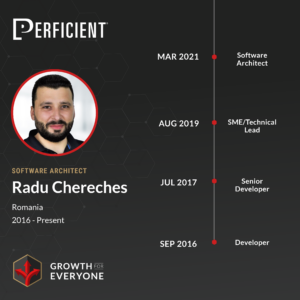
]]>When Radu Chereches joined SMEDIX as the tenth employee, he never imagined his career path would lead to Perficient. Today, based in Cluj-Napoca, Romania, Radu is a software architect leading complex projects, collaborating with global teams, and shaping the technical direction of client solutions. Throughout his career, he has followed his passion for growth and hands-on problem solving.
“I like complicated stuff,” said Radu. “I like to be there when things are hard to figure out, when people really need help.”
Radu’s Career Journey
Radu began as a developer, working on what would become one of the company’s largest client engagements. Over time, his deep understanding of the medical device product led him to become a subject matter expert (SME), then a technical lead, and eventually a software architect.
Perficient acquired SMEDIX in 2024, and Radu joined the team as a software architect. His growth has been fueled by opportunity, curiosity, and a willingness to step up when needed.
Leading With Purpose and Precision

Radu guides multiple teams across two major projects, balancing technical design with delivery goals. He works closely with managers and clients to ensure alignment, maneuver roadblocks, and maintain momentum. Both projects are in the medical space — one is a legacy system being modernized gradually from Delphi to .NET, while the other was built from scratch with .NET, Angular, and hosted on AWS.
“I’m here for whatever our clients need. Whether it’s planning, technical insights, or just helping them stay focused, I’m willing to help.”
Read More: Perficient Obsesses Over Outcomes to Drive Client Success Through Expertise and Innovation
Radu’s leadership style is rooted in adaptability. He positions himself as a resource for clients and colleagues, always providing support and a steady presence when challenges arise.
Continuous Learning Driven by Curiosity
An important part of his career journey is centered around continuous learning. Radu learns new technologies best by taking a hands-on approach to solving complex problems and pushing himself beyond his comfort zone. While certifications and courses have played a role, Radu finds the most value in experiential learning.
“Getting my hands on the keyboard and building something real is what works best for me. I enjoy having that pressure to motivate me.”
Radu also offers advice to those looking to grow professionally: “Don’t get comfortable. Challenge yourself continuously. Find ways to grow.”
Read More: Top Advice and Words of Wisdom for New Perficient Colleagues
Finding Balance Beyond Work: Embracing the Open Road After Hours 
Outside of the office, Radu loves to ride his motorcycle. It offers clarity, which helps him return to work with a fresh perspective and renewed energy.
“When I’m motorcycling, everything clears out of my head. All the stress and worries clear away. It’s a moment of silence and calm.”
He also cherishes time with his family, building memories with his wife, child, and extended relatives.
Key Takeaways
Radu’s impact extends beyond technical leadership. He’s a trusted colleague ready to offer guidance, step up to the challenge, and take initiative. Whether it’s supporting clients or mentoring teammates, Radu makes a difference by showing up and doing the work. Whether he’s solving technical puzzles or riding his motorcycle to clear his mind, Radu brings authenticity and drive to everything he does.
MORE ON GROWTH FOR EVERYONE
Perficient continually looks for ways to champion and challenge our workforce, encourage personal and professional growth, and celebrate the unique culture created by the ambitious, brilliant, people-oriented team we have cultivated. These are their stories.
Learn more about what it’s like to work at Perficient on our Careers page. Connect with us on LinkedIn here.
]]>Perficient’s vibrant culture thrives on collaboration, innovation, and a shared commitment to making a difference. We recently connected with Adrian Pop, a lead technical consultant based in Cluj-Napoca, Romania, who brings these qualities to his role at Perficient. For the past eight years, he has helped deliver transformative medical device solutions to healthcare clients while fostering a team environment built on trust, curiosity, and continuous learning.
Adrian specializes in building and optimizing medical device technology, ensuring systems run reliably and communicate effectively. His work empowers healthcare teams and enhances patient outcomes worldwide. In this People of Perficient profile, explore how Adrian’s technical expertise and people-first approach strengthen our teams and create lasting impact for clients and communities.
 What is your role? Describe a typical day in the life.
I’m a lead technical consultant. My day starts with a quick stand-up meeting to align the team on priorities, followed by code reviews and planning for the rest of the day. Between meetings, I remove roadblocks for teams, escalate risks, and carve out time for technical learning or automation work.
How do you explain your job to family, friends, or children?
I work on the technology behind medical devices, ensuring they run reliably and that different systems communicate seamlessly. It feels good to know my work supports healthcare teams and patients, and I’m proud to tell my family that what I do helps people.
READ MORE: Understand How Perficient is Driving AI-Powered Transformation in Healthcare
 What keeps you at Perficient? Could you describe the team culture?
What keeps me at Perficient is the people and the purpose behind my projects. My teammates have become friends who make the challenging work manageable, and I value that my projects directly help clinicians and patients. Those two things motivate me to show up and do my best.
Working with my team and business unit feels like being part of a busy, friendly workshop. Everyone pitches in, shares knowledge, and we genuinely enjoy each other’s company. The culture is collaborative and supportive. Folks are curious and happy to help, even when we come from different backgrounds and perspectives.
READ MORE: Discover Five Key Trends Shaping Medical Device Innovation and Experience
 Whether big or small, how do you make a difference for our clients, colleagues, communities, or teams?
I clear obstacles, mentor others, and share practical knowledge through code reviews and pair sessions. Coaching my teammates is rewarding because that shared knowledge spreads beyond code. These efforts help my team deliver higher-quality work and grow more confident in their skills. I also take pride in knowing my technical work helps clinicians and patients by improving real-world medical device workflows.
LEARN MORE: Perficient’s Medical Device Software Development Practice
What has your experience at Perficient taught you?
 My time at Perficient has taught me to truly appreciate my teammates. We spend so much of our lives solving problems together, often continuing after hours, so those relationships matter. Having colleagues who are real friends makes the workday better, helps build trust under pressure, and turns tough sprints into shared wins. That camaraderie is one of the reasons I stay, learn, and show up every day.
What advice would you give to colleagues who are starting their career with Perficient?
Don’t be afraid to speak up or to make mistakes. That’s where learning happens. Ask questions, try new things, and share your ideas. Mistakes are feedback in disguise, and speaking up helps you build credibility faster than staying quiet.
Why are you #ProudlyPerficient?
 I’m proud that my work positively impacts millions of people. I’m motivated by learning something new each day and knowing my work contributes to better health outcomes.
I started my career at Perficient and never left. Hands-on projects, supportive mentors, and stretch opportunities helped me grow into a lead technical consultant. Along the way, I gained new skills and now mentor others.
READ MORE: Learn How Perficient’s Award-Winning Culture Embraces Growth for Everyone
With Perficient’s mission statement in mind, how do you shatter boundaries?
I shatter boundaries by treating each day as a chance to learn and grow. My future is built on what I’ve learned so far and how I use those lessons to tackle bigger challenges.
If you had to define yourself using one Perficient value, which would it be and why?
I’d choose People because strong relationships make the work better. When we trust each other, we solve problems faster and deliver stronger results.
What are you passionate about outside of work?
 I’m passionate about tennis, hiking, and watching sports. Tennis is my true passion, and I stay balanced by playing tennis with my colleagues. What started as after-work practice turned into real friendships that combine exercise, social time, and camaraderie all in one.
It’s my goal to become more fit and mentally sharp through tennis, gym sessions, and regular hikes. Professionally, I want to improve my automation testing skills and continue helping others grow.
It’s no secret that our success is because of our people. No matter the technology or time zone, our colleagues are committed to delivering innovative, end-to-end digital solutions for the world’s most admired brands, and we bring a collaborative spirit to every interaction. We’re always seeking the best and brightest to work with us. Join our team and experience a culture that challenges, champions, and celebrates our people.
Learn more about what it’s like to work at Perficient at our Careers page. See open jobs or join our talent community for career tips, job openings, company updates, and more!
Go inside Life at Perficient and connect with us on LinkedIn, YouTube, X, Facebook, and Instagram.
]]>If you believe great Salesforce architecture is built through collaboration, curiosity, and real world problem solving, Architect Dreamin’ is your kind of event.
Taking place January 21–22, 2026 in Scottsdale, Arizona, Architect Dreamin’ brings together solution architects, system architects, senior consultants, and senior developers for two days of deep technical exploration and peer-led learning. And this year, two of Perficient’s own experts, Allie Vaughan, Technical Director AI & Data 360, and Anu Pandey, Technical Director AI & Data 360, are helping lead the conversation.
What Is Architect Dreamin’?
Architect Dreamin’ is designed for professionals who already architect, design, and deliver at scale. It is created by architects for architects, with no sales pitches and no basics, just meaningful exchange among peers who have been there.
What you will experience:
- Real world insights and practical solutions tailored specifically for architects
- A collaborative setting that fosters sharing and learning among industry leaders
- A program dedicated to maximizing your Salesforce capabilities
- Expanded workshops, immersive design challenges, and interactive solutioning sessions
- Community activities that recharge and reconnect, because strong architecture is built on strong relationships
Architect Dreamin’ unites the global Salesforce architect community to share, learn, and grow together. Every discussion, diagram, and debate helps shape the future of scalable, sustainable Salesforce solutions.
Spotlight Session: Unifying the Un‑unifiable in Data 360
When customers span multiple accounts and roles, traditional unification models fall short. This session tackles that complexity head‑on, focusing on how architects can design flexible, high‑performing models that support advanced segmentation and activation.
Unifying the Un‑unifiable: Exploring Custom Unification Strategies in Data 360 invites participants to collaboratively explore patterns, tradeoffs, and practical approaches grounded in real architecture challenges.
This session will provide:
- Frame a real scenario with multi account, multi role customer relationships
- Facilitate open discussion and live whiteboarding to explore custom unification strategies
- Dive into identity resolution and Data Model Object design within Data 360
- Consider impacts on segmentation, activation, and cross system alignment
- Produce two visual modeling diagrams you can take back to your teams, one representing the source Salesforce org and one depicting the proposed Data 360 solution with identity resolution
This session is not about a single right answer. It is about surfacing practical patterns and shared insights that architects can apply in their own environments.
In their own words:
“Data 360 gives us incredible power, but the real challenge is modeling relationships the way customers actually exist in the world to create solutions that can scale and are optimized for a consumption-based product.”
— Allie Vaughan, Technical Director, AI and Data360, Perficient
“What I love about this topic is that there is not a single right answer. Every organization carries hidden assumptions in its data model, and uncovering those together is where the real learning happens. This session is about slowing down, thinking deeply, and designing unification that truly serves the business.”
— Anu Pandey, Technical Director, AI and Data360, Perficient
Spaces are limited, so be sure to sign up today.
Ready to Join the Architect Dreamin’ Community?
Architect Dreamin’ is where experienced Salesforce professionals come together to challenge assumptions, sharpen their craft, and learn from peers who have been there.
Event details:
- Dates: Wednesday, January 21 – Thursday, January 22, 2026
- Location: Scottsdale, Arizona
- Format: 20+ architect‑led sessions across five tracks, hands‑on workshops, collaborative experiences, and community‑driven activities
 Seats are limited.
Secure yours and join the architects who are building the future of Salesforce, together.
]]>