[admin post] [sticky entry] Admin Post: Sticky: About, Rules & Posting Guidelines

Dec. 28th, 2023 04:28 pm
quillpunk: screenshot of Rue (with a super innocent expression) from the webcomic The Villainess Flips the Script (rue2)
[personal profile] quillpunk

Welcome to [community profile] booknook, made because a lot of the reading comms on DW seem pretty dead and/or focused on getting you to read.

This is made to be a general reading community. Hopefully there'll be a few regular posts:

  • RIP (Read In Progress) Wednesday
  • Monthly themed rec post (to be clear, inviting other people to rec books that fit the theme in the comments, not me reccing books)

(If you realize I've missed a regular post, you're more than welcome to post it in my place! My memory can at times not be relied upon.)

Members of the comm are able to post whenever they want. A few suggestions are things like reviews, discussions about a particular book/author/series, reading challenges, reading memes, asking for recs, recomending books, news about upcoming books you're excited about (or dread; there can be a lot of feels about books!).

While you need to be a member to post, you do not need to be one to comment.

General Posting Guidelines

  • The subject line should always make it clear what kind of post it is; IE, it should state if it's a review, recommendation, request for recommendations, discussion post etc.
  • All posts should be tagged. If the tag you need doesn't exist, use the tag [!] non-existent tag. If the amount of tags is overwhelming (I know it can be), then use the tag browsing feature on the post creation page, at which point there will be an option to search for tags. Use that to search for the tags you need and ignore the rest. And don't worry; as the admin, I can add/remove tags as needed!
  • If your posts includes NSFW material, whatever that may be, adjust the post's age restriction. The default is no restriction. There's also NSFW and SFW tags; these are voluntary.
  • Review posts should include headers with all necessary information; title, author, genres, content warnings etc.
  • Crossposting is allowed! But if you're crossposting a post here, do please post it in its entirety, don't just go "and you can continue reading at..."
  • All spoilers (no matter how old the book is!) should be behind a cut or an accordion. These are both HTML functions.

HTML Code for a read more cut:

<cut>this is where the text behind the cut goes</cut>

HTML Code for a read more cut with a custom 'read more' text:

<cut text="you can write whatever here and it'll replace the generic 'read more' bit">this is where the text behind the cut goes</cut>

HTML Code for accordions:

<details><summary>This is where you say/warn for what's inside: you can think of it like a subject line</summary>This text is hidden until you click it open!</details>

This is not a self-promo community for authors, but in the interest of there being clear rules about that, here are those:

  • One (1) promotion post per title OR one (1) promotion post per series. It should be clearly tagged as self-promotion, and the subject line should go like this: [Self-Promo] your books title (Genre, Sub-Genre)
  • You are not allowed to rec your books unless a person is asking for recs that your book specifically fits.
quillpunk: John Sheppard from SGA in front of an explosion, text 'boom' in foreground. (sga john go boom)
[personal profile] quillpunk
Hello, hello! [community profile] booknook is (again) tossing its hat in the ring for [community profile] 3weeks4dreamwidth in the form of a friending meme :D

This is the same meme as last year, as I do not have the brain-space to make a new one, but who knows! You're answers might have changed! You might not have seen the newest entries! You might have completely forgotten to check it out at all, even though you're the admin and you really should have. So let's do this again! <3

Copy and paste the text from the little box below into a new comment on this post. Feel free to remove the questions that aren't relevant for you! (If you want to fill this out in a post somewhere else, you're welcome do so, simply credit [community profile] booknook :D)

rocky41_7: (Default)
[personal profile] rocky41_7
Title: Our Share of Night
Author: Mariana Enriquez
Translator: Megan McDowell
Genre: Fantasy horror, fiction, family drama

If Mexican Gothic left you craving more South American fantasy horror, Our Share of Night by Mariana Enriquez of Argentina (translated from Spanish by Megan McDowell) has you covered. This is a family epic intertwined with the dark machinations of a macabre cult and its impact. It's also a splendid allegory for the evils of colonialism and generational trauma. This book was #15 from the "Women in Translation" rec list.

The book begins with Juan, a powerful but ill man who acts as a "medium" for the cult to commune with its dark god. Juan, struggling with the health of his defective heart, the wear-and-tear of years as the medium, and the grief and rage of his wife's recent death (he suspects, at the orders of the cult he serves) is desperate to keep his son Gaspar from stepping into his shoes, as the cult wants. Juan's opening segment of the book is about his efforts to protect Gaspar.

From there, the book branches off into other perspectives which give background to both the cult and the family. This is a great way of giving us a holistic and generational view of the cult, but it does drag occasionally. Gaspar's sections--in his childhood and then later in his teens/young adulthood--together make up the majority of the book, and while enjoyable, do amble off into great detail about his and his friends' day-to-day lives, such that I did wonder sometimes when we were getting back to the plot. I don't like to cite pacing issues, because I think that gets thrown around a lot whenever someone didn't vibe with a book, but the drawn-out length of these quotidian sections doesn't fit well with how quickly the climax of the book passes and is wrapped up. I would have liked to have spent less time with Gaspar at soccer games and more on his plans for addressing the cult.

However, on the whole, the book is a fun, if very dark read. It also serves well as a critique of Argentina's moneyed class and of colonialism in general, and how money sticks with money even across borders. Here, Argentina's wealthy have more in common with English money than with the Argentine lower classes (and that's how they want it). The cult, populated at its upper echelons by the privileged, is an almost literal blight on the land, willing to sacrifice an endless amount of blood, local and otherwise, to beg power off a hungry and unknown supernatural entity.

It brutalizes its mediums, which it often plucks from poverty to wring for power and then discard. Juan was adopted away from his own poor family at six, under the insistence his parents would not be able to pay for the medical care he needed, and he is the least-abused of the cult's line of mediums. As soon as the cult sets their eye on his son, Juan must begin scheming how to keep Gaspar away from them.

Although he acts out of love of his son, Juan is also a deeply flawed person. He is secretive, moody, lies constantly (there is actual gaslighting here) and doesn't hesitate to knock Gaspar around to make him obey. The more he deteriorates--a common problem with all cult mediums--the less human he becomes. Part of this is his work, but much of it is also attributable to years of being used by the cult for its ends and the accumulated emotional trauma. This, of course, is then inflicted on Gaspar through his father's tempers and secrets.

Similarly flawed are the other members of the immediate family. Juan's wife Rosario, despite a better nature than her parents, still supports this cult and is eager for Gaspar to follow in his father's footsteps as a cult medium, in part for the prestige it will bring her as his mother. Gaspar, although far more empathetic and gentle than either of his parents, eventually grows up with his father's temper. Watching him grow from a sweet-natured little boy into the troubled young adult he becomes after years of his father's abuse and neglect is painful, but realistic.

The book is also unexpectedly queer. It's not often a book surprises me with its queerness, because that's usually what landed it on my radar in the first place, but this one did. Juan and Rosario are both bisexual and later in the book we spend some active time in Argentina's queer scene, including during the AIDS crisis in the 1980s. 

An ambitious novel that for the most part, pulls off what it's trying to do. As mentioned, I wish the ending had gotten more room to breathe, and I would not have minded this coming at the cost of some of the middle bits of navel-gazing, but I still felt the story was satisfying. 

silversea: A woman typing at a typewriter (Typing)
[personal profile] silversea
Happy Wednesday! What are you reading now?
rocky41_7: (Default)
[personal profile] rocky41_7
Title: Looking for Smoke
Author: K.A. Cobell
Narrators: Shaun Taylor-Corbett, Katie Anvil Rich, Jordan Waunch, Julie Lumsden
Genre: Crime thriller, murder mystery, fiction

Earlier this week I finished another commute audiobook, Looking for Smoke by K.A. Cobell. This is a crime thriller/murder mystery that takes place on the Blackfeet Indian Reservation. When a teenage girl is found strangled at the Indian Days summer powwow, four of her classmates become the prime suspects in her murder. 

I would say this is a solid entry in the murder mystery genre. The book alternates perspectives between the four classmates, which allows the author to do some fun things keeping the reader on the hook. One character will make a big discovery only for the POV to pop over to another who doesn't have that information, so Cobell can keep information from the reader without it feeling too forced. The audiobook has a separate narrator for each POV, which was also fun (although I didn't care for Eli's reader) and if you're prone to picking up and putting down your audiobook in the middle of a chapter, this helps you keep track of whose POV you're in.

Cobell uses the format of the crime thriller, like Marcie Rendon in Where They Last Saw Her, to draw attention to the crisis of Missing and Murdered Indigenous Women (MMIW), but the book still feels like a novel its own right; it never feels like just a tool for explaining the MMIW issue. And it's an important issue that deserves a lot more attention. The statistics on violence against Native American women are shocking--even if you think they're bad, they're probably worse than you're imagining--and specific stats get highlighted in the text and in the author's note at the end. In this way, I think the book has enormous social value. Cobell uses her characters to personalize the problem and show the comorbid impacts of poverty and drug use on the reservation. 

Outside of its interest in the MMIW crisis, I don't think the book does much that's particularly groundbreaking. The teens band together to try to solve the mystery and absolve themselves, as you'd expect. At various times they suspect each other, family members, law enforcement. Cobell keeps you on the hook while offering reasonable suspicion for a number of characters. She avoids my least favorite move in the murder mystery genre, which is pinning it on some rando at the last minute.

The ending is pretty explosive and I enjoy some of the things she does with perspective here as well. We the readers know what the killer thinks of their crimes because the text tells us. But the other characters never hear that explanation except third hand, and many of them simply don't believe it. And that feels real--they end the story with their own version of the truth and there's simply no space for that to be corrected (and why would they believe the word of a killer anyway?) The killer feels a little one-dimensional, but the motives make sense, if they're unsurprising. The motivations behind most violent crimes are pretty repetitive. 

The prose is fine. We're reading from the perspective of teenagers, so expect a lot of melodramatic metaphors and jumping to conclusions based on minimal evidence.

Overall, this book tells an important story. It was entertaining as a narrative and sheds light on a community that deserves a lot more attention.
susieboo: An icon of Double Trouble from She-Ra and the Princesses of Power, with slightly muted colors. DT is resting their chin in their hand with a thoughtful expression. (Default)
[personal profile] susieboo
Title: Everything, Everything
Author: Nicola Yoon
Year: 2015
Age group: young adult
Genre: contemporary romance, coming-of-age
Content warnings: illness and medical trauma, abuse, mentions of child death, grieving / mental health struggles


“Sometimes I reread my favorite books from back to front. I start with the last chapter and read backward until I get to the beginning. When you read this way, characters go from hope to despair, from self-knowledge to doubt. In love stories, couples start out as lovers and end as strangers. Coming-of-age books become stories of losing your way. Your favorite characters come back to life.”
The cover of "Everything, Everything" by Nicola Yoon. The tagline is, "The greatest risk is not taking one." The cover shows the book's title, the first "Everything" being written in plain blue with a paper airplane over the R, the second "Everything" in white surrounded by intricate drawings of flowers, an airplane, sea creatures, and butterflies.

This was my fourth read of Yoon's debut, following 18-year-old Madeline Whittier, who was diagnosed with SCID (severe combined immunodeficiency) as a baby, and cannot leave her house without risking severe illness or death. She reads, a lot - not much else for her to do. She goes to school online. She rarely sees anyone except her mother and her full-time nurse, Carla, and when she is allowed other visitors, they have to go through a full physical and a lengthy sterilization process. As Madeline says, "It's a pain to come see me." Madeline is aware of her limitations, of the milestones she's missed and adventures she'll never get to have, but she's as happy as she can be, given the circumstances. But then a new family moves in next door, and with them comes Olly, a boy her age who spots Madeline in the window and is determined to talk to her. The two develop a friendship while emailing and texting in secret, and start to fall in love, which Madeline realizes can't end well for either of them.

For me, this is one of those books where, nearly every criticism I hear of it, I'm like, "Yes, you're right." The portrayal disability and illness is questionable (more about that in the spoiler section), and the book can be melodramatic and silly. But I eat it up every time; each time I've read this book, I've read it in under 24 hours. The romance is very sweet, and both Olly and Madeline are very likable and compelling characters. The story is a love story first and foremost, and if you want an easy-to-read, enjoyable romance, this might be a good pick for you.

I revisited this book because I've been in a terrible reading slump for the past couple of weeks, and it worked like a charm. The book flies by as you read it, with prose that's both accessible and pretty, and the inclusion of things like medical reports, book reviews Madeline posts online, and receipts from purchases she's made is a nice touch. Madeline's voice is eloquent but believable for a teenager (especially one who's been solely in the company of adults her whole life), and it was a delight to revisit this book for the first time in several years.

Here there be spoilers... )
silversea: Buffy holding a red book (Buffy Reading)
[personal profile] silversea
It's that time of the week again! What are you reading?
rocky41_7: (Default)
[personal profile] rocky41_7
Title: A Desolation Called Peace (Teixcalaan #2)
Author: Arkady Martine
Genre: Sci-fi, fiction

A Memory Called Empire left me in such a place that I of course had to rush after the sequel, A Desolation Called Peace by Arkady Martine. In the second book of this duology, we're tackling the bomb dropped at the end of the last book: that a hostile alien force has been picking at the borders of Teixcalaanli space.

This became a first contact story, which delighted me, because I love first contact stories. The book posits another interesting philosophical question to the readers. Darj Tarats wants Teixcalaan to go to war with these new aliens, because it would likely drag on for quite some time, sucking up Teixcalaan's resources and keeping them focused on something other than colonizing Lsel Station, and might even destroy them in the end. Mahit does not want Teixcalaan to go to war with these new aliens because it would be an unnecessary and vast loss of life on both sides, and because in spite of its nature as an empire, there's so much Mahit likes about Teixcalaan, even though peace allows Teixcalaan much more time and resources to potentially conquer Mahit's home.

Book 2 breaks into a mulit-POV style, which works very well I think for giving us a 3D view of the situation when first contact is made and what happens after. Emotions, naturally, are running very high on all sides, so getting to see many characters' thoughts is helpful to understanding this house of cards.

Martine does a great job I think of presenting us with aliens that are alien, but still people. The question is whether they and the Teixcalaanli can work that out before someone does something fearful.

She also does well with layering Mahit and Yskander here. There are a few conversations Mahit has that hit so much harder now that we have a full picture of Yskander and how long the ambassador to Teixcalaan has been kicked around the Lsel council like a football as they all pursue their own best course for keeping away from Teixcalaan. Knowing that that fragment of Yskander is there, seeing the fallout of his own death and how it came about makes these conversations especially powerful.

The story is laid out gradually and builds to a believable conclusion. The ending is slightly abrupt--there's not really any denouement--but it didn't shortchange the story. 

One of the perspectives we see in this book is imperial heir Eight Antidote, now 11. And he's either quite precocious, or Six Direction was a genius, which is possible. This kid's a regular Johnny-on-the-spot, but he is also a narrative tool representing a very different future for Teixcalaan than Emperor Nineteen Adze represents. He is Six Direction unencumbered by years of war and politicking; he is Six Direction without the grim, dog-eat-dog-world attitude of an adult raised by Empire. But he's also young and vulnerable; he represents a Teixcalaan that could be--but also one that could so easily be smothered in its crib, a fate Nineteen Adze is desperate to avoid.

Mahit and Three Seagrass continue to struggle, even more than in the last book, with the nature of their relationship. Three Seagrass is pure Teixcalaanli, and can frequently be insulting without meaning to, but Mahit is also primed by years of Teixcalaan's cultural chauvinism to see insult even where none was intended. I felt like they landed, by the end of the book, somewhere believable--although I would absolutely read more about them if Martine was offering!

I didn't notice this book having the issue with repetition that I found in book 1, so that was a nice improvement as well.

I was worried at the end of the last book how the story would handle this shocking, massive plot drop, but I think Martine did it very gracefully. It feels like a natural continuation of book 1 while still expanding the focus of the story. I would love to see more of this universe, but I'm also satisfied with where we've left things. There are no easy answers to what to do about Teixcalaan, but that doesn't feel unrealistic either. Well done all around!
vamp_ress: (Default)
[personal profile] vamp_ress

Duras, Marguerite: Abahn Sabana David. Open Letter Books. 2016.
I've bought this years ago in a bundle with several Duras-books and I must say, I've no idea what I read here. I think the word one uses for something like this nowadays is: word salad. At least it was short.

Riddle, John: Contraception and Abortion from the Ancient World to the Renaissance. Harvard University Press. 1992.
This was delightful. I actually bought this for fic research, but I thoroughly enjoyed it even apart from the excellent info it provided. The author's thesis is that - contrary to popular belief - people in antiquity and well beyond had very detailed knowledge about contraception (and abortion). Later, this knowledge was lost. The assumption is that this loss was caused by Christian religion and its rigid moral standard. Fascinating!

Steinbeck, John: The Grapes of Wrath. Penguin. 2006.
I read "Of Mice and Men" as a teenager and was absolutely blown away. I always meant to give Steinbeck another go and find a few more favourites. I went with "The Grapes of Wrath" because this is argueably his magnus opus. And boy, did I hate it. Maybe it's an unpopular opinion, but this book didn't age well. The most interesting thing about it is the fact that it's widely popular and acclaimed in the U.S. despite its openly communist agenda. (Mind you, not that there's anything wrong with a communist agenda, per se - but my understanding is that the U.S. and communist ideas don't mix well.)

Donaldson, David Santos: Greenland. Amistad. 2022.
This was such a missed chance. The blurb says this is a novel within a novel about E.M. Forster's love affair with an Egyptian tram conductor, but I learnt basically zero about that. Everything about Forster and his affair read like an author self-insert (or maybe a protagonist self-insert, since the protagonist is also the author of the book within a book). I took basically nothing away from the read expect maybe the info that black gay men in New York are obnoxious and annoying. (Sorry to all N.Y. gay men ...)

Moore, Kate: The Radium Girls. Simon & Schuster. 2016.
God, this was painful (pun intended). This is such an important book with such a strong sujet, but the execution wasn't even mid it was infuriatingly bad. The writing had the level of a romance book you buy at a whim at a train station. It was that bad. Moore clearly wanted to write a kitschy novel - every character here (and there are way too many) was introduced by bodily features. Women have dazzling smiles and men have strong arm muscles. Paired with the subject matter of the book this approach made me gag. The book needed to be written, but Kate Moore was the wrong woman for the job, sorry.

Johnson, Denis: Train Dreams. Picador. 2012.
I had never read anything by Denis Johnson but right after finishing this I bought another of his works. This was so good! It deals with the life of a man in the Idaho Panhandle throughout the 20th century. It starts in 1917 and ends in the 1960s with his death. In the nostalgia this evokes it reminded me a little of Harrison's "Legends of the Fall" which is equally panoramic in its approach and shows a time not too long ago but ultimately lost and absolutely alien to us now. Fantastic read!
 

silversea: Asian woman reading (Reading)
[personal profile] silversea
It's Wednesday! Are you reading anything?
rocky41_7: (Default)
[personal profile] rocky41_7
Title: Affinity
Author: Sarah Waters
Genre: Fiction, romance, queer lit, historical

I finished my second Sarah Waters book this week after devouring most of it on my flight to Texas and she has surely done it again! This book was Affinity, a much less-talked about one of her novels, which concerns Victorian lady Margaret Prior, who in an effort to overcome her grief for her recently deceased father and a mysterious illness that gripped her around that time, decides to become a "Lady Visitor" to a women's prison: someone who comes to talk with them from time-to-time. She almost immediately becomes enraptured with a young medium, Selina Dawes, doing time for murder and assault. 

I don't usually like to do extensive summaries in these reviews, but I want to highlight what USA Today called "thinly veiled erotica" in this book. This book is best approached, I think, with a measure of dream logic (or porn logic, if you prefer), where things can be deeply erotic in concept that in real life would certainly not be. Nothing illustrates this better than the opening chapter of the book.

In the opening chapter, Margaret makes her first visit to Millbank prison. Waters does an excellent job of making the prison itself a terror; a winding maze of whitewashed, identical hallways inside a cocoon of pentagonal buildings set unsteadily into the marshy bank of the Thames within which Margaret immediately becomes turned around. She is passed from the gentleman family friend who first suggested she become a Lady Visitor to the matrons of the women's side of the prison, a realm populated entirely by women. As Margaret passes into this self-contained place which feels entirely removed from the rest of the world (the prisoners are allowed to send correspondence four times a year) she becomes keenly aware of the strange blurring and even erasure of the boundaries, rules, and customs of the outside world. Furthermore, Margaret is reassured over and over again that she is, effectively, in a position of power over all these vulnerable women, trapped in their cells and subject to the harsh rules of Millbank. The prison fully intends for Margaret to be someone for them to idolize and look up to, someone whose attention can make them strive to better themselves. Margaret, a repressed Victorian lesbian, is dropped into this strange realm of only women in which she operates above the rules that strictly govern the rest of them. 

It is in this state, after this long journey through Millbank, that Margaret first catches sight of Selina Dawes, and is taken from the start.

The book is not heavy on plot, and some reviewers have called it dull, but I was riveted. The plot is the development of Margaret and Selina's relationship, and the progress of Margaret's mindset on the question of whether Selina's powers or real, or if she's just a very talented con artist. These are by nature things which progress gradually. Practically, it's true that not much happens: Margaret visits the prison. Margaret goes to the library. Margaret has a disagreement with her mother. But her mental and emotional changes across the book are significant. 

There are also the vibes. Waters does such a good job of capturing a very gloomy, gothic atmosphere where Margaret (and the reader!) are constantly sort of questioning what's real and to what degree and there's a powerful sense of unease that permeates the entire story. It ties in so well with Selina's role as a spiritual medium and the Victorian obsession with such things; it creates a very holistic theme and feel to the book that I just sank into.

On the flip side of the erotic view of the prison we see early in the book, Waters also uses it to terrifying effect to simulate the paranoia of a closeted gay person at this time in England. As Margaret's feelings for Selina develop and become more explicit, she lives in terror that the matrons of the prison will realize that her interest in Selina is not the polite interest of a Lady Visitor in her charges. She is always analyzing what the matrons can see in her interactions with Selina and what might go under the radar; she is constantly wondering if rude comments or looks from this matron or that is simple rudeness, or a veiled accusation of impropriety. The panopticon pulses around Margaret more and more but she can't keep away from Selina even to protect herself from the danger of being caught.

On the whole, I thought this book was fantastic. I enjoyed it even more than Fingersmith. Waters was really cooking here and I've added several more of her books to my TBR, because she obviously knows what she's doing.
silversea: Cat reading a red book (Reading Cat)
[personal profile] silversea
Happy Wednesday (it's still Wednesday here)! What are you reading?
rocky41_7: (Default)
[personal profile] rocky41_7
Title: Homegoing
Author: Yaa Gyasi
Genre: Fiction, historical fiction, family drama

Homegoing is family epic by Ghanaian-American author Yaa Gyasi. It follows the descendants of two half-sisters in Ghana in the 18th century: One, Effia, marries a British governor there. The other, Esi, is captured in raids and sold into slavery in America by that same governor. Gyasi's novel traces the story of their family from there. 

As I'm sure you can imagine just by the novel's description, Homegoing is a heavy book. It's not long--only 300 pages--but the subjects it deals with are dark. Homegoing shines a very personal, intimate light on historical atrocities and it is unflinching in the stark reality of those things. However, it is not sensationalist--the things that happen, particularly to Esi's family, are shocking, but not because Gyasi is playing a gotcha game with the reader, simply because we know these things really happened. This isn't a story about real people, but it is true, in that sense--these things did happen, to generations of people. 

Each chapter is a generation of the family--chapter 1 is Effia's story about marrying the governor, chapter 2 is Esi's story about her capture and imprisonment, chapter 3 is the story of Effia's son Quey, etc.--which allows Gyasi to span centuries of history, shining a light both on the development of Ghana first as it is brought under the yoke of colonialism, through its fight for independence, to regaining its sovereignty; as well as the struggle of Black Americans first against slavery and then on the successive attempts to maintain racism in the state: Jim Crow, chain gangs, the war on drugs. 

While there is great suffering in Homegoing, Gyasi also shows, I think, that joy exists even in the worst times. Even the hardest-suffering of Gyasi's characters still have hopes and dreams; they still fall in love; they still have inside jokes with friends; they still dance and sing and teach children to walk and try to preserve the memories of their loved ones. Homegoing documents an almost unfathomable amount of hardship, but it also knows that life will always try to find a way.

The novel is obviously very well-researched. Gyasi has put a lot of effort into a holistic understanding of both Ghanaian and American history and it shows.  

Although we don't get long with most of the characters, each of them stands out as distinct from one another. Gyasi does a wonderful job of showing their own mindsets, opinions, virtues and vices, relationships with their family and their history, and how that intersects with that character's particular struggle. 

Really a very well-done book. I know I'm going to be thinking about this one for a long time, and I think it has undoubtedly earned its place on the various recommendation lists where it sits. If you are squeamish about the subject material, or not someone who usually goes for books that deal with such heavy issues, I would strongly suggest giving this one a try anyway. It matters that we remember not only that these things were wrong, but why they were wrong, and Gyasi shows that here in vivid detail. It's really worth the read.

rocky41_7: (Default)
[personal profile] rocky41_7
Title: A Memory Called Empire (Teixcalaan #1)
Author: Arkady Martine
Narrator: Amy Landon
Genre: Fantasy/Sci-fi, fiction

I realized as I was approaching the end of this book that it is the third unfinished series sapphic SFF centering the machinations of an empire that I've read lately (the others being The Locked Tomb and The Masquerade). A Memory Called Empire is the first book in the Teixcalaan series by Arkady Martine (narrated by Amy Landon in the audiobook) and tells the story of Mahit Dzmare, a diplomat from an as-yet-unconquered satellite state of the Teixcalaanli Empire entering her role as ambassador for the first time--after the previous ambassador went radio silent. 

For fans of fantasy politics, I highly recommend this one. Mahit enters a political scene on the cusp of boiling over and is thrown not only into navigating a culture and society she's only ever read about, but having to piece together what her predecessor was doing, why he was doing it, and what happened to him. It's a whirlwind of not knowing who to trust, what to lean on, or where to go.

Martine creates such an interesting world here in Teixcalaan and the mindset of a people who pride themselves on being artists above all and yet exist as ruthless conquerors within their corner of space. Furthermore, Mahit herself is in a fascinating position as someone who's been half in love with this empire since childhood, and yet is all too keenly aware of the threat it poses to her and her home. Mahit does well in Teixcalaan--she loves the poetry and literature they so highly prize, she's able to navigate Teixcalaanli society and see the double meanings everywhere, and she's excited to try her hand at these things. And yet--if she plays her cards wrong, it will end with her home being gobbled up by Empire, and as Mahit herself says: Nothing touched by Empire remains unchanged.

I really enjoyed her characters too--3-Seagrass stole the show for me--and they all have believably varied and grounded views and opinions, with the sorts of blind spots and biases you would expect from people in their respective positions. There's character growth and change too, which is always fun to see, and I'm excited to see how that progresses in the next book.

If I had a complaint, and it's a minor one, it's that the prose is sometimes overly repetitive and explanatory, as if Martine doesn't quite trust her audience to remember things from earlier in the book, or understand what's being implied, which occasionally has the effect of making Mahit look less intelligent than her role would demand. However, it didn't happen often enough that I was truly annoyed, and I think the book gets better about it as it goes on.

On the whole, a fun, exciting read (although it takes its time to set up--expect a slow start!) that left me actually looking forward to my commute for a chance to listen to more. Already checking to see if my library has the next book available.

rocky41_7: (Default)
[personal profile] rocky41_7
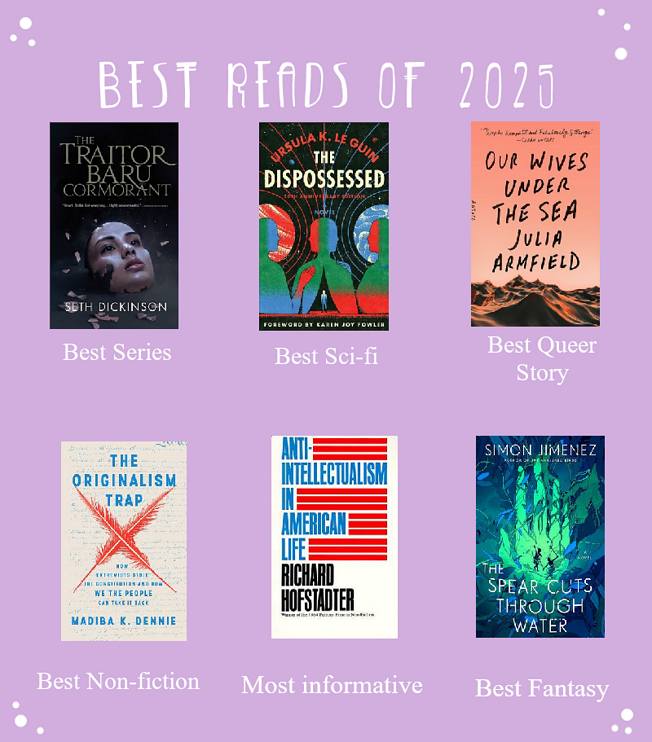
Image

Mae's Top Reads of 2025!

I wanted to put together a little highlight reel of the year's reads, so here it is!

The Masquerade series by Seth Dickinson: This series is is all fantasy politics. There's no magic or fairies or prophecies, just Seth Dickinson's invented world and the titanic machinations of Empire. And it is electric...Baru herself is the epitome of ruthlessness. Her goals are noble—her desire to free her home, to end the tyranny of the Masquerade—but she will do anything to achieve those goals. She is a truly fascinating character, calculating, controlled, brilliant—and constantly tormented by the need to weigh her choices and the potential futures ahead.

The Dispossessed by Ursula Le Guin: Le Guin captures truly great sci-fi because this work is so imbued with curiosity. Le Guin is asking questions at the heart of any great sci-fi work: What defines humanity? What can we achieve, and how is it done, and what does that mean for society? What is society? What does it mean to be alone? What does it mean to be part of a whole? To me, sci-fi can't be truly sci-fi without a measure of philosophy, and The Dispossessed has this in droves.

Our Wives Under the Sea by Julia Armfield: Armfield's writing beautifully illustrates this journey, and she does a particularly good job of doling out information a little at a time, so that the reader often share's in Miri's confusion and muddled state of mind.

The Originalism Trap by Madiba K. Dennie: Dennie does a great job making this book accessible to everyone...She doesn't stop at "here's what's wrong" either--she has proposal and suggestions for how to counter the outsized influence of this once-disfavored theory and what we as citizens can do to push back against it.

Anti-Intellectualism in American Life by Richard Hofstadter: The book is obviously well-researched, and Hofstadter does a thorough job of documenting his sources and influences, as well as recommending additional reading on a broad range of topics touched on in his own book. So much of what he establishes here makes perfect sense when looking at modern American society. He so neatly threads the needle between where we started and where we are now that at some moments, it felt like the fog was lifting on something I should have seen ages ago.

The Spear Cuts Through Water by Simon Jimenez: Jimenez's writing is beautiful and vivid—for good or for ill, as there are some gruesome events that take place—and really sweeps you up in the events of the story. He also does a wonderful job capturing the emotional mindsets of the characters. In particular, I thought the way he handled the relationship of the two main protagonists, Jun and Keema, was very realistic given who they are, and the emotional payoff of his taking the time to work through that was so worth it.

And for the haters among us, below the cut are my most disappointing reads of 2025.

Booooo )
rocky41_7: (Default)
[personal profile] rocky41_7
Title: Empty Wardrobes
Author: Maria Judite de Carvalho
Translator: Margaret Jull Costa
Genre: Fiction, literary

I collect false treasures in empty wardrobes.

This quote by Paul Eluard opens book #14 from the "Women in Translation" rec list, which continues to fatten up my TBR list. This is Empty Wardrobes by Maria Judite de Carvalho, translated from Portuguese by Margaret Jull Costa. This novella, originally published in the 1960s, is about the ways in which women are subsumed by the men in their lives, or otherwise are buffeted about with less control over their lives than they ought to have.

The forward by Kate Zambreno is a wonderfully complementary piece. She talks about the anger she feels going to a woman's funeral and hearing the dead woman sanctified by men in her life who did nothing but take from her, who can speak of her only to praise what she did for others, and can say nothing about what the woman herself was. 

Sometimes you can read a book and just know the author was angry when she wrote it. This is one of those. The book uses the phrase "discreet rage" about one of its characters, and I think that sentiment succinctly describes the whole book. The protagonist, Dora Rosario, is ten years into widowhood, and she has devoted her entire life to mourning her unremarkable husband as much as she had previous devoted her life to supporting his every opinion regardless of whether or not she agreed with it. Now, a decade on, her mother-in-law reveals something about Dora's late husband that changes her entire perspective.

I would like to believe we are moving away from the world portrayed in Empty Wardrobes (though not with as much success as I'd like), but this is a stark reminder of how even a few generations ago, in the Sixties, a woman's identity was so controlled by her husband's. There are only two men in this book--Duarte, Dora's dead husband, and Ernesto, the longtime partner of a side character--and they both, through social structures, exercise incredible control over the lives of the women around them without any respect or even knowledge of their impact.

The three main women in this book--Dora, her daughter Lisa, and the narrator--each take a different approach to the male romantic partners in their lives, and none of them comes out the better for it (well, perhaps for Lisa, but I personally doubt it will last), because the ultimate problem is societal attitudes about the way men and women are meant to relate to each other. 

It's not a long book, and I can't say much more without spoiling things, but I also think it does some fabulous things with its narration and perspective, and the way it doles out information. Really an excellent framing that allows for a lot of fluidity and filling in gaps with your own visions while remaining clear in the nature of the story it's telling. 

This book was only translated into English in 2021, which is a shame, because I think it would have struck a nerve much earlier, but we have it now! Costa does an excellent job with the work too; the writing is full of punchy phrases like the above, and she captures some realistic dialogue--characters repeating themselves, responding in ways that don't quite match up with what was asked, etc.--while keeping it natural-sounding.
silversea: Asian woman reading (Reading)
[personal profile] silversea
Humble Bundle's running a sale where you can pick up 65 science fiction, fantasy, and horror books by women for only $18 through January 31st.

Pretty good deal, if you ask me!

https://www.humblebundle.com/books/fierce-women-science-fiction-fantasy-horror-open-road-media-books

Edited: Apparently this bundle is only available in the US (unsure if it's available in Canada?).
quillpunk: screenshot of langa from SK8, with a joyful expression (langa7)
[personal profile] quillpunk
It's Wednesday! What are you reading?
rocky41_7: (Default)
[personal profile] rocky41_7
Title: The Orphan's Tales: In the Night Garden
Author: Catherynne M. Valente
Illustrator: Michael Kaluta
Genre: Fantasy, fairy tale

First book of 2026! This was The Orphan's Tales: In the Night Garden by Catherynne M. Valente with illustrations by Michael Kaluta. I have no recollection of how this ended up on my TBR and I was a little skeptical checking it out in the library, but I'm glad I stuck with it because it ended up being a lot of fun and I will definitely check out the second volume.

You might be a little confused in the beginning, as In the Night Garden is a series of nested stories within stories and the style takes a minute to get used to, but it's worth it. Valente unfolds a veritable matryoshka of tales into neat blooms whose petals all fit together. Retroactive reveals and recontextualiations are delightful here. 

Valente's vivid prose brings together her fantastical tales with such clarity; she attends frequently to all five senses, so that the reader knows what the characters are not only seeing, but hearing, smelling, tasting, and feeling as well. There's obviously a lot of fairy tale inspiration here, but Valente definitely brings her own flavor. Women are almost always the hero of Valente's tales (though they play the villains too!) and there are such a great variety of them. Monsters abound too, but they get their chance to tell a tale too. (There's also some gentle ribbing at the Arthurian legends, with one witch lamenting about "all that questing" princes get up to.)

I was so engrossed in the work I didn't realize until quite late in the book how little romance factors into it. In a fairy tale inspired book like this, I would have expected a great many characters motivated by romance, but I can only think of two here who are primarily motivated by a love interest, and this delights me too. I'm arospec myself and while I enjoy a good tale of romance, I also weary of how frequently and totally it is centered in stories, so I was really enthused by how little that's the case here.

Friendship and family relationships do make frequent appearances though, and the friendship between the orphan teller of tales and the young boy hanging onto her words is the framing story. Love between mother and daughter, between brother and sister, even between strangers is a common thread.

She also avoids a pitfall I see in various modern fantasy stories which are so keen to explain the magic of their world they strip it of all mystery. Valente's world remains largely unexplained and asks the reader to simply take it as it is, which I found fun and appropriately mysterious.

The style of the book allows Valente to pull in a great many diverse characters and voices, which she does it well. Most impressive though is her ability to pull a cohesive tapestry out of all the various threads she's juggling.

A really fun and unusual story which I enjoyed a lot--a great start to a new year of reading!
vamp_ress: (Default)
[personal profile] vamp_ress
Lots of middling stuff in December with one notable exception:

Parrott, Ursula: Ex-Wife. Faber & Faber. 2024.
Discovered, once again through Lost Ladies of Lit (my favourite literary podcast by MILES) this novel from the roaring 1920s gets compared to The Great Gatsby a lot. In my opinion, this is the better book. Bold, outspoken, modern - Ex-Wife (despite the stupid title) is an excellent novel and I'd love for more of Parrott's work to get re-issued. Alas, I can't find anything anywhere. Such a shame!

Schweblin, Samantha: Little Eyes. Riverhead Books. 2020.
For years after Covid I couldn't touch dystopias, even though I've always loved that genre. I'm slowly getting back to those novels (very tentatively), but this was just not IT. It should definitely have been a short story. This isn't so much a novel as it is a collection of interconnected stories in the same world where smart plushies invade people's most intimate spaces. The novel wants to say so many things, but it never really goes there. Additionally, while I think the basic premise sounds plausible to a lot of people it simply doesn't hold up under scrutiny. I won't deny that something like this would appeal both to voyeurists and exhibitionists. But that's about it. The most shocking thing about this novel is the fact that it was on the longlist for the International Booker.

Bridle, James: New Dark Age. Technology, Knowledge and the End of the Future. Verso. 2018.
Bridle sometimes goes on the wildest tangeants (I now know more about Peppa Pig than I ever wanted to know) and his own interests show clearly (he seems overly interested in air travel), but overall this was a riveting and thought-provoking read. I thoroughly enjoyed following him on his journey through the history of technology.

Wood, Benjamin: Seascraper. Viking. 2025.
This novel is set in the 1960s, but it reads like it's the 1660s. Nice language and prose, but it sounds too much like a creative-writing-class for my taste with no actual plot to carry all these fancy words over the finish-line. The last 25% did not seem to belong with the rest of the book and stood out like a sore thumb. If you want to give this a go either way, I'd recommend the audiobook. Well read (and sung) by the author himself.

Whitehead, Colson: Underground Railroad. Doubleday. 2016.
My least successful Whitehead so far, maybe "only" because I'm not American and I couldn't really tell when he was being faithful to the history of slavery and when he was making stuff up. That considerably lessened my enjoymend and what I could take away from the novel. Also, he wasn't doing himself any favours with the many voices and POVs he used throughout. I've been looking forward to reading Underground Railroad for years now, but I must say that this - sadly - was a letdown.
merrileemakes: A very tired looking orange cat peering sleepily at you while curled up on a laptop bag (Default)
[personal profile] merrileemakes
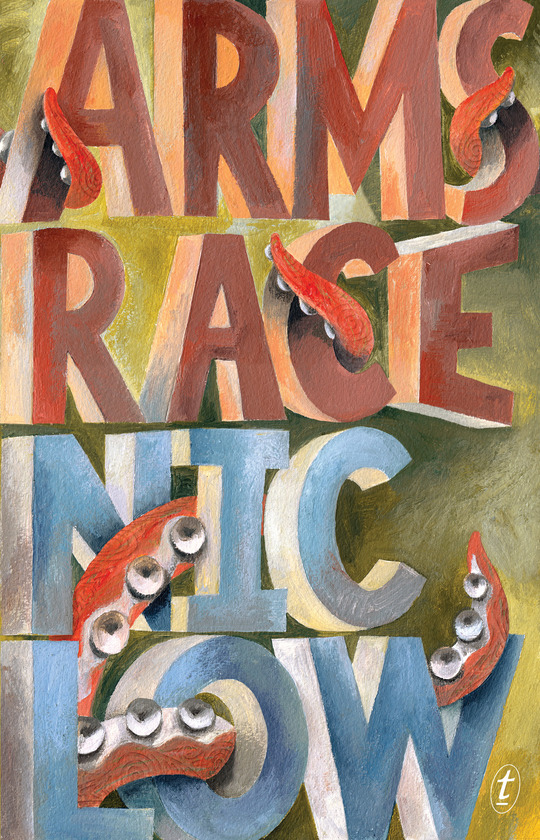
Image
Arms Race: And other stories By Nic Low

Nic Low is a writer of Ngāi Tahu and European descent who divides his time between Melbourne and Christchurch. His writing on wilderness, technology and race has been widely published and anthologised on both sides of the Tasman. His first book was Arms Race, a collection of speculative fictions shortlisted for the Readings and Steele Rudd prizes, and named a New Zealand Listener and Australian Book Review book of the year.

This was a real mixed bag of stories, not in quality or interest but in tone. They ranged from very speculative future dystopias to... I don't even know what the counter to spec fic is. Normie? Mundane? I can't remember the last time I read garden variety fiction. But one of the Low's mundane stories was a total riot - 'Rush' describes a group of First Nations Australians styling themselves as the Aboriginal Land Council of Minerals and digging up a war memorial in central Melbourne to prospect for gold. It was bang on in tone and hilarious in the way it perfectly captured the double standards and unconscious (or just fucking conscious, really) bias of colonised Australia. (hey remember the time when a brown muslim woman tweeted on ANZAC day about the human rights violations Australia was inflicting on (brown and mostly muslim) refugees and the backlash was so strong she lost her job, had to move house and eventually had to flee the country?)

I had to check to see when this book was published to work out which of the many sacred First Nations sites destroyed by the resources industry could have prompted this story, but considering the book is 11 years old there's too many to even consider.

I also really liked 'Facebook Redux', about a 70 year old millennial who digs up his old Facebook Profile to find his dead wife's old profile and gets scammed by Russian AR hackers. A really prescient story about what we broadcast online and how it can be used against us.

Low's style of not using quotation marks for speech was a bit challenging to get used to, but it was worth persevering to experience the depth and variety of these well-crafted stories.

5/5 stars. Some of these stories will stay with me for a long time.
quillpunk: Mr. Villain from the anime Mr. Villain's Day Off (mr villain is thinking)
[personal profile] quillpunk

r/fantasy MegaSale 2025

Dec 26-27

All books 99¢ or free. Each sale or download benefits the Mary Cariola Children's Center.

https://megasale.yrliu.com/

Profile

a nook just for the books

February 2026

S M T W T F S
123 45 67
89 10 11 12 1314
151617 181920 21
22232425262728

Syndicate

RSS Atom

Most Popular Tags

Style Credit

Expand Cut Tags

No cut tags
Page generated Feb. 22nd, 2026 01:39 pm
Powered by Dreamwidth Studios