
Entries by tag: tutorial
There's nothing wrong with using a "big word" in writing. They're especially useful in essays. If you know the proper meaning of a word and how to use it, you should use it, sure. However, I personally don't like to use complicated words in my own writing. ( This is whyCollapse )
Take a look at this example:
Frank ambled through the aggregating indivduals with an unrefined gait and a minatory expression dominating his visage.
That sentence may be very pretty on some level. Some of the words you might have had to look up. Most of the words may be in your ready to use vocabularly, but I doubt you use them in everyday conversation.
But if I read that, even knowing the words before hand, I'd be like, "Why didn't you just say Frank walked like a jackass with a mean mug?!"
See, totally different affect there. Or take a look at this one:
Frank slinked past the people in his way, looking like a snake so anxious for the bite his fangs oozed venom.
I love similies, but sometimes I'll put them in my writing as a place holder. A similie asks you to make a connection between two things that aren't necesarily alike, like the way Frank walks and how a snake poses before it lunges for a victim. There's still something more in that statement, and I could open it up more to affect the reader.
Look at this one:
The way Frank brushed by people with that familiar "Go ahead and try it" expression, the parting crowd felt like mere soulless bodies being knocked aside.
"Candace, Candace my girl... why are you ranting on about language and writing again today? Would you please stop trying to feed me these small doses of narrative theory?"
"No, I won't stop talking about it. Today, I was angered by my vocabulary workshop in my GRE course ;)"
- Current Mood:
 crazy
crazy
You know how you have really good teachers who say one thing and it sticks with you for the rest of your life? Well, my high school English teacher was like that. Unlike other teachers at the time, I felt like she actually knew what would be expected of us at the college level and she prepared us for it. She gave us a strong foundationg.
The first one I won't dwell on, but she said that we all have a sense of irony. We can identify it, but so few of us could actually say what it means. She said to take this definition with us for the rest of our lives, "Irony is the opposite of what's expected." You may find it stated otherwise in the dictionary, but think of every ironic thing that's happened to you. You that feeling like you're a sucker or a real smacked ass. Why? Because you didn't see that coming!!
( Here there be monsters! No... just some things to keep in mind that can help you be a more aware readerCollapse )
Why am I digging this crap up now? Now that I'm focusing on revising my writing and tightening it up for publishers, these are things I would like you to be aware of, because they are common places were authors miss the mark. If my stories seem nice and enjoyable on the outside, but they aren't the kind of stories you'd want to show your friends or would pick up again in the future, they're missing one of these important things. The kind of stories that persist through time have direction and they make a connection with their readers. Even if you're not a writer yourself, keeping these things in mind when you read a story will really improve the way you help to define it.
One last thing, though. It would be really helpful if you would hint to what kind of emotion the story leaves you with at the end. Tell me the mood of the story, how does it make you feel? Also, if you could, tell me what the tone of the story is. What sort of attitude does the narrator address you with? If this story could be someone wandering around on the streets, what sort of impression would it leave with you?
Or just tell me to shove off, lol >.>;
- Current Mood:
 indescribable
When you read a story, it's very easy to attach a value to it. Either you like it or you don't, and that is your first reaction. That is fine on a cursory level, but if you're reading a work for the express purpose of improving it, these comments fall horribly short of anything useful to the author. Use this article as a quick refresher course on how to take your commenting to the next level.
1 - Address the work, not the author
This goes far as a good faith effort to show the author that you have the work's best interest in mind. Leave the author out of the discussion, and talk about their work as an independent entity. That way, if those pesky "I like/don't like" qualifiers slip out, and they do, it reminds the author that you are trying to make the work better, and not commenting on the author's failure to portray their idea.
Remember, you want to amplify what is already on the page and clarify what the author is trying to say. Don't try to impose your own style or personal tastes onto the work.
You have a voice and an opinion. You took the time to read it, don't be afraid to comment, even if you don't have a literary background.
Always keep in mind, that the author has the power of veto whether or not to accept your suggestions. It has nothing to do with the validity of what you say, it's the author fine tuning how the piece is meant to be expressed as the final coordinator of ideas on the page.
2 - Work from the broad down to the specific
So you don't like the work. That's great. You have an opinion and that's the first step in improving writing. In order for it to be helpful, you need to figure out why you don't like it. If you dislike the work for the topic, theme, or contents, that means you are not the correct audience for that piece of work. You may not want to leave feedback if you feel you are not qualified in this way, or a simple "I do not like the subject matter" will suffice.
However, if you disliked the work because it did not read well, that is something the author can work with. You can point to specific passages where the word choice was confusing, the grammar was not in agreement, or the order of events did not flow smoothly and etc. What is the most helpful to an author is to locate the offending sentence or sentences and make a suggestion that would clarify what the author meant to say. It would be even more helpful if you would pinpoint the word that fouled up the works.
Also, if you don't like a character, be aware that this may have been an intention. If you don't like the character's actions because you think they are an awful person, that's good. You're supposed to have some reaction on an emotional level. If you don't like the character because they are inconsistent, not well thought out, or too stereotypical, that's something you'll want to address with the author.
Don't be afraid to tell an author that you don't like something about the work, but be prepared to explain why.
3 - Take a moment to talk about what the author does well
Constructive criticism can come across as harsh if you only focus on what needs to improve. Your heart is in the right place, but you're doing the author a diservice if you fail to mention what is done well. This is not solely for self esteem. If you find a choice of words, a scene, or a well constructed character you like, you need to mention it and explain why. Now, the author has a baseline for what good work actually looks like, and the author can use this information to produce more quality work like this.
If you only point out to the author the bad, the author may scrap everything, beautiful parts and all.
By the same token, if you're in love with this piece and you can't find something wrong with it, this is also counter productive. Don't be a snob and nit-pick, but you can still make suggestions about how to move the story along, or how to better develop a character. Guarenteed, when that story is taken to a professional editor, the editor is not likely to say its perfect as it stands.
4 - Ask questions
If you're confused about what happened, ask yourself why first. Is something missing? Reread the passage. If you still do not understand, you should ask the author next. Do not ask directly "What happened here?" That is not helpful because it won't tell the author where in the work the problem is. You should tell the author your interpretation of what happened in the story, then ask the author to verfiy if that's what was intended to happen. Then, the author can compare your narrative, and research why there was a disconnect.
Common problems include: too many pronouns; incorrect speaker tags (he said, she said); no transiton (how'd they suddenly end up in the subway?!); lack of proofreading.
Also ask questions concerning plot and character. Tell the the author these questions, even if they're resolved later. These questions will help your author adjust foreshadowing and how the audience is meant to feel at certain times in the story. Part of writing is manipulating the audience's emotions, so if you ask, "Why doesn't he stop beating the poor dog?" the author will know they hit the proper heart string. Even little interjections, like "Thank goodness he finally stopped hitting the dog!" will help the author know where you stand.
If at any point you feel like you need to stop reading, ask yourself why. Are you tired? The piece may be too long. Are you emotionally warn out? The piece may be too sentimental. Are you bored? The piece may need to adjusted for a better pace. Be sure to tell the reader where this happened as well, at the exact line. It may have nothing to do with the line, but it will give the author a point of reference to work with.
5 - Copy edit
This is where you look for grammatical errors, typos, and inconsistences. You need to address them as errors, not incompetencies. Simply correct the error, and tell the author the rule they did not follow. "You used 'who' here whereas it should have been 'whom.'" A serious author should have an MLA, APA, or Chicago Style, or comon grammar handbook. Remember, this author has probably been pouring over a work for a number of hours. The work is fresh to you; you'll see what they didn't notice.
They are trying to create a world, mind you. Don't fall into the trap of thinking that they don't know how to properly use the langauge, and do not fault them where they fall short. Afterall, someone isn't going to pick up a piece of fiction because it has amazing agreement with its antecedents! They will however, put it down if they're awful.
If you scratch your head because before the character walked through the door, their shirt was green, and when they sat on the couch, it was blue, make a note of that, too. A fine eye for detail goes a long way here.
That should be enough to get you started.
For more information, see these links
Proof reading checklist http://fictionwriting.about.com/od/thebusinessofwriting/a/editingchklist.htm
Revision (revising is not the same as proofreading!) checklist http://fictionwriting.about.com/od/writingexercises/tp/revision.htm
The four step process to critiquing art http://www.dl.ket.org/humanities/resources/art/critproc.htm
How to close read a passage http://web.cn.edu/KWHEELER/reading_lit.html
How to peer edit a story http://www.sff.net/people/james.van.pelt/teenfinity/peer.htm
- Current Mood:
 busy
busy
Finally done writing up all the tutorials -and- cutting them to save your friend pages ^^;
I know I can be really wordy, so I tried to make the articles themselves easy to scan through for information. And here's a quick jump to list.
Plz don't tl;dr me lol!
So, the table of contents
I: Jaws
-Intro
-How to make gums
-Painting your monster
-Conclusion
II: Eyes
-Casting eyeblank overview
-Adding color to your eyes
-Finishing your eyes
-Making eyelids
III: Hair
-Intro
-The three fails of wigmaking
-Wigbuilding tutorial
IV: Face
-Intro
-Building the shell
-Waterproofing the shell
-WIP Silverwufff photos
I know I can be really wordy, so I tried to make the articles themselves easy to scan through for information. And here's a quick jump to list.
Plz don't tl;dr me lol!
So, the table of contents
I: Jaws
-Intro
-How to make gums
-Painting your monster
-Conclusion
II: Eyes
-Casting eyeblank overview
-Adding color to your eyes
-Finishing your eyes
-Making eyelids
III: Hair
-Intro
-The three fails of wigmaking
-Wigbuilding tutorial
IV: Face
-Intro
-Building the shell
-Waterproofing the shell
-WIP Silverwufff photos
- Current Mood:
 accomplished
Part four: The face >:l
How to make a realistic mask from paper mache
( IntroCollapse )
( Waterproofing the shellCollapse )( WIP Silverwuff photosCollapse )
More photos and a video available here http://s305.photobucket.com/albums/nn209/candychic125/fursuit%20for%20jake/
Happy building!
Candace
- Current Mood:
 content
Part three: OMG SO MUCH HAIR. I mean, making a fursuit wig. >.>;
( IntroCollapse )
( The three fails of wigmakingCollapse )
- Current Mood:
 blah
blah
Part two: The eyes
How to make your own "glass" fursuit eyes
( Casting eyeblank overviewCollapse )( Adding color to your eyesCollapse )( Finishing your eyesCollapse )
- Current Mood:
 okay
okay
Part one: The jaws.
How to make your own taxidermy jaw set
( IntroCollapse )
( How to make gumsCollapse )
( Painting up your monsterCollapse )( ConclusionCollapse )
How to make your own taxidermy jaw set
( IntroCollapse )
( How to make gumsCollapse )
( Painting up your monsterCollapse )( ConclusionCollapse )
- Current Mood:
 blank
blank
Introduction
In other words, an informative tutorial on how I make footpaws.
A lot of my friends already know how to do this, so if this shows up on your friends page, just ignore it. I just happen to have a few resources laying around, so I decided to write this in order to consolidate them.
Now to begin, footpaws are a fun accent to any textile creation. They could be for your cosplay costume of your favorite otherly-footed character. They could be for a comfy, goofy pair of slippers to keep your feet warm around the house. And most commonly, they can be used to complete the illusion on a partial or full fursuit costume. The process is not very complicated, and the end result can be very pleasing to the eye.
You must excuse, but as you may know, my camera of three years died a while ago, and since then I've been taking pictures with my cell phone :B But here ya go as an example -
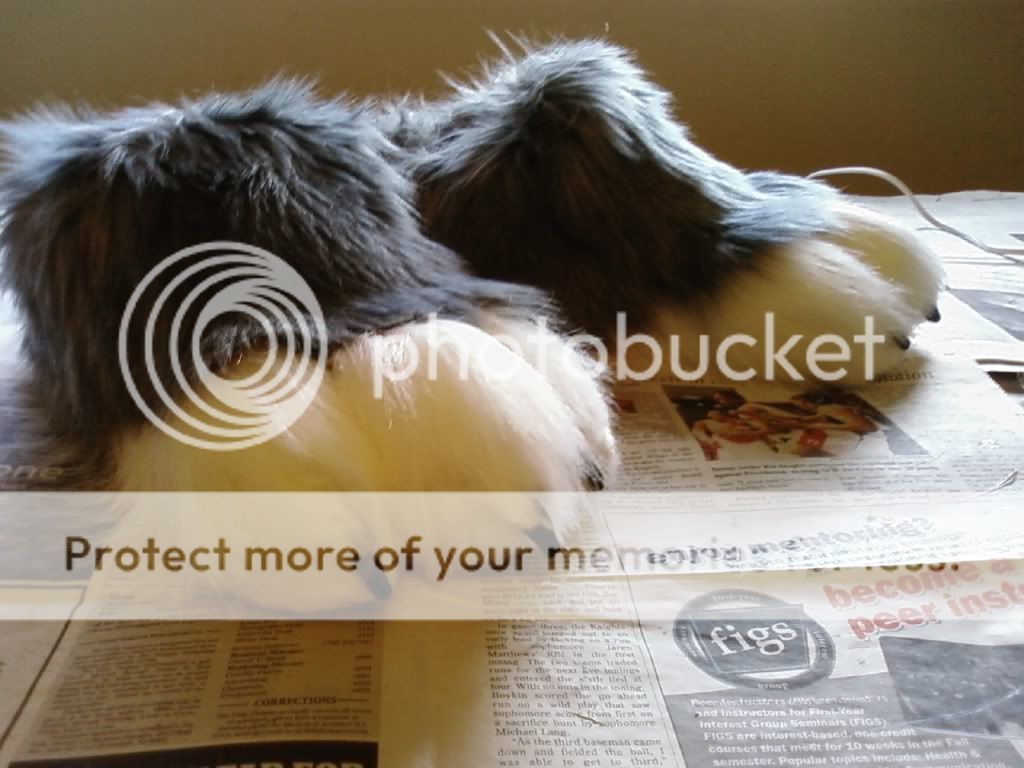
I made these footpaws a few months back on a trade with my friend Bunny for a hard disk drive. They were supposed to be snow leopard feetsies. I airbrushed some rosettes onto them, but I never actually took a decent, not blurry or other wised messed up photo afterwards.
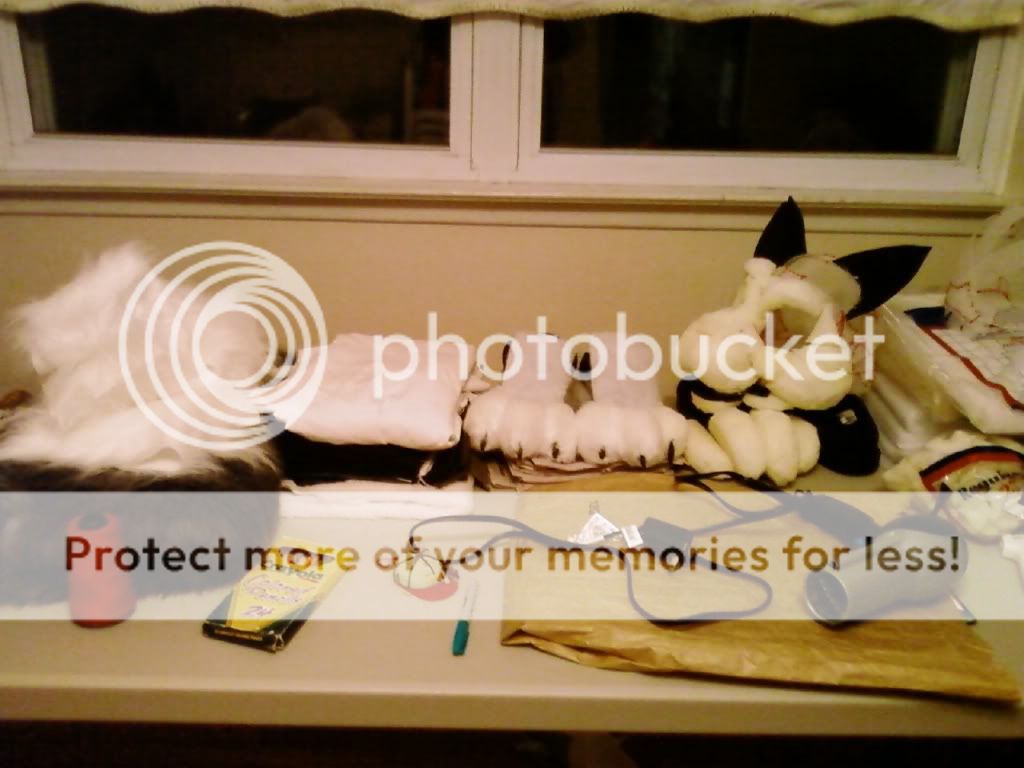
In this photo, you will see (among other things) the paws before furring sitting on the table.
This tutorial will walk you through carving your footpaws on a pair of shoes. This is one of the most efficient ways of making a pair of footpaws that you can take with you indoors and out.
This tutorial is divided into three steps. Each step has smaller substeps. Each substep has an explaination. To make it easier to skim this document, the sections are formatted this way:
Step X
Step summary
Step X-Substep
Step X-Substep Summary
Elaboration
( Cick here for the entire tutorial!Collapse )
For more information, please consult the builders and resources at the fursuit
Tyvm,
Candace
In other words, an informative tutorial on how I make footpaws.
A lot of my friends already know how to do this, so if this shows up on your friends page, just ignore it. I just happen to have a few resources laying around, so I decided to write this in order to consolidate them.
Now to begin, footpaws are a fun accent to any textile creation. They could be for your cosplay costume of your favorite otherly-footed character. They could be for a comfy, goofy pair of slippers to keep your feet warm around the house. And most commonly, they can be used to complete the illusion on a partial or full fursuit costume. The process is not very complicated, and the end result can be very pleasing to the eye.
You must excuse, but as you may know, my camera of three years died a while ago, and since then I've been taking pictures with my cell phone :B But here ya go as an example -

I made these footpaws a few months back on a trade with my friend Bunny for a hard disk drive. They were supposed to be snow leopard feetsies. I airbrushed some rosettes onto them, but I never actually took a decent, not blurry or other wised messed up photo afterwards.
In this photo, you will see (among other things) the paws before furring sitting on the table.

This tutorial will walk you through carving your footpaws on a pair of shoes. This is one of the most efficient ways of making a pair of footpaws that you can take with you indoors and out.
This tutorial is divided into three steps. Each step has smaller substeps. Each substep has an explaination. To make it easier to skim this document, the sections are formatted this way:
Step X
Step summary
Step X-Substep
Step X-Substep Summary
Elaboration
( Cick here for the entire tutorial!Collapse )
For more information, please consult the builders and resources at the
fursuitTyvm,
Candace
- Current Mood:
 geeky
geeky
Profile
 candychic125
- candychic125
- Candace on Deviant Art
Syndicate


Comments
„For one, I used to dabble in animation, and I already have CS5 on…
They always sound way too curious about this stuff, don't they? One time I had a screwdriver in my bag I didn't know…