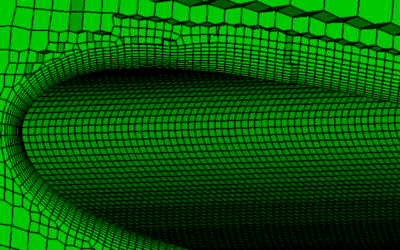
Introduction The main goal of this post is to give you the best meshing practices for high-quality CFD simulations, regarding geometry preparation, cell sizing techniques and boundary layer generation. You’ve probably heard the phrase: "Garbage in – garbage out." This...
Is it always the mesh? Part 7: Volume Ratio – the Secret Killer Nobody Talks About
Quite often, I hear complaints about non-orthogonality, the required number of non-orthogonality correctors to achieve convergence, and how it is worthless even trying to run a solver on a mesh, etc. The point of this series of posts is to give you an overview of the...
Automatic Acute Edge Detection and Fillet Creation Algorithm
Introduction In Computational Fluid Dynamics (CFD), maintaining mesh quality is crucial for achieving convergence and accuracy. A common issue arises when dealing with acute feature edges—regions where two parts of the surface meet at sharp angles. These edges...
Join us at the upcoming webinar “Next-Gen Meshing Technology at IANUS” with CF-MESH+
In April 2025, Creative Fields Holding signed a contract with IANUS Simulation from Dortmund, Germany, making CF-MESH+ soon to be a part of their StrömungsRaum® simulation platform. The goal of this partnership is to produce high-quality simulation applications for...
Our Common Meshing Terminology
CFD meshing terminology can be quite daunting, especially for beginners. This article will give you an overview of the most common CFD meshing terms and expressions we use daily, in alphabetical order. If you are struggling with some of the expressions we are using in...
Low-RE turbulence modelling of boundary layers with CF-MESH+
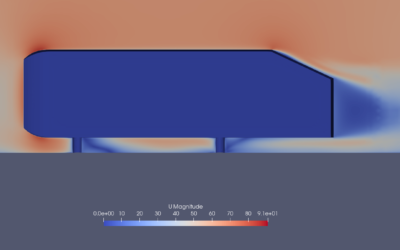
The goal of this post is to discuss the best practices of boundary layer generation in CF-MESH+ needed to perform low-Re turbulence modelling of boundary layers, on Ahmed body example. In order to show the importance of accurate boundary layer modelling, the post...
Is it always the mesh? Part 6: Feature edges and corners
Quite often I hear complaints about non-orthogonality, the required number of non-orthogonality correctors to achieve convergence, and how it is worthless even trying to run a solver on a mesh, etc. The point of this series of posts is to give you an overview on the...
Optimized CAD-to-Mesh: A Comprehensive Guide to Enhanced Workflow
Introduction The process of importing CAD files has become simpler, more efficient, and packed with enhanced functionalities in the latest update to CF-MESH+. Users can now seamlessly import .step, .iges, and .brep files via the command line using the new CADToFMS...
Is it Always the Mesh? Part 5: Boundary Layer Meshing
The point of this series of posts is to give you an overview of the popular myths and to help you understand what is going on in your Finite-Volume CFD code and how to interpret mesh quality checks for your problem. The goal of this post is to de-mistify the impact of...
5 Most Important Steps in CF-MESH+
For the mesher to do its work the best it can and create high-quality meshes, it is necessary to follow some CFD meshing guidelines. Our experience taught us about the 5 most important steps and features in CF-MESH+ you should consider, depending on your meshing case:...