Notice and Wonder Timeline (Part 2)

This part of the story is how my teaching practice changed after implementing different things I’d learned from CMC South, online, and various other trainings.

Over the next few years, after attending CMC South in 2015, my classroom changed drastically from my first 10 years of teaching. I became more comfortable with giving students more low-floor/ high-ceiling tasks and framing the lessons so they struggled with me as back-up. Our school district adopted the CPM curriculum, which came with hours of professional development training on discovery based, cooperative learning. I was doing less of the talking in my classroom.

As I reflect on the evolution of my teaching practice over those years, I believe that the starting domino was having my students Notice and Wonder. As a teaching strategy, it is a low-floor / high-ceiling in that you can add it into almost any lesson. I’ve used it as a warm- up, error analysis, intro to a topic, graph analysis, hook for a performance task, and on homework. Because homework is “practice”, if a student doesn’t know how to do a problem, I have them answer “what do you notice? what do you wonder?” about the problem, and they still get credit for doing their work. It also works on assessment for that purpose too. If a student is stuck on a test question, they can do Notice and Wonder about the test question, and depending one what they write, I have a better sense of their understanding or confusion and can evaluate them better than if they left the question blank.

Fall of 2019, I felt like I was at the top of my game professionally. I was still learning and growing, but I could see how the changes I’d made to how I taught math had resulted in a positive, safe learning environment for my students. I was excited.

And then the pandemic happened. I’m not going to lie about this stage of the story. Teaching math through zoom was a challenge for me. As much as I tried to recreate the positive learning environment through the computer, I felt like a failure. Plus, I was managing distance learning for my 4th grader and trying to keep things as normal as possible for my pre-K child. I was in survival mode.

I’ve struggled since the 20-21 school year to get back to the place I was at in fall of 2019. I’m not sure I can get back there. I’ve changed too much. My feelings about this profession have changed, too. So when Annie Fetter reached out to me to speak with her about Notice and Wonder at NCTM Los Angeles in Fall 2022, I immediately said yes! I was hopeful, in Fall of 2021, when she reached out to write a proposal, that things would go back to normal.

My experiences with my students the past two school years leave me both hopeful and exhausted. I think teaching problem based learning with cooperative structures takes faith in yourself as a teacher and faith in your students abilities. There is a certain amount of trust that learning in a more open environment requires. I have to learn to trust myself and my students again to start that journey. But I know that I’ve done it before, so I can do it again. So here is me, starting over. Again.

What do you Notice? What do you Wonder? I notice that each year after 2020, things are getting a little easier. I notice that students talking about math is still my favorite thing about my job. I notice that some things are more difficult right now: like cell phones and air pods and photo math and absences. I notice that my students are curious. I wonder if I can balance my work life with my home life. I wonder what my students are learning. I wonder what they will take with them.

Notice & Wonder Timeline

The art of teaching is difficult. There are so many skills that you need to learn and things you need to understand. And there are a lot of factors that affect your ability to do your job.

I completed my student teaching at the ripe, old age of 23, in 2003. 5 years into No Child Left Behind (NCLB), my training revolved around mastery of the CA state standards at the time, and helping students pass the STAR test and the California High School Exit Exam. I learned about cooperative structures, differentiated instruction, and discovery based learning, however I never saw it modeled in a high school math classroom. I was never taught that way, and most math teachers I knew taught traditionally: rows, notes, lecture. In 2003, you were high tech if you had fancy overhead projector printouts and a Texas Instrument attachment for your projector. I had a desire to teach differently, but then, it is very difficult to teach in a way you were not taught.

I attended my first training on the new Common Core Math Standards in 2012, and immediately realized that I was going to have to drastically change something for students to be able to master the new standards. We struggled on our own for a few years, and in 2015, our district sent a bunch of us to CMC South, a California Math Conference held yearly in Palm Springs. The last time I’d attended was in 2008, prior to a bunch of budget cuts that stopped us from going for 7 years.

One of the sessions I attended at CMC South was given by Annie Fetter (@MFAnnie) on Notice and Wonder. I noticed how engaged I was in each of the images she showed us because she asked us to Notice and Wonder. I was intrigued by her story of the students who noticed and wondered all the mathy things about the area problem and wondered if my students would do the same thing if I started by having them answer the two questions: What do you notice? What do you wonder? It seemed like a simple thing I could to. Low stakes. I could do it Monday when I returned without having to overhaul anything in my lesson plans.

I started asking students to Notice and Wonder before I “lectured”. When I gave students a traditional handout, I asked them to Notice and Wonder about the problems on the page before doing the problems. I tried some of the problem based tasks that I saw at CMC South and online and asked students to Notice and Wonder before they did any work. The more I asked students to Notice and Wonder, the more opportunities I found to ask them to use this thinking structure.

And as a teacher, I started to Notice and Wonder things about my students and about my teaching. I noticed that students were much more engaged in whatever task I wanted them to work in when we started with Notice and Wonder. I noticed that often I would scrap my lesson because the things they said when the class shared would often allow us to have a class discussion and we covered the material without a lecture from me. I noticed that they would often surprise me with their curiosity and incite. It made me wonder what other things I could do as a teacher. It made me wonder what other things my students were capable of.

Time to Discover: The Exploding Dots Machine

Why are you a teacher? I know in the last year, there are many who call themselves teacher who have chosen to walk away from the profession. Some may be temporary leaves, but there are many who won’t come back. And I don’t know how we can count those who might have become teachers and never sign up.

For me, I’m still in the classroom because of my students. Being in person this year has reaffirmed that for me. And yet, I’m struggling in a way that feels different than previous years.

So then, I ask, why do you teach math? I love using math as a vehicle for helping students grow and think and build confidence. Some love math. Many don’t. But my goal every year is that they like it more than previously. But as great as it is to teach math, I’m still struggling.

When I was brainstorming ideas in spring of 2020 for sessions to submit for Fall CMCSOUTH in Palm Springs, CA, I really wanted to create a session that teachers could engage in something that rekindled the joy we find in math. I wanted to learn and play with math just for us. We are life long learners too, who love math.

So I ask you, why do you like math?

There were many sessions at CMCSOUTH. Some about math, Math Ed, equity in math, technology and math, stories, grading policies, classroom culture, etc.

If you are like me, and need to experience some wonder and joy through exploring math, and you couldn’t attend my session on Exploding Dots, you are in luck.

The Global Math Project has a free website that will guide you through the entire Exploding Dots experience. I promise you, if you start the journey, you will be delighted and surprised and curious and all the emotions that come with a new understanding of something you thought you knew. Please watch the few videos. They are a few minutes long. You will want a small whiteboard next to you as you watch them. And then, please comment below or reply to my Tweet sharing this blog post about your thoughts.

http://gdaymath.com/courses/exploding-dots/

https://globalmathproject.org/learn/

Here is the link to the slides to my session. https://bit.ly/3mHxTXQ

(I did not invent the Exploding Dots machine. This is the work of Dr James Tanton of the Global Math Project. Follow him on Twitter @jamestanton. )

I am a teacher

I am a teacher. I decided to become one in 3rd grade and never changed my mind.

I am a teacher. It’s all I’ve done for work after college.

I am a teacher. This year has taken a lot out of me. Week after week. I stumble through my toughest year in this job. Wondering if I can do this another week. But I do. I don’t know what else to do. For me. For my family. For my students. For my school.

I am a teacher. I wonder what if? What if I left? What if I did something else? What if I stayed? What if I stayed and I’ve lost my fire for this job? What if I can’t relight the fire?

I am a teacher. I worry so much about the impact all of these impossible choices and situations that are beyond our control are having on our young people. My students. My daughters. I worry about my girls. I worry about my colleagues. I worry about our county. I worry about the world.

I am a teacher. Can you turn your video on? Can you answer in the chat? Can you reformat that file because our LMS will not read it? Can you come to office hours for help? Can you hear me? Or am I on mute?

I am a teacher. Of course you can use the restroom. Yes, please come to office hours for help. Thank you for the kind email. I love the jokes you put in the chat. It is so good to see you in Zoom today.

I am a teacher. And I will be one next year too. Because I don’t know what other job so closely aligns with my strengths or my passion. So this year has me seriously doubting my resolve to do this job. And I have a strong suspicion next year might too. But I will stay for another year.

Because I am a teacher.

A Challenge I Faced In 2020

Have you ever been on a zoom call and when the person shares their screen, you can see they have 20 tabs open? Or someone shares a screen shot and you can see they have 12,476 unread messages? And then it becomes a discussion point. And it quickly highlights the very different type of people there are in the world and how they organize their work life.

Well, since March, I’ve felt like I’m functioning with 20 tabs open in my head at all times. I’m terrified that one will close and I will lose the information or I won’t be able to find the information I need.

I also feel like I have an inbox in my head with 12,476 messages. Some very important, some with invitations to things I want to do, some with advertisements.

This has been an overwhelming year. My Wi-Fi signal is weak and I need to organize my tabs and inbox. I don’t have enough bandwidth to add any more apps or programs to my life.

So I apologize if yours was the zoom call I missed. Or yours was the 5 book reads I signed up to do and I just couldn’t get to it. I’m doing my best this year, and my best right now is to just get by.

Stay Positive (Year 18)

Image
Stay Positive

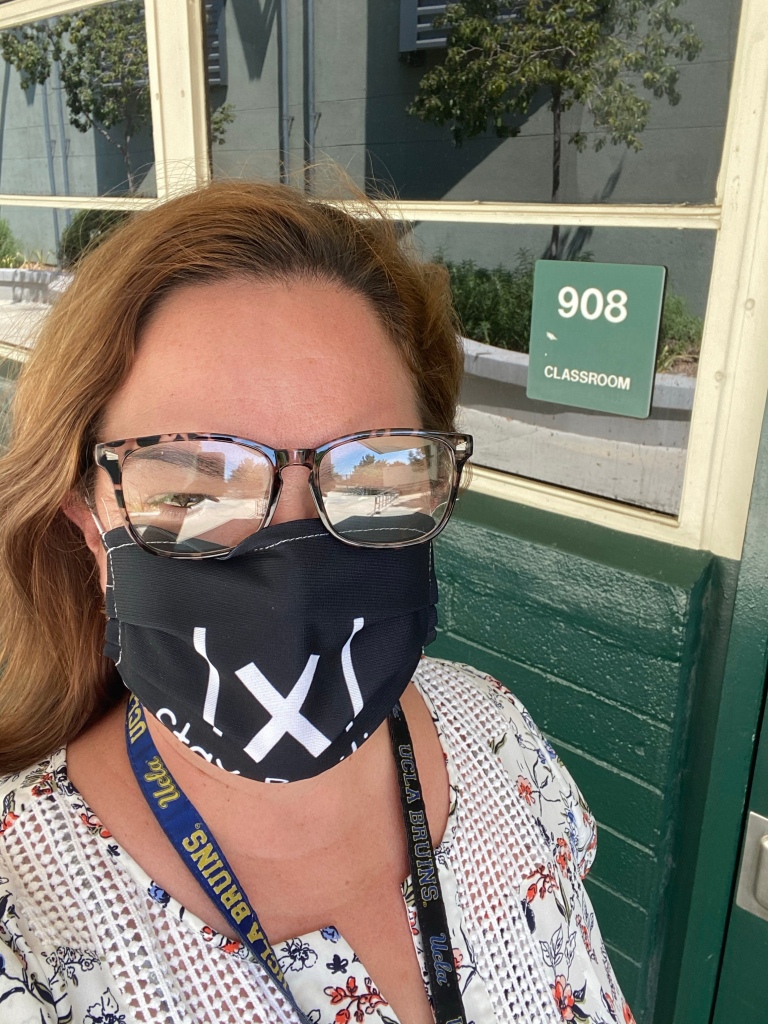
Next week, both my IM1 and IM3 classes will explore functions. Today, the first day of school in the virtual setting, I think about this function (seen on my mask), absolute value, that is the distance a number is from zero. So no matter the input, the output represents distance and is a positive value. Well, unless the input is zero.

Image
Absolute Value Function

And yet, this year feels like we’ve reflected this function over the x-axis. No matter what we put in, the outcome is negative.

Image
What 2020 Feels Like

I’m tired of complaining. I’m tired of all the bad news. I’m tired of things going wrong. I know all the bad things are still going to happen. As I think about my day, and scroll through my pictures, I noticed the mask I was wearing today. I bought it the second I saw it in my FB ads. (Don’t judge. They know me too well.) . This mask with the absolute value function on it. I have a shirt with this too. it made me start thinking about all the things that happened today.

What was positive today?

1. I had 100% of my students present in my classes today. I was not expecting that.

2. Zoom first period was a disaster. And it wasn’t the students. It was me. But I got better each period, and by 7th period I felt confident navigating Zoom.

3. My classroom feels lonely without my students, but it was good to see all their faces in the zooms.

4. Student submissions of assignments in Canvas happened immediately after 7th period. So many for me to read through and grade.

5. The students are being really honest in the information Google form. They miss their friends and learning in person. Some are afraid of math. But so many expressed excitement for a new school year and hope. They give me hope.

6. My 4th grade daughter came out of her first day of zooms and said “that went fast!” She seems excited about the school year.

7. This challenge has brought our math department together in a way that is amazing. So much encouragement and support between colleagues. I’m proud of the work we’ve done to prepare for the school year.

8. Our admin team should take so much credit for the fact that our students were all logged into the zooms today with very little absences. So much planning and training and passing out of materials and Canvas support. I’ve been overwhelmed by the scale of what I have to do, but their tireless work set us up to succeed as much as possible today.

Today’s first day of school picture was brought to you by the absolute value function, here to remind you to stay positive. In a year that feels like everything has gone wrong, I’m going to try to focus on the positive things that happened today.

Power in Numbers- #NCTMSD2019

I often tell my students that collectively we are smarter than we are by ourselves. I really felt this when I was at the NCTM Conference in San Diego, in April 2019.

I started this blog post after returning from the conference and never finished it. It’s now been over a year since I attended this conference, and I’d like to share how it’s impacted me since. And how this idea of Power in Numbers is also going to be important during the 20-21 school year.

Attending the NCTM Conference has been on my bucket list of things I’d like to do since I first started teaching. However, it’s rarely near me, and I’m a fearful flyer, and it’s expensive, for many years our school would only cover so much for us to attend CMC in Palm Springs, and well, I’m an hour away from the CMCSOUTH Conference in Palm Springs. CMCSOUTH is an amazing math conference and every year its an hour away. I can attend without booking a hotel room, although the only year I’ve done that was after maternity leave.

So when we saw that NCTM was coming to San Diego, we started pestering our admin and even applied to speak. My session, A Journey from Rows to Groups, was accepted and as a secondary TOSA, my district helped cover the cost of the hotel and food and registration.

Attending NCTM was an amazing experience.

Here’s a link for the top retweets using the conference hashtag, #NCTMSD2019, compiled by Dan Meyer.

https://s3.amazonaws.com/conference-handouts/2019-nctm-san-diego/hottweets/1-25.html

Image

My colleague, Patricia Vandenberg, who was also going as a speaker, and I were so excited to attend and experience everything. We even registered for sunrise yoga on the first day.

My husband. “You are not a morning person and you don’t work out.”

Me. “You’ve obviously never met math conference Claire. And they give you a yoga mat that says I love math!”

Every session I attended was energizing. The conversations I was apart of and those I overheard between sessions as people were rushing to the next session or lingering in the exhibit hall were full of purpose and ideas and life.

One thing that struck me was the scale of everything. The San Diego Convention Center is huge. And there were math educators from all over the world. And through social media, there were thousands of teachers all over the world who were not at the conference who got to be apart of the conversation, too.

And then, Dr Talithia Williams, a statistician at Harvey Mudd, and author of “Power in Numbers: the Rebel Women of Mathematics” presented a powerful closing address.

I left that conference with an overwhelming feeling that we, the community of math educators, have a power in Numbers.

It’s been over a year since that conference. As a group, we face a challenge that seems impossible this school year. How do we care for our students in the midst of a worldwide pandemic? How do we keep them safe? How do we protect their right to an education? A right we often take for granted in our first world nation. How do we pass on the beauty and joy and wonder within mathematics to the next generation? And do it over zoom? How do we help heal the pain and fear many of our students face over health and jobs and politics and unrest that’s all over the news?

I think the answer is that we work together. We are a community of teachers and there’s power in our numbers.

Have a question? Please ask! Have an idea, share it! Someone sharing a difficulty, let’s listen and learn. Need a place to start in the conversation? Search the hashtags and then include them to help engage in the conversation.

I don’t know all the #MTBoS and #iteachmath hashtags, so please share below to help any newcomers. We are all going to need each other to get through the year.

#WhyTwitter

[I drafted this March 10, before COVID-19. Cleaning out my drafts for #MTBoSBlaugust. ]

Last month, I was fortunate to attend the CPM Conference in San Francisco, CA. This Conference is for teachers who use the CPM Curriculum, which is designed for student collaboration. Each session I attended, the tables were set so that attendees could have conversations. Just like our classrooms. Even if the session was delivered primarily as a “speech”, the speakers used many of the cooperative strategies we use in our classes to get our students talking to each other.

I am fortunate and attend with many people that I know, but this conference makes it super easy for adults to make new professional friends. People that you see passing to the next session and feel comfortable saying “hi!” (I’m an introvert, so this means something to me.)

One of the first things I ask someone at a Conference I attend is, “are you on Twitter?” To someone who is not on Twitter, this question probably sounds weird. Maybe creepy. I’m not trying to be creepy.

You see, I often get weird looks and then statements like “I’m not on social media.” Then I find myself trying to explain what Twitter means to me professionally. And a month ago, I know I wasn’t explaining myself very well. But, I’ve realized in the few weeks since the CPM Conference #WhyTwitter.

You know all the conversations I mentioned at the beginning of this post? The ones I had in my conference sessions? When both of us are on Twitter, we get to extend our conversation past the session.

Since I started following math teachers using the #MTBoS hashtag on Twitter, I’ve extended my professional learning network past the borders of my school and district. This has been a place that I’ve come to in the past 5 years to grow and learn and push myself. It’s also like attending a professional conference anytime I want and have all the conversations I want.

I am a better teacher because I’m on Twitter. And now when I attend a conference, I have people to save me a seat at a session.

What are your reasons?

Reflections

Translations, rotations, and reflections, used to appear as maybe one question on the California Star Test back when we taught under NCLB. Most years, I didn’t teach it. I really didn’t understand it’s value in the curriculum.

After we switched to Common Core and our school adopted the Integrated Pathway, Transformations were the area I had the most to learn about. See

Transformations

It’s so funny how the more you teach a topic, the more connections you make to different topics. I taught Pre Calculus for 10 years and absolutely loved teaching students the Unit Circle. Each year, I’d find a new pattern I’d never noticed before.

My last year teaching Pre Calculus, 4 years ago, I showed my classes a bunch of sine curves and had them make a list of everything they noticed about eacH graph. I also had them predict the equation of the curve.

Image
What do you notice? What is the equation?

Y=sin(x) they figured out but when I revealed y=sin(x/2) they gasped. They had predicted y=sin(2X). So when they started talking about what happened to the period they described the period change as 2pi/b. All by themselves.

Image
Can you figure out why they predicted y=sin(2X)?

I had to give up Pre calculus to be a part time math coach for the past 4 years, so this past week is my first time introducing students to the unit circle since then. This is my first group of students to learn the Unit Circle who learned about transformations in Integrated 1.

Can I say that I now see the importance of learning about Translations, Rotations, and Reflections?

My students found the coordinates of points on the unit circle given an acute angle. Then, without any direction from me, just by reading a question in their CPM textbook, reflected the triangle over the x and y axis to find the points in the other three quadrants AND their angles from 0 degrees.

The textbook has them plot the points of the height of those triangles based on specific angles to initially discover the sine function and make observations about the points on the graph. Some students observed to find the other points on the sine curve with the same and opposite values, you reflect over the y-axis and translate it. And others observed the points on the sine curve were a 180 degree rotation about the point (180,0).

I’m 17 years in this profession and I’m still learning how everything is connected. My reflection is that we might not fully understand the impact of the mathematics we teach, but the significance is there and it may not appear for a few more years.

(Also, my reflection is that reflections are important. )

Fur Babies

[I initially write this February 17, 2020. Cleaning out my drafts for #MTBoSBlaugust.]

I grew up with cats. I love their independent nature. I love that they don’t necessarily like everyone they meet. I’m secretly jealous that they get to lie around all day and no one expects different from them. I love how affectionate they can be, when they want to or if you’ve opened a can of tuna.

Tuxedo cat came home my freshman year of high school and he got us all through high school. We’d come home from school stressed in a way that teenagers are stressed, pick him up, and instantaneously felt better. I couldn’t wait to get my own cats when I “grew up”.

The day we got home from our honeymoon, we went to the shelter and picked out Galileo, a gray tabby cat.

Two years later, Mark called me on his way home from late football practice to say that I should wait up. He walked in holding a little white kitten. We named her Guinevere and we were a two cat household.

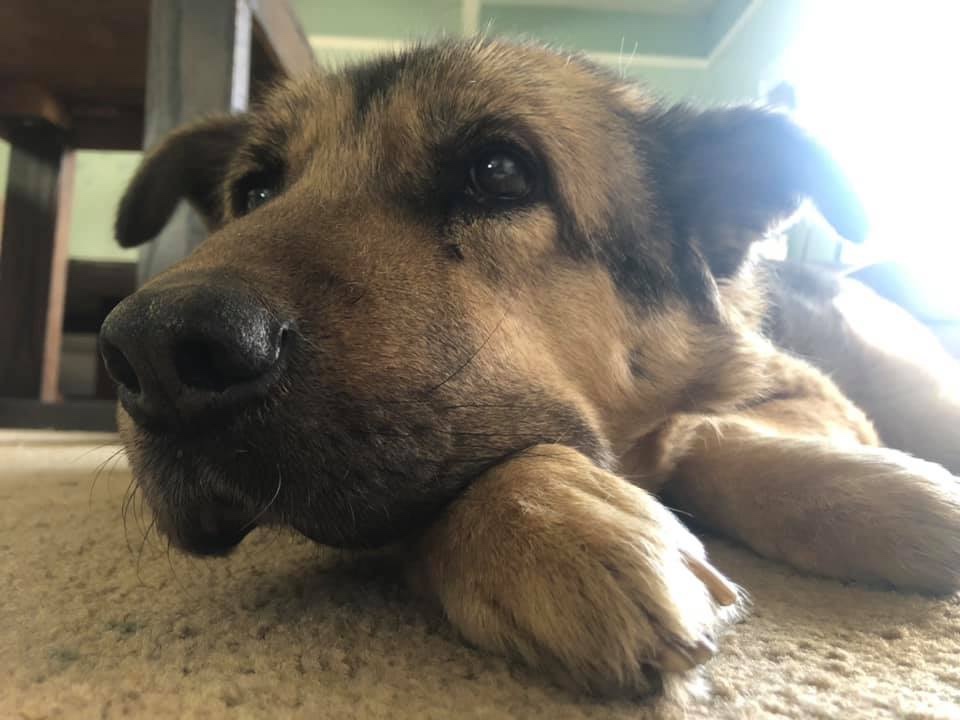
Our first Christmas break after we bought our house, we went to the animal shelter again and found Lincoln. He was a 10 month old, German Shepherd mix with the saddest eyes and sweetest personality. He was my first dog.

Yesterday, we said goodbye to our dog Lincoln. I cried when I realized we had to make the appointment for that day and I cried at the vets office as the vet was administering the medication that would send him home.

Image
Lincoln.

I wrote this post in February, right after saying goodbye to my first dog. We didn’t plan on adopting another dog for a while. Then, the following month, we were sent home for Stay At Home orders for the pandemic. Two days into social distancing and I told my husband we need to adopt another dog.

Image
Mona

A month later, our cat Guinevere got really sick and we had to say goodbye to another Furbaby.

Image
Guinevere

Mona was an amazing distraction from all the bad news in the world and our sadness over saying goodbye to our cat. But, we soon realized that she probably thought we lived at home all the time and started to get concerned about how she would deal with things going back to normal. So I started looking for a 2nd dog.

Image
Millie

They are crazy together.

Image
Sisters, like Anna and Elsa in Frozen… (my daughters love the sister thing)

The potty training and craziness is a lot. So is the training and the digging in the backyard. But having our fur babies has helped all of us through this crazy time. And even though it’s really sad to say goodbye to them, and we know from having to say goodbye to 3 fur babies in a year, they are worth it.

Image
Definitely worth it.