Now hiring – International Climate Change Adaptation Modeler

ImageClimate Interactive is looking for a new team member – a Senior Modeler to work in the growing area of International Adaptation and Resilience. CI is currently engaged in projects in Kenya and the Horn of Africa, and is beginning work in the Democratic Republic of the Congo, Nigeria, and possibly other regions of the world.

Job Description – Senior Adaptation Modeler (PDF)

To submit an application: climateinteractive.org/job

Join CI’s Beth Sawin Tomorrow at UMASS or Online

Join CI's Beth Sawin Tomorrow at UMASS or Online

Too Late for What?  Real Choices on a Changing Planet

Find out what leading experts on climate change impacts, activism, and policy are saying about our choices today and our world tomorrow.  Add your voice to the discussion on our campus, in our community, and beyond.

Watch online

Date: Oct. 17, 2013
Time:  4-6 PM EST

Or, for those in Massachusetts go to Cumnock Hall, North Campus

Also featuring short films produced by UMass Lowell and Cambridge students and an open discussion of how to move UMass Lowell’s Climate Action Plan into the future.

To attend, registration is free and open to the public, but space is limited. Register by completing the form here: https://climate-change-teach-in.eventbrite.com/

Online En-ROADS Model Debuts at Stanford World Energy Exercise

Stanford grad students experienced the thrill and complexity of dealing with climate change head on recently, as Climate Interactive brought our World Energy exercise to Stanford’s Precourt Institute for Energy for the second year running.

Online En-ROADS Model Debuts at Stanford World Energy Exercise
Drew Jones briefs Stanford students ahead of the World Energy exercise

Led by Climate Interactive Co-Director Drew Jones, World Energy challenges participants to create an energy policy that will limit global warming to 2 degrees Celsius while at the same time meeting economic and political goals. With our En-ROADS model, participants can adjust inputs such as emissions prices, efficiency standards, taxes and subsidies, land use changes and breakthrough improvements from R&D, and see the effects in real time.

Much of this year’s exercise was familiar — groups of astute grad students plugging away at the models on their computer screens, lots of invisible light bulbs clicking on, a good deal of surprise — but this time around, we offered a slight twist — thanks to funding from Stanford, the entire simulation was run online.

“One thing the students found particularly helpful this year was the fact that the simulation was online and accessible via a web browser, so the students could run scenarios from anywhere at any time and share results with teammates,” Jones said. “We’re now exploring the possibility of moving it into a shareable space so educators across the world can have access to it”

Continue reading

Climate Interactive’s Travis Franck talks insights at UMass Lowell

Image
Travis Franck presents Climate Interactive’s “Climate Pathways” mobile app

As part of its ongoing interview series, the Climate Change Initiative at University of Massachussetts Lowell talked recently with Climate Interactive’s Travis Franck about some of our simulators and the insights they’re providing on climate change.

As Franck explains, Climate Interactive’s emphasis on an analytical approach called systems thinking gives its models a uniquely comprehensive view of the complex systems involved in climate change.

“Very often in academia, we work in silos, or departments,” he says. “With systems, it’s really thinking across those silos…and it’s really taking that perspective that combines those multiple disciplines and then looks at all the feedbacks and interactions.” Continue reading

19 Reasons Why We Need Climate Change Solutions Now


In his latest blog for Transition Voice, Prof. Guy McPherson of the University of Arizona provides us with an excellent reminder of just how urgent climate action is with a list of 19 natural phenomena that are exacerbating global warming. The list illustrates a point that we’ve written about in previous posts and frequently try to reinforce — unless we act quickly, the effects of climate change will be felt faster and harder than we tend to realize.

Here’s the full list: Continue reading

Rewards and Lessons From A Day of Systems Thinking with the Dalai Lama Fellows

Rewards and Lessons From A Day of Systems Thinking with the Dalai Lama Fellows

“That’s another way we can ensure that traditional skills are passed on!”

 “If we modify the program we can include that whole group of kids we were forgetting!” 

“Should I invite the funders to come to the village from the start? Even if it’s not perfect they could see where they could help.”

Exclamations like these are the reason I always come back to teaching systems thinking. There’s just no sweeter pleasure than watching someone’s moment of breakthrough insight, especially when the breakthrough holds within it the potential of bigger, faster or better results “at the intersection of peace, justice, and ecology.”  That intersection is where the Dalia Lama Fellows work, learn, dream, and experiment, and their playground became my own for a day when I had a chance to introduce the newest class of fellows to the basics of systems thinking.

We gathered together at a retreat center in the hills of Northern California far from their homes in Africa, North America and Asia—and far from my own in Vermont—for a six-hour introduction to vision, stocks, flows and feedback loops as a taste of a body of knowledge they could pursue at home through books, articles and classes like the Climate Leader.

With each fellow immersed in the design of the service project that will be a key part of their fellowship year, I was hopeful that systems thinking would help them see new possibilities and avoid potential pitfalls as they roll out their projects.

Teachers always learn as much as students in settings like this, of course, and a few lessons seem particularly worth sharing as we at CI are investing more energy than ever in making systems thinking training available to a global audience via the Climate Leader.

Continue reading

New Version of C-Learn Released: Now Embeddable

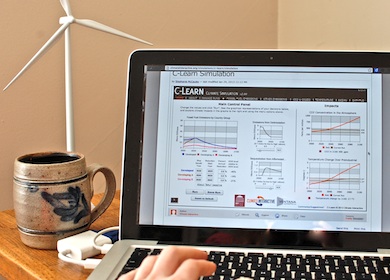
ImageWe are pleased to announce the launch of a new version of the C-Learn simulation for the web. 

Image

C-Learn enables you to explore the level of emission reductions it will take to address climate change across three different groups of countries. This updated version is built on a new platform, so those familiar with the old version of C-Learn will notice slight changes to the interface. The Forio Simulate platform that we have switched to allows you to embed the simulation on an existing website and create a free account to save your scenarios for later.

We’ve also improved the ability to use C-Learn for running the World Climate Exercise and added a new feature that calculates how annual emission reductions equate to the percent change above or below 2005 levels of CO2 in 2050.

Continue reading

MIT Professor Says We Are Playing Russian Roulette With Our Children’s Future

John Sterman, MIT Professor and fellow collaborator on many Climate Interactive projects, lays out the stark realities we are facing with climate change inaction in his presentation at the MIT Museum last month. He describes the risks we face by not taking immediate measures to address climate change in every sector of society and equates it to playing Russian Roulette with a revolver that has 19 of 20 chambers filled. His conclusion: we can despair, take no action, and allow the worst case to happen, or we can immediately initiate measures to reduce our carbon emissions as an insurance policy against the worst risks. Watch the video below for his complete presentation. Beginning around time 27:40 Professor Sterman demonstrates the unexpected dynamics of time delays and shows the Climate Interactive C-ROADS simulation, to demonstrate common misunderstandings about our climate system.

Image

Rio: More than Beaches and Diplomats

Image
Credit: Ellie Johnston

While the negotiations for Rio+20 progressed, Drew and Travis of Climate Interactive were sharing analysis and facilitating a group that is exploring pathways to break through the climate impasse at the Rio Climate Challenge. This event, part conference, part workshop, went beyond a typical conference speaker series with hundreds of audience members listening to experts who drop in for their part and then scoot off to the next thing. The Rio Climate Challenge included a plenary hall where audience members hear from leaders in different areas of climate, like from Yvo de Boer, the former secretariat of the UN climate change negotiations. The unique part of this event was that speakers when not on stage are working together in a small group to develop a set of recommendations for the climate change negotiations and Rio+20. Continue reading

Climate Scoreboard Helping the Leaders at UN Rio+20 Summit

Image
Image

Happy to see evidence of our tools getting around in places we never knew…

Elevator of Drew Jones’s hotel. Rio.

Drew: “Hi, how are you doing?”

Other guy: “Fine, heading to the Summit…. What organization are you with?”

Drew: “Climate Interactive.”

Other guy: “Oh, I know your work. I use your Scoreboard in my presentations. BAU, Goal, Current Pledges”

Drew: “Great, who are you with?”

Herman Rosa Chavez: “I’m Herman Rosa, the minister of the environment for El Salvador and lead diplomat here at the Summit. Thanks for what you all do.”

Thanks for using it to make a difference, Minister Rosa!