




What Does Decryption Mean?

Decryption is a security process that allows authorized parties to revert previously encrypted content (ciphertext) back to the original message (plaintext).

In blockchain, both encryption and decryption are usually automatic. While they don’t directly prevent data breaches, this data is unusable for potential attackers to cause losses.
Authorized users can bypass decryption using previously generated private keys to reveal the plaintext. It’s possible to theoretically force the decryption without keys, although it takes near-infinite computing power and time.
The development of different encryption methods and algorithms is called cryptography.
The Working Principle of Decryption
“The security of a cryptographic system shouldn’t rely on the secrecy of the algorithm”
– Kerckhoffs’ Principle
Decryption aims to maintain security despite using well-known algorithms, ensuring that the communication is transparent and efficient. The full decryption meaning is:
- Confidential: Only authorized parties can access the data
- Integrous: The decrypted text is unmodified and accurate with the original plaintext
- Authentic: Digital signatures can verify the data’s origin
- Non-repudiatory: A reliable communications record prevents users from denying having sent or received data
Decryption is defined as:
- Symmetric (slower). The same key that encrypted the plaintext can be used to decrypt it.
- Asymmetric (most common). Senders use the recipient’s public key to generate ciphertext while the recipient decrypts it with a private key.
For example, the Bitcoin blockchain uses an asymmetric variant called ECDSA, Elliptic Curve Digital Signature Algorithm.
What Is The Key Difference Between Decryption and Encryption?
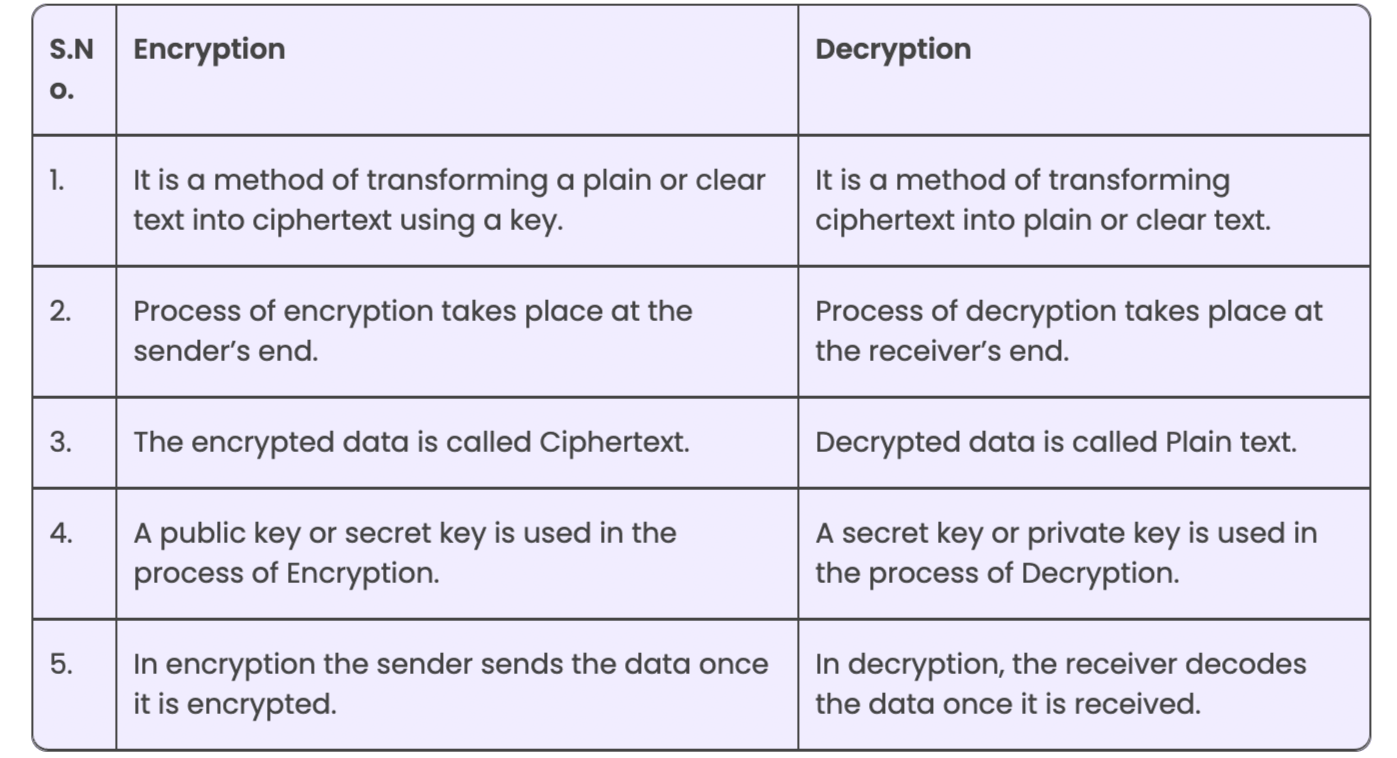
The encryption transforms data into unreadable text while the decryption methods revert it. Here are other encryption and decryption differences:
- Dependencies. Decryption is only possible using the same algorithm and keys generated in the encryption process.
- Generation keys. Generally, the public key is used for encryption while the private key is for decryption.
- Algorithm flexibility. Not every encrypted data can be decrypted. Blockchains often use one-way encryption functions (hashing), which create irreversible ciphertext. Hashes allow nodes to verify data publicly without revealing the original content.
The Importance of Decryption
Decryption allows blockchain users to secure data as well as recover it:
Secure Communication: Decryption keys prevent anyone other than the intended recipient from accessing the data, even if the encrypted ciphertext is public.
Data Protection: Decryption also allows recipients to verify the original sender and confirm that the message wasn’t altered.
Password Recovery: Private keys allow crypto exchanges and other platforms to recover or reset user passwords.
Another similar example of decryption is private keys for Web3 wallets. If users forget the password or haven’t saved the private key, they can still enter a secret 12-word “seed phrase” to recover the key and regain access.


