
Grab a hot cup of Irish tea!!! It’s a long one.
FROM VERANDA: Capard House
In 2017, I wrote a story about interior design great Martyn Lawrence Bullard. I had seen a photo on his Instagram that stopped my scroll - as the young influencers say. His photograph showed a living room that was very traditional and very English (I thought.) It was a departure from Bullard’s usual designs. It was obvious this living room wasn’t his glamourous design for his Hollywood stars, it also wasn’t ultra modern, nor was it inspired by a near-eastern country. Instead, it reminded me of the classic work Bullard had created years before and I absolutely loved it. His room on Instagram was stunning and I was determined to find out where the house was located. I spent weeks going over his Instagram with a fine tooth comb, looking for any clues I might find about this room. The blog story I wrote back in 2017 was about my search which was truly worthy of a private investigator. In the end, I learned the house was located in Ireland, not England. The design of the room I loved so much was pure Irish and with knowledge of the house’s name – Capard House – I was able to find many Before photos and, even more, stories about the house’s long history.
At that time and in the years since, I have been patiently waiting for a design magazine to do a photoshoot of Capard House – but year after year, no magazine took up the challenge.
Until today!
Finally, Veranda magazine and James McDonald photographed Capard House in all its glory - exteriors and interiors. The photoshoot coincides with the publication of a new book Bullard has written.
To preorder, click here
Capard House shows the true, immense talent of the man. Martyn Lawrence Bullard can design anything – a residential house to a hotel to a restaurant to a beach resort to a mansion in Ireland. His portfolio is so varied and so inspiring and now, with the addition of Capard House, it shows a welcome return to his roots.
As Martyn says, “I don’t decorate for me, I decorate for my client” which explains the wide range of his “style.”
If you are interested in reading the original detective story I wrote about Capard House, go here. Also, we had entertaining Martyn on our podcast, The Skirted Roundtable. To listen, go HERE.
CAPARD HOUSE:
The house is actually two houses: the Main House on the left and on the right, the white house, known as the East Wing or originally, the Dowager House. The houses were never actually connected, but it’s possible the new owners finally did connect them.
Capard House
The house is located in Ireland, in the Slieve Bloom Mountain region of North County Laois.
The main house was built in the 1790s and was known as “one of the most beautiful” in Ireland. Located on a large demesne, the landscape includes a long, romantic gravel drive, lakes, flower filled meadows, a fountain and a Grecian temple folly reflected in a pond. There is also a walled garden that covers 2 acres, along with many garden paths for long walks. And now, there is a newly created private golf course, along with a natural grass helicopter pad, stable block, and a newly renovated caretaker’s cottage. Back during the potato famine, one of the caretakers was found in the cottage, dead from starvation.
For over three centuries, Capard House was the home of the Pigott family. John Pigott built the Main House and later the second house was built on the east side known as the Dowager House, but today – both houses are known as one, Capard House.
Mary Pigott, daughter of John Pigott who built Capard House in the 1790s
Capard House during the 1900s. At the right is the white Dowager House.
Capard House was the scene of an important battle during the Irish civil war. In 1922 ant-treaty forces occupied the house leaving it damaged and derelict for several years until everything was finally repaired.
Bullet holes from the civil war siege can still be seen on the stone facade.
Edward Kenney Senior. As a young man, he and his family lived at Capard House during the civil war siege. While the gunfire barrage was happening, the Kenney family hid in the silver storage and remained unhurt.
After the civil war, there was political pressure to break up the estate which lasted until the 1950s. The Pigotts managed to hold on to the house until Charles de Jenner, a member of the Swedish Pigott clan, died in 1973. Though the estate was once over 3000 acres, today only 200 remain.
On the left is the original main house, built of local sandstone in the neo-classical Greek Revival style, with 8 bedrooms upstairs. And to the immediate right of the main house is the East Wing, a second, separate house with 5 bedrooms. The two houses, not actually connected, but together they total 16,500+ sq. ft.
Photos from Veranda and James McDonald.
All other photos are from Instagram and the Internet.


FROM VERANDA
Back in 1990, a Dublin jeweler and his partner bought Capard House and spent years restoring it and filling the house with period antiques. Twenty-five years later, the couple, wanting to downsize, held a large estate sale and auction. During the two day event, much of the furnishings were auctioned off.

FROM VERANDA: These urns now stand on each side of the main house.

Enter Martyn Lawrence Bullard. The estate was purchased in 2015 as a second home by previous clients of his. Bullard had already designed a house for the family in the United States which was featured in both House Beautiful and Belle magazines.

The view from Capard House.
When Capard House was sold in October 2015, the sale was reported as one of the largest of the year in Ireland. The new owners are from America and they use the house as a vacation home and a Christmas holiday house.
The sale of the house made news in national newspapers with Bullard named as the designer. He had been seen in Dublin and on visits to historic estates where he gathered inspiration for the decor of Capard House.

BEFORE:
The main house has a drawing room, two dining rooms, a kitchen, library, wine cellar, pantry, boot room, and laundry room. There are eight bedrooms, seven of which are en-suite – a rarity in Ireland.
The East Wing, previously known as the Dowager House. Legend has it that one of the owners had seven children out of wedlock with a possible servant. They all lived in the East Wing away from his primary family. While the Main House has kept all its original Georgian features, the East Wing had been modernized by the couple who owned Capard House prior to 2015.
Ready to go inside?
Here are the plans for both the Main House and the East Wing. This is from before the Bullard restoration, so there are some changes today.


THE ENTRY HALL:
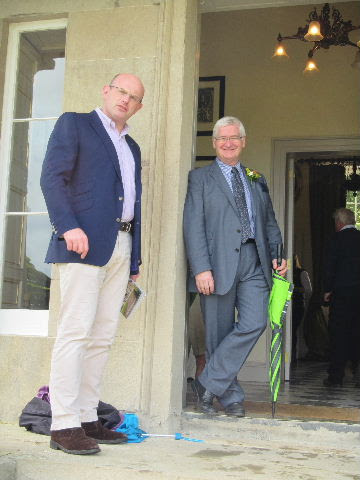
Before: Visitors to the auction stand in the doorway. Past this entrance room is the Entrance Hall.

BEFORE: Matching consoles stand opposite each other at the entrance.
Love those dogs!!
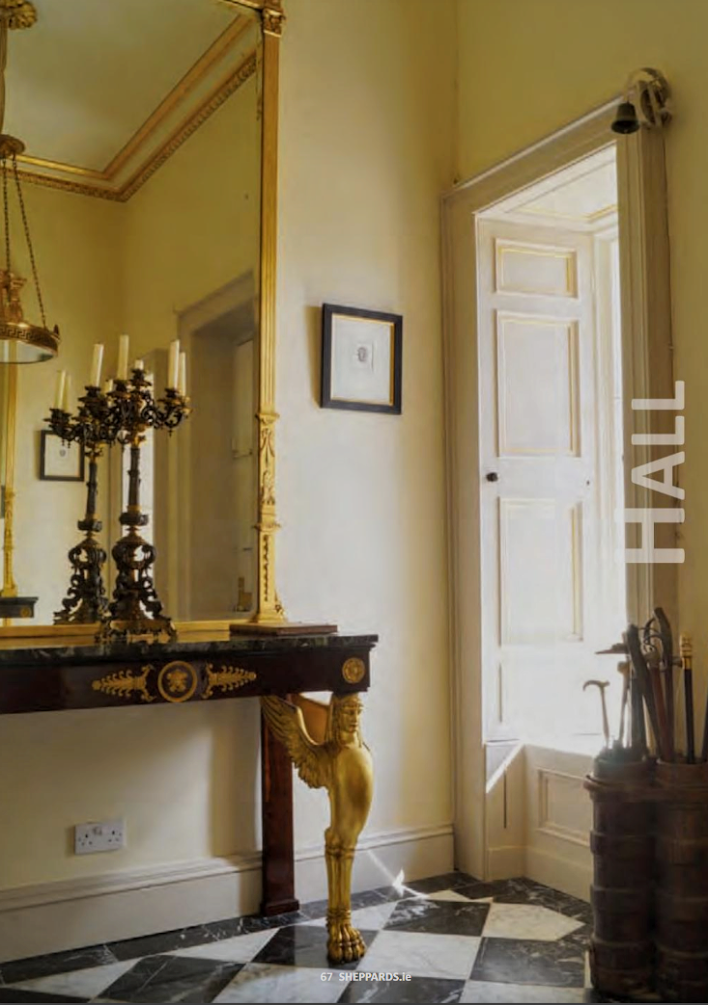
BEFORE: On the other side of the room.

AFTER: FROM VERANDA
The Entrance Room redone by Bullard. Mirrors and matching consoles on both sides of the room which past the double doors leads into the Print Room or Entrance Hall.
Notice the light gray and white marble floors which Bullard laid throughout much of the house.
Entrance Hall/Print Room

BEFORE: From the 2015 sales brochure. Past the front door entry, is the formal Entrance Hall.

AFTER: Bullard created a Print Room in the Entrance Hall. The inspiration came Castletown, a grand Irish house. Print rooms were in vogue during the 18th century. Bullard removed the gilt molding and painted the room gray. Notice that the light fixture was the previous owners. Many items were purchased from the previous owners who were jewelers and antique dealers. Instead of curtains at the window, there are now shutters.
The period neoclassical statues came from an Irish auction house, along with the regency hall chairs which now boast the Capard crest.

2 FROM VERANDA: This view shows the double doors that lead to the front door entrance. The decoupage came from Ireland’s Birr Castle where the Earl’s son-in-law found them in his family’s library and gave them to Bullard to use here.

A collection of stunning Blue John mineral urns.

And on the opposite side of the table is a collection of design books for guests to peruse.

For Christmas, a twinkling tree stands in front of the window. In Instagram, Bullard states that he designed all the Christmas trees pictured in these photos. He probably did this while he was decorating the house for three years, not sure he still trims the Christmas trees today.

And a glimpse into the Drawing Room that you enter through the Print Room.
Bullard wrote that each small paper piece was first chosen, then it was cut by hand, then glued on the walls. The Print Room took a team of 4 artists and two weeks to complete.

BEFORE: From the Print Room, another door leads to this sunny yellow hall with the gray and white marble floor. Past the first doorway is the original flagstone floor that leads to the kitchen area and the Billiard’s Room. The room at the end of the hall is the original study/office. Unfortunately there are no After photos of the study/office.

AFTER: The same hallway as seen above. Bullard kept the hall painted in what he calls a Nancy Lancaster yellow. In this photo, you can see into this back hall that leads to the kitchen area. This set of pink damask chairs go around the table in the Ballroom in the Dowager House.
DRAWING ROOM:

BEFORE: The Drawing Room is through the door, seen right off the Print Room/Entry Hall. This decor is really not a favorite. It is just so stunning to see how using antiques can be so garish compared to how Bullard decorated this same exact room using many of the same antiques. He is just a design genius.
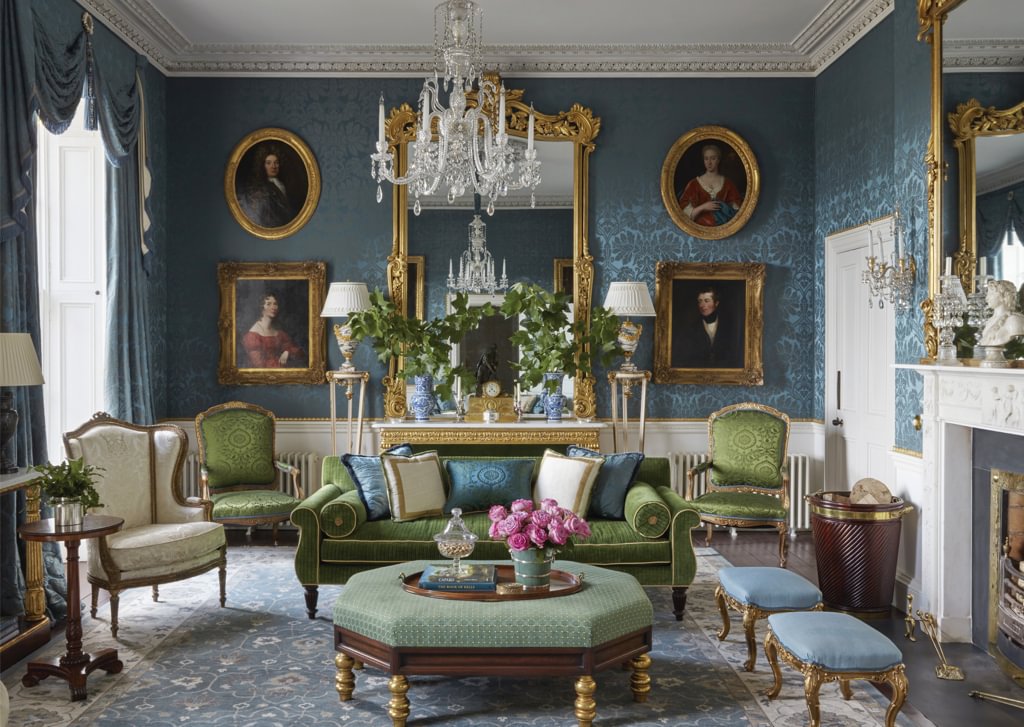
AFTER: FROM VERANDA.
By Martyn Lawrence Bullard. Notice how much more beautiful this room is now – such a difference. It’s a real eye opener to see the difference between a mediocre decorator and one with excellent taste, like Bullard.
The Drawing Room is so pretty in Russian blues and green rather than the garish red. What’s interesting is how many antiques Bullard bought for this client during the Capard auction. For instance, the large mirror and the console were bought from the previous owners, as were the two rectangular paintings flanking it. Even the mahogany peat buckets came from the auction.
As in every public room, Bullard painted over the gilt molding.

This photo from Instagram shows that there are two sofas facing each other, flanking the fireplace. The walls are blue silk damask and the room is filled with regency and William IV furniture most of which is of Irish origin.
THE STAIR HALL
Out the door from the Drawing Room is a long hall where the stairs are located. This hall also connects to the Print Room and the Powder Room, along with other public rooms. Look at the above floor plan for clarity with how all the rooms connect.

BEFORE: The grand staircase is the focal point of this hallway.


Before: The first floor stair hall.

Before: The cupola.

Before: A closer look of the cupola.

AFTER: FROM VERANDA.
Notice how beautiful the stone cantilevered stairs are. Just stunning. Bullard placed a new Starke runner on the stairs. Beautiful arrangement of marble busts on the sunny yellow walls. And notice how wonderful the bright yellow goes with the red and the floors. Even the stairhall looks so much better After than Before!
Through that door is the former small Dining Room, today called the Library.

INSTAGRAM. Christmas time!
CLOAK ROOM:

BEFORE: Off the stair hall is the Cloakroom. This room still had the original 300 year flagstone floors.

AFTER: FROM VERANDA: Bullard installed the marble floors over the flagstone and added the vanity. Notice how the entire room had framed prints which connects this area to the next door Print Room.
Notice how perfectly the mirror fits over the vanity. Which makes me question – how does Bullard do it? He lives across the globe yet he still manages to get all these minute details so perfectly???? Did he hire an assistant that lives in Ireland? How does he get everything so right without being at the project daily to watch for small errors?

AFTER. INSTAGRAM. Everyday styling for guests.

INSTAGRAM. The opposite side of the cloak room showing the entrance to the toilet room.
THE LIBRARY:

BEFORE: The library. On the floor plan – you can see that next to the library is the small dining room. These two rooms are now open to each other divided by newly placed columns. This mantel was removed and the gilt molding was painted over. Ballard reused this Chippendale mirror.
GET READY!!!
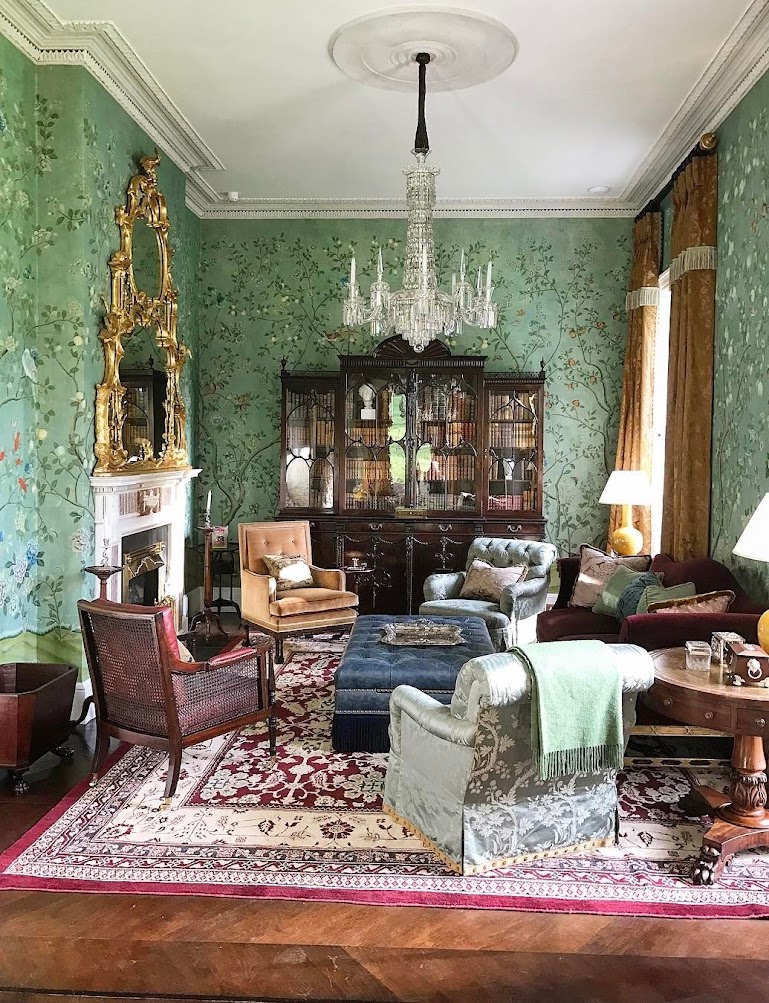
AFTER: This was the original Instagram photo I saw on Bullard’s page back in 2017. I literally gasped and then spent hours trying to find out where this room was located. England? Scotland? Eventually from Bullard’s Instagram photos I discovered it was Capard House in Ireland. How stunning is this room? The wallpaper is deGournay, originally designed for Yves St Laurent. Bullard purchased the mirror to reuse it in this room, along with the peat bucket. The chandelier was new to the room, as were the hardwood floors. The cabinet is absolutely beautiful.
The room is stunning. It’s off the stair hall, past the Drawing Room, so its more private which makes it a perfect place for after dinner drinks.
This photo was taken early in the job – you can see in the photo below that the two paintings were later added above the sofa, along with the obelisks on the cabinet.
LOL – I just noticed that!!!

Another view. Notice how many colors are used on the upholstery: burgundy, blue, orange, red and peach. Yet it all works. Absolute genius by Martyn L. Bullard.

FOR VERANDA. Close up view of the new mantel. Also, the Chippendale mirror was originally in this room.
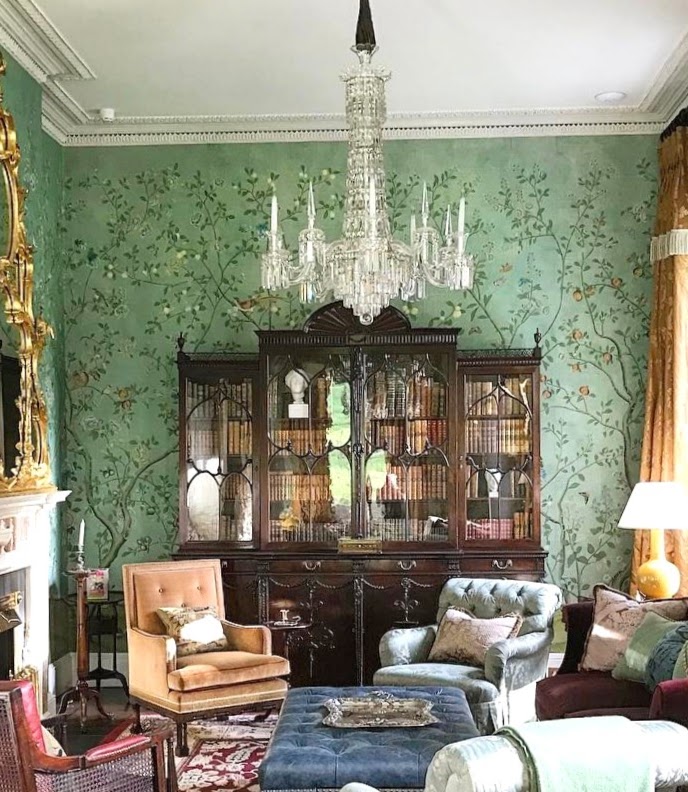
Closeup of the magnificent antique Irish cabinet.

Christmas in the Library.
The Library was opened up to the next door Small Dining Room to became one room, separated by columns, below:

After: Looking from the Library into what was once the Small Dining Room.

BEFORE: And here is the original Small Dining Room. This room is now part of the Library, separated by columns.

AFTER. FROM INSTAGRAM. The smaller side of the Library, ready for Christmas. The two rooms are decorated the same, same wallpaper, same chandeliers, same curtains. But, the furniture is different. The smaller side is more casual, more set for quiet talks over a late night drink while playing a game of chess. Notice the small door. This is the one that opens up to the stair hall, right underneath the stairs.

A daytime photo. Apparently the owners use the house for Christmas holidays and Martyn was often invited, hence these photos from Instagram.
Let’s take a look at the big Dining Room.

BEFORE: I have to say I just hate this decor! The purple wallpaper and the green curtains look so garish. Just awful. Bullard kept this chandelier and the mantel and reused them in his newly decorated dining room.
Again, study this decor versus the Martyn Lawrence Bullard decor below to learn the difference between mediocre design and genius design.

AFTER. FROM VERANDA.
Just gorgeous!!!!!! Absolutely beautiful. Everything is perfection.
Bullard again, as in all the other public rooms, removed the gilt molding. The hand painted walls with scenes of the indigenous trees and views near to Capard House is beautiful. Below, the walls are upholstered with regency style silk upholstery.
Notice how wonderful the touch of red in the portrait’s coat is. Also notice how beautifully executed the curtains are.
Look for a moment how perfectly the mural’s tree limbs flank the portrait. This small detail was accomplished by a designer who lived across the world, and with seemingly little effort. But it only SEEMS that way. His Instagram is filled with photos of trips across the globe during the time he decorated this house and it makes one wonder. How does he do it all? And make it seem so easy? It’s not of course. But that one small detail – getting the trees to flank a portrait that probably hadn’t even been purchased before the walls were painted.
Incredible.
And that’s the difference between mediocrity and genius.

INSTAGRAM. Table set for breakfast. You can only imagine how delicious the food is!!
The table is 18th century Irish. The chandelier is 1830s Osler.

The mirror is Booker and the mantle is also 18th century.
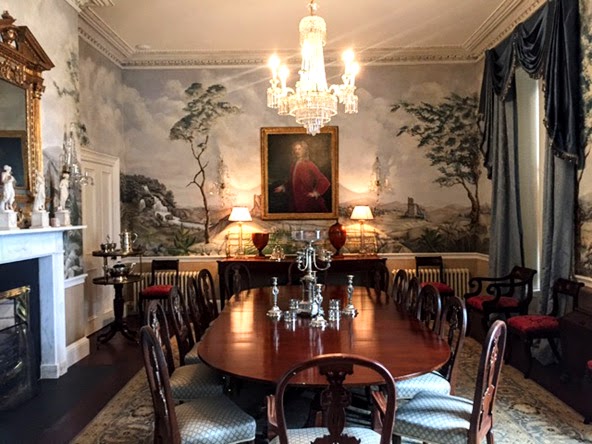
INSTAGRAM. The room as it normally is when not set for a meal.
THE KITCHEN AREA:

Before: A typical Irish country kitchen.

BEFORE: You can see the hooks in the ceiling, probably from hanging meats or pots. The hooks remain today.

AFTER: FROM VERANDA.
A new Aga was installed and a new farm sink was moved to under the window. The cupboard was repainted and a table from 1880 with a pine railway bench were added. Modern pendants replaced the brass chandelier. But truly, the kitchen looks practically the same, only better. Notice the wonderful 300 year old flags on the floor, original to the house.
Blue & White from OKA HERE.

INSTAGRAM. After breakfast.
Not sure where the dishwasher is. Perhaps one of the nearby small rooms is where the cleanup occurs?
BREAKFAST ROOM:
BEFORE: This room was originally used by the staff in former days. Today it is the breakfast room.

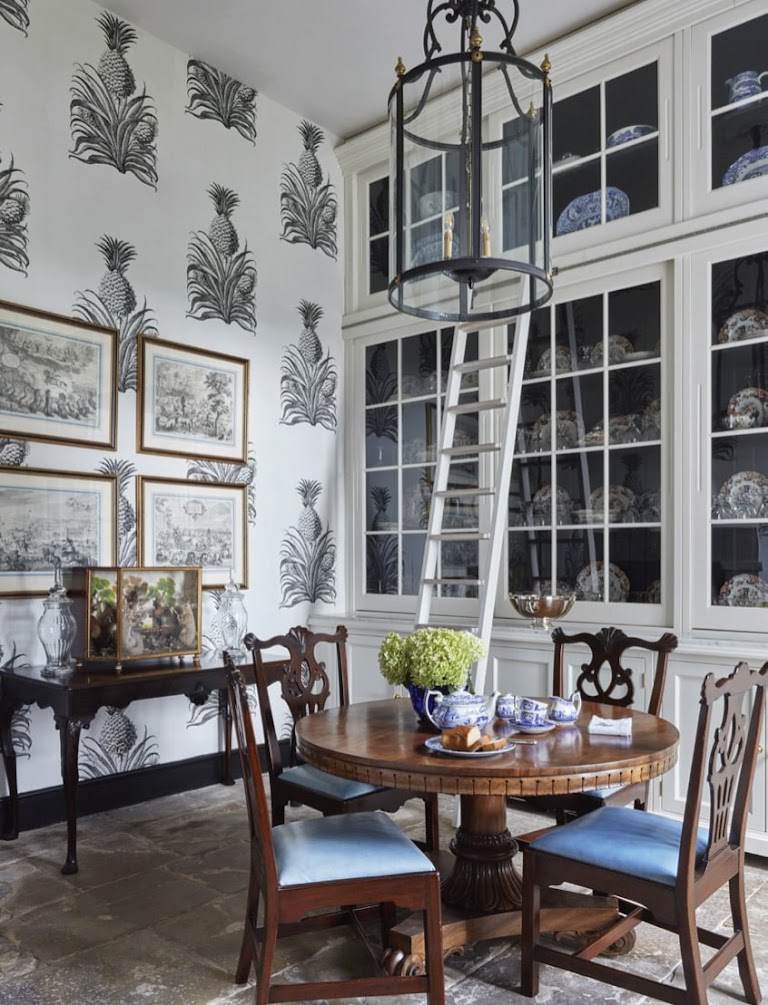
The Georgian symbol of hospitality is the pineapple, hence the wallpaper. The flags are original, 300 years old. The table is 18th century Irish as are the chairs.


AFTER: Notice in the reflection of the glass you can just barely make out the original, ancient stove that remains in the room.

The Pub is located in the old wine cellar and is called “Hair of the Dog.” Hence, all the antique Staffordshire dogs on the walls.

FROM VERANDA: Close up of the Hair of the Dog room. Antique Staffordshire dogs share wall space with a collection of round mirrors.

A view of the house high up on the hill.

I added two rooms on this floorplan. The Orangery, a large, important structure room was recently added between the two areas of the main house. And, in the former dining room I added what it is now – the Billiard’s Room or Pool Room.
THE ORANGERY
The biggest change in the house is without a doubt the Orangery. It’s a massive glass house located in what was once a courtyard at the back of the Main House. Decorated by Martyn L. Bullard, the Orangery is a feast for the eyes as you will see!

Before: The back of the main house. Located in the open courtyard, the massive glass house is now the focal point of the house.
Notice on the roof, the cupola above the main staircase.
And notice how the front of the house is limestone, yet the back is either stucco or rendering – a cost saving tool. The entire Dowager House is in the same white stucco – no stone facade at all.

BEFORE: The back of Capard House showing the vista which reaches miles away.

BEFORE: The side of the main house and further in the back, the Dowager House. There are a few landscaping structures that lead up the hill. This is one of those structures with a retaining wall and urn.

AFTER: Here is the Orangery, placed in the former back courtyard of the Main House.
Two urns sit at the top of a landscaping structure that leads up the hill at the back of the house.
The architectural design team who designed the Orangery won first place for Best Glasshouse at the International Design and Architecture Awards held in London.

AFTER: At the far right is the new terrace that extends from the Orangery to this side of the house where the view is best. There is a new iron pergola attached to this side of the house, along with the large gravel terrace which holds a white table and chairs.

UNDER CONSTRUCTION: Showing the back of the main house. On the left, you can see the new Orangery that is being built. And, on the roof the cupola is being restored (would LOVE to see it!!) At the right, a new terrace is being laid to the right of the Library. There is now a pergola over the windows, probably to hold sun shading vines.

And this view shows the cupola after it was restored. I don’t know if they changed anything, because it looks the same. Perhaps it was leaking or something mundane like that, that needed correcting.

The entry to the Orangery
The idea to add a conservatory in Capard House came from the nearby Ballyfin estate, which today is a boutique hotel. While Bullard was designing the house and doing his research of Irish estates, he stayed at Ballyfin which is only 18 miles away from Capard House.
The Orangery at Capard House is especially cozy with the addition of underfoot heating. The room is used for afternoon tea and smaller dinner parties. You can enter the Orangery through two former windows which are now doors located in the Billiard’s Room. Also, there is a door located off the sunny yellow hall that leads to the kitchen area.
My two part story on the boutique hotel/historic house Ballyfin can be read HERE and HERE.
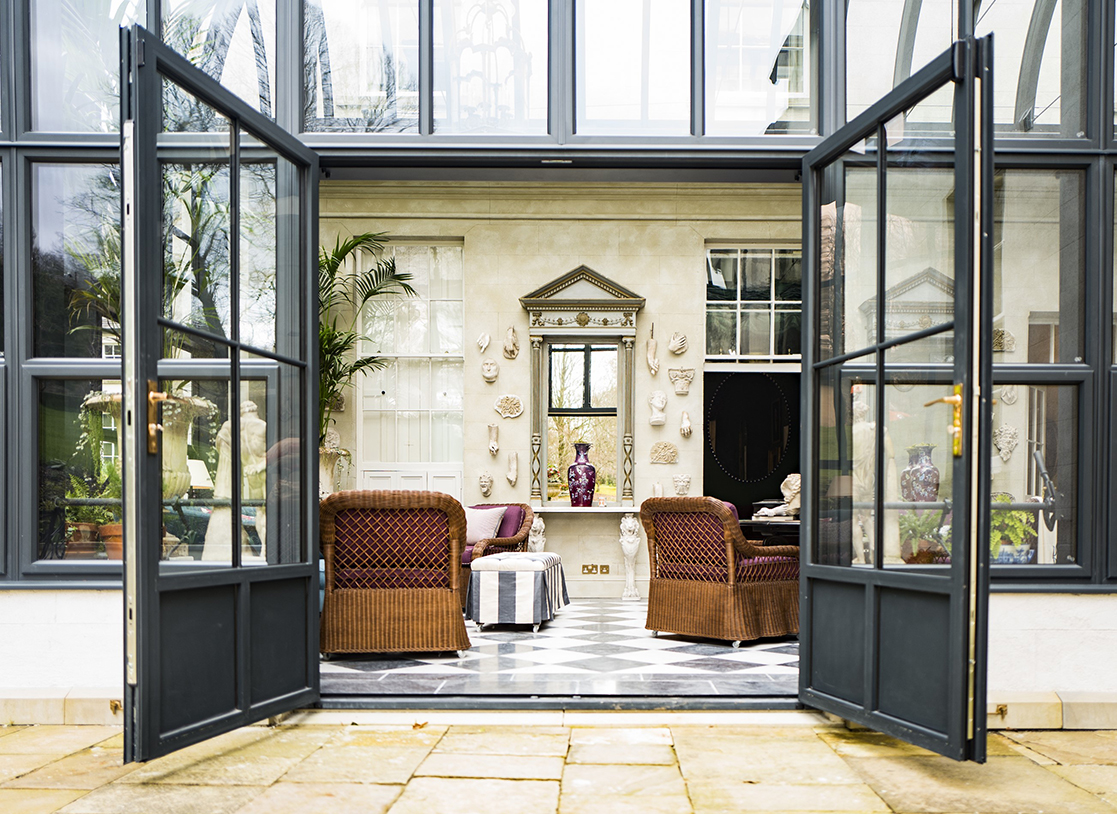
The double doors open to the Orangery. Inside, the two windows flanking the mirror act as doors, which lead into the Billiard’s Room.

Inside the Orangery you can see the door to the sunny yellow hall which leads to the kitchen area.

Interior in mauve and turquoise. Through the door/window you can see the pool cues for the pool table. The underfoot heated marble floor is the same marble flooring that is used throughout much of the main house.

FROM VERANDA. The center table doubles as a dining table for smaller parties.

Another view of the beautifully decorated Orangery. Outside the view is of the hill behind the house.

FROM VERANDA. The console between the two windows/doors of the Billiard’s Room. Through the windows you can see the green damask shades hanging inside the Billiard’s Room.
On the walls are a collection of 1940s plaster models of architectural elements and anatomy by French artist Max Le Verrier.

FROM VERANDA: The center table set for dinner with a collection of Irish chairs.

Looking from the inside out towards the back terrace.
THE BILLIARD’S ROOM:
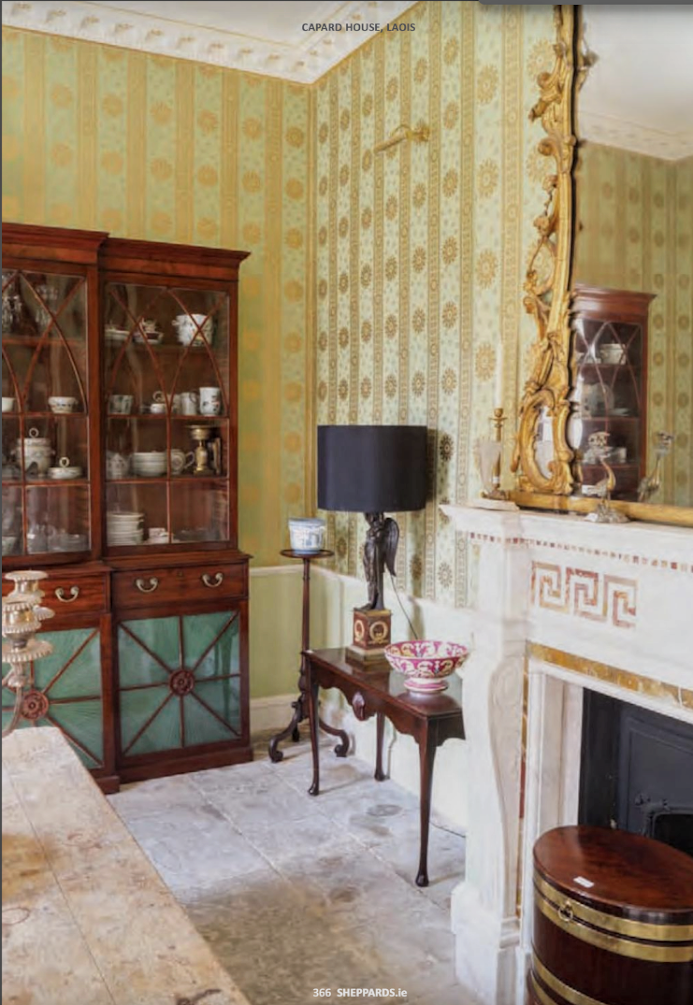
BEFORE: This was once the servants dining room but later was a casual dining room for the family.

AFTER: The Billiard’s Room is just past the kitchen area. The floor is the original 300 year old flags and the mantel remains from its previous life as a dining room.
Silk damask on the walls matches the green felt on the table. The chandelier is so beautiful.
This room, just a destination to play pool, is so romantic, so pretty. And imagine how it must now look with its windows opening up as doors to the Orangery!

Before the room was finished being decorated. Through the door is the bright yellow hallway that leads to the kitchen area. Notice the hanging clock. It’s one of many that Bullard placed throughout Capard House.
Above the mantel is a portrait of Arthur Guinness who invented the most famous of all Irish beers.
UPSTAIRS AT THE MAIN HOUSE:

BEFORE: The upstairs hall that leads to the bedroom ensuites.

BEFORE: The Master Bedroom: very ornate. Very tacky. Notice the cornices, Bullard will reuse those in another suite.

AFTER. FROM VERANDA. The Master Bedroom today. Wonderful rug. More Irish antiques. Beautiful bed, a 1825 George IV mahogany antique. Bullard used the same chandelier that was originally in the room. Compare the Before room with the After. The curtains are just so gauche compared to the more simple, yet elegant curtains that Bullard chose. Striped wallpaper. The two rooms can’t compare. It’s just very hard to compete with Martyn Lawrence Bullard.

BEFORE: The master bath.
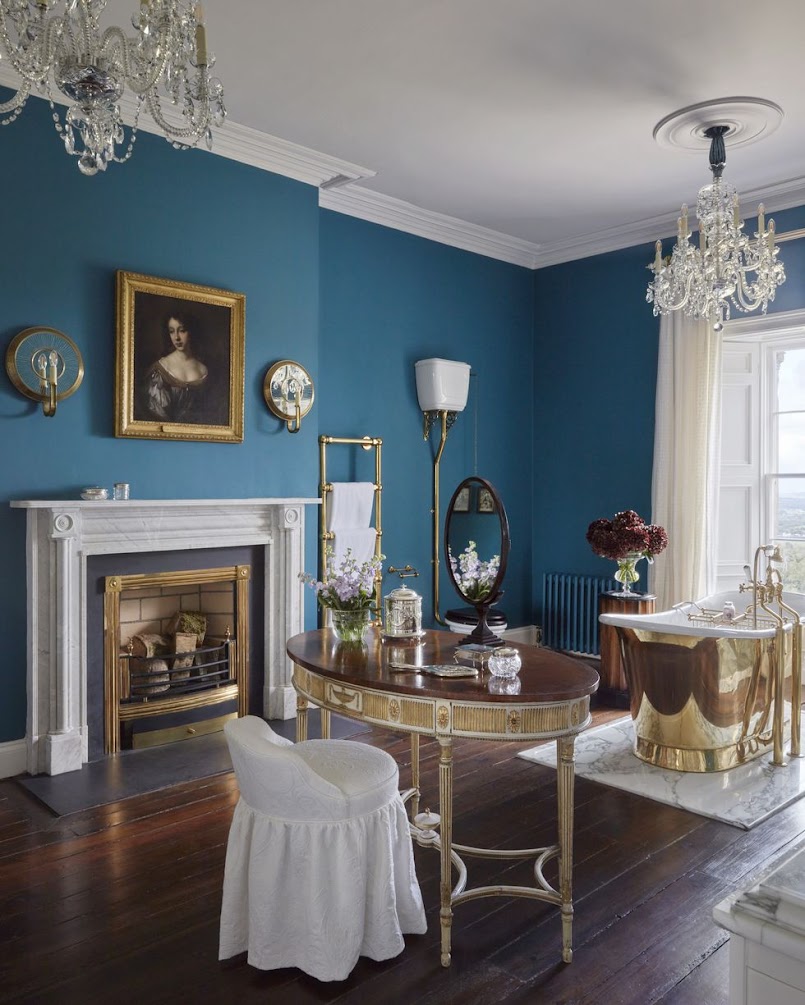
AFTER: FROM VERANDA What a bathroom!! At the time this house was built, it was very unusual that each bedroom (minus one) would be en suite. It was unheard of, even in large mansions. The mantel was designed in 1827. Love the toilet and notice the tub on the marble pad. So pretty!!!
One word about Bullard. While the original bathroom was nice, notice how with just a few touches, he has made this room elegant. The paint color. The vanity floating in the room. The portrait and the crystal chandeliers. He is just so very talented – especially when you think of his varied range, his portfolio. This isn’t a style he does often, but you would think he was an expert in this classical decor.
Another photo from the master bath showing the vanity and closet with Chippendale motifs. In the mirror you can see the corner shower is clad in marble.
BEFORE: A guest room with wood floor and an interesting ceiling, along with a pretty stone mantel that distinguishes this room.


AFTER: FROM VERANDA: The same Guest Room as shown above. Classic decor filled with Irish antiques. Notice the wall clock above the mantel. New toile wallpaper and a crowned canopy makes this a dreamy guest room.
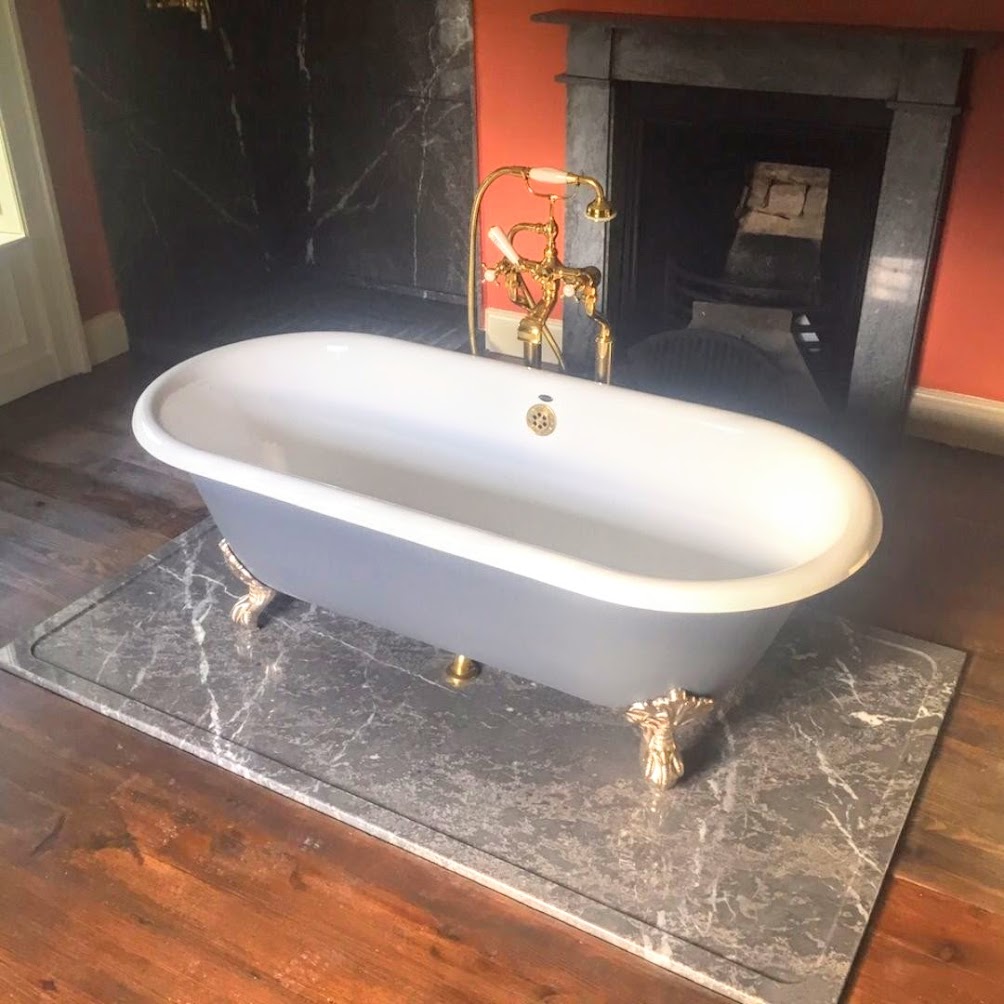
AFTER: Another bathroom with the tub on a marble rug. There is also another corner marble shower and an original fireplace mantel.

AFTER: FROM VERANDA. Yet another guest room. Charming wallpaper and cafe curtains. The paisley shawl and red blanket came from OKA. Love this room!!

BEFORE: Another guest room in red toile.

AFTER: Bullard reused the same red toile wallpaper in this guest room. The curtain cornices came from the former Master Bedroom and were reused in this room.
The East Wing/Dowager House

BEFORE: The East Wing/Dowager House before it was bought by the current American clients and spruced up.

AFTER: The East Wing/Dowager House after the house was painted a more cream color and cleaned up. Bushes and vines now grow on the front of the facade, softening the once bare front.
BEFORE: The front door to the Dowager House leads directly into the yellow Drawing Room. Past this room is the smaller Dining Room.
INSTAGRAM: The front door to the Dowager House with curtains flanking the entry.


This is the only AFTER photo of the Dowager House’s Drawing Room.

BEFORE: Upstairs hall that leads to the Ballroom and bedrooms in Dowager House.

BEFORE: This room was used for banquets, balls, and auctions. Lining the walls are a series of modern art paintings, sharing space with antique wall sconces.

AFTER: The Banquet Room or the Ballroom, set for a fancy dinner. Bullard upholstered the walls in deep red (I think it is upholstered, not verified.) New sconces and art work ring the walls. Above the console is a wall clock, of course.

AFTER: And as it usually looks.

AFTER: In the Dowager House across from the Ball Room is this bathroom. It had been modernized but Bullard replaced it all, including these latrine styled fittings. He used deep red, which ties into the Ball Room, right across the hall.
STABLES AND CARETAKERS COTTAGE

AFTER: The company that built the Orangery also remodeled the stables block and the Caretakers Cottage into rooms and apartments for the employees who run the estate for the American owners.
Quite a nice room with old portraits and tiled floors.

A bedroom that continues the Irish theme for the employees.

BEFORE: One of the original out buildings.
GARDENS:
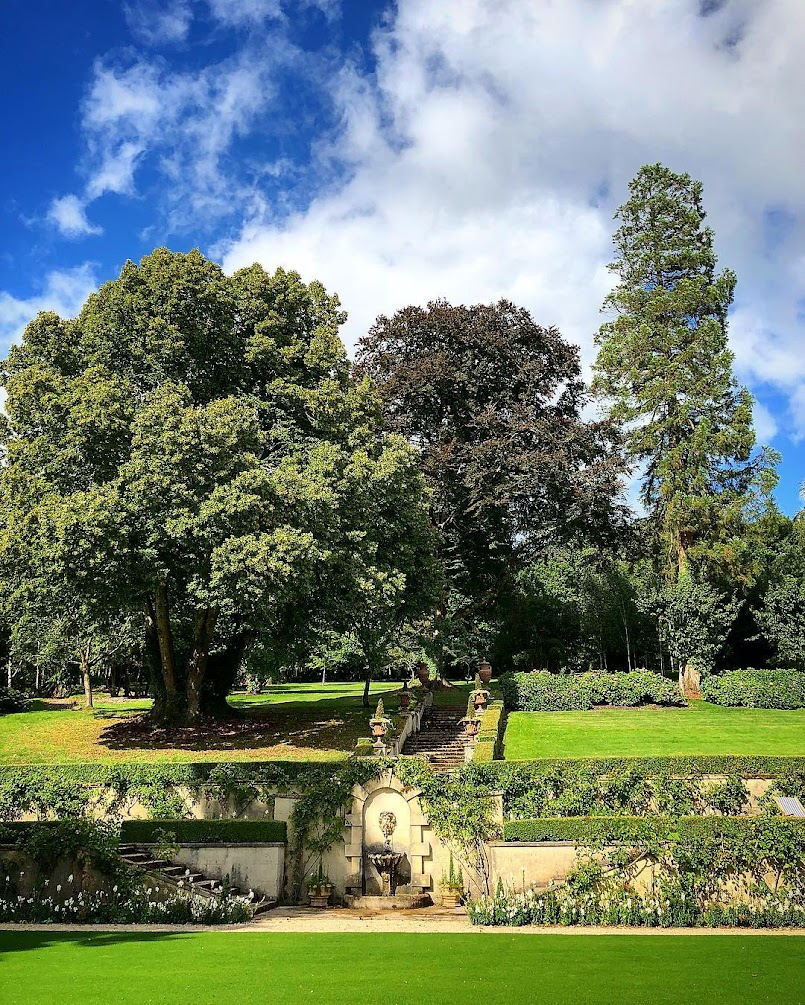
AFTER: Autumn at Capard House. Behind the house there is a large hill which is reached by climbing this stone stairway.

AFTER: FROM VERANDA. Taken in spring, the staircase has colorful flowers in urns on the stairs including Buff Beauty and Iceberg roses.
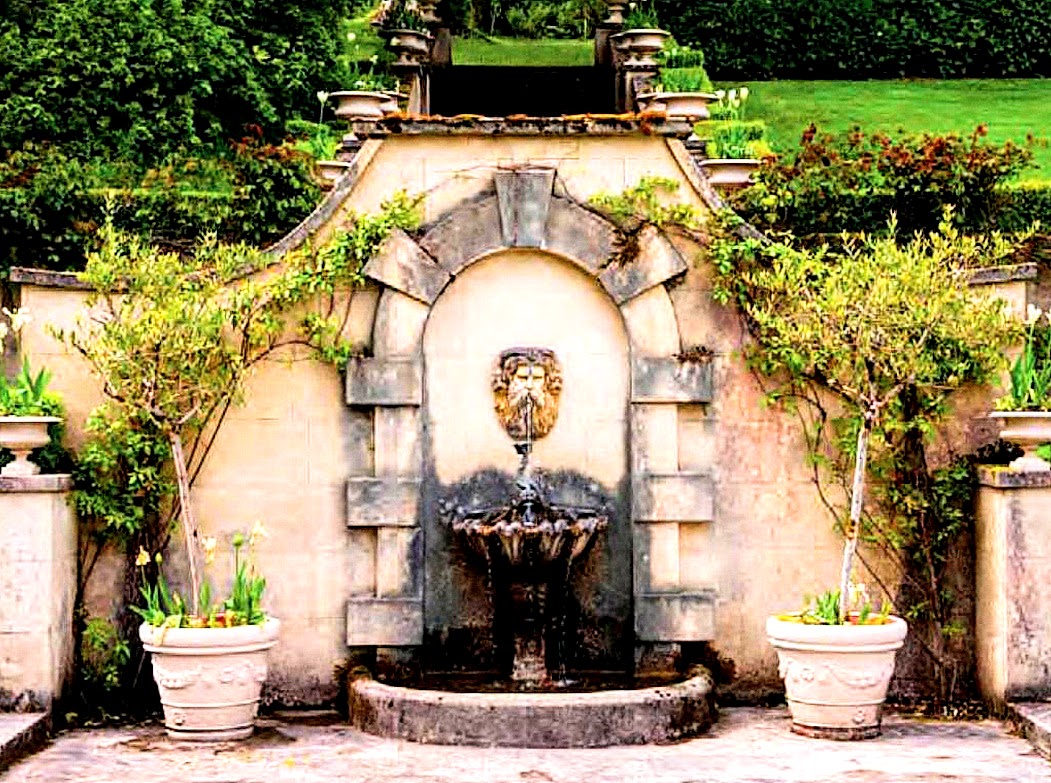
At the base of the stone stairs is a fountain.

The gardens include a five acre bluebell wood and a wildflower meadow.

Spring flowers.

The view over the Slieve Bloom Mountains.

BEFORE: The walled garden. One entrance is through the arch in the brick wall.

BEFORE: Outside looking in.

BEFORE: Inside looking out.

BEFORE: This entrance to the walled garden is a round circle.

AFTER: FROM VERANDA The circle now has a iron gate securing the private garden.

AFTER: FROM VERANDA The topiaries came from Belgium, but they most resemble King Charles’ fanciful topiaries at Highgrove.

The previous owners (the jeweler and antique dealer) installed this Greek temple folly as a place “to sit with a drink and watch the sun set.” The rectangular reflecting pond reminds one of the Washington DC Lincoln Memorial.

BEFORE: Something tells me this temple has been decorated since this photo was taken.

Streams from the mountains feed the water features and lakes on the estate. To the far left of this lake you can see the Temple folly and its reflecting pond, fed from this lake.

Close up of the beautiful stone bridge.

AFTER: A private Golf Course – being built on the estate. Permission was given to the American owners to build the course as long as it remained private, to be used by the owners only.
Must be nice!!
Additionally, there is a Helicopter grass pad hidden on the property that was already in situ when the estate was bought by the Americans.
Lastly after spending over three years designing Capard House, Martyn Lawrence Bullard told Veranda:
“Because of this project I am absolutely, 100 percent, without a doubt going to end up buying myself a country house.” He’s laughing, but he’s also gravely serious.
We shall see!!! I would LOVE nothing more to see the country house Martyn Lawrence Bullard would make his own!!
