defrog: (onoes)
I have somehow been recruited for a mission in which I’m supposed to impersonate Donald Trump. I don’t remember who hired me for this, what the point of impersonating Trump is, or why I agreed to do it.

I’m told it’s for some livestreaming forum, although Trump is the only speaker, so it seems more like an overblown press conference, with a small in-house audience whose job is to laugh at his jokes.

I’m made up to look like Trump with spray tan and a wig. I go to the event and judging from the attendee reaction, my impersonation is convincing, although I notice some ppl behind me seem to be interested in my hair, and might have figured out it’s a wig. I figure Trump gets this all the time, so I don’t worry too much.

Shift: After the event, I’m at my mom’s old house, still in my Trump get-up. A van pulls into the driveway and as I go to the side door, I see Trump approaching, wearing a long black overcoat, his expression the same menacing scowl as his official presidential portrait. I back away as he steps inside, and as he approaches me, I’m surprised that he’s taller than I thought – almost 9 feet.

Before I can say anything, he opens his overcoat, revealing that he is actually sitting on the shoulders of a man in a general’s uniform. Kust as I remember being warned earlier about the general, he reaches out with one hand, grabs me by the shoulder and pulls me to him in an embrace. With the other hand, he pulls out a long knife and stabs me in the back. There’s a sharp pain, and everything fades to black.

And then I woke up.

Trumped again,

This is dF
defrog: (devo mouse)

The Lunar New Year is upon us again.

Specifically, the Year of The Horse.


Have I got just the playlist for you.


DISCLAIMER: I made this back in 2023 as a kind of response to a setlist by BBC Radio’s Gideon Coe in which he did three hours with songs about horses. I did likewise, just to see if I could do it.

Obviously, I could. And I did.


Anyway, it was lying around handy, and I didn’t see the point of making another playlist. So this will have to do.


Of course of course,


This is dF
defrog: (45 frog)
… Is another Valentine’s Day playlist.

Possibly this one.

Possibly not.

But it’s here if you need it.


Love love love,

This is dF
defrog: (books)

And we’re off! To a very slow start. Because I was traveling and busy and enduring general madness and whatnot.

Anyway, it’s a start.

Lorelei of the Red MistLorelei of the Red Mist by Leigh Brackett

My rating: 2 of 5 stars

Continuing my exploration of the works of Leigh Brackett, this 1946 novella is an interesting curiosity in that (1) it’s co-written with Ray Bradbury and (2) it wasn’t a collaboration so much as a case where Brackett wasn’t able to finish the story after she got an offer from Howard Hawks to co-write the screenplay for The Big Sleep with William Faulkner, so she asked Bradbury (whom she was mentoring at the time) to think up an ending and finish it for her.

The story is a planetary romance set on Venus, in which professional thief Hugh Starke is on the run after stealing a million credits. His ship crashes and he’s left for dead, but he wakes up in a new body – specifically, a warrior named Conan – thanks to a mysterious sorceress named Rann who is also Conan’s former lover. There is a war going on between the humanoid fish sea-people who live in the Red Sea, Rann’s people (descendants of the sea people) and the humans of Crom Dhu, which is under siege. Rann wants Starke-as-Conan to kill the leader of Crom Dhu and end the siege. Starke has other ideas. There's also a zombie army at some point.

The story itself is pure planetary-romance pulp, and it’s okay if you like Conan stories (and this was apparently intended as an homage to Robert E. Howard) – which, I confess, I’m indifferent to. It’s perhaps more interesting to see how the story obviously switches writers in midstream, and also how at least some of the details here would find their way into Brackett’s Eric John Stark tales, which she started writing a few years later, particularly her descriptions of Venus as a liveable planet – she would reuse the Red Sea concept in Enchantress Of Venus. Anyway, it's not terrible, but it's probably more worthwhile if you want to see what Bradbury was doing before he became famous.

View all my reviews

Play Red Misty for me,

This is dF
defrog: (45 frog)

Another year, another Best Albums list.


And you’re lucky to get one – not just because I was busy traveling for a couple of weeks over the holiday, but also because, to be honest, it wasn’t exactly a banner year for new music for me. Quite a few usually reliable artists put out albums that just didn’t really work for me (hey, it happens), and most of what I came across throughout the year, while good, didn’t really set my world on fire.


Luckily, several late-year releases moved the needle, but even so, the only way I could fill out a Top 20 list was to lump LPs and EPs into a single category rather than break them out separately.


And why not? This ain’t Rolling Stone, after all. And that’s not a bad thing. Besides, good music is good music regardless of running time.


dEFROG’S TOP 20 LPs/EPs OF 2025


BB Bomb

Practice Songs (Damnably)

Taiwan hardcore punk band that started in 2003 as an all-girl outfit led by singer/guitarist Hsu Pei Hsing, who is now the only original member (and only woman) left. As far as I know, this is their second album, and it’s louder and faster than their debut, with 15 songs in under 21 minutes – which is intentional in that Hsu has said that she challenged herself to write songs more quickly because the first album took 17 years to release. In any case, it’s noisy shouty fun.


Billy Nomates

Metalhorse (Invada Records)

Third album by British singer-songwriter Tor Maries, who goes by the stage name Billy Nomates, and whom I’d never heard of until I came across this. Loosely organised around the concept of a decrepit funfair, the song cycle ruminates on themes of loss and insecurity, inspired by the recent death of her father from Parkinson's and her own diagnosis of MS. Which sounds like a bummer, but it’s a surprisingly upbeat album musically, and the songs are pretty sharp.


The Bug Club

Very Human Features (Sub Pop)

Fourth LP by Welsh duo, and their second for Sub Pop that essentially doubles down on last year’s On The Intricate Inner Workings of the System – so, more eccentric fuzzy indie rock. This didn’t knock me out as much as the previous album – it’s somewhat less fun, with some songs getting a bit more reflective and personal – very human, you might say. Still, that’s not necessarily a bad thing, and there’s still plenty of charmingly snarky bounce to be had.


The Cleaners From Venus

Neverland For Now (Mr Mule)

The evergreen Martin Newell returns as The Cleaners From Venus with another EP of slightly psychedelic indie rock in which he seems to long for simpler days in a crazy world, although he also whimsically volunteers to save America from itself by becoming its latest pop obsession (cos hey, someone’s gotta do it). Hey, I’d vote for him. Anyway, it’s a nicely solid and lovely little collection of songs.


Del The Funky Homosapien + thegoodnews

This Just In! (Nature Sounds)

Thegoodnews is Del The Funky Homosapien, producer CTZN and rapper Po3 presented mainly in cartoon form via illustrator Pete Cosmos. But this ain’t Gorillaz – the cartoon bit is secondary to the musical style, which is adjacent to Deltron 3030 (whom Del has also worked with in the past), with Juan Alderete (of Mars Volta and Dr Octagon) and Taka Tozawa (who has also collaborated with Deltron 3030) also onboard the project. They’ve been a thing since the mid-2010s, and this EP was released for Record Store Day. Put simply, if you like Deltron 3030 (or any project that has Del in it), you may like this. I do and I did.


Holly Golightly

Look Like Trouble (Damaged Goods)

Holly Golightly had a busy year, both with her return to duty in Thee Headcoatees and this, her 14th solo album (not including the ten LPs she did with The Brokeoffs). Golightly returns to her Southern Gothic torch’n’twang sound that suggests smoky nightclubs at 2:30am as she casually sings about life’s ups and downs with a twinkle in her eye and a switchblade in her boot.


Half Man Half Biscuit

All Asimov and No Fresh Air (RM Qualtrough)

Somehow I’d missed the fact that Half Man Half Biscuit were still active. This is their 16th LP, and it’s pretty much business as usual for singer-guitarist Nigel Blackwell and bassist Neil Crossley – biting and subversive satirical lyrics set to catchy hooks, with references to everything from Isaac Asimov, Edgar Allen Poe and Badly Drawn Boy to horror clowns, Legoland and telepathic crime-solving chickens. The doom-folk epic “Falmouth Electrics” literally made me laugh out loud. That’s your review right there.


Thee Headcoatees

Man-Trap (Damaged Goods)

Billy Childish revived two of his old bands this year – Thee Headcoats and Thee Headcoatees, the latter being an all-girl band that was originally created by Childish as an alternate backup band to Thee Headcoats but became successful on their own terms before breaking up in 1999. This is by far the better of the two comebacks – groovy, solid garage rock with great vocal interplay between all four members.


The Hives

The Hives Forever Forever The Hives (PIAS)

Two years after their comeback album The Death of Randy Fitzsimmons, their majesties The Hives return for album no. 7. Their mission and sound remain unchanged: swaggering tongue-in-cheek garage rock intent on world domination. They dress like kings now and everything. And you know what? They’re entitled.


Kling Klang

Half Life (Wrong Speed Records)

Experimental synth rock from Liverpool! Kling Klang have been around since 1999, but their recorded output isn’t prolific – this is only their second LP (and the first, 2006’s Esthetik Of Destruction, was really just a singles/EP comp). I’d never heard of them before, but I have now, and this collection of mostly instrumental tracks is strangely addictive – not alt-Kraftwerk so much as a Delia Derbyshire/Hawkwind collaboration. Whatever it is, it’s oddly mesmerising, and the more I listen to it, the more it embeds itself in my brain.


Leenalchi

Heungboga (HIKE)

Second full length LP from Korean band that blends traditional pansori folk with bass-driven dance-pop. The songs here are based on the pansori epic of Heungbo, who rescues an injured swallow and is rewarded with fortune, while his greedy brother Nolbo brings about his own ruin. Even if you don’t speak a word of Korean (which I don’t), Leenalchi knows a catchy dance hook when it hears one, and the blend of that and pansori vocals makes Leenalchi utterly unique. Nothing else sounds anything like this, and it’s fantastic.


James McMurtry

The Black Dog and the Wandering Boy (New West Records)

James McMurtry (son of Larry) has been making records since 1989, but I only got into him a couple of years ago after coming across his brilliant song “We Can’t Make It Here” via a book about protest songs. This is his 13th studio album, and while nothing on here quite reaches the expectations set by that song, it comes close a lot of times. McMurtry specialises in solid storytelling embodied in songs populated by ne’er-do-well characters haunted by regret and seeking redemption – the kind of thing Warren Zevon used to do so well. Two cover songs (Jon Dee Graham’s “Laredo (Small Dark Something)” and Kris Kristofferson’s “Broken Freedom Song”) seamlessly bookend the album. Powerful stuff.


Willie Nile

The Great Yellow Light (River House Records)

16th studio album from NYC stalwart who gets compared to Dylan, Springsteen and Lou Reed, which I think is overselling it, but there’s no doubting Nile’s gift for passionate lyrics and his ear for air-punching anthems. The song quality falls a little short of the best bits of his previous album The Day The Earth Stood Still, and I think sometimes he tries too hard to sound inspiring and hopeful. And yet I can’t help admire that he makes the effort, bless him.


Nusantara Beat

Nusantara Beat (Glitterbeat)

Indonesian Sunda Pop from Amsterdam! Sunda Pop first emerged in the 1960s in Indonesia, where traditional Sundanese music with contemporary pop, psychedelia, surf music and funk. Nusantara Beat – all of whom are of Indonesian heritage – essentially put a modern spin on Sunda Pop that tilts the balance a little more in favor of pop over Sunda. This is their debut LP after having the spent the last year or so putting out several 45s on the Les Disques Bongo Joe label.


Jonathan Richman

Only Frozen Sky Anyway (Blue Arrow Records)

Jonathan Richman returns to duty with his 18th studio album, which also reunites him with former Modern Lover (and Talking Head) Jerry Harrison. Despite the album’s underlying theme of death and mortality (and it’s jarring to remember Richman has been making music for 55 years now), it’s a typically light-hearted and whimsical affair, with some occasional welcome musical experimentation (with Richman giving fair warning in “But We May Try Weird Stuff”).


Sparks

MAD! (Transgressive Records)

Album no. 26 from the unstoppable Mael brothers, and it’s about what you’d expect from Sparks – synth pop, art rock and repetitive lyrics about everything from rocky relationships to JanSport backpacks and being stuck in freeway traffic. This is one of those cases where “more of the same” is both good and not so good. By general standards it’s good – by Sparks standards, it’s good but average.


Mavis Staples

Sad And Beautiful World (Anti-)

14th studio solo album from Mavis Staples featuring a collection of (mostly) cover songs selected as vehicles for her to reflect on the state of the world we live in and what we can (and should) learn from the past as we look towards an uncertain future. Obvious highlights are Tom Waits’ “Chicago” and Leonard Cohen’s “Anthem”, but just about everything here is gold in Staples’ hands – moving and inspiring without resorting to bombast or preaching, and offering a ray of hope. This is indeed how the light gets in.


Stereolab

Instant Holograms On Metal Film (Warp/Duophonic UHF)

Stereolab returned to active duty this year with their 11th studio LP and their first album of new music in 15 years. Superficially it’s like they never left – posh electronics, song titles lifted from operator manuals and lyrics that read like socialist essays – but their sound has matured over the decades into something simultaneously laconic and fizzing with energy. They also haven’t lost their ability to muck about with their own formula. Mary Hansen’s absence is still noticeable for me – the Groop have never quite managed to duplicate the natural vocal interplay between Hansen and Laetitia Sadier. But it’s still nice to have them around.


Cosey Fanni Tutti

2t2 (Conspiracy International)

Third solo LP from legendary Throbbing Gristle co-founder Cosey Fanni Tutti that offers up experimental electronica ranging from hypnotic beats to abstract moods. Probably not for everyone, and I admit I have to be in the right frame of mind to appreciate it (long bus rides, for example). But it’s pretty trippy. If nothing else, it’ll make a great soundtrack for the next Blade Runner movie someday.


Voice of Baceprot

Transisi (Dark Anthem Records)

Second EP from all-girl Indonesian metal trio who continue to kick against the pricks. The songs cover a range of social and political problems – war, violence, colonialism, govt corruption, deforestation, etc. More striking (and encouraging) is that VoB continues to evolve into something that’s more than the sum of their musical influences. Still possibly the most underrated metal band in the 21st century.


HONOURABLE MENTIONS


Annie and the Caldwells

Can't Lose My (Soul) (Luaka Bop)

Annie and the Caldwells are a funk-gospel outfit that have been around since 2000 and have released a couple of albums on the Memphis-based Ecko label. This is their first for Luaka Bop, and it reworks six of their earlier tracks. There’s no doubting Annie Calwell’s pipes and sincerity, but I came away feeling she was trying a little too hard to engage with the listener. Still, it do be funky.


Gelli Haha

Switcheroo (Innovative Leisure)

Second LP from the artist formerly known as Angel Abaya, and her first as Gelli Haha, her alter ego that embraces her inner child. The switch to Gelli also sees Abaya switch from fairly standard indie rock to more experimental synthesiser dance pop. Doesn’t really hold up after a few listens, but it’s goofy fun while it lasts.


The Let's Gos

Tracks For Lucks ~Swampbag Sessions~ (CMA-SUN Records)

Tokyo’s The Let's Gos is an all-girl punk band that have been around since 2009 cranking out fairly standard pop punk – pretty good, but nothing Shonen Knife and a few dozen other bands on K.O.G.A. Records haven’t done before. This mini-LP of covers, on the other hand, is rather charming, not least because of their obvious love for the material. It’s also an strikingly eclectic selection, from The Who, The Clash and The Beatles to Strawberry Switchblade and France Gall.


Stress Eater

Everybody Eats! (Silver Age)

In which comic book-inspired hip-hop supergroup Czarface team up with Kool Keith, who takes on the character of Stress Eater. For the most part, it doesn’t really add up to more than the sum of its parts, but the parts are high quality, so it has its moments.


Throwing Muses

Moonlight Concessions (Fire Records)

11th studio album from Throwing Muses, who pivot from the heavy vibes of 2020’s Sun Racket to a bleak, stripped down acoustic sound that isn’t that far removed from some of Kristin Hersh’s solo material, though at this stage there seems to be increasingly little difference between a Hersh solo LP and Throwing Muses album apart from personnel. Anyway, there’s some good stuff here but overall this didn’t really click with me.


Vondré

0:00 (Bandcamp)

Second album from Mexican alt-rock band that are invariably described as a combination of shoegaze, grunge and post-punk. To my ears, they’re more reminiscent of 90s bands like Curve – droning noise over catchy basslines fronted by melodious female vocals singing about alienation (only in Spanish!). I like it, but sometimes it feels like a case of form over substance. Then again, some of it is riveting. Will be keeping an eye on them to see where they go with this.


BEST SINGLES


David Boring

Nancy Nightmare (Damnably)

Hong Kong no-wave-inspired post-punk noise band David Boring returned to action on Halloween 2025 after time off due to the back-to-back upheavals of the 2019 protests and COVID-19 with several new singles ahead of their second LP, which is due out this month. This is the first of those, and it’s nightmarish indeed – in the best possible way. Looking forward to the new album.


Fulu Mikiti

Fungola (Moshi Moshi)

Latest single from Congolese band where literally every instrument they play is made from stuff recycled from the dump, from petrol cans and flip-flops to car parts and plastic tubing. They also describe themselves as an Eco-Friendly Afrofuturist Punk collective. In any case, they remain as fun as ever to listen to.


THE PLAYLIST


Wanna sample the above? Well you can.


Same time next year,


This is dF

defrog: (Default)

Well, I got bogged down with lots of end-of-year stuff, so I didn’t even finish any books in November, and only finished two for December. But hey, at least I beat my Goodreads Reading Challenge. Twice!

(To explain: I originally targeted 23 books this year, then when it was clear I would comfortably sail past that, I bumped it up to 25 books. I finished with 26. Isn’t that interesting?)

Anyway, here’s the last two books for 2025.

Jesus and the DisinheritedJesus and the Disinherited by Howard Thurman

My rating: 4 of 5 stars

This was a reading assignment for a class, though I admit it comes with a pitch that appeals to me – this 1949 book is based on a series of lectures by Howard Thurman on what Jesus had to offer the “disinherited" (the oppressed), which for Thurman’s purposes means black people in America, though it can also apply to any oppressed group. And as legend has it, Martin Luther King Jr studied this book during the Montgomery bus boycott and would carry a copy around with him.

In essence, Thurman breaks down several key characteristics of oppressed people (fear, hate, and deception as survival tactic), how they’re experienced by black people, and how Jesus’ teachings address each of these to make the point that love is the most powerful response to oppression. To get there, Thurman focuses on the historical, human side of Jesus, which provides crucial context for understanding his teachings on these matters. Put simply, Jesus was a poor Jew living under an oppressive regime, which means his ministry was thus crafted and delivered in the context of living under oppression by the Romans. As such, his teachings can also be interpreted as non-violent survival techniques for resisting oppression as an alternative to armed resistance or giving up and joining the oppressors (or at least staying out of their way).

Despite Thurman’s pedigree as a pastor, he takes a strikingly secular approach to Jesus and his ministry, which seems to annoy many Christian readers who argue you can’t separate the human Jesus from the divine Jesus or his mission of salvation. I would agree in that Thurman is perhaps oversimplifying why Jesus said what he did, and this may have been because he was targeting secular audiences with these talks. Where I think the book really shines is Thurman’s description of the black experience in racist America, how fear, deception and hate manifest in that context, and what’s like to live in that particular state. I also agree that context is essential to understanding both Jesus’ ministry and how people of colour feel about systemic racism – especially now that America’s leaders are busy pushing the idea that DEI is racist against white people.


CandideCandide by Voltaire

My rating: 4 of 5 stars

For whatever reason, despite it being an obvious favourite of a lot of music artists and authors that I like, I never bothered to read this or anything else by Voltaire on the general assumption that philosophical fiction by philosophers is heavy on philosophy and light on everything else. Recently, however, I started hearing people talking about how it’s satire (which I didn’t know) and still funny a couple of centuries later. So I finally decided to try it out. And it just goes to show how much I know about anything.

The book is basically intended as a rebuttal to Gottfried Wilhelm Leibniz’s philosophy of optimism, which insisted on God's benevolence despite all the terrible things that happen in the world. Candide, the illegitimate son of the sister of the Baron of Thunder-ten-Tronckh, lives a happy innocent life in the castle and is taught by his tutor, Professor Pangloss, that they live in the "best of all possible worlds" and that "all is for the best". Then Candide is literally kicked out of the castle after the Baron’s daughter, Lady Cunégonde, flirts with him, and finds himself gangpressed into the Bulgarian army. From there it’s one calamity after another as Candide travels the world and sees that it’s nothing like what Pangloss has described.

Which doesn’t sound very funny. But it’s how you tell it. Voltaire’s storytelling is playful and briskly paced, parodying classic adventure-romance tropes, while Candide maintains an oafish innocence for much of the novel as he tries to see the upside of all the bad things happening to him and his friends while he struggles to reunite with his beloved Cunégonde. As for Voltaire’s take on optimism and the problem of evil and suffering, there’s plenty to argue about, and people still argue about it to this day, so there's no need to assume Candide is the last word on the topic. Anyway, I get why it’s one of the most influential novels in literature.

View all my reviews

Candide camera,

This is dF
defrog: (Default)

It’s that time of year again, and I got you the same thing I always get you – a playlist of tunes to make your Christmas somewhat merrier.

Or as close as we can get to that, given … [gestures vaguely at everything].

Anyway, this one is – perhaps appropriately – a bit off the rails.

Then again, you should see the stuff that didn’t make the cut.

And anyway, it’s either this or risk being Whammed.


Caroling caroling,

This is dF
defrog: (45 frog)

The US Thanksgiving holiday is upon us again.

You might need a playlist for that.

This might not be that playlist.

But then again who pays attention to music on a day where everyone’s mostly eating and football?

Beside me, I mean.

Anyway, it’s a pretty good playlist, says I.


Be thankful for what you got,

This is dF
defrog: (devo mouse)
Naptime dream:

I am sitting in a cramped bedroom watching Poison Ivy from The Cramps trying to rewire a fuzzbox pedal to broadcast a vibrato effect that will hypnotise people and give them trashy psychedelic hallucinations.

Lux Interior (who looks like the cover of Good Music for Bad People, only fuzzier and with grey hair) is lying on the shag carpet between the bed and the wall.

She asks him to hold a component in place while she tests the transmitter. He doesn’t answer, and I notice he’s sleeping. I’m afraid to wake him up because he might bite me.

Ivy notices my hesitation and says to me, “Let him sleep – I’ll test it later,” and starts reassembling the pedal.

And then I woke up.

We’ve got a fuzzbox and we know how to use it,

This is dF
defrog: (45 frog)

Daylight Savings Time is over in the US and whatever other countries observe that particular practice.

If you’re not sure what time it is, perhaps you could consult this playlist.


While you’re readjusting your timepieces, I mean.

Every hour on the hour,

This is dF


defrog: (books)
Well, pretty fast, anyway.

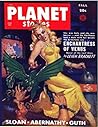
Enchantress Of Venus (Planet Stories)Enchantress Of Venus by Leigh Brackett

My rating: 2 of 5 stars

Continuing my exploration of the works of Leigh Brackett, this is the second of her Eric John Stark novellas, which I would have read before the third one, Black Amazon of Mars, if I’d realised at the time there was a copy of it on Project Gutenberg, but then these things weren’t really written with an ongoing story arc in mind. Anyway, this one opens with Stark – the Tarzan/John Carter hybrid who makes a living as a mercenary – on Venus, sailing along the Red Sea to the town of Shuruun, to find his missing friend Helvi.

True to form, Stark finds himself in trouble by the end of Chapter 1 after inadvertently making an enemy of the ship’s captain Malthor. He makes it to Shuruun, a pirate town which is run by the Lhari, a cruel, power-hungry family. Stark learns that the Lhari are enslaving people to search the ruins of an ancient temple whose ancient god-like builders had supposedly developed a secret technology that can create new life and transform existing people into god-like monsters. The Lhari want that technology. Stark thinks that might be a bad idea.

And so on. As usual, Brackett writes this stuff well above average, and also as usual, the love-interest angles are the least-believable elements in the story. It’s good for what it is, but I felt this one was a little light on plot and a little slow in the second act, compared to the first and third Stark tales. Still, as planetary romance goes, it’s alright.


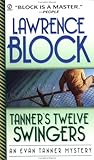
Tanner's Twelve Swingers (Evan Tanner #3)Tanner's Twelve Swingers by Lawrence Block

My rating: 4 of 5 stars

Continuing my revisit of Lawrence Block’s Evan Tanner series, this is the third instalment, in which Tanner – lover and joiner of lost cause groups who also does jobs for a super-secret agency that mistakenly thinks he’s one of their agents – chooses his own mission just to get out of doing another mission. The Chief wants Tanner to stop the Colombian Agrarian Revolutionary Movement from overthrowing the current regime. Tanner – who happens to be a member of the Colombian Agrarian Revolutionary Movement – says he’s not available because he has a mission already lined up in Latvia (which at the time, you may remember from history class, was part of the USSR).

Tanner is not exactly lying – the truth is that he had drunkenly promised a lovelorn friend in the Latvian Army-In-Exile (of which Tanner is also a member) that he would go to Latvia to bring his gymnast girlfriend Sofija to America – which is impossible, but it gives him an excuse to not go to Colombia. Naturally, things get complicated as he makes his way to Latvia via various Eastern European contacts, all of whom have their own favours to ask. Before long, Tanner has to not only smuggle Sofija out of Latvia, but also her sister, her entire gymnast team, a subversive Yugoslavian author (and his manifesto), two rolls of microfilm, some documents written in Chinese, and a six-year-old girl named Minna who happens to be the heir to the Lithuanian throne (once the monarchy is restored, which is another cause Tanner supports).

This one takes a little while to get going, as Tanner spends the first few chapters establishing how he ended up on this mission in the first place, while also taking time to visit his infant son in Macedonia (see The Thief Who Couldn't Sleep for details). But the fun builds up as he finds himself saddled with one task after another. It’s also considerably lighter in tone than the previous book The Canceled Czech (well, I mean, come on, Nazis) and displays a lot of the humour I remember enjoying about this series. And while Minna now comes across to me as a little too mature for a six-year-old, she’s also rather likeable, and anyway, who reads these things for gritty realism?


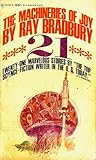
Machineries of JoyMachineries of Joy by Ray Bradbury

My rating: 4 of 5 stars

Back to Ray Bradbury with this 1964 collection of short stories that, if nothing else, shows how eclectic he was. In fact, it’s interesting how often Bradbury is described as an SF writer when really he was so much more than that. It’s perhaps more accurate to say he was a writer of the fantastic and slightly weird (I mean, even his SF was never that scientific, but it was decidedly imaginative and almost never dull). There’s certainly very little SF here, and even when there is, it’s more speculative than anything else.

The title track features two priests wondering what man’s upcoming exploration of space means for their vocation. "Boys! Raise Giant Mushrooms in Your Cellar" hints at an alien invasion, but could also be a metaphor for drug addiction. “The Chicago Abyss” and “The Vacation” dip into post-apocalyptic dystopian territory. Yet other stories involve Mexican funerary customs, talking ventriloquist dummies, an homage to Ray Harryhausen and a competition to see who can exit an Irish movie house the fastest before the national anthem starts playing.

As always, some are better than others, but Bradbury’s writing style almost always captivates and mesmerises me – and he certainly does here. Sometimes it really is more about how you tell it.

View all my reviews

Heavy machineries,

This is dF
defrog: (halloween)

It’s that time of year again when you need a playlist to entertain the trick-or-treaters, Halloween party guests, everyone in the Costco parking lot and whatnot.

Or maybe you’re thinking, “Well, we’re gonna skip music and watch a bunch of classic horror movies.”

Have I got just the thing for you.


Notice how it’s three hours long – which just happens to be around how long your standard classic science fiction double feature picture show would last.

Coincidence? Probably.

Anyway, have fun and be safe.

In the back row,

This is dF
defrog: (books)

Slowing down again, but I’m ahead of schedule, so why not?

The Man Who Knew Too Much (Dover Literature: Crime/Mystery/Thriller Short Stories)The Man Who Knew Too Much by G.K. Chesterton

My rating: 4 of 5 stars

Not to be confused with the Hitchcock films of the same name, which borrowed the title (and nothing else) from this 1922 collection of what are billed as detective stories, but are actually far more than that – they’re really commentaries on corruption and skullduggery among the upper class in the British govt at the time, and how they can literally get away with murder. While the stories are essentially standalone, they also form an interconnected narrative when bookended by the first and last stories.

The title character is Horne Fisher, a respected member of the upper class from a political family who is very well connected with top government officials – including the Prime Minister – and seems to know everybody and everything. That also means that while he is very adept at solving the murder mysteries that occur in these tales, he also believes that reporting his findings to the police will be not only futile, but also potentially damaging to the govt and the stability of the British Empire, or what’s left of it. Fisher’s cynical pessimism (some might say realism) contrasts to his sidekick, political journalist Harold March, whom he befriends in the first story.

Like Chesterton’s Father Brown stories, the mystery-solving bit is almost incidental to the scenarios in which they take place, with the crime usually happening mid-way through the story and Fisher solving the mystery quite quickly. For my money, I think that approach works better here than with the Father Brown mysteries, if only because Fisher comes across as a better defined character. What’s even more interesting is that Fisher is more of an anti-hero because of his complicity. He knows who’s guilty, yet is unwilling to turn them in – a point that March eventually calls him out on.

I will say that Chesterton probably assumed his audience would be informed of the big political issues of the day in early-1920s England – or at least the framework in which his fictional issues occur – so if you’re not up to speed on that, you may feel a bit lost, especially during the final story. Possibly more problematic for contemporary readers is the blatant anti-Semitism in one story, even if you take it as an accurate reflection of political sentiment at the time. (Chesterton himself has been accused of being anti-Semitic, though he always denied this and also denounced Hitler before it became popular.) Anyway, I found it strangely compelling.


Leaves of GrassLeaves of Grass by Walt Whitman

My rating: 1 of 5 stars

I read a few selected Whitman poems in a poetry class in university, and of course I’ve heard quotations of and references to his work in Dead Poets Society and Ray Bradbury stories and whatnot. And I remember learning that Whitman was very controversial for his day, not just for disregarding metre and rhyme, but also for the sexual overtones of some of his poems, not all of which could be said to be exclusively heterosexual, if you see what I’m saying. So sure, I figured I’d dive in his sole collection of poems, which originally started with 12 poems and now contains over 400.

And, well ... I’m probably not the most qualified person to review it, not exactly being a connoisseur of poetry. Let’s just say everyone has their own taste in poetry, and I have mine, and for the most part, Whitman is not it. There are a few gems here, all of which are among his shorter poems. In fact, I got more out of the short ones, as Whitman’s style is so grandiose and (for lack of a better term) emo to the point of pretentiousness that it makes the longer poems a real slog. Put another way, Whitman makes Bill Shakespeare look like Bukowski. Points for going against the grain, ditching conventions and celebrating the natural world and all, and the good ones are certainly worthwhile, but man, I’m glad that’s over.

View all my reviews

Sheer bloody poetry,

This is dF
defrog: (books)
Well, fast enough for jazz. Whatever that means.

Anyway …

Black Amazon of MarsBlack Amazon of Mars by Leigh Brackett

My rating: 3 of 5 stars

Continuing my dive into the works of Leigh Brackett, this pulp novella from 1951 is her third story featuring Eric John Stark, the Tarzan/John Carter hybrid who makes a living on Mars as a mercenary. This time, the story opens with Stark accompanying a dying native Martian named Camar to his home in Kushat, which is up around Mars’ polar ice cap. Camar wants to die in his homeland – which is awkward because the reason he left in the first place was that he stole a sacred talisman designed to protect Kushat from evil – namely, the evil beyond the Gates Of Death that Kushat is supposed to protect the rest of Mars from.

According to legend, a million years ago, Ban Cruach created the talisman – and embedded his own memories into it – so that people would not forget the evil lurking beyond the Gates of Death, and how to defeat it should it ever come back. Stark reluctantly promises Camar he will return the talisman to Kushat, and is promptly captured by barbarian soldiers of Lord Ciaran, who knows the talisman has been stolen and plans to take control of the unprotected Kushat – or better yet, recover the talisman to make the task easier. Suspecting Stark knows where it is, Ciaran decides to torture the information out of him. Big mistake!

And so on and so on. As before, it’s fairly standard pulp stuff that’s more fantasy than science, and yet Brackett writes it well. And while she sticks to the usual he-man tropes expected for the genre at the time, she also quietly subverts it with stronger-than-usual female characters that you generally don’t find in the works of her Golden Age contemporaries, let alone writers like E.R. Burroughs.


MichaelmasMichaelmas by Algis Budrys

My rating: 3 of 5 stars

I’ve tried reading Algis Budrys once before with Rogue Moon, regarded as a classic of the SF genre. I was so unimpressed I actually quit about halfway through. Which I mention because when I came across this 1977 novel in a second-hand bookstore a couple of years ago, I’d forgotten this was the same guy who wrote Rogue Moon – and I didn’t remember that until after I’d already bought it. So it goes. Anyway, the premise is interesting: in the year 2000, Laurent Michaelmas is a world-famous TV journalist with his own secret sentient AI assistant, Domino, that has access to every computer network on Earth. Together, they secretly run the world by spinning big news events to keep conflict to a minimum, particularly between the US and the USSR, who are now cooperating to explore the solar system under the United Nations Astronautics Commission (UNAC).

However, all of that is put in jeopardy after Reuters reports that Walter Norwood – the US astronaut in charge of a planned UNAC mission to Jupiter who was killed in an accidental shuttle explosion before the novel starts – has turned up alive in a sanatorium run by the famously brilliant Dr Limberg, who claims to have healed him. Michaelmas and Domino don’t believe it’s the real Norwood, but if it’s not, then who is he, where did he come from and how? With a Russian astronaut slotted to take Norwood’s place, Michaelmas must find out fast before Norwood’s reappearance wrecks the UNAC alliance.

It sounds like a straightforward techno-thriller, but it’s not. The book relies heavily on expositional dialogue between Michaelmas and Domino, interspersed with inner monologues and ruminations about the power of news and how it is presented to us – and yet Budrys manages to be so subtle about what’s actually happening that you really have to pay attention (or re-read earlier chapters) to keep up with what’s going on, which slows things down considerably. That said, the pace picks up about halfway through, and while Budrys doesn’t exactly stick the landing, the eventual explanation is mind-bending enough that I’ll give him credit for swinging for the fences. I don’t think I’ll be reading Budrys again (except by accident, maybe), but this was better than I expected, and at least I finished it, so there’s that.


The Canceled Czech (Evan Tanner, #2)The Canceled Czech by Lawrence Block

My rating: 4 of 5 stars

Continuing my re-read of Lawrence Block’s Evan Tanner pseudo-spy series, this is the second instalment that sees Tanner – permanent insomniac and joiner of every lost cause on earth – accepting his first official assignment for the super-secret govt agency that mistakenly deduced in the first book that he is one of their agents. His mission, should he choose to accept it (which of course he eventually does), is to spring a Nazi out of prison in Prague.

Why would anyone want to do such a thing? It turns out the Nazi in question – Janos Kotacek – is a Slovak who was high-up in the Nazi regime and hiding in Portugal running an underground neo-Nazi network until he was captured and brought back to Prague to be tried and executed. The Agency believes Kotacek has a hidden cache of records detailing his neo-Nazi activities and contacts, which makes him more useful alive than dead – at least until the records archive is found. Tanner is assigned to find those records by breaking Kotacek out of prison and back to Portugal – all by himself.

This time around, I notice that the plot relies more on coincidence than the first one, although it doesn’t push the limits of believability (mostly). Possibly more problematic is the fact that Tanner has to hobnob with Nazis by pretending he is one, and sometimes is a little too good at it. Block makes clear Tanner is no Nazi, and at some point Tanner does start to realise he’s getting a little too in character for the mission, and yes, it was different in the 60s, but by 2025 standards it’s … awkward, to say the least. The character of Greta – a Nazi nymphomaniac with a circumcision fetish who helps Tanner – hasn’t aged so well either. It’s still a good Bond sendup and all, and I like it, but fair warning: some modern readers may cringe a little at the Nazi stuff (though they may find the ending satisfying, if they make it that far).

View all my reviews

Nazi rock,

This is dF
defrog: (puzzler)
ITEM: Cracker Barrel has changed its logo for the first time in 47 years.

Image


And MAGAland is absolutely flipping the f*** out.

Do I have thoughts? I kinda do, yeah.


1. For Pete's sake, get a grip, MAGA!


2. Logo changes are always controversial. But how the new one is in any way remotely "woke", I have no idea.


3. I guarantee no MAGA talking head who eats at Cracker Barrel gave two hoots about the folksy guy with the barrel until the company dropped it.


4. Personally I don't think the classic logo needed changing, but I also think it was fake nostalgia for a time that hasn't existed in most of America since the 1960s or earlier. Certainly none of the talking heads complaining about it ever once shared stories leaning on a barrel.

(Fun fact: the first Cracker Barrel opened in Lebanon, TN in 1969, at which time Lebanon had about 12,000 ppl, with no country store selling stuff out of barrels where townsfolk gathered to talk turkey.)


5. So, yeah, this is more classic manufactured MAGA outrage over a minor issue to throw more fuel on a sociopolitical culture war that they started.


6. FULL DISCLOSURE: I ate at a Cracker Barrel once.

Once.

Because I had to.

(I have family back in TN and that's where they wanted to go for the family dinner when we visited one year.)

It wasn't terrible, but it didn’t rock my world, either.

The other thing is that, having grown up TN, I'm not big on "Southern Cuisine", especially when it's packaged as an ersatz Simple Country Life sales gimmick.

To be clear, there's lots of good Southern food that I like. IMO, Cracker Barrel mostly serves the other kind. And of the food I do like on their menu, I can get it elsewhere for the same price or lower, and without the “downhome country values” propaganda.

Roll out the barrel,

This is dF
defrog: (books)

Well, that’s more like it, Bubba! Apparently it helps when you add a bunch of pulp fiction to your reading list.

The Girl, the Gold Watch & EverythingThe Girl, the Gold Watch & Everything by John D. MacDonald

My rating: 2 of 5 stars

I’ve been aware of John D. MacDonald for ages, but I can’t remember ever reading any of his stuff, not even The Executioners, which was filmed twice as Cape Fear. I may have tried one of his Travis McGee novels decades ago, but I couldn’t swear to it. Anyway, I found out awhile back that he’d written a few science fiction novels during his long career, one of which is this 1962 novel. I came across a copy of it and thought, why not?

The premise: Kirby Winter is a mild-mannered maladroit ninny whose uncle, the mysteriously wealthy Omar Krepps, has just died. Winter inherits nothing but a pocket watch and a letter to be opened in a year’s time. Kirby’s life changes dramatically when (1) everyone from Krepps’ business partners and the IRS to international grifter Charla Maria Markopoulo O’Rourke thinks Kirby is sitting on a fortune in embezzled funds, as well as the secret to Krepps’ inexplicable wealth, (2) he has an accidental sexual tryst with exotic dancer Bonny Lee Beaumont, and (3) he discovers that the pocket watch can freeze time for everyone except the person holding it.

I should note that the time-freezing aspect is more fantasy plot device than anything remotely scientific – which is fine, and probably as well, since Kirby doesn’t discover the watch’s ability until halfway through the book. MacDonald has fun with the kinds of things you could do with that ability, even if some of them are cringey by modern standards. In fact, there’s a lot of cringe to go around – the book has not aged well in terms of how Kirby relates to women, especially as the plot revolves on his evolution from sexually hung-up zero to assertive hero with the help of Bonny Lee’s Manic Pixie Dream Girl character (though, to be fair, it’s relatively progressive by 1962 sex-comedy standards). That said, the dialogue is a bit clunky at times, and I didn’t find Kirby and Bonny Lee’s love affair all that convincing. Overall, it’s okay for what it is and fun at times, but it didn’t convince me to give JDM another go.

Cape Fear is great, though. (Both of them.)


The Thief Who Couldn't Sleep (Evan Tanner, #1)The Thief Who Couldn't Sleep by Lawrence Block

My rating: 5 of 5 stars

It was 40 years ago that I first started reading Lawrence Block, and his Evan Tanner series – which started in 1966 when lots of authors were diving into lucrative James Bond territory – was my entry point. I was immediately hooked, and the influence of Block and the Tanner novels on my own writing style cannot possibly be overstated. I loved the idea of a spy novel featuring a guy who is incapable of sleep due to a war injury, whose hobby is joining hundreds of international organisations with hopeless causes (like, say, returning the Stuart line to the throne of England), and ends up working for a secret agency so secret that he doesn’t know who they are and they don’t know he’s not actually one of their agents. Anyway, I recently decided to reread all eight books in the series to see how it holds up after all these years. And so here we are with the book that started it all.

As a permanent insomniac, Tanner spends his extra waking hours studying, learning languages, joining lost causes, and writing theses for college students. After being hired to write a thesis on the Turkish massacres in Armenia in the early 20th century, Tanner – who is a member of the League To Restore Cilician Armenia – just happens to meet Armenian belly dancer Kitty Bazerian, who grandmother tells him a tale of how, in 1922, all the gold in Smyrna (573lb) was stashed under the porch of her family’s house in Balikesir in case the Turks invaded, which they eventually did. Tanner figures there’s a good chance the gold is still there, and decides to go to Balikesir to find out and – if it is – steal it. To give you an idea of how that goes, the book opens with him in a Turkish jail cell, having been promptly arrested at immigration.

It gets somewhat freewheeling from there, as Tanner is forced to make it up as he goes, becoming an international fugitive in the process, and leveraging his contacts with various organisations (not all of whom can be trusted) to get from one point to the next. This being a Bond-adjacent genre book, he also manages to get laid several times (hey, it was the 60s – which, incidentally, is something to keep in mind for several passages in this book). Throughout it all, what makes it work is Block’s breezy writing style, sharp dialogue, steady pacing, dry humour and generally keeping it as realistic and believable as you can keep a story involving a lost-cause enthusiast who can’t sleep trying to steal a fortune in Armenian gold. Reading it again, I can see how this made me a Block fan for life, and as international men of mystery go, I’ll still take Tanner over Bond any day.


The Night of the Long KnivesThe Night of the Long Knives by Fritz Leiber

My rating: 1 of 5 stars

I recently came across a trove of old SF novels, novellas and short stories at The Gutenberg Project, all scanned from Golden Age SF pulp magazines that are out of print and at least believed to be public domain at the time TGP scanned them. One of them is this, a post-apocalyptic novel by Fritz Leiber, who is most famous for his Fafhrd and The Gray Mouser series. I’ve never read those or anything else by Leiber, and who doesn’t like a good old-fashioned post-apocalyptic pulp novel? So I gave it a try.

The premise: after a nuclear war, the American continent is mostly a wasteland with pockets of civilization nearer the USA’s former borders. In the middle is the Deathlands, where humans have more or less been reduced to two basic instincts – fuck or kill (or possibly both). The narrator, Ray, encounters Alice – a tough woman with a hook for one hand. They go for the first option, after which they spot a hover plane that lands nearby. They kill the pilot, go aboard, are joined by an old man who happened to witness everything, and try to hijack the plane to get out of the Deathlands, upon which the old man, Pops, tells them he has started a movement to reject murder, and that they’re welcome to join.

Leiber has a stellar rep in pulp SFF circles, but this did not work for me at all. Apart from the trope of Ray spending pages and pages explaining what a bad-ass he has to be to be to survive in the Deathlands and justifying his murderous instincts, he also spends pages and pages laying out a lot of exposition for the overall setting. I gather that the story is partly meant to be a rumination on whether humanity can still be redeemed when fear and murder are the only characteristics it has left, but I didn’t find the transformation of Ray and Alice to be all that convincing – not after reading all those pages of Ray wallowing in his own hard-ass Deathlands philosophy.


Saint Francis by Nikos Kazantzakis (1-Jun-1963) PaperbackSaint Francis by Nikos Kazantzakis (1-Jun-1963) Paperback by Nikos Kazantzakis

My rating: 4 of 5 stars

A long time ago in a galaxy far far away, I read Nikos Kazantzakis’ The Last Temptation of Christ (while I was in Greece, no less – I picked up a second-hand copy of the book while I was there). I’d seen the Scorsese film and loved it, so I wanted to see what the book was like. I enjoyed it immensely, but never got around to read Kazantzakis again – until I came across a copy of this (in Tennessee, not Greece). While I knew very little about Saint Francis of Assisi, I was interested to see what Kazantzakis did with him, and what I’d make of it, as my spiritual outlook is far different now than it was 28 years ago. Admittedly it took a couple of tries, but eventually I found myself sucked into it.

As you might guess, this is a fictionalised bio of Francis, as narrated by Brother Leo, a seeker of God who accompanies Francis from his spiritual epiphany to his death. Kazantzakis weaves together fact and legend to create a portrait of Francis as a passionate fanatic preaching the “new madness” of God’s perfect love, which the people he encounters react to either by throwing things at him or joining him. Francis’ quest to imitate Christ as close as possible drives him to pursue Perfect Poverty (and all the suffering that goes with it) whilst also developing an affinity with God’s creation itself.

As I say, I don’t know enough about Francis to judge how much of Kazantzakis’ version is accurate and how much (if any) is blasphemy. And I can’t say how much I learned about the real Francis from this. But I can say it’s a bonkers novel that succeeds in exploring what it truly means to devote your life to imitating Jesus’ example at the expense of everything else in a world that either rejects you or seeks to exploit you. What made it work for me is that Francis is balanced by Brother Leo, who represents the true believers who don’t have nearly the willpower to be a Saint Francis, and gives a voice to those who believe that we don’t have to be a saint to be any closer to God than Francis is said to be.


Queen of the Martian Catacombs: Planet Stories, Summer '49Queen of the Martian Catacombs: Planet Stories, Summer '49 by Leigh Brackett

My rating: 3 of 5 stars

Continuing my exploration of the works of Leigh Brackett, this is her first novella to feature Eric John Stark, her most famous series character who is equal parts Tarzan, Mowgli and John Carter – born on Earth, orphaned on Mercury, raised by a local indigenous tribe, now a mercenary on Mars. Awhile back I read the first two books of her Stark reboot in the 1970s (The Ginger Star and The Hounds of Skaith), and while the results were mixed, the character was interesting enough for me to want to see what Brackett did with him in the 1940s.

Stark’s debut sees him on the lam from the Earth Police Control for running guns on Mars. Simon Ashton – the man who rescued him from Mercury and, as it happens, an EPC officer – gives him a choice: do 20 years for gun-running, or help stop a civil war. Stark has already been hired by a man named Delgaun for what he thinks is a private war, but is in fact part of a plot by the barbarian leader Kynon – who claims to offer immortality by way of ancient cult magic – to start a rebellion against the ruling govt. Ashton wants Stark to join Delgaun’s army in order to stop Kynon and his queen, the luscious redhead Berild, who may have plans of her own.

And so. It’s classic “planetary romance” swords-and-sorcery stuff, and here it works for two main reasons: (1) Brackett really was good at writing this sort of thing, and IMO wrote it as good as (or arguably better than) Edgar Rice Burroughs did, and (2) Stark is a strangely compelling character – an anti-hero that embodies an uneasy mixture of savagery and civility with a soft spot for the oppressed. The story is alright as these kinds of stories go, although – typical of the genre – the love-interest angle is even less convincing than the idea that there is indigenous life on Mars, Venus and Mercury. Anyway, I liked it well enough.

View all my reviews

Cooler than Mars,

This is dF

BITE HARD

Jul. 21st, 2025 05:11 pm
defrog: (devo mouse)
I hear it’s Shark Week on the Discovery Channel.


Apparently, it’s the 37th year they’ve done Shark Week,


I don’t watch it, of course – not least because I don’t have cable TV or whatever streaming service Discovery Channel might be on.


But I made a playlist for it anyway. Just to see if I could, really.


Sharp teeth pretty teeth,

This is dF
defrog: (45 frog)
Hello, Teenage America.

Got a playlist for your 4th of July cookout?

If not, I got one for you right here.

It may not be exactly festive. But it’s two hours of pretty good music.


PARENTAL ADVISORY: Playing this loud in yr back yard could result in a visitation from your local ICE franchise.

Gasoline dreams,

This is dF
defrog: (books)

Flippin’ the pages, yo.

Introducing the New Testament: A Historical, Literary, and Theological SurveyIntroducing the New Testament: A Historical, Literary, and Theological Survey by Mark Allan Powell

My rating: 5 of 5 stars

It’s always strange to review a textbook, but I got a Goodreads Reading Challenge quota to meet, so why not? Anyway, this was for a class, of course. And as the name implies, it’s an academic introduction to the New Testament, though in this case “academic” doesn’t mean dense or inaccessible. Powell has a fairly breezy writing style, so as textbooks go, it’s actually an interesting and informative read.

What works even better is that Powell makes very good use of sidebars for handy reference when you need to look things up quickly (for example, to illustrate similarities and differences between the four gospels). Even better is the various artworks scattered throughout the book that illustrate various parts of the NT as seen from different cultures around the world, not just the usual Western European Christian art.

Anyway, Powell does a great job explaining the content and historical context of each book and letter, who (probably) did or didn’t write what, and the various theological interpretations and arguments that are still ongoing to this day. Some might find it a bit simplistic, but it IS meant as an introduction to a vastly complex and multi-faceted topic, so it worked great for me.


Rocket to the MorgueRocket to the Morgue by Anthony Boucher

My rating: 2 of 5 stars

Never read Anthony Boucher before, but came across this 1942 novel as a Kindle deal that sounded interesting, as the central mystery (written under his pen name H.H. Holmes) revolves around the Mañana Literary Society, a real group of pulp science-fiction writers which Boucher was a member that held informal meetings hosted by Robert A. Heinlein. So the novel serves as both a murder mystery and a fictionalised snapshot of the community of pre-WW2 Golden Age SF when it was still relatively obscure. The book is also the second Boucher/Holmes novel to feature police detective Terry Marshall and Sister Ursula, a nun and amateur sleuth.

The premise: the murder of a drifter named Tarbell leads Marshall to Hilary Foulkes (son of the late great Fowler Foulkes, author of the popular Dr Derringer mysteries), who thinks someone is trying to kill him – Marshall thinks so too, not least because someone mails a bomb to Foulkes during their first meeting. It turns out Foulkes has a long list of enemies in the pulp publishing field due to being notoriously ruthless about his management of his father’s intellectual property. And one attempt on Foulkes’ life results in the arrest of Marshall’s friend (and aspiring SF pulp writer) Matt Duncan.

Boucher evidently intended this book in part as an attempt to capture the community of the early pre-WW2 Golden Age SF authors before SF became more of a mainstream pop culture staple. Supposedly this is one reason it’s one of the few Boucher novels still in print. The actual mystery is beside the point – which is as well, since it’s underwhelming as mysteries go, and the dialogue shoots for Hammett-style Nick and Nora banter and misses more often than not. That said, even the Golden Age SF only really works if you are obsessively familiar with even the most famous writers (Heinlein, Campbell, Hubbard, etc) outside of their actual stories. The target audience might like it, but the odds of me reading more Boucher seem pretty low.

View all my reviews

Rocket in my pocket,

This is dF
defrog: (books)

That’s more like it!

The Night MayorThe Night Mayor by Kim Newman

My rating: 3 of 5 stars

This is my first time reading Kim Newman outside of his articles for Empire. I’d been meaning to try out his Anno Dracula novels, but this was the first of his books I managed to come across – and it also happens to be his first novel, so I guess it’s kind of an appropriate place to start. And based on this evidence, Newman decided to start off with a fully weird take on virtual-reality cyberpunk based entirely on noir films, where everything is black-and-white and it’s always 2:30 in the morning and raining.

In this alternate future, VR (a.k.a. “dreaming”) has replaced films as entertainment and runs on Yggdrasil, a sentient AI that runs a global computer. Professional Dreamers create VR narratives in Yggdrasil, but master criminal Truro Daine has used this to “escape” from prison into his own virtual world based on 50s noir films and established himself there as The Night Mayor – which might not be an issue except he’s expanding his world with the aim of taking over Yggdrasil completely. The govt sends in pro Dreamer Tom Tunney (a.k.a. Richie Quick, 50s noir private eye) to kill Daine inside his VR world, but when Tunney loses his grip on reality, it’s up to pro romance Dreamer Susan Bishopric to save the day.

Like I say, it’s an unusual take on cyberpunk, with Newman making the most of his encyclopaedic knowledge of noir films to the point that all of the supporting characters are named as the actors typecast in those roles (Ralph Bellamy, Dan Duryea, Mike Mazurki, Otto Kruger, John Carradine, etc), which if nothing else is a treat for film nerds like me. And while Newman avoids the technological specifics (wisely or otherwise), he does have some fun with the possibilities of tracking down an omnipotent criminal in a malleable virtual world where you can, say, throw Godzilla in there if you really want to. His Chandler-esque patter ain’t bad, either.


The Compass RoseThe Compass Rose by Ursula K. Le Guin

My rating: 3 of 5 stars

Continuing my dive into the works of Ursula K Le Guin, here’s another anthology, this one from 1982, ostensibly organised as points on a compass, although Le Guin herself notes in her introduction that her reasons for placing a particular story on a particular point aren’t always serious. But it’s fair to say the stories are all over the map in terms of both genre and approach.

Indeed, this collection kicks off with fictional extracts of therolinguistic studies on the language of ants, penguins and plants, and ends with a secret all-women expedition to the South Pole. In between are stories of memory-erasure, Atlantis, grief, Schrödinger's Cat, time shortages, mental-health dystopias, and a lab experiment from the POV of the mouse, among others.

Nothing here is particularly dull, but not much sticks in the memory either – at least not for me, which seems to be especially true of the more “literary” pieces that get a bit surreal with the prose. On the other hand, the ones that do stick are engaging, moving and brilliant, or at least fun, and those at least are worth the price of admission.


The Cross and the Lynching TreeThe Cross and the Lynching Tree by James H. Cone

My rating: 4 of 5 stars

This is my first time reading James Cone, though I’d heard of him and his works on black theology. This was a class reading assignment, and thus a good opportunity to try him out. As you might guess from the title, the thesis of the book aims to draw the connection between the cross and Jesus’ crucifixion with the practice of lynching black people in America – the idea being that both involve torturous suffering and injustice – and point out the horrible irony that many white Christian churches in America who didn’t make the connection either actively condoned lynching or at best stayed silent about it.

Cone – who grew up at a time when white supremacy was mainstream and lynching was still a thing – argues that of all the elements of the Gospels, the cross was the symbol that resonated the most with African-Americans precisely because the crucifixion was, in essence, an extralegal lynching that mirrored the brutality of lynchings in America. Cone traces the influence of the blues and African-American spirituals on black activism and the civil rights movement, and how it was mostly artists, musicians, writers and poets like Countee Cullen, Langston Hughes and Richard Wright – rather than while American church leaders and theologians, especially Rheinhold Niebuhr – who had the imagination necessary to connect the two, theologically or otherwise.

To be clear, Cone isn’t equating black lynching victims with Jesus as the Son of God. His argument is that the parallels matter partly because it embeds Christ’s suffering in the meaning of the cross, making it more than a sterile icon of God’s love, and partly because it holds white American Christianity accountable for its failure to oppose white supremacy and defend its victims. What you make of that will obviously depend on your religious and sociopolitical worldview. There’s a lot to appreciate here and a lot to argue with (personally I think he’s a little unfair to Niebuhr), but I found the pop-culture connections fascinating, and I also found the overall book valuable as a dire account of just how horrifyingly evil lynching was, and a warning that America ignores and erases its racist history at its own peril – especially given the current actions by the Trump admin to strike DEI, CRT, the 1619 Project etc from the public record.

View all my reviews

History repeating,

This is dF

Profile

defrog: (Default)
defrog

February 2026

S M T W T F S
1234567
89101112 1314
1516 17181920 21
22232425262728

Syndicate

RSS Atom

Most Popular Tags

Style Credit

Expand Cut Tags

No cut tags
Page generated Feb. 24th, 2026 06:10 am
Powered by Dreamwidth Studios