-
-
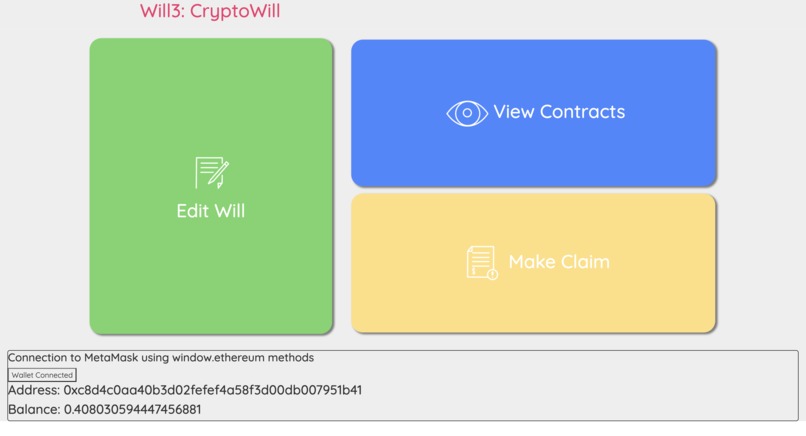
Landing page for Will3.
-
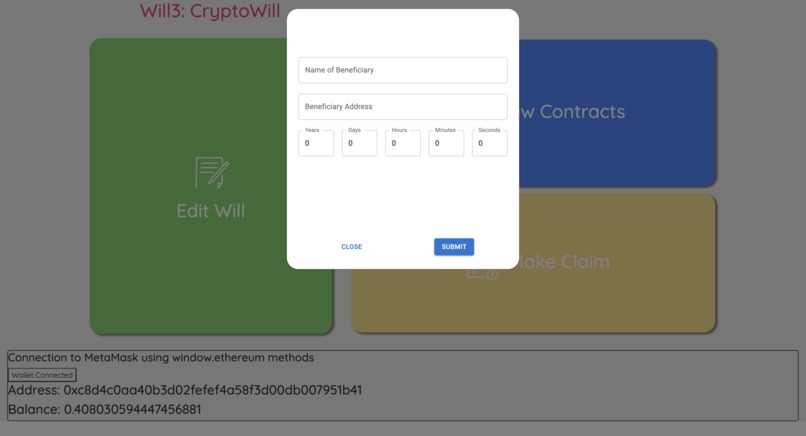
Add Will3.
-
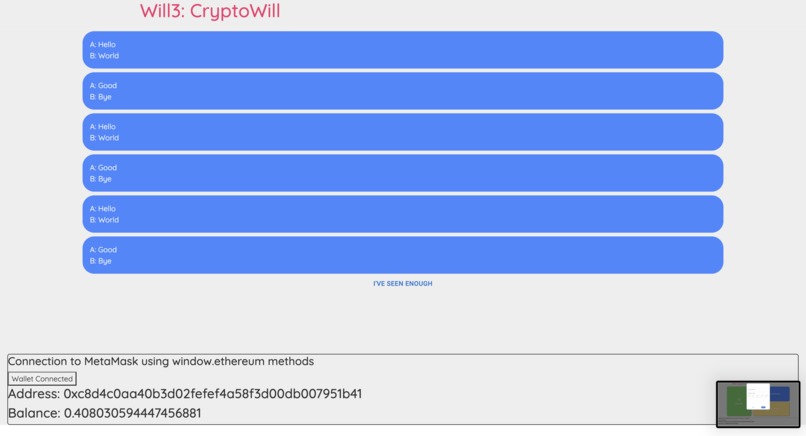
View Will3s.
-
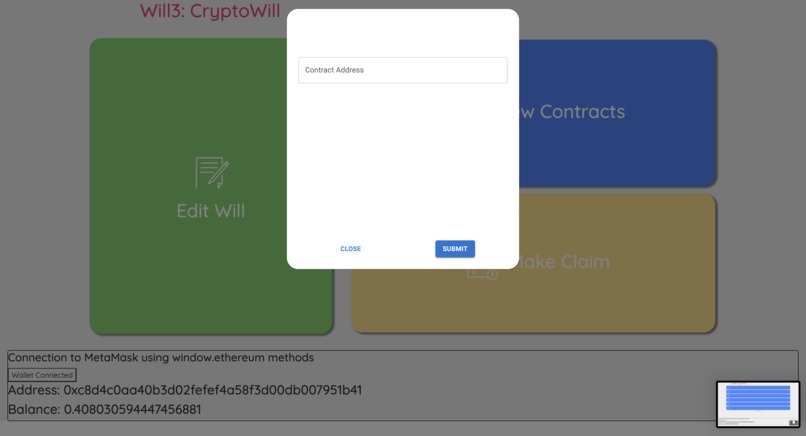
Claim Will3.


Inspiration
Estate planning may not be the first concern people think about with crypto, but as it is exploding into mainstream usage, it is more important than ever to ensure that there is a mechanism for your beneficiaries to have access to your crypto inheritance just in case. We first became aware of how pressing this issue can be from the story of Gerald Cotten, the former CEO of QuadrigaCX. His passing stranded $215 million in crypto, none of which was recoverable without his private keys. It’s not just death that could disrupt your crypto — others have lost their life’s assets forever upon medical incapacitation or loss of their private keys, situations that could have also been mitigated using Will3’s timed inheritance mechanisms.
What it does
To make sure that you have a backup plan for your crypto just in case, Will3 allows you to specify your final wishes for the distribution of your crypto assets. You can specify the wallet addresses of your beneficiaries along with their respective share, to be inherited after a set amount of time without exposing your original private keys either. No probate court, extended disputes, or misinterpretation — the smart contract self-executes and distributes exactly how it is written.
How we built it
We deployed a Solidity smart contract on an Ethereum test network and built a frontend using React.
Challenges we ran into
Since we have just gotten into the Web3 dev space, we ran into some hurdles figuring out how to integrate a MetaMask wallet and debugging a contract on a testnet. Since the space is so new right now, there was not much documentation for us to learn from, but we were able to find solutions after extended trial and error (and a bit of luck!).
We also considered the ethical challenges that our product might face. First off, there are several areas of ethical conflicts with traditional estate planning that Will3 successfully resolves. For example, traditionally, lawyers might have conflicts of interest with the testator or beneficiary, but with a self-executing smart contract, this issue does not exist. The largest issue at play is the ethical and legal concept of testamentary capacity. Normally, one must be 18 years of age to write a will, and lawyers might also make the judgment that one is or is not sound enough of mind to write the will. Because of the decentralized nature of the blockchain, these checks are not inherently in place. Harms that might result include protracted legal disputes over the capacity of the testators to create Will3s, and the legitimacy of the beneficiaries to receive them. Especially since crypto is not as regulated yet, this could be a very murky legal area. However, we are committed to tackling this problem through the implementation of strict KYC (Know your Customer) standards similar to traditional financial institutions. Through the implementation of some identity and source fund verification before users are allowed to create new Will3s, but done solely for the purpose of guaranteeing the legitimacy of their Will3 creation. In the future, we hope to continue building on this idea while collaborating with Harvard’s Edmond J. Safra Center for Ethics to continue to explore what ethical minefields may exist and how best to navigate through them.
Accomplishments that we're proud of
We were able to successfully deploy our contract on the Ropsten testnet. Moreover, we were able to solidify our understanding of Solidity as well as React JS. We also learned more about undervalued problem areas in crypto at a macro scale, and altogether, we are happy to have come out of TreeHacks with a greater understanding of both technical and fundamental aspects of web3. Our Texas group members are also quite proud that they were able to train their new dog to stop biting people.
What we learned
Being one of the first hackathons we’ve competed in, we picked up some good lessons on what not to do under a time crunch. We scaled back the scope of our idea a couple of times and seemed to overestimate our ability to get certain aspects done when we should’ve poured all our efforts into developing a minimally viable product. We discovered that not all features on all services have complete documentation and that this should be taken into consideration when deciding on a minimally viable product. Additionally, with team members scattered across the US, we have gotten a number of takeaways from working virtually, including how to best delegate tasks between team members or sub teams. There were many times a group couldn’t continue because it was waiting for another team to finish something, leading to inefficiencies. In the future we would spend more time on the planning phase of the project. We also learned the hard way that a short nap will most likely be many times as long as anticipated, so it is usually a bad idea to fall for the seductiveness of a quick rest.
We were able to come out on the other side with React JS, Solidity, and Web3 under our belts.
What's next for Will3
We are excited to continue building the UI/UX to make creating, updating, and executing a will very seamless. We feel this is an under-represented issue that will only continue to grow over time, so we felt now was a good time to explore solutions to crypto asset inheritance. Additionally, as tokenization and NFTs become more ubiquitous, Will3 could allow users to add their non-crypto assets onto their virtual will. In addition, we would like to look for alternate methods of verifying that a user is still active and does not need their Will3 to execute, even at the time they have previously declared.


Log in or sign up for Devpost to join the conversation.