-
-
Cover

Inspiration
We sought to make an affordable product that would help vision-impaired individuals navigate through complicated areas because it is often difficult for blind individuals to detect potential obstacles especially those with different heights.
What it does
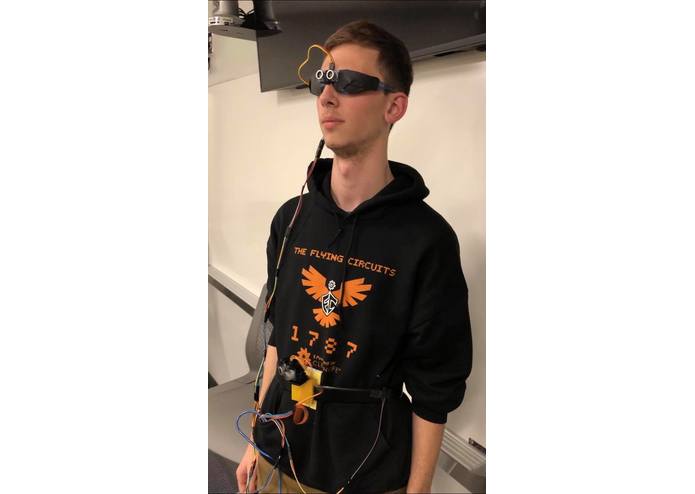
We designed two devices: a body obstacle detector and a walkable car. Our fashionable product consists of a two ultrasonic sensors on a pair of stylish glasses as well as a leather belt. These sensors will trigger a buzzing sound if an obstacle is detected in the path of the individual, thus warning them of potential hazards. The distance of the detected object will change the pitch to allow the user to get a better perception of the distance (meaning that the closer the object, the higher the pitch). Accompanying the distance detectors is a line-following car that can be safely be followed with a string so that the individual can be guided across a complex area. The car is halted by pulling on the string if the individual wishes to stop.
How we built it
We built the body obstacle detector by connecting two ultrasonic sensors to an Arduino and mounting them to safety glasses and a belt. The buzzer, sensors, Arduino and battery are all wearable and independent of external wiring. The car has an Arduino which controls the vehicle's wheels and two Elegoo line detectors which allow it to follow a line. It is able to drive along a strong black line against a white background due to the sensitivity of the dual line detectors.
Challenges we ran into
We initially were planning on using 5 Elegoo obstacle detectors; however, we were only able to obtain two and they weren't functional thus causing us to ultimately use ultrasonic sensors instead. Also, we faced many issues debugging our devices due to problems with random electrical noise, our line detectors not detecting any lines, and general issues constructing the car and the wearable devices.
Accomplishments that we're proud of
We made an actual project that we really enjoyed making and playing with after! Even though the plan deviated from our initial plan, we were able to readjust and design a working product with the functionality that we intentionally sought after.
What we learned
Learn a lot about Arduino (and how not to lose hope when nothing worked)... We also used the 3D printers, crafting tools and plywood at the invention studio for the first time which was a cool and interesting experience since we got to learn what the maker space had to offer. It was a fun day involving some loud signs and confused faces, yet still an overall education, memorial and exciting day.
What's next for 6th Sense
If we ever sought to expand this project, we would likely incorporate better measurement equipment and speaker so that the device could audibly tell the individual which location to go in. It would also be interesting if the scoot moves independent of a black line and assist the user to allow him/her better recognize and avoid nearby obstacles.
This is the first hackathon for half the team.


Log in or sign up for Devpost to join the conversation.