-
-
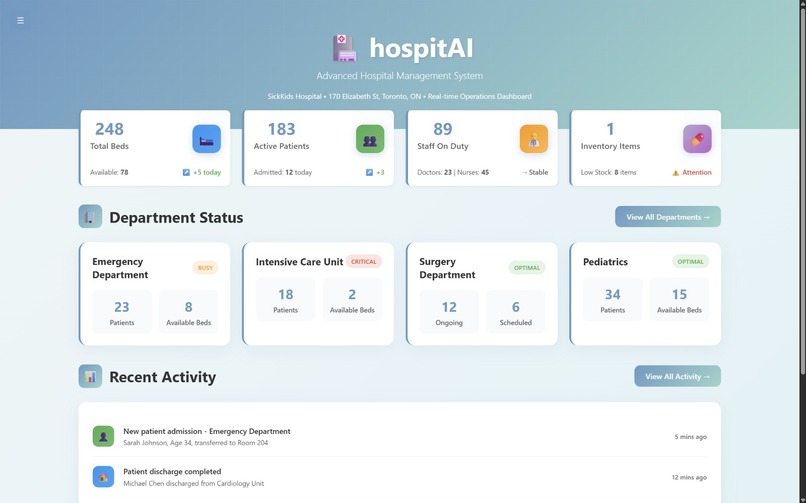
Dashboard
-
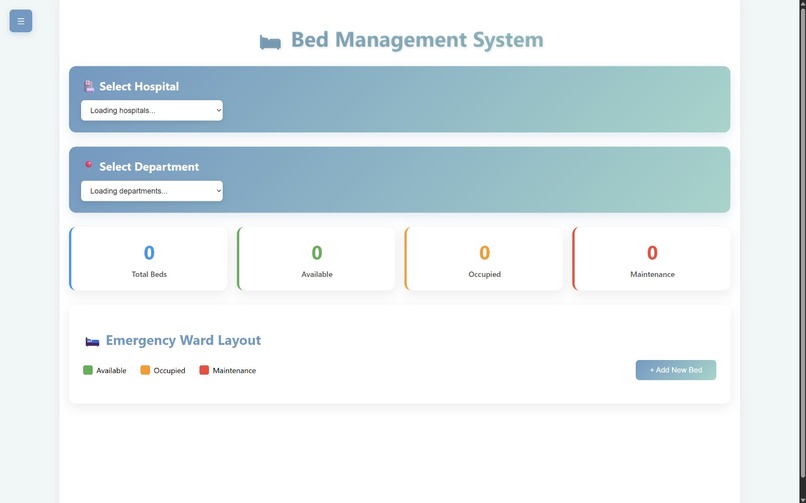
Bed Management System
-
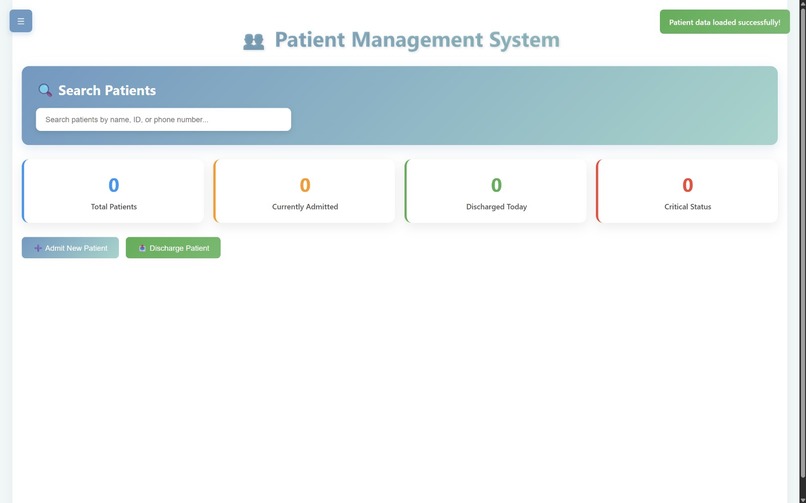
Patient Management System
-
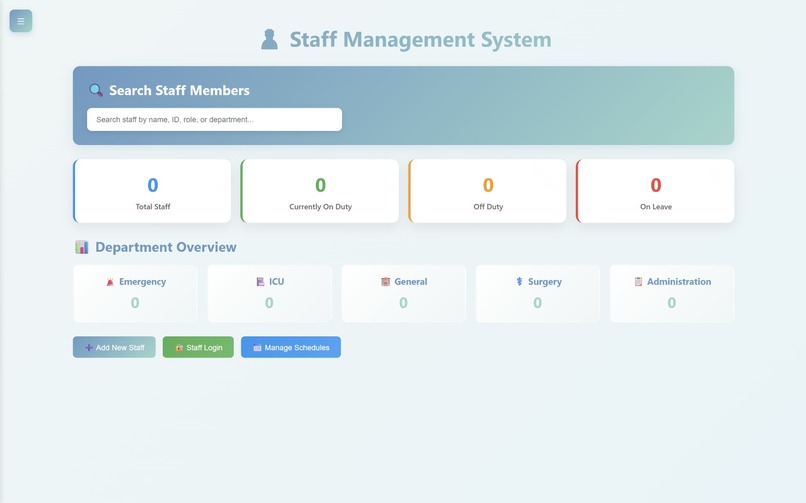
Staff Management System
-
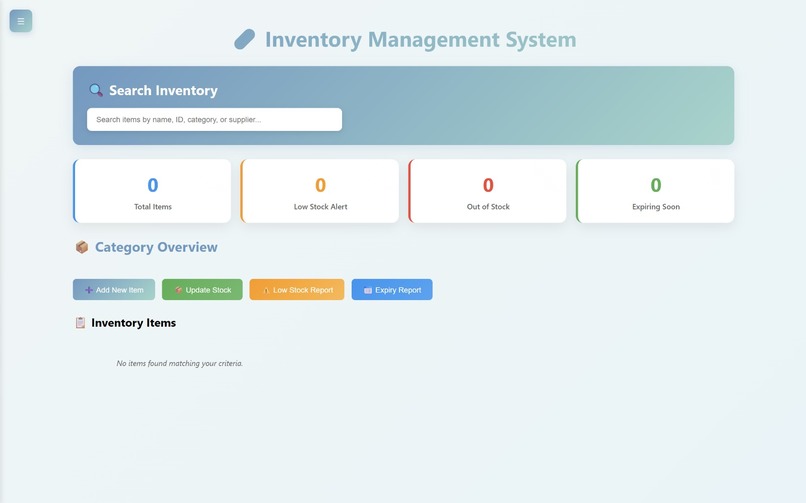
Inventory Management System
-
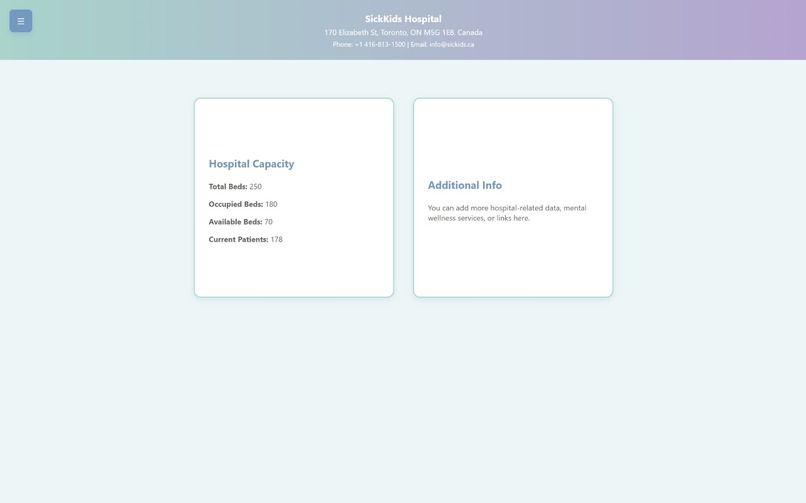
Hospital Info
-
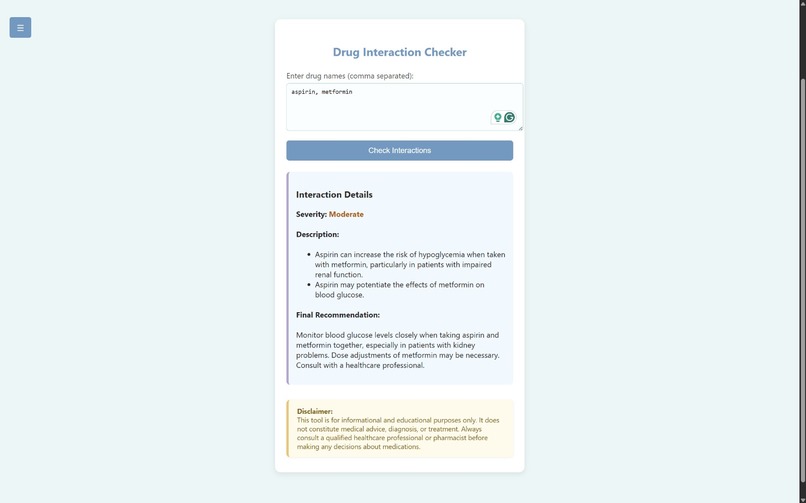
Drug Checker Example


Inspiration
I was involved in a very bad car accident 2 years ago. We were hit so hard in the back that even with the brakes applied, we went forward into another truck that was in front of us, so to speak, sandwiched between two trucks. We got into the hospital, and even though we were hurt, it took us a long time to get any help. The emergency room was congested, and since our injuries were not life-threatening, we had to wait behind the people who were in a worse condition.
Such an experience shocked me. Having to endure pain, being unsure of the injuries you have sustained, and waiting endlessly to get some assistance is something no one should experience. I have also learned that there are delays inherent in the intake and triage process, which can make the experience more stressful and may also negatively affect the patient. That is when this project was conceived, because I wanted to be able to help hospitals and other organizations go faster, get information early enough, and never leave a person helpless in times of an emergency.
What it does
We are working on a web-based project that would significantly cut down wait times in hospitals as the process of taking care of the patient in the emergency unit is digitized and automated. Speech-to-text is used to record and transcribe the conversation when a person calls 911. Gemini AI then works on that transcript to extract the important information, which includes the identity of the patient (should it be known), his condition, his symptoms, and the type of emergency. This is all systematized into a report and the report is directly sent to the hospital to enable the medical personnel to get ready even before the patient arrives. Moreover, we have created an in-built drug compatibility checker, which can be used by patients as well as health experts to enter the drugs one is using and get an immediate response of compatibility or any harmful combinations with the use of AI. This bi-system gives emergency teams the ability to react more quickly, more safely, and more confidently.
How we built it
Our frontend is built using Next.js, which will give the best user interface. Django was used to do the backend since it handles APIs and server-side logic. SQLite was used to save the emergency reports and input data of the user, and MongoDB was adopted to realize the hospital management system and the history of drug compatibility. Gemini is instrumental in two fundamental needs: the production of intelligent, clinically relevant summaries of call transcripts and the evaluation of medication combinations concerning safety and compatibility. This combination of technologies creates an uninterrupted chain between initial contact (the 911 call) and hospital care that results in a more informed response to the medical issues. We also have a fully self-hosted and deployed instance of our application, complete with Cloudflare tunneling for complete security.
Challenges we ran into
One of our biggest challenges was to bring together many tech stacks into a single working system. Synchronization of data between SQLite and MongoDB had to be done accurately and in the shortest time possible, which necessitated careful design and a strategy for the databases. Another barrier was the incorporation of speech-to-text transcription programs and the guarantee of good output, taking into consideration background noise and unstructured dialogue between mock 911 calls. Another task we needed to complete was to fine-tune the prompts used by the Gemini to make its summaries reliable and usable by medical staff. The larger issue we encountered during the process was the simulation of a high-stakes system in the real world in a limited time frame.
Accomplishments that we're proud of
We are excited that we were able to create a full-stack emergency response simulation that is not only end-to-end but also addresses a real-world issue. We have managed to develop AI that provides us with an opportunity to extract and transmit actionable medical data even before a patient enters the doors of a hospital. Our team has built a feature that could help both doctors and patients to avert risky interactions, a drug compatibility checker. Maybe most importantly, we have made a complex and high-pressure process a practical digital solution that is both technologically enabled and aware of what is critical when it comes to the human element of healthcare.
What we learned
This hackathon gave us a better insight into how technology can be used to improve emergency medicine, but without invading human judgment. We also got an idea on how to integrate various programming languages, frameworks, and databases to produce a harmonized product. The incorporation of Gemini showed us the way to optimize AI prompts to be used only in precise and sensitive situations. Otherwise, more generally, we acquired experience related to developing under pressure, operating an effective team workflow, and prioritizing features to match the actual needs.
What's next for Agent 911
In the future, we expect to connect to the real hospital networks through APIs to Electronic Medical Records (EMR) using Electronic Medical Records (EMR) systems such as FHIR. Our other desire is to enhance our speech recognition performance with the help of powerful models such as OpenAI Whisper. One of the possibilities of a future release of our product would be to introduce a mobile application for the patients to plan drugs and emergency options in time. We also want to conduct the pilot test of the system with actual hospitals or emergency services to test it in real conditions. Finally, we are sure that our platform will become one of the strongest instruments in making emergency care quicker, safer, and smarter.
Built With
- cartesia
- css
- django
- django-be
- djangobe
- gemeni
- gemini
- html
- javascript
- mongodb
- next
- next.js
- react
- sqllite-db
- sqllitedb
- typescript


Log in or sign up for Devpost to join the conversation.