-
-
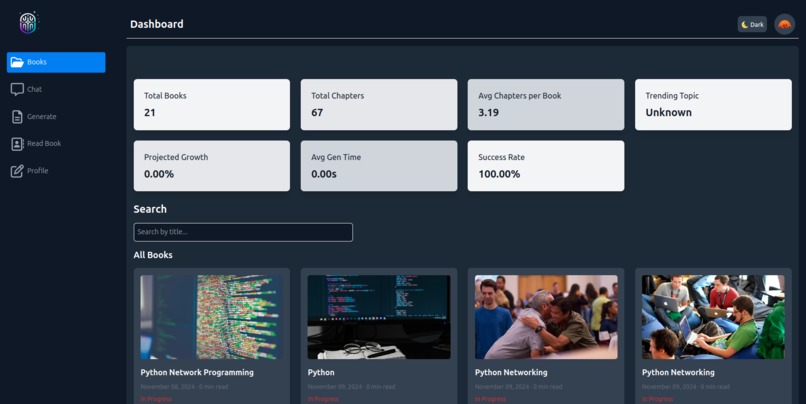
main dashboard dark theme
-
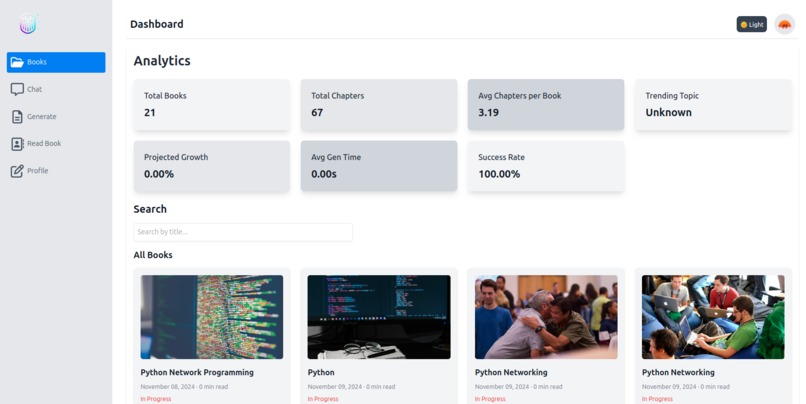
main dashboard light theme
-
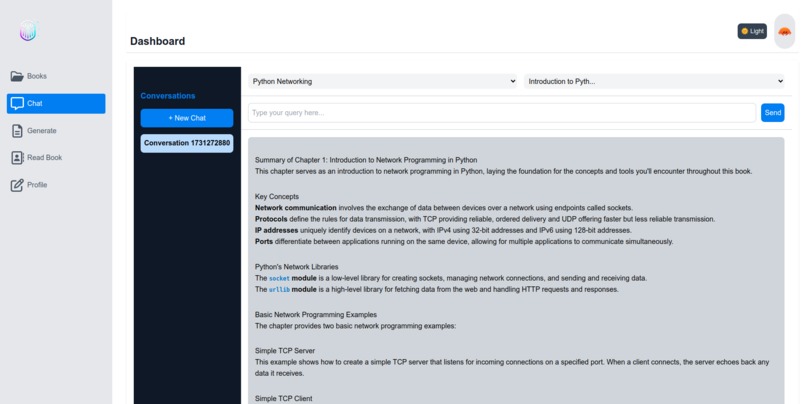
book's chatpers chat interface light theme
-
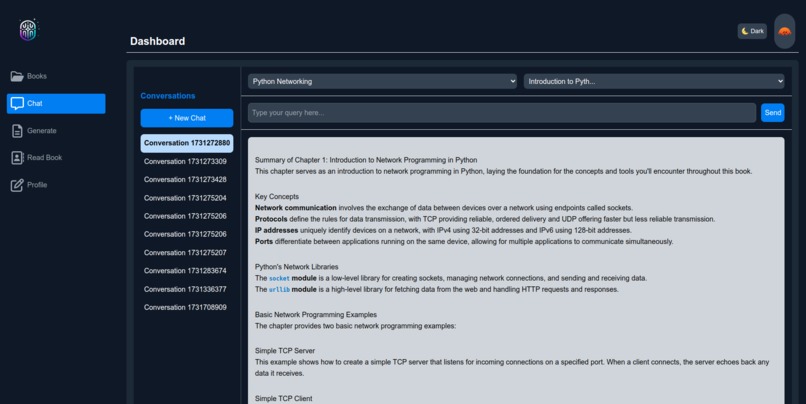
book's chatpers chat interface dark theme
-
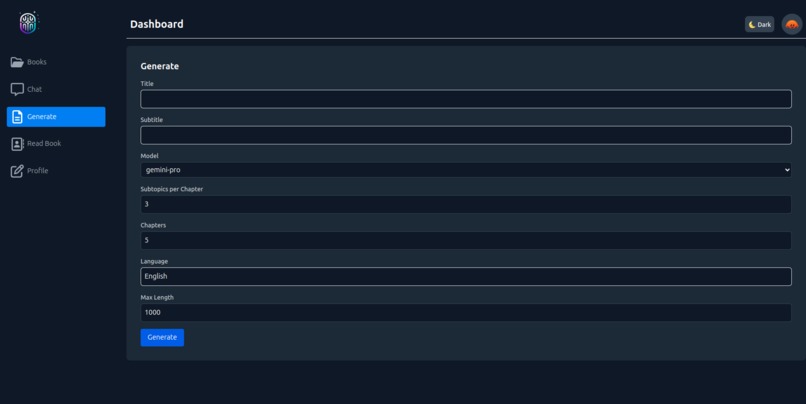
books generation form dark theme
-
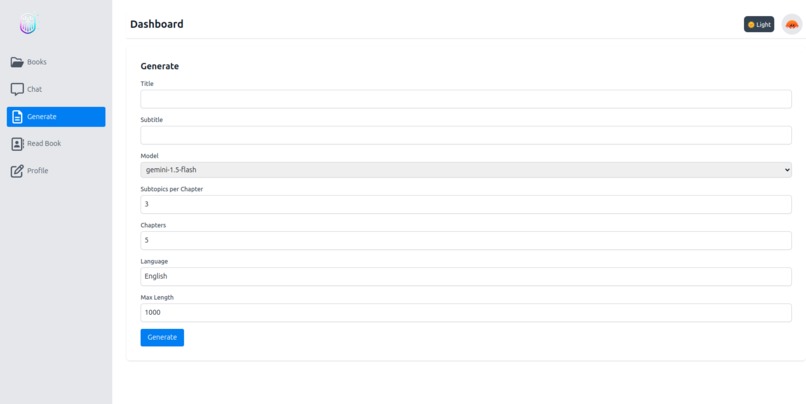
books generation form light theme
-
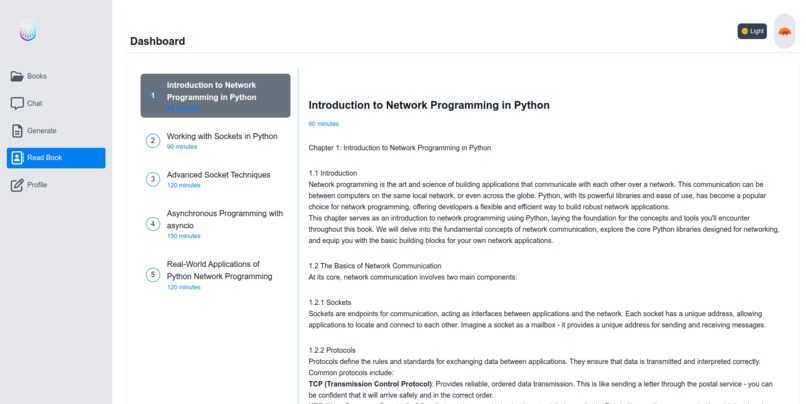
reading books light theme
-
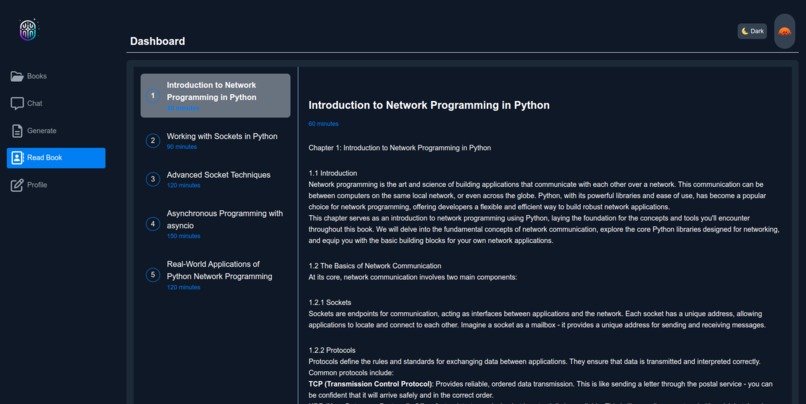
reading books dark theme
-
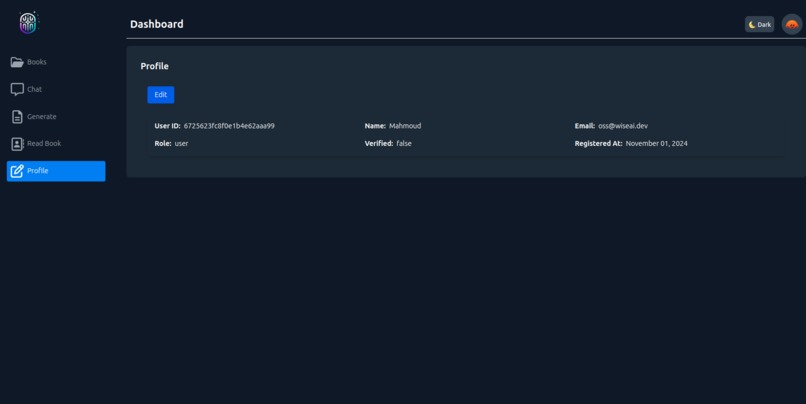
profile page
-
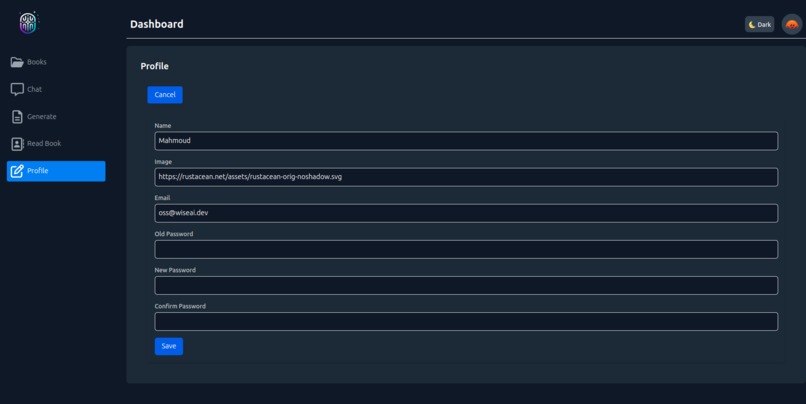
edit profile page dark theme
-
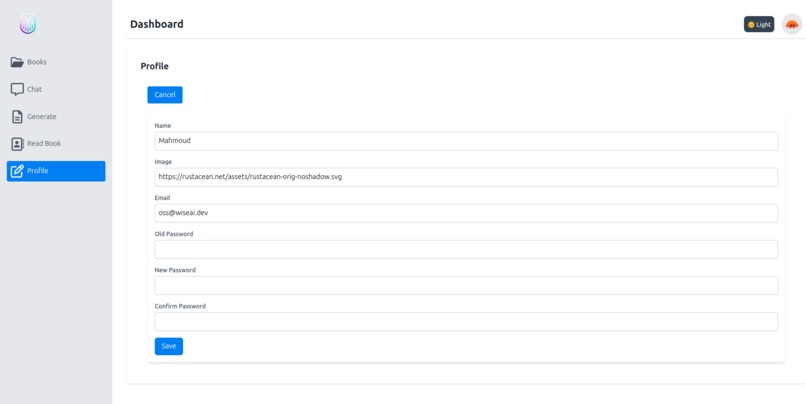
edit profile page light theme
-
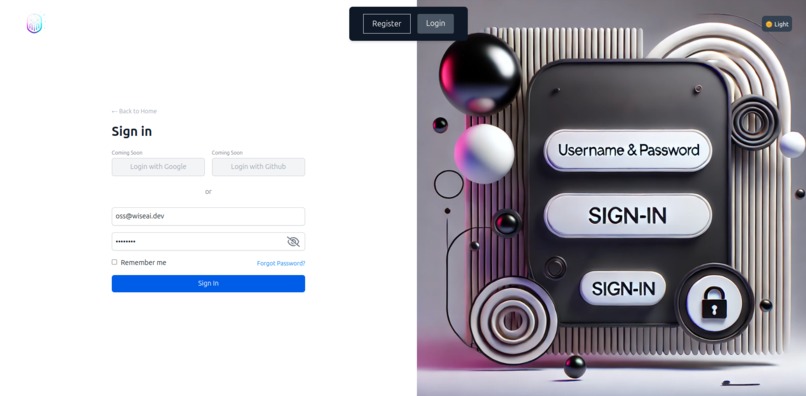
login page light theme
-

register page dark theme
-
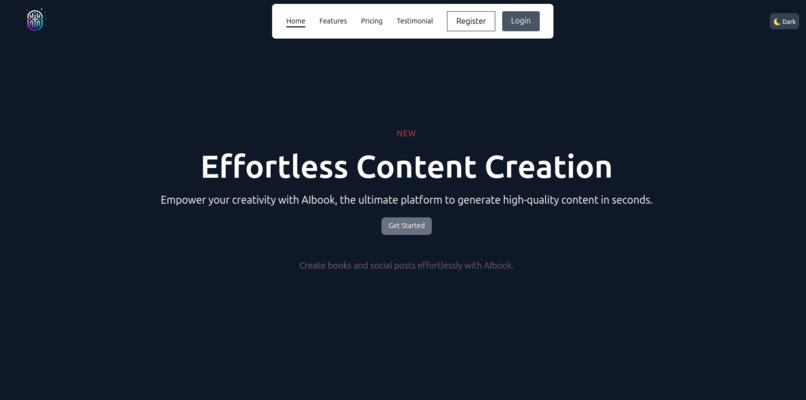
landing page hero section dark theme
-
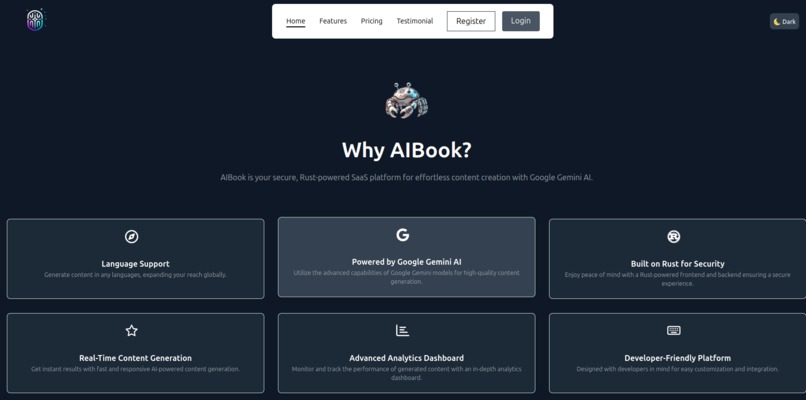
landing page features section dark theme
-
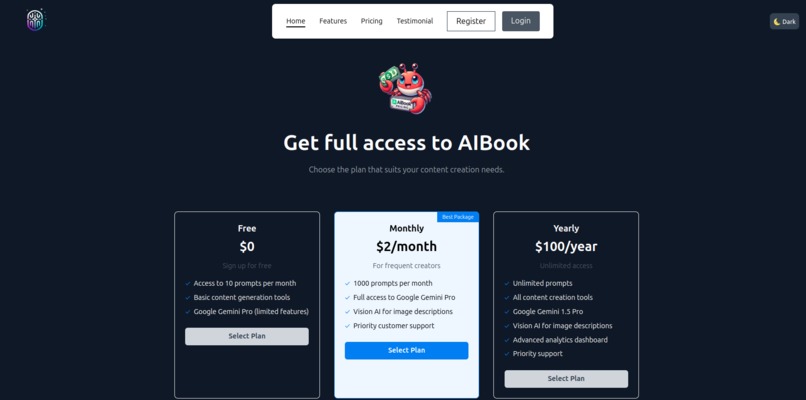
landing page subscription section with stripe integration dark theme
-
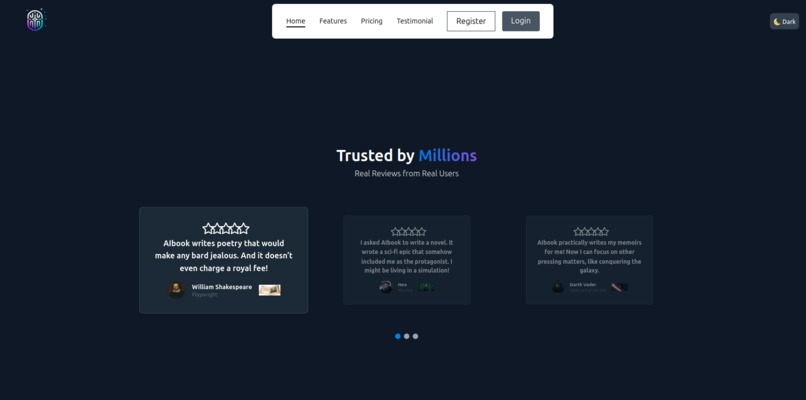
landing page testimonials section dark theme
-
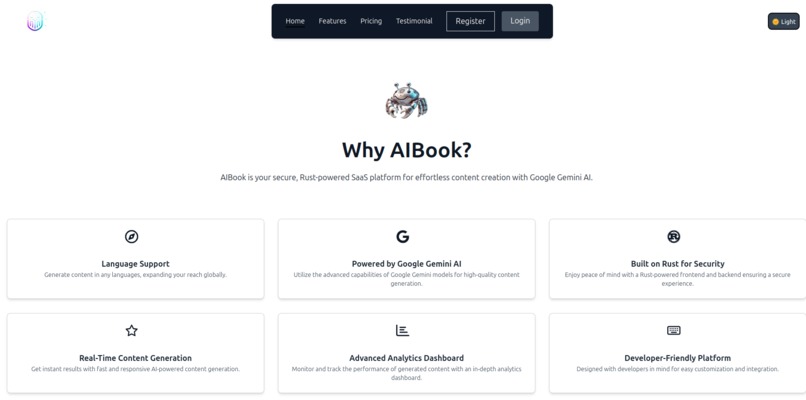
landing page features section light theme


AIBook
Overview
AIBook is a cutting-edge, AI-powered SASS platform designed to streamline the process of creating high-quality books using Google's Gemini AI model. Developed using Rust, AIBook harnesses the power of both advanced machine learning and robust programming techniques to create a platform that excels in speed, security, and scalability. The core purpose of AIBook is to provide a seamless, intuitive environment for creators and developers alike, allowing users to generate entire books with minimal effort and time. Whether you're a seasoned author or a new content creator, AIBook equips you with the tools to bring your ideas to life, while developers will appreciate the customizability and integration capabilities that the platform provides.
Designed to offer both convenience and performance, AIBook supports real-time content generation, allowing users to view and adjust their work instantly. This rapid feedback loop empowers creators to experiment with ideas, rewrite content, and explore new directions in their writing. The AI's natural language generation capabilities can handle everything from simple blog posts to complex, multi-chapter books, in multiple languages, making it a versatile tool for creators worldwide. AIBook isn't just about generating content; It's also about creating a secure and reliable space for writers, powered by Rust's industry-leading performance, which ensures that data is handled safely and efficiently.
The platform's focus on security is not just a bonus; It is a fundamental aspect of AIBook's design. With growing concerns over data privacy and the integrity of online platforms, AIBook was built with Rust's memory safety features to ensure that user data and generated content are protected from external threats. The use of Google Gemini AI further enhances the platform's capabilities, ensuring that the content generated is not only high-quality but also contextually aware and relevant to the user's needs. All of these elements combine to create a platform that redefines the way books and content are created, stored, and protected in an increasingly digital world.
🌟 Inspiration
The inspiration behind AIBook comes from the desire to revolutionize and democratize the book creation process. In a world where the demand for content is increasing rapidly and readers expect high-quality work, AIBook was designed to make writing easier, faster, and more accessible. As more people explore writing as a creative outlet, there's an increasing need for powerful, intelligent tools that can help authors develop their ideas and transform them into polished, professional works. We set out to build a platform that could provide creative freedom while leveraging the power of Google's Gemini AI for content generation and Rust for optimal security and performance.
One of the core principles guiding the development of AIBook was democratizing content creation. Writing and editing a book should not be reserved only for the experienced or those with technical knowledge. AIBook levels the playing field by allowing both newcomers and seasoned authors to create comprehensive books with ease. Whether it's generating entire chapters or assisting with the writing process step by step, AIBook breaks down the barriers to publishing and empowers anyone to become an author.
In addition, we wanted to combine cutting-edge technology with the security and reliability that comes with Rust. As AI systems and machine learning models become more embedded in our daily lives, concerns about data privacy, cybersecurity, and AI integrity have become crucial. Our decision to use Rust was deliberate, as it offered a secure, memory-safe environment that could handle the demands of a real-time, AI-powered platform without sacrificing performance. Combining these elements, the creativity enabled by AI and the robust security of Rus, was at the heart of AIBook's design.
Another inspiration was the recognition of the growing trend toward multilingual content. With the globalization of media and content, the ability to generate books in various languages is becoming increasingly important. AIBook was built to support multilingual writing, making it possible to generate content that reaches a global audience. This not only broadens the platform's appeal but also provides authors with the ability to create books for a diverse and multilingual readership.
Finally, our inspiration was also shaped by real-time content creation. Traditional writing tools often require long hours of drafting, editing, and formatting before you see the results of your efforts. We sought to create an environment where writers could instantly generate content, tweak it, and make revisions with minimal friction.
⚙️ Features
🌎 Language Support: Generate content in multiple languages, breaking down language barriers to reach a global audience.
🤖 Gemini AI Models: AIBook utilizes the advanced capabilities of Google's Gemini AI, delivering rich, context-aware content tailored to specific user requests.
🔒 Rust-Powered Security: Rust provides AIBook with a secure backend, protecting user data and offering reliable, safe interactions.
⚡ Real-Time Content Generation: Users receive immediate feedback with fast and responsive content generation, making it easy to iterate and perfect their material.
📊 Analytics Dashboard (WIP): Gain insights into content performance with detailed metrics to help optimize and refine content.
👨💻 Developer-Friendly Platform: Built for developers with easy integration options, allowing customization and adaptability.
🤝 Collaboration: Users can easily share their work by generating a link that allows others to view their content. This feature fosters collaboration by enabling users to showcase their progress, gather feedback, or simply share their creative process. For example, log in to the platform and click the following link to share your work: https://aibook-8syx.onrender.com/dashboard/book/read/672e6cad285c99198b845da7.
🛠️ How It Works
AIBook operates through a simple yet powerful process that begins with user input and concludes with high-quality content generation. The system is designed to be intuitive and flexible, allowing users of all levels to create books effortlessly while maintaining control over the content. Below is an overview of how AIBook works:
- User Interaction: The process begins when the user enters the details for their book. After the information is provided, the platform triggers Google Gemini AI to process the request and generate a book outline. The selected AI model is designed to understand both broad topics and specific instructions, ensuring that the generated content aligns with the user's expectations. Below is the prompt for this step, which can be found at opensass/aibook/src/server/book/controller.rs:
    let outline_prompt = format!(
        "
        **System Prompt (SP):** You are an expert in book creation, generating a structured outline.

        **Prompt (P):** Generate an outline for a book titled '{title}', with subtitle '{subtitle}'. Main topic is '{title}' in {language}.
        The book should contain {chapters} chapters covering {subtopics} subtopics. Provide an estimated duration for each chapter.

        **Expected Format (EF):**
        ### Chapter [number]: [Chapter Title]
        **Estimated Duration:** [Duration] minutes

        **Roleplay (RP):** As a book editor, create an engaging outline.
        ",
        title = req.title,
        subtitle = req.subtitle,
        chapters = req.chapters,
        subtopics = req.subtopics,
        language = req.language,
    );
The backend then calls the Unsplash API to fetch a random image. Afterward, it instructs Gemini AI to generate both markdown and HTML formats for the details of each chapter. The prompts used in this step can be found at opensass/aibook/src/server/book/controller.rs:
    let markdown_prompt = format!(
        "
        **System Prompt (SP):** You are writing detailed content for a book chapter.

        **Prompt (P):** Write content for chapter '{chapter_title}' of the book '{book_title}' on the main topics '{main_topic}' in {language}. Ensure clarity, detailed explanations, and structured markdown.

        **Expected Format (EF):**
        - detailed markdown format for this chapter.

        **Roleplay (RP):** Provide as much educational content as possible.
        ",
        chapter_title = req.chapter_title,
        book_title = req.book_title,
        main_topic = req.main_topic,
        language = req.language,
    );

    let html_prompt = format!(
        "Generate a comprehensive HTML-formatted book chapter with examples, links and images, based on the outline: '{}' in {language}. \
        Each section should be structured with appropriate HTML tags, including <h1> for the main title, \
        <h2> for chapter titles, <h3> for subheadings, and <p> for paragraphs. \
        Include well-organized, readable content that aligns with the book's outline, ensuring each section is \
        clear and logically flows from one to the next. Avoid markdown format entirely, and provide inline HTML styling \
        if necessary to enhance readability. The HTML content should be well-formatted, semantically correct, and \
        cover all relevant subtopics in depth to create an engaging reading experience. \
        Make sure to always return back with html formmatted text and not empty response.
        ",
        markdown.clone(),
        language = req.language,
    );
Chat with Chapters: Once content is generated, users can select a book and a specific chapter to engage in interactive chats. This feature allows users to chat with the chapters, refining and evolving the content through an AI-driven conversation. The content is presented in a flexible, easy-to-edit format, typically using Markdown or HTML, enabling users to make changes seamlessly across different platforms and devices.
Secure Data Storage: Behind the scenes, AIBook ensures that all data is securely stored in a MongoDB database. This database is structured in a way that supports complex relationships between users, books, chapters, and conversations, ensuring that all content is well-organized and easily accessible. MongoDB's flexibility allows the platform to scale effectively, accommodating an increasing volume of users and content without compromising performance. In addition to content storage, user data and interactions are handled with care, ensuring privacy and security across the entire platform. Whether you're creating one book or managing a series of projects, AIBook's backend structure ensures smooth, consistent performance, even at scale.
📐 How We Built It
At the heart of our AI-powered functionality is a custom Rust crate called gems, developed by our team in a previous hackathon. This crate allows Rust applications to communicate directly with Google's Gemini AI, making it easy to send requests, format prompts, and process AI-generated content right from Rust.
AIBook's architecture is designed to handle complex content generation tasks while providing a fast, secure, and responsive experience. The platform is built using a microservice architecture, with each component designed to handle specific aspects of the system's operation. Let's break down the core components of AIBook's technical infrastructure:
Architecture
Frontend: The frontend of AIBook is built with Dioxus, a modern, high-performance full stack Rust framework that provides a smooth and reactive user interface. Dioxus is optimized for quick, real-time updates, making it ideal for interactive applications like AIBook, where content is constantly being generated and edited. The frontend is designed to be responsive and user-friendly, ensuring that creators of all technical backgrounds can navigate the platform easily. The interface is clean, intuitive, and highly customizable, allowing users to adjust the look and feel according to their preferences.
Backend: On the backend, AIBook uses Axum, a powerful Rust web framework that enables fast, secure API interactions. Axum ensures that API calls are processed quickly and securely, allowing seamless communication between the frontend and the AI system. Axum's asynchronous nature means that AIBook can handle multiple user requests simultaneously without delay, ensuring a smooth experience for all users, even under heavy load. Axum was used for server functions in Dioxus instead of traditional APIs to bring the frontend and backend closer together.
Database: AIBook uses MongoDB for its data storage, chosen for its scalability and performance. MongoDB's document-oriented structure allows for flexibility in storing complex data models, such as users, books, chapters, and AI-generated content. The database also ensures that data is securely stored and easily accessible across different parts of the platform. MongoDB's ability to scale horizontally means that as the platform grows, it can handle large amounts of data without sacrificing performance. Whether users are generating a single book or a large catalog of content, MongoDB ensures that everything is stored efficiently and securely.
AI Integration: AIBook's integration with Google Gemini AI is managed through a custom Rust crate called
gems, which interfaces with the AI model to handle content generation. This crate is designed to handle complex prompt processing, ensuring that AI-generated content meets the specific needs of the user. The gems crate acts as the bridge between the backend and Gemini AI, handling user input, AI processing, and output formatting. It ensures that content is generated quickly, accurately, and securely, without compromising performance. The crate's efficiency is key to ensuring that real-time content generation remains smooth and uninterrupted.
🚧 Challenges
Despite the platform's success, the development of AIBook came with its own set of challenges. These obstacles pushed us to refine our approach and rethink certain aspects of the project. Here are some of the main challenges we faced:
AI Integration Complexity: Integrating Google Gemini AI into AIBook was no simple task. The model had to handle a wide variety of genres, languages, and prompts, all while producing content that was both contextually appropriate and high-quality. This required extensive testing and tuning to ensure that the AI understood the nuances of different writing styles and topics. Additionally, the real-time generation of content added complexity, as the AI needed to generate coherent, structured content rapidly, without causing delays or errors. The challenge was ensuring that the AI-generated output always met the platform's high standards, regardless of the user's input.
Real-Time Performance: Balancing real-time content generation with the platform's security requirements was another challenge. While users wanted content to be generated quickly, this needed to be done in a way that didn't compromise the security of their data. Ensuring that sensitive information, such as user credentials and generated text, remained safe during the generation process required careful attention to security protocols and encryption. Optimizing the platform's performance also meant fine-tuning the underlying infrastructure. From the API layer to the database and AI processing, every component needed to work seamlessly to ensure that content generation remained quick and fluid, even during high demand.
UI/UX Optimization: Another challenge was designing a user-friendly interface that was both intuitive and functional. While AIBook's functionality is highly sophisticated, we needed to ensure that non-technical users could navigate the platform without confusion. The challenge was creating a clean, minimalistic interface that didn't overwhelm users, while still offering advanced features for more experienced creators and developers. Additionally, balancing the front-end responsiveness with backend complexity proved to be tricky. As the platform generates large volumes of content and manages extensive data, ensuring the interface remained fast and responsive was essential.
Multilingual Content Generation: One of the more ambitious aspects of AIBook was supporting multilingual content generation. Ensuring that the AI could generate high-quality, contextually appropriate text across different languages proved to be a complex task. The AI had to handle not only syntax and grammar but also idiomatic expressions, cultural nuances, and different writing conventions. To address this, we leveraged Google Gemini AI's multilingual capabilities and conducted extensive testing in various languages. However, certain languages presented unique challenges, such as handling regional dialects or language pairs with vastly different syntactic structures. We continually refined the prompts and integrated feedback loops to improve multilingual support, ensuring that the output was both accurate and meaningful.
Security Concerns: Given the nature of AIBook as a cloud-based platform dealing with both sensitive user data and AI-generated content, ensuring robust security was crutial. We faced significant challenges in ensuring that user data remained encrypted during transit and at rest, especially as user content can vary in sensitivity. The platform needed to be resistant to external threats, such as data breaches, cyberattacks, and unauthorized access. Rust's memory safety features played a critical role in mitigating some of these concerns, but we also had to implement additional security layers, including end-to-end encryption, and regular security audits. Ensuring that the AI content generation process was secure, especially in real-time scenarios, required constant rigorous testing.
🎉 Achievements
Despite the challenges, AIBook has made significant strides in the world of AI-driven book creation. Some of our key achievements include:
Real-Time Content Generation: One of the most groundbreaking features of AIBook is its ability to generate high-quality content in real-time. This achievement allows authors to interact directly with the platform, receiving immediate feedback on their writing. This dynamic relationship between the user and the AI enhances the creative process, offering writers the freedom to experiment and adjust their work instantaneously.
Multilingual Book Generation: AIBook's multilingual capabilities have allowed authors to publish content in a variety of languages, expanding the global reach of their work. The success of the multilingual model has attracted a diverse international user base, positioning AIBook as a valuable tool for creators worldwide. We have received positive feedback from users in countries where the ability to write in multiple languages was previously a barrier to publishing.
Integration with Google Gemini AI: The integration of Google Gemini AI into the platform has allowed us to create highly personalized and engaging content across a wide range of genres. The flexibility of the AI model enables AIBook to handle everything from creative fiction to educational resources with equal competence, offering users high-quality outputs in multiple domains.
Scalability and Performance: Built using Rust's efficient concurrency and low-level memory management, AIBook has been able to handle a growing user base and large volumes of content generation without compromising performance. The platform can scale to accommodate more users, whether it's for individual writers or large publishing projects, while maintaining a seamless user experience.
📚 Lessons Learned
Throughout the development and launch of AIBook, we encountered numerous lessons that have shaped the platform's growth. Here are some key takeaways:
Iterative Development Is Key: AIBook's AI-powered content generation system needed constant iteration. Even though we launched with a robust version of the AI models, user feedback and real-world testing revealed new challenges and areas for improvement. Listening to users and continuously refining the system based on their needs proved invaluable. Iteration also helped us fine-tune performance, ensuring that the platform remains responsive and stable under heavy load.
Multilingual Support Requires Deep Localization: Simply translating text isn't enough to create high-quality content in multiple languages. We learned that true localization requires a deep understanding of the target culture and language. This meant paying attention to cultural context, idiomatic expressions, and region-specific terms. We also learned that AI can struggle with less common languages or dialects, and constant tuning was required to ensure the output was of the highest quality.
Security Cannot Be Compromised: Even though we used Rust's memory safety features to ensure security, we quickly realized that building a platform that generates content in real time can create complex security concerns. Ensuring that user data, AI-generated text, and credentials are always protected has been a constant learning process. We've learned that security must be implemented into every part of the platform, from the backend to the frontend, to ensure that both users and their content are always safe.
User Experience Must Be a Priority: AIBook is designed for a diverse group of users, ranging from beginners to experienced authors. Balancing simplicity with powerful features was one of the most challenging but important aspects of our design. We learned that a clean, intuitive interface is critical for keeping users engaged, while offering more advanced tools for power users.
AI Isn't Perfect, but It Can Improve: No AI model is without its limitations. While Google Gemini AI is highly advanced, it still requires constant improvements, particularly in understanding more abstract concepts or creative prompts. We learned that, rather than relying entirely on AI to produce polished content, human guidance and feedback are still essential to producing the highest quality work.
🚀 Future Plans
Looking forward, AIBook has big plans for expansion and improvement. Some of our key goals include:
Pre Designed templates: We plan to allow users to either start from scratch or choose from a variety of pre-designed templates that AIBook offers. These templates will be particularly useful for those who are unsure where to start, as they provide structured guidance for creating different types of books, such as fiction, nonfiction, and technical writing.
Enhanced AI Features: As Google Gemini AI evolves, we plan to integrate new features that allow for even deeper personalization of the generated content. We envision an AIBook that can learn from a user's past work, adjusting its style, tone, and preferences to better align with the writer's unique voice over time. We also plan to integrate Imagen 3 for image generation.
Collaborative Features: One exciting future feature is the ability for users to collaborate on books in real time. This would allow teams of authors, editors, and content creators to work together seamlessly within the platform, streamlining the creation of joint projects and publications. At the current release, users can share a link to allow others to view their work. For example, log in to the platform and click the following link: https://aibook-8syx.onrender.com/dashboard/book/read/672e6cad285c99198b845da7.
Advanced Editing Tools: While AIBook excels at generating content, we recognize that some users require more advanced editing tools. We are exploring ways to integrate grammar checkers, style analyzers, and plagiarism detection into the platform. This would make it a comprehensive writing solution, from creation to publication.
🛡️ About Us:
We are Open SASS, a passionate team dedicated to advancing the future of secure and high-performance web development. Open SASS stands for Open Software as Secure Service, and our mission is to ensure that production software is not only secure but also type-safe and reliable, qualities that the Rust programming language excels at delivering.
At Open SASS, we believe that security should be a foundational aspect of every application, and Rust's powerful, safety-focused design aligns perfectly with this vision. By championing Rust for web development, we are contributing to a more secure, efficient, and scalable future for web applications.
Our team is committed to building solutions that make a difference in the way developers create and deploy software, ensuring performance and reliability every step of the way. We're excited about the possibilities that lie ahead and invite you to join us on this journey.
Your support can help us continue to shape the future of secure and fast web applications. Let's build something amazing together!


Log in or sign up for Devpost to join the conversation.