-
-
Immersive Mode
-
-


Inspiration
Missile Command, of course! But we also took inspiration from elegant hit mobile games like Fruit Ninja and Cut the Rope that focused on a single, tactile input verb. We wondered... what is the simplest native verb in hand-tracking MR? How can we recreate that point-and-click feeling, in 3d?
What it does
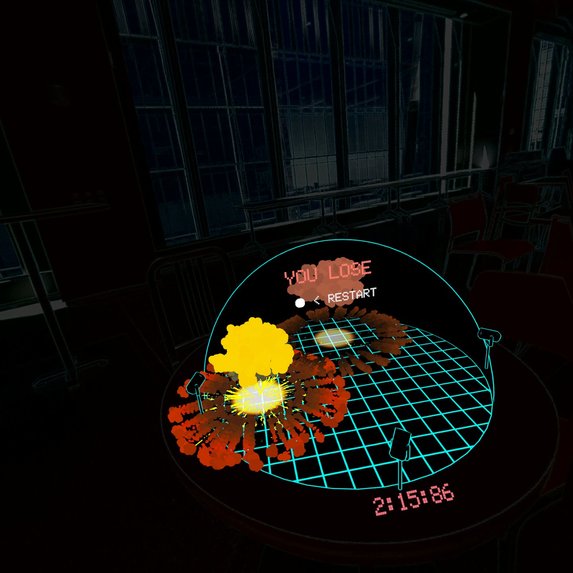
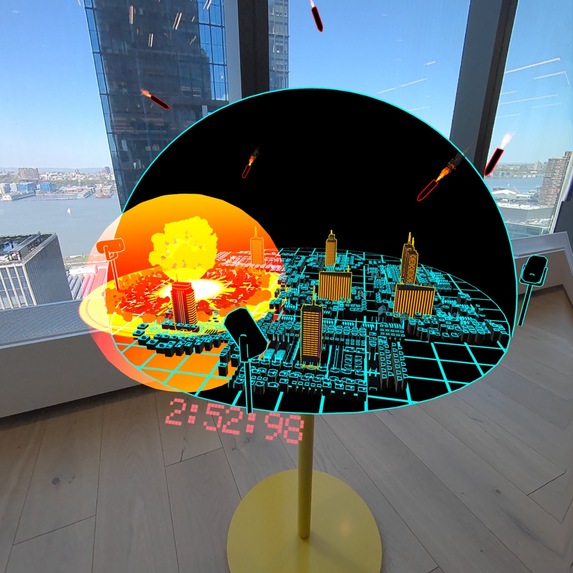
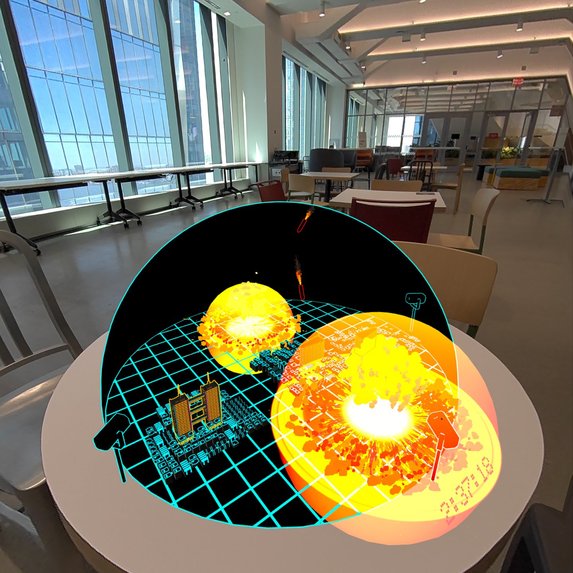
Enter the war room! A futuristic, highly sophisticated tabletop computer interface which can render 8 high-definition colors.
Pinch anywhere in the airspace to launch a missile. When it reaches its destination, it leaves a lingering volumetric explosion, and can cause chain reactions. But be careful! Your launchers take time to reload, so you'll have to be strategic in where and when to launch.
How we built it
Given the time limitations, we used a parallel work schedule. Input (especially gesture recognition), room placement (detecting the nearest front-facing table center), and basic gameplay were implemented with whitebox assets. During this time, the rest of the team was building 3d assets, particles, and sound effects, using asset packs to source parts when convenient.
Only on the third day, after the core gameplay had been iterated to the point of fun, were the rest of the assets integrated, although the city and many other elements had been brought into engine for vr viewing and testing throughout.
Challenges we ran into
The first iteration of the design actually completely missed what made missile command so intuitive and fun. Instead of "point and click" pinch targeting, we were using "pinch and drag", which was difficult and slow to aim. It works for Angry Birds, where the player has unlimited time to evaluate their targeting, but it was awful in an action game. Only on the last day did we pivot to the far superior current input model, which also allowed us to increase the frenetic action of the gameplay.
Accomplishments that we're proud of
Players reach the skill level where they are thinking strategically very early, which seems like a good sign. Additionally, the gameplay has a self-balancing quality, where as the player loses buildings the enemy missiles appear to concentrate themselves more, which created tense moments before we had even tried to tune the difficulty.
Finally, the 3rd dimension really works for Missile Command, as it turns out. Leaning around your buildings to pick the perfect angle; arranging chain reactions for missiles coming from 3 different directions...
What we learned
Hand tracking is getting quite good, but it still falls short for many purposes. That said, it feels great. Controllers are old hat! So, systems that are simple enough to function entirely with hand tracking will feel great.
What's next for Airspace Defender
Commercialization! A completely intuitive re-interpretation of a classic idea doesn't come around every day... this thing has legs!
It's easy to envision additional enemy and player missile types -- for instance, a "splitter" which turns into 2 missiles before landing. "Roguelike" play-extension where upgrades to the player's tools come in semi-randomly over the course of each session would also be a good fit for the simple arcade gameplay.
On the polish front, it would be very interesting to use the Audio sdk and scene re-lighting to create the illusion that the action happening on the "retro-digital" interface in front of the player is also happening outside their room.
Built With
- meta-xr-sdk
- unity


Log in or sign up for Devpost to join the conversation.