-
-
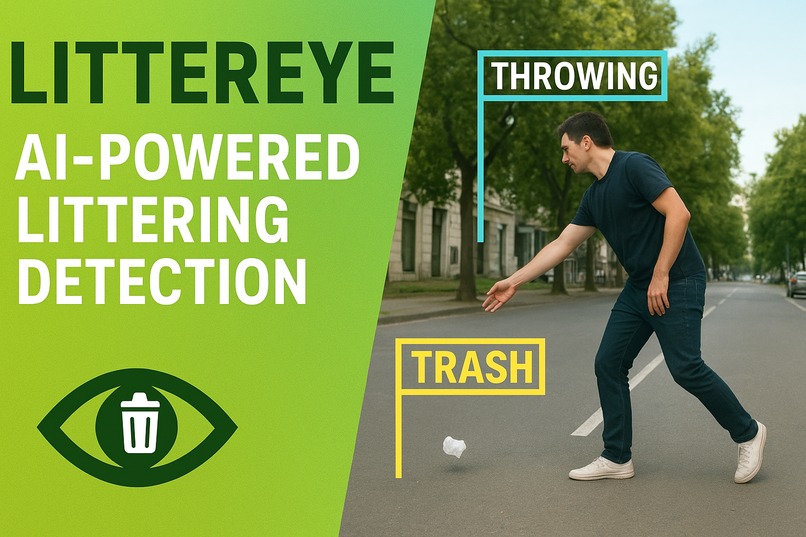
LitterEye – AI-Powered Littering Detection for Cleaner Cities

Inspiration
With rising urbanization, littering on streets and public spaces has become a growing issue, contributing to pollution and unhealthy environments. We wanted to explore how AI-powered vision systems could simulate a real-world solution for identifying littering behavior and enforcing penalties — without requiring custom hardware. Our goal was to merge computer vision + action recognition into a practical civic-use case.
What it does
LitterEye is an AI prototype that:
- Detects trash items on the ground (plastic, glass, paper, etc.).
- Recognizes when a person performs a “throwing” or “dropping” action.
- Fuses both events to simulate a littering detection system.
- Issues an automated penalty entry and logs it in a database.
- Displays results in a simple Streamlit dashboard with charts, tables, and video playback.
How we built it
Datasets:
- TrashNet for trash classification.
- Litter Detection Dataset for object detection.
- UCF101 for human action recognition.
- TrashNet for trash classification.
Tech Stack:
- YOLOv8 for trash detection (with simulation fallback).
- MediaPipe for action recognition.
- Streamlit for building the interactive demo app.
- SQLite for storing penalties and logs.
- YOLOv8 for trash detection (with simulation fallback).
System Flow:
- Input video (uploaded or demo clip).
- Run trash detection + action recognition.
- If “trash detected” ∧ “throwing action detected” → flag as littering.
- Log penalty in database + visualize on dashboard.
- Input video (uploaded or demo clip).
Challenges we ran into
- Finding a relevant dataset that combined human actions with littering scenarios.
- Training models on limited compute without using custom hardware.
- Designing a simulation pipeline that feels close to real-world usage.
- Integrating different ML models (object detection + action recognition) into one smooth pipeline.
Accomplishments that we're proud of
- Built a complete simulation prototype with no external hardware.
- Successfully fused object detection and action recognition into a single decision system.
- Delivered a working demo app with database, dashboard, and penalty system.
- Created a reusable and extendable code structure.
What we learned
- How to integrate multiple pre-trained ML models into one workflow.
- Practical challenges of building civic AI solutions.
- The importance of datasets, preprocessing, and simulation design when hardware isn’t available.
- How to design a project that can scale from a prototype → real-world deployment.
What's next for LitterEye – AI-Powered Littering Detection
- Deploying the system on edge devices (CCTV, Raspberry Pi, Jetson Nano) for real-time use.
- Adding face anonymization + privacy-preserving tracking.
- Expanding the dataset with real-world littering scenarios.
- Collaborating with municipalities to pilot the system in smart cities.
- Exploring reward-based systems (e.g., citizen credits for reporting littering) in addition to penalties.




Log in or sign up for Devpost to join the conversation.