-
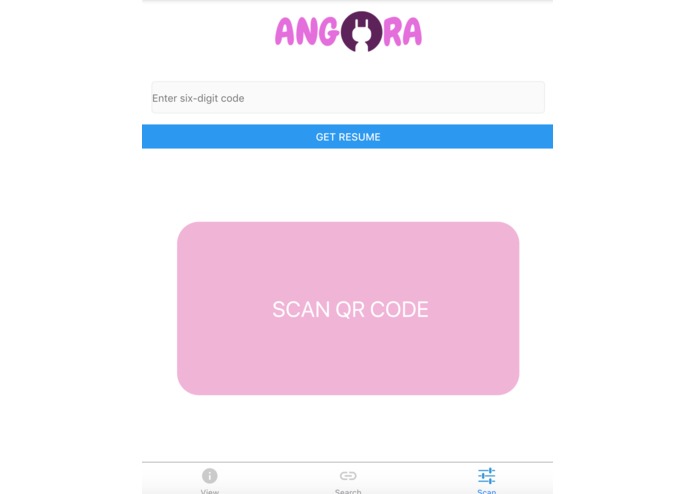
Page for acquiring the applicant's code and being redirected to ones resume.
-
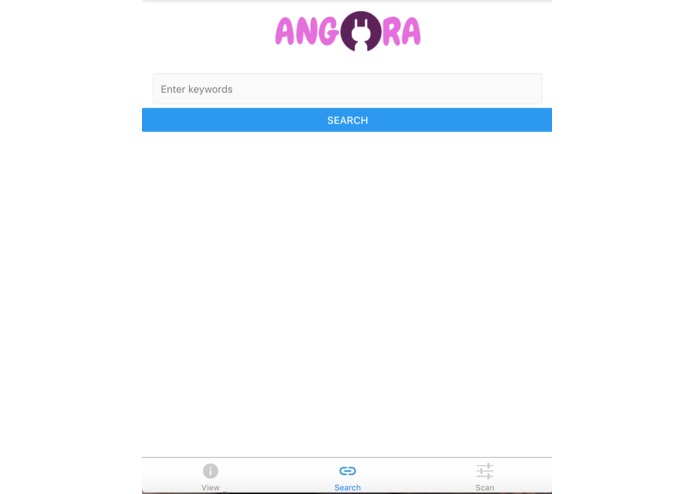
Search tool for the company to find resumes via our search API.
-
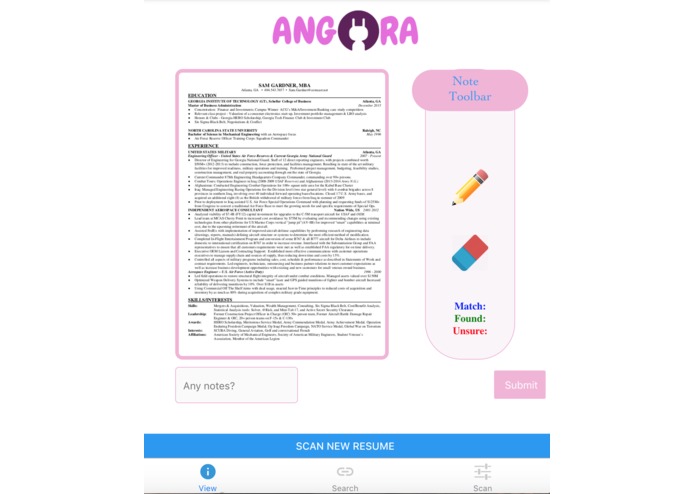
Page for taking notes and see simple Text Analytics.
-
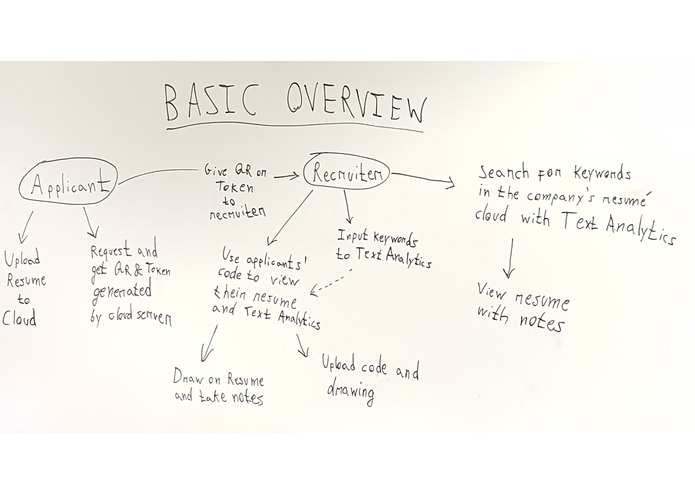
General project overview


Inspiration
We were inspired by the image of many piles of resumes over companies desks in career fairs and by the idea that career fairs where still being carried out without the implementation of technology. After a short discussion regarding our experiences, all of our team members realized that we had printed a stack of resumes for them and most of which ended up being thrown away afterwards. Furthermore, we discussed how recruiters were manually taking notes, piling, or then, at some point, scanning people’s resumes. This not only seemed like many notes and resumes would be lost in the jumble, but that it was a very poor, antiquated way of doing things. We knew there had to be a better way, and so we created Angora- a platform to streamline the exchange of information between those looking for jobs and recruiters.
What it does
Angora helps applicants and recruiters in a career fair manage resumes in a more effective way. Step 1: Applicant’s upload their resumes, which are then stored in the cloud. They receive a QR code with a unique code, which they will take with them on their phones to the career fair. Step 2: Recruiters scan/enter the unique code and, in the Angora app on their tablet, the resume of the applicant shows up. Step 3: They can take live notes, choose to schedule for an interview or contact further, and see an in-depth resume analysis from our machine learning algorithms - all of which are powered by Azure. Step 4: After the career fair, all the resumes that the recruiter had scanned are neatly organized and can be searched for.
How we built it
Most of our project development was based on Microsoft Azure's API and on the React Native framework. We used Azure’s machine learning platform to analyze resumes that were stored on the Blob. Furthermore, we used Azure’s search function in order to be able to search through and sort through algorithms. Finally, we worked with Azure’s web hosting service in order to build and deploy our web app which hosted these features.
Challenges we ran into
We ran into many technical and design challenges while creating Angora. Our main design challenge was balancing ease of use and simplicity of the platform with functionality. We wanted to be able to give the recruiters a ton of usability and value, but we also wanted to avoid making a clunky and hard to use the product at all costs. Furthermore, our technical challenges were two-fold, firstly coming across a plethora of issues on the backend, especially regarding creating a machine learning model that would make a percentage match and keyword finder. Secondly, we had difficulties integrating our frontend system with the many usage cases that we had designed and built for in the backend.
Accomplishments that we're proud of
We effectively implemented Azure's Computer Vision API with their Blob Storage and their Text Analytics API. With that, we were able to move data around the cloud and our local machines while using the Azure’s AI models to test the functions that we created. So, as we coded Angora, we felt that this product has the potential to help all businesses, small or large, to find awesome applicants.
What we learned
When we got at HackGt 6, we had minimal Azure and website development experience, which inspired us to learn much of what we did from the ground up. We had an incredible time learning to use Azure and found that the platform gave us a ton of functionality and ability to make an incredible amount of applications, all on one streamlined cloud service.
What's next for Angora
Our next step is to be able to finish our online platforms and effectively integrate all of our different resources together. We will also be trying to add two-factor authentication for the companies to log in to our environment. Furthermore, we plan to provide more functionality for the recruiters regarding the searching mechanism and its analyzes.
Built With
- azure
- azure-computer-vision
- azure-libraries
- azure-text-analytics
- blob
- c#
- javascript
- python
- react-native


Log in or sign up for Devpost to join the conversation.