-
-
Banner
-
Landing Page
-
Login Page
-
Dashboard
-
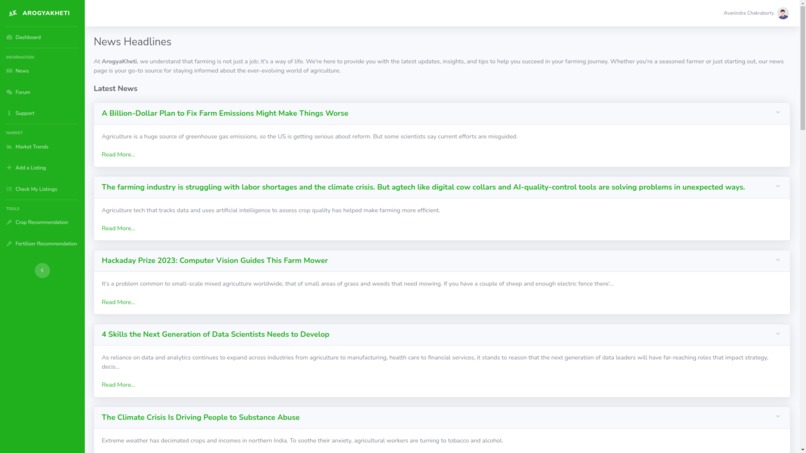
News Page
-
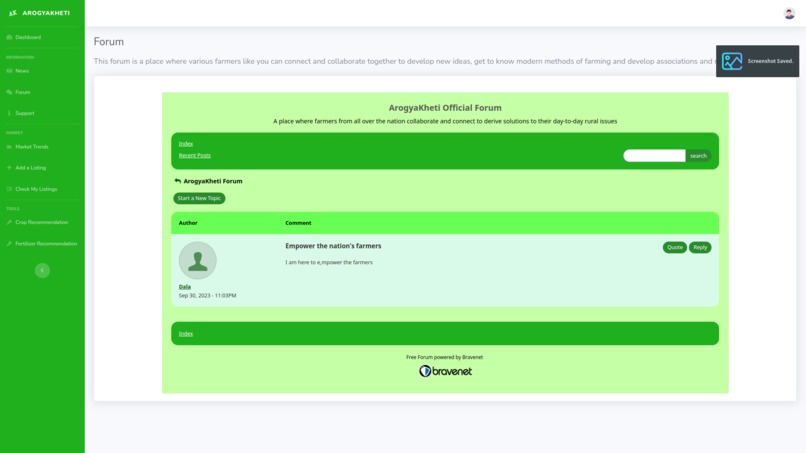
Forum Page
-
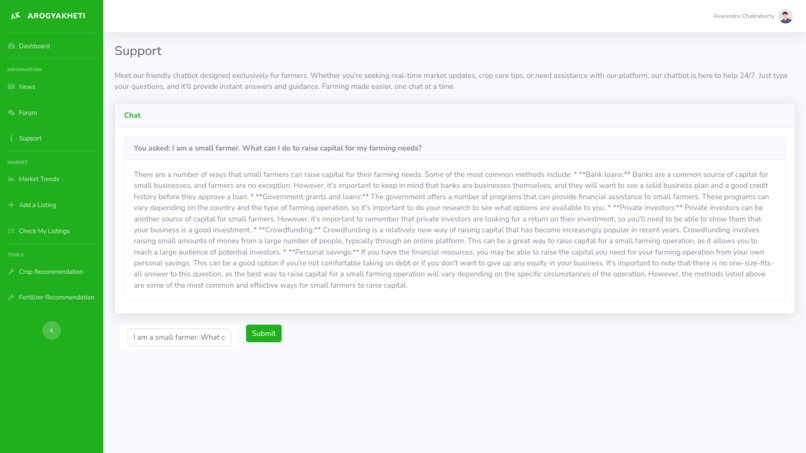
Support Page
-
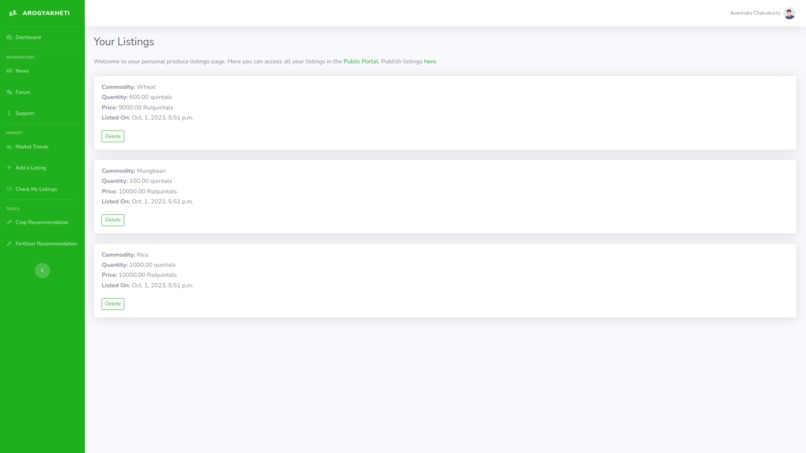
Check My Listings Page
-
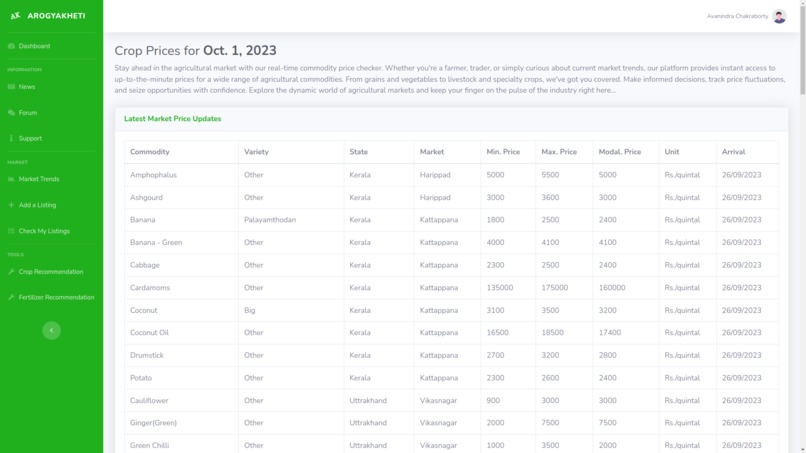
Latest Market Status Page
-
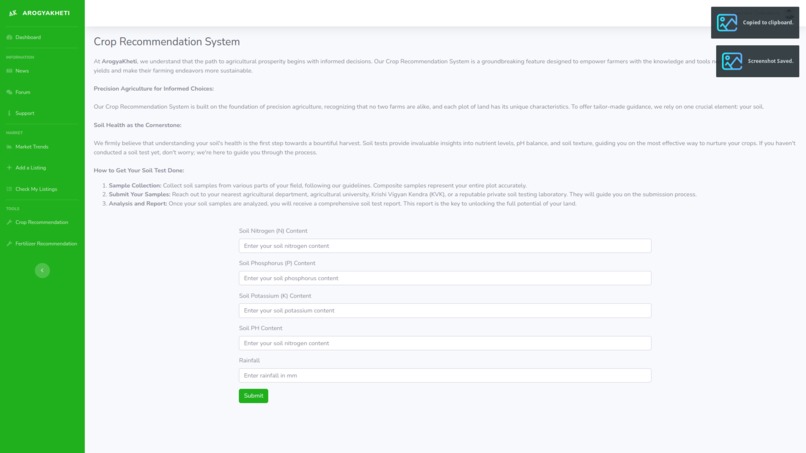
Crop Recommendation System
-
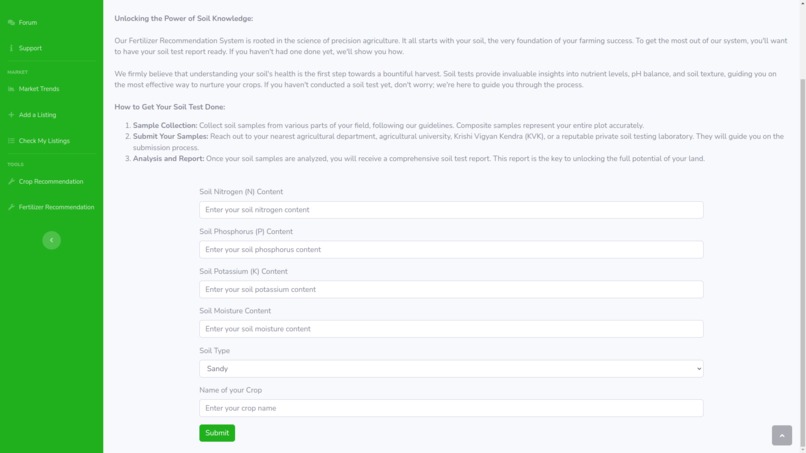
Fertilizer Recommendation System


NOTE:
Go through the project in the following manner in order to perfectly understand the project contents and vision:
- Read the content below first
- Visit the Github Repo and read the README.md
- Watch the Demo Video. If the voiceover feels too fast, it is recommended to watch in a speed of 0.75x or 0.5x
Inspiration
In India, agriculture is considered as the primary source of income for the majority of the population. That basically concludes that agricultural sector is the most important sector in the nation. But, on the other hand, agriculture in India can be seen as one of the most unorganized sectors too. 47% of the population in India is directly dependent on agriculture for their income. With such a great agricultural force, India would usually be expected to have negligible hunger and food security issues. But, unfortunately, that does not hold true. India ranks #107 on the Global Hunger Index and #68 in the Global Food Security Index. This is majorly because of the lack of proper management among the agricultural sector, especially in the case if small and medium farmers, who often end up taking wrong decisions due to less education or lack of information.
According to UN, by 2050, we will need to increase the world's food production by 70% to feed the world's population. Even today, one in eight people of the world do not get enough food to eat. Technology can be used to address these issues and help farmers to increase their productivity and reduce food waste.
Agriculture has both local and global significance. Addressing agricultural challenges can improve the quality of life for local communities while also contributing to global food security. While modern social problems are undoubtedly critical, agriculture intersects with many of these issues and provides a unique opportunity to address them at their roots. By focusing on agriculture, we can create systemic and sustainable change that positively impacts a wide range of social challenges.
What it does
At ArogyaKheti, we aim to provide a solution to the problem through a combination of innovative technology and a deep understanding of the agricultural ecosystem. Our platform harnesses the power of data analytics, providing farmers with valuable insights into crop management, communication, and market trends. Our mission is to empower farmers with the tools and knowledge they need to thrive in a rapidly evolving agricultural landscape, ultimately contributing to food security and the eradication of hunger, formally addressing the UN SDG - Zero Hunger.
Problem-based Analysis
- Enhancing Communication between Farmers: The ArogyaKheti forum plays a vital role in enhancing communication by providing a collaborative platform where farmers can share knowledge, exchange ideas, and discuss challenges. It facilitates the exchange of best practices, innovative techniques, and local wisdom, empowering farmers with valuable insights. By providing a space for open dialogue, the forum helps farmers learn from one another, stay updated on the latest agricultural trends, and collectively navigate obstacles.
- Helping Farmers stay Updated: ArogyaKheti users are provided with curated news articles which play a crucial role in keeping farmers informed with timely and relevant updates on weather, market trends, farming schemes, and policy changes. It empowers farmers to make informed decisions, reduce risks, and optimize their resources, ultimately contributing to the sustainability of farming communities.
- Bridging the Gap between Consumers and Farmers: The public portal displaying the farmer's produce listings directly connects farmers with consumers, thereby eliminating the need for middlemen. It ensures transparency and fair pricing for both farmers and buyers. This direct interaction not only cuts down on unnecessary costs but also empowers farmers to have greater control over their income. It contributes to eradicating middlemen and fostering a more equitable and transparent agricultural ecosystem while supporting the economic well-being of farmers.
- Guiding Farmers to Make Calculated and Informed Decisions: Our Smart Crop and Fertilizer Recommendation Systems offer data-driven guidance to farmers. Both use Machine Learning with some real-time data and soil health data to analyze and provide curated suggestions. Together, they maximize yields, reduce waste, and promote sustainable farming. AI-enabled Support Channels: AI-powered Chatbots curated for farmers to help them with their queries and problems. This provides them a 24x7 support channel to get their queries resolved.
- Farmers and Technology??: Whenever one associates the rural sector with technology, a major question that arises is that how comfortable will they be?The ArogyaKheti platform is designed to be user-friendly and accessible to farmers of all ages and backgrounds. It is designed to be multi-lingual and is developed to be a Mobile-first application, taking in consideration that a computer would be a distant dream in such areas. The platform is designed to be rather simple, intuitive and easy-to-use, ensuring that farmers can easily navigate the site and access the information they need, without getting lost in the details.
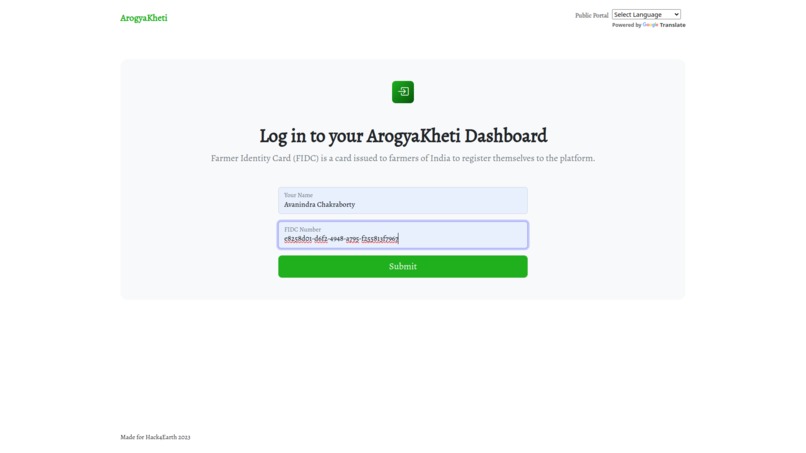
- Traditional Methods of Logging-In: In recent times, the Government of India has been pushing for the e-verification of Aadhar Cards and other such methods of authentication in Government sites. This system of carrying "Identity Cards" has rooted to a lot of people in the country, for whom we have introduced a system of FIDC (Farmer's Identity Card). The ArogyaKheti platform is designed to be FIDC-Enabled, which means that farmers can easily log-in to the platform using their FIDC Cards. But you might be wondering what FIDC is? It is a bit project specific in this case. No such card exists in real life, but it is a concept that we have visualized hypothetically, where FIDCs are cards that are issued to farmers by the Government of India, which contain their basic information along with their farm ownership details. tl;dr it is basically a substitute for Aadhar Card/Pan Card in this case.
Features in a Nutshell
- Simple and Intuitive UI/UX
- Mobile First UI to make it widely accessible
- FIDC-based Authentication System
- Crop Recommendation System
- Fertilizer Recommendation System
- The ArogyaKheti Forum
- A Public Portal
- Curated News Delivered Right to the Farmer's Dashboard
- AI-powered Support Channels
- Multi-Lingual Support
How we built it
The Journey Begins
Due to my exams, I was pretty busy till 23rd September, that is, the 2nd Day of the Hackathon. And in the morning of the 3rd Day of the Hackathon, there I was, with no ideas. I started brainstorming ideas and by the end of 24th September, I had a rough idea of what I do. I decided to target agriculture as I feel, while targeting sustainability, we often involve in much complex and higher level problems, while the actual problems lie in the roots. Proper food provision lays the roots to building a healthy and productive population, and when a population is productive, the nation grows in every aspect. In India for example, independence came in 1947, but the early decades of post-independence saw poverty and hunger in the nation filled with refugees. Hence it became crucially important for Indian Government to focus on eradicating poverty and hunger first, yet after 76 years, issues like poverty and lack of food security are still relevant. With a clear idea of the problem set in my mind, I started the development on 25th of September (Day 4).
25 September 2023
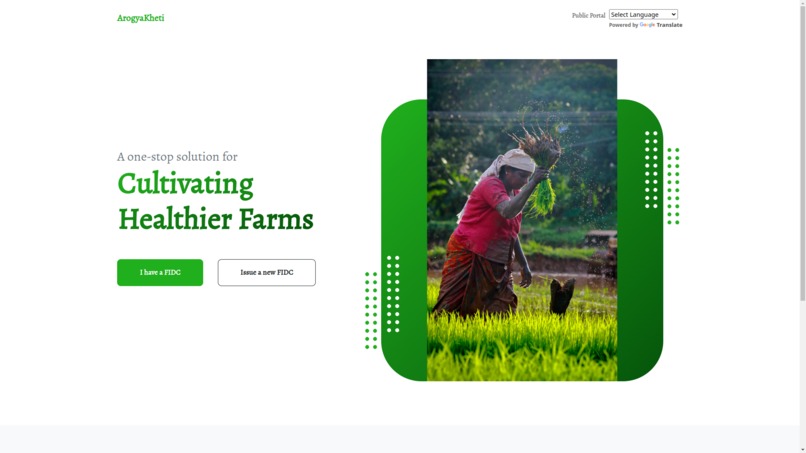
The development starts with me programming the UI. I wanted the UI to be as simple as possible, in order to meet my goals of reaching my target audience, without intimidating them with excess of clutter in their screen. I also realised that a major challenge to integrate farming and technology would be it's cost, and in such state I don't expect a farmer to be sitting in front of a large screen to be able to use my website, so responsiveness was one of the features I just could not ignore. So by the end of the day I was ready with a responsive UI for my landing page and my dashboard. I'd be honest I had to take help from the internet for the Admin Portal UI. I used Bootstrap for the UI Design as it made my development speed faster, and I felt I did not really need much complex custom components which needed to be done from raw CSS. I did write some CSS though. And yeah, I had decided to use Django, Bootstrap and SQLite3 for the project as my tech stack.
Don't ask me why. I don't know. I have little experience with Bootstrap, and I was pretty much a newbie in Django. I only knew that for my crop recommendation systems and fertilizer recommendation system, I had to integrate python into my website somehow. I was also aware of the Flask framework, but management in Django through CLIs looked easier. So essentially the tasks I had in front of me was to learn Django and Backend Development in one day and atleast invest 3 days into the project.
26th September
Again an issue on the personal level, had three tuitions and school, and had to reach home at 10PM. I then had to pull up till 2:00AM to learn the fundamentals of Django. Little would I know that watching video tutorials for 3 hours without actually doing stuff would give me a rough time later on. Well, not like I didn't know it, but I didn't have access to my computer.
27th September
The days that followed from here are the workaholic ones. On 27th, I initialized my project and branding. By the end of the day, I was ready with my login system. I decided to use the concept of FIDC to spark a contrast among the traditional username and password logins.
28-29th September
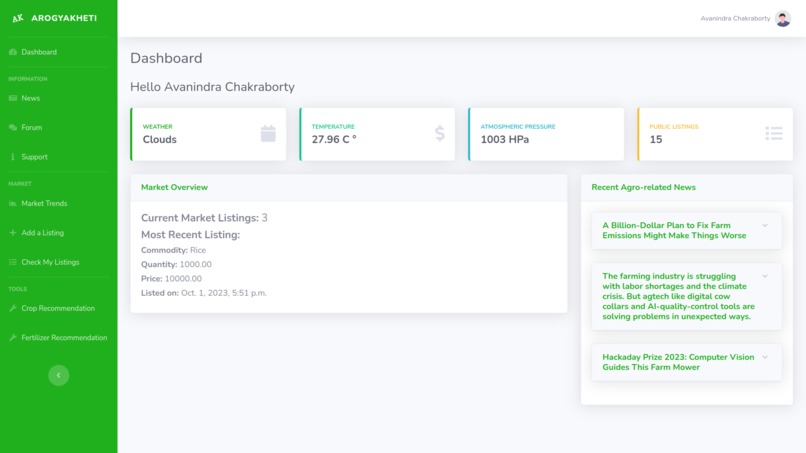
I one-by-one coded all of the pages- the forum, the news portal, the support portal, the market, the tools and the dashboard. The forum was made using BraveNet and later integrated into the website after customizations. For the news portal I used NewsAPI with filters to get curated agriculture-related information. The support portal was powered by the Google PaLM API, curated to produce responses related to agriculture. The market used the Agmarknet API by the Government of India to list down the current prices. Rest of the functioning was done by listing the produces in databases. The Dashboard was designed to deliver real-time data and provide the users an interface to get an overview of their profile.
For the Crop Recommendation System and the Fertilizer Recommendation System, I used Machine Learning along with Data Analysis in order to get my results.
- The Crop Recommendation System first reads the Crop Recommendation Dataset and trains the data with several models like RF Classifier, Decision Tree, Gaussian NB and Naive Bayes. The highest accuracy was provided by RandomForestClassifier hence I decided to go ahead with it.
- The Fertilizer Recommendation System also uses the RandomForestClassifier to predict the fertilizer type, with respect to the Fertilizer Prediction Data
30th September
This day was spent in debugging, providing error handling in the website and cleaning code, and getting it ready for submitting. I realised I had to use a serverless database like PostgreSQL to host my website in free services like Vercel. I really wanted to deploy the website but being unable to do so, I decided to submit the project code with a detailed README instead. I ensured I was almost submission-ready on 30th September, as 1st October would rather be a very busy day for me.
Challenges we ran into
- The major challenge that I faced was my unfamiliarity with Django and Backend Web Development as a whole. I come from a ML and systems programming background and have not had much experience in the server side web. I had to spend majority of my time debugging Django
- Another major challenge was collecting enough trustable data that could provide atleast some close-to-real-time information
- I also had to revise my Bootstrap and JavaScript skills which also took a considerable amount of time
So basically, there was really no inevitable problem in my journey, with probably some more time investment and preparation, I would have completed the project sooner. The time crisis mostly came due to my lack of preparation due to examinations preceding the Hackathon, and of course, due to the amount of time that went into learning new technology. But I was pretty clear with my vision of the project, and that I believe is the key to why I didn't face any major problems in the project.
Accomplishments that we're proud of
On a Personal Level:
- The time crisis that gave me barely 3 days of total development time, really helped me work hard and speedrun, contributing to my skills for working continuously to match deadlines. I'd say the deadline is the boost every programmer needs while he's working on his project. It provides you a roller-coaster ride through the phases of tension, stress, happiness and satisfaction at the same time.
- After a long cycle of exams, this was the perfect refresher for me to step back into the world of programming and the competitive environment where I can do what I love along with winning several perks.
On a Professional Level:
- I have been wanting to learn Django for a long time now, but I lacked enough reason to actually learn it. I don't usually learn things out of the air and always need a project I can do to learn something. This served as not only my hackathon project but also my pathway to learning Django, which gave me insights to all of its conventions, systems and structure, and helped me gain a notable amount of experience in it.
- It had been 1.5 years since I last did an ML Project, and now after a long time, I was finally able to engage in one and successfully produce my desired outputs.
- I am happy that I was able to implement the basic features of the project to give the idea some life. But I've also noted a lot of other ways by which we can use technology to make more additions to the project. Well this was just a starting point, and I'd be more than happy to continue the project and make the additions, along with making some UI improvements.
What's next for ArogyaKheti
This was just the first step to the project, restricted by time limits. I would like to continue ArogyaKheti further and add more features to it. Some of the features that I would like to add:
- Introducing a Blockchain System to Ensure Safe Transactions between Farmers and Buyers
- Introducing a Crisis-Detection System to warn Farmers beforehand
- Introducing a Crowdfunding System to help Farmers gain Capital
- Improving the Translation Quality
- Providing Secure Phone Numbers to avoid data leaks
- Improving the security of the FIDC System
- Introducing a System to help Farmers track their finances and accounts smartly
Built With
- bootstrap
- bravenet
- css3
- csv
- django
- github
- html5
- javascript
- jquery
- jupyter
- llm
- machine-learning
- newsapi
- openweathermap
- palm
- python
- rfc
- scikit-learn
- sqlite


Log in or sign up for Devpost to join the conversation.