-
-
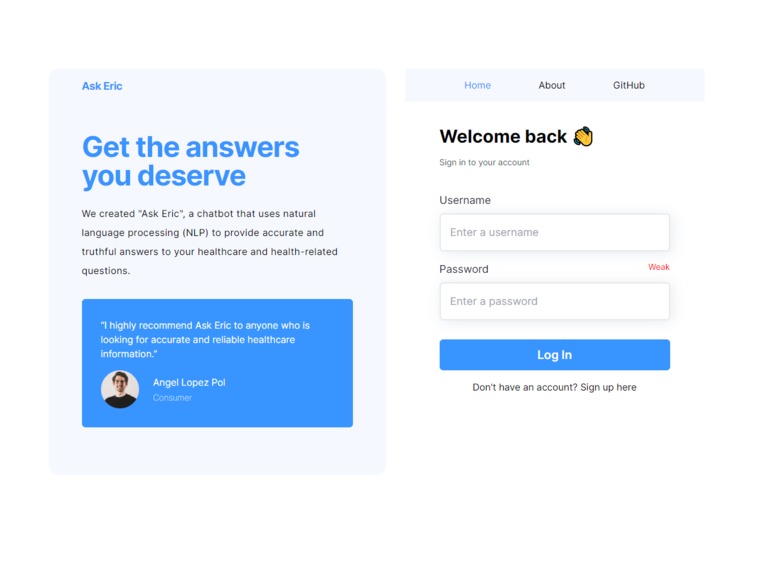
Home page

Inspiration
We’re constantly updating and improving Eric to ensure that you have access to the most accurate and reliable information possible. We believe that everyone has the right to accurate and reliable health insurance information. That's why we've made our chatbot available to everyone, free of charge. So whether you're a patient, a caregiver, or just someone looking for information, we're here to help.
What it does
At AskEric, we understand that navigating the health insurance system can be a difficult and confusing task. That's why we created "AskEric", a chatbot that uses natural language processing (NLP) to provide accurate and truthful answers to your health insurance and health-related questions.
How we built it
At AskEric, we believe in using cutting-edge technology to provide our users with the best possible experience. Our tech stack consists of the following components:
Frontend:
React: We use React for our frontend, which provides a user-friendly and intuitive interface for our users to interact with Eric. React allows us to build dynamic and responsive pages that make it easy for users to get the information they need. Hosting:
Vercel: We host our frontend on Vercel, a cloud-based platform that provides fast and secure hosting for web applications.
Backend:
Django: Our backend is built on Django, a high-performance Python framework that allows us to rapidly develop and deploy our chatbot. Chatbot Functionality:
OpenAPI's BERT module: Our chatbot uses OpenAPI's BERT module to provide accurate and truthful answers to our users' questions. BERT is a cutting-edge NLP model that has been pre-trained on a massive corpus of text, allowing it to understand context and provide relevant information. Communication:
REST API: Our frontend and backend communicate with each other via a REST API, which allows for seamless and secure data transfer between the two components. Authentication:
JWT: We use JSON Web Tokens (JWT) for authentication, which allows us to securely identify and authenticate our users. Overall, our tech stack provides a robust and scalable solution for delivering accurate and reliable health insurance information to our users.
Challenges we ran into
The biggest challenges we ran into were understanding the process of optimizing our AI, and merge conflicts. Like, a lot of merge conflicts. Close to the submission deadline we ended up getting a quadruple merge conflict as a result of SOMEONE (me, Angel) accidentally removing node_modules from the gitignore. This resulted in us panicking for about an hour before we just decided to do away with the old repository and taking our last working version and putting it on a new one.
Accomplishments that we're proud of
One of the main accomplishes we are proud of is learning to use and integrate the OpenAI API onto our backend. We also enhanced the functionality of the service by using context provisioning techniques to verify the correctness of our AI’s answers. This was due to the fact that we wanted to provide a high degree of correctness when it came to Health and Health insurance related questions, which is something that needs to be taken account of with Generative processing models like ChatGPT and those hosted on OpenAPI.
Another accomplishment that we are proud of was our effective parallelization of tasks during the development process. Often times parallelization is easier said than done, especially when working on a system with a high degree of interconnectedness. However, we were able to split frontend and backend items efficiently and maximize project throughput.
For some of us, this was our first time using AI, Django, and React, so we are pretty proud of everything we were able to produce given how little time we had to learn it 😊
What we learned
As mentioned earlier, we learned some technology libraries and frameworks like React and Django. We also learned how to optimize generative AI models through the use of context provisioning and correctness-checking.
What's next for Ask Eric
We are definitely looking to expand the capabilities of the AI, be it by feeding it user health plan information or providing it with more Health and Health insurance related data to train on. Additionally, we hope to expand the user accounts feature with additional conversations (not unlike ChatGPT), and implement the remainder of the UI that we had previously decided on through Figma




Log in or sign up for Devpost to join the conversation.