-
-
Our project logo!
-
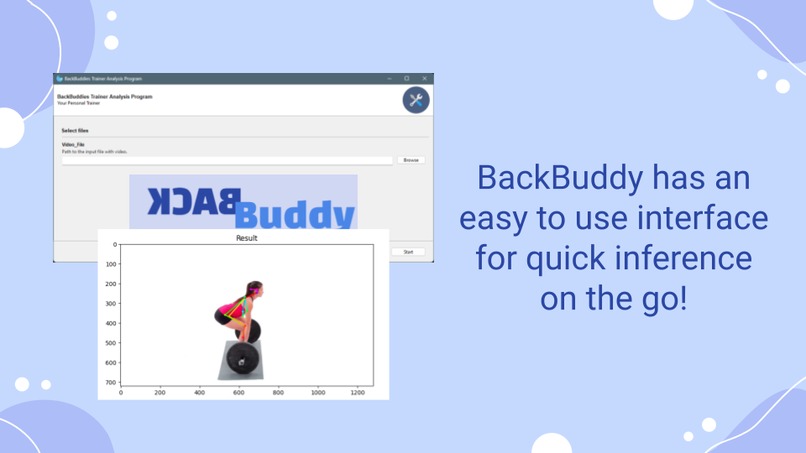
Our GUI Example.
-
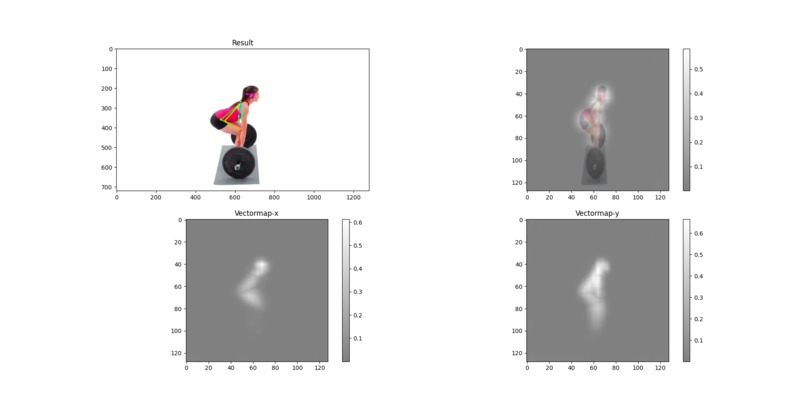
Keypoints analysis example 1
-
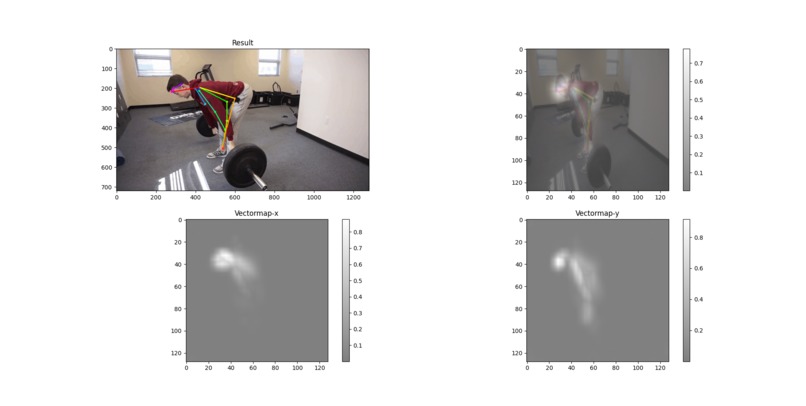
Keypoints analysis example 2


BackBuddy
What it does
BackBuddy is a simple GUI application that takes an input video from a user, and passes it to an AI algorithm to help teach proper form during deadlifting. This algorithm is a keypoint detector, which tracks the joints of a person, which is used to analyze the positions of the hands and feet on a person performing a deadlift. Additionally, we used geometric calculations to evaluate the accuracy of the lift.
Info Slides: link
Using The GUI
Using the program is easy! Simply select your video and hit the "Start" button. See GitHub for more information.
Installing BackBuddy
- Ensure Microsoft Visual C++ Build Tools is Installed
- (Optional) Install GPU drivers from Nvidia (CUDA 11.2, cuDNN 8.1.0)
- Create Python Virtual Environment and Install Packages
python -m venv venv
venv\Scripts\activate
pip install -r requirements.txt
- Run the program!
python main.py
Inspiration
At our age, weightlifting has become a popular interest for many of our peers. However, many people avoid the deadlift because they fear the dangerous implications that it may have on your body from bad form. Even amongst trained weightlifting elites and professionals, 31% of injuries are due to the deadlift. Some beginners may be uncomfortable with hiring a personal trainer, so we designed an application to score the form a user submitted deadlift. This can help the user understand if their form is good or bad.
How we built it
First, we collected data for our keypoints algorithm, and for our final deadlift calculations. We did this by web scraping YouTube videos, using Supervisely to provide a label for each video, and then training a TensorFlow-MobileNetSlim model. While the model was training, we prepared our data further by splitting each video into separate frames, and augmented the data 4 times to create 17,694 individual JPG files in total. After this was done, we pulled keypoints from each of the videos, and created a function to calculate accuracy based on the foot keypoint coordinates and the feet keypoint coordinates.
Challenges we ran into
At first, we attempted to create and design our own keypoints algorithm from scratch, but were unable to do so successfully with good accuracy. We also attempted to use logistic regression to analyze the keypoints of each video, with the labels that we had already created. However, different videos contained different amounts of keypoints, as some joints were not visible. This led to difficult data preprocessing, so we were unable to use our ML algorithm to classify inputs.
Accomplishments that we're proud of
- First time using Tensorflow Pose Estimator, was able to apply it in <36 hours
- Never created our own dataset before this
- Was able to figure out how to label data
- Created Python GUI from scratch, and was able to connect our AI algorithms
- Created a working demo
- Model is accurate
What we learned
- Tensorflow Pose Estimator
- Keypoints Algorithm
- OpenCV for camera usage
- Creating a Python GUI
- Data Augmentation
- The troubles of data preprocessing
- Connecting GUI front end with AI based backend
What's next for BackBuddy
For future goals, we want to implement live camera streaming to judge their level of deadlift. We have attempted to add a live camera, but due to the time restraint we were not able to successfully work it into our program. We also want to add logistic regression to rate the deadlift for a more accurate classification system to better the users deadlift to ensure the greatest level of safety for the athlete.


Log in or sign up for Devpost to join the conversation.