-
-
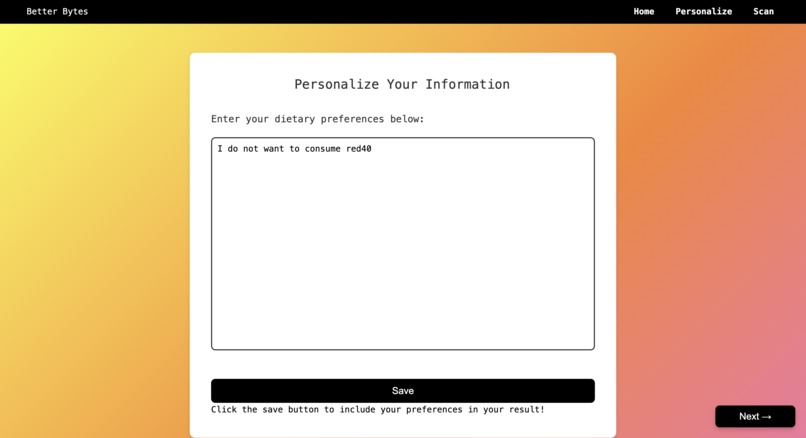
Personalization page
-
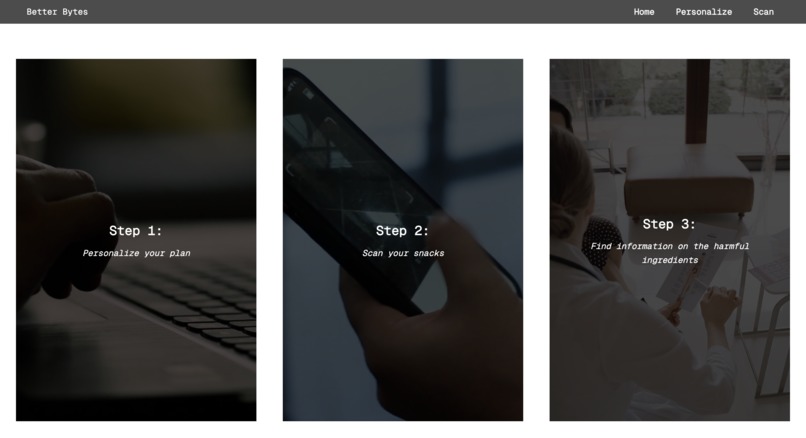
Home page cont.
-
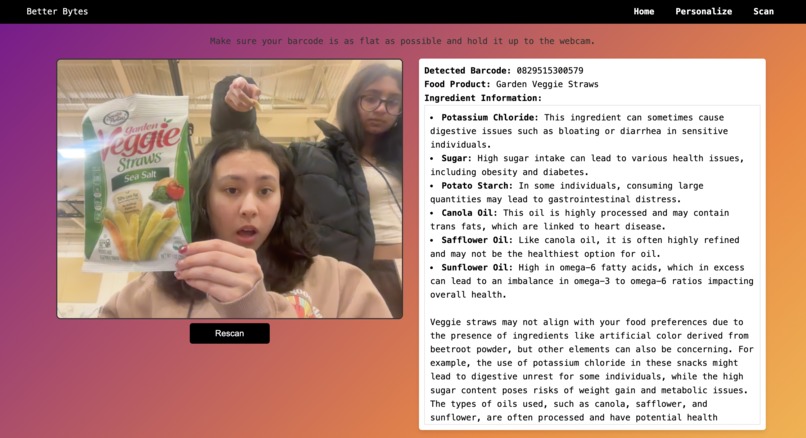
Scanner Results
-
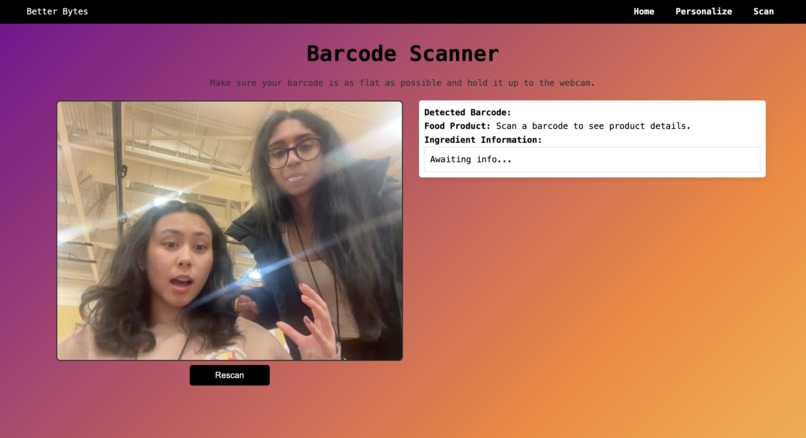
Barcode Scanner
-
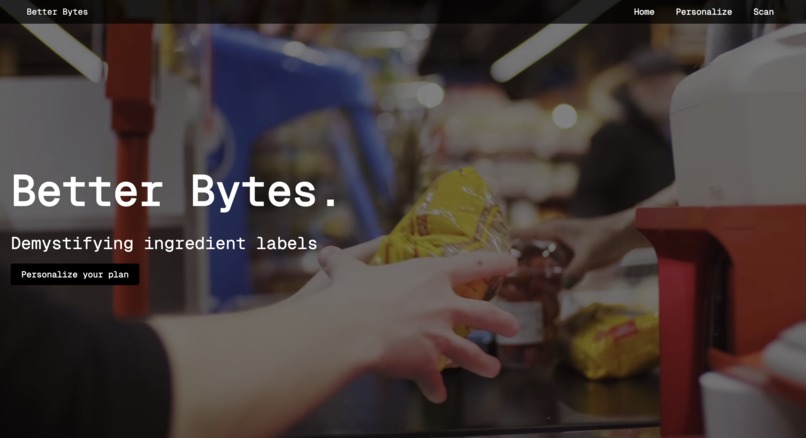
Home page


Better Bytes
Inspiration
The idea for Better Bytes stemmed from the growing awareness around the ingredients in food products and the need for a simple and efficient way to provide consumers with detailed information about the food they are purchasing. We wanted to create an easy-to-use tool that empowers users to make healthier choices by scanning product barcodes and receiving valuable insights into ingredients and product details.
What it does
Better Bytes is a barcode scanner tool that provides detailed information about food products. After scanning a barcode, users receive:
- The detected barcode and product details.
- Ingredient information sourced from a knowledge base (e.g., GPT-powered responses).
- Personalized suggestions based on the scanned product.
The app is designed to help consumers make more informed decisions about the products they consume.
How we built it
We used several technologies to bring Better Bytes to life:
- Frontend:
- HTML for the structure of the page.
- CSS (with custom animations) to ensure the page is visually appealing and user-friendly.
- JavaScript (along with the QuaggaJS library) for barcode scanning functionality.
- Backend:
- A Flask-based Python server that serves the front-end page, handles scanning logic, and processes ingredient data using GPT for personalized recommendations.
Challenges we ran into
- Barcode Scanning Accuracy: Ensuring that the barcode scanner worked consistently across various devices and different product types was a challenge. We had to fine-tune the scanner settings for accuracy.
- Integrating GPT for Ingredient Information: Sourcing accurate ingredient data and delivering it in a way that was useful to the user was a challenge, especially considering the variability in product packaging and descriptions.
- Frontend-Backend Communication: Setting up smooth communication between the front-end barcode scanner and the backend that processes ingredient information, especially handling data asynchronously.
Accomplishments that we're proud of
- Barcode Scanner Functionality: The barcode scanner works effectively across multiple product types, providing quick and accurate results.
- User Experience: We’re proud of how intuitive the interface is. The real-time feedback and simple layout make the tool easy to use.
- Personalization: The app offers personalized suggestions based on the scanned product, which helps users make healthier choices based on their preferences.
What we learned
- Integrating APIs and Libraries: We learned how to integrate third-party libraries (like QuaggaJS for barcode scanning) and how to interact with APIs to pull ingredient data from GPT-based sources.
- Frontend and Backend Integration: Understanding how to ensure smooth interaction between the frontend (JavaScript, HTML, CSS) and backend (Flask) was a key learning point.
- Handling Asynchronous Requests: We encountered and learned to handle asynchronous API calls to fetch data and ensure the user interface remained responsive.
What's next for Better Bytes
- Expanded Ingredient Database: We plan to expand the database with more detailed ingredient information and add support for a wider variety of products.
- User Personalization: Implement features that allow users to create profiles, set dietary preferences (e.g., vegan, gluten-free), and receive more tailored product recommendations.
- Mobile App Version: Developing a mobile app version of Better Bytes to make the tool more accessible and user-friendly on mobile devices.
- Barcode Database Integration: Incorporating a broader barcode database to improve scanning results for more obscure products.
Built With
- css
- flask
- html
- javascript
- openai
- openfoodfacts
- python
- quaggajs

Log in or sign up for Devpost to join the conversation.