-
-
BiteBuddy: A GraphML + LLM-powered all-in-one meal planner and personal CRM.
-
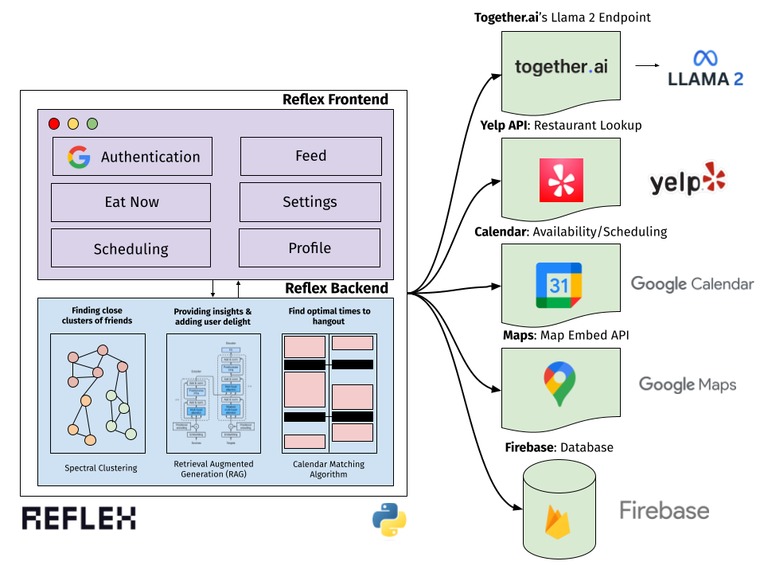
Tech Stack: Unified stack built for ML
-
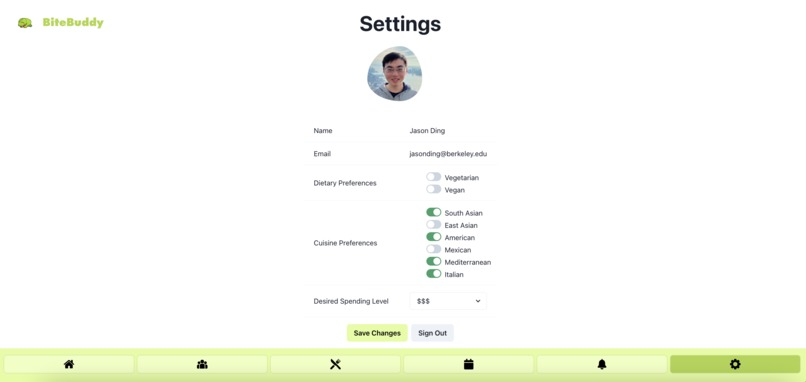
Settings: Jason is not vegetarian...
-
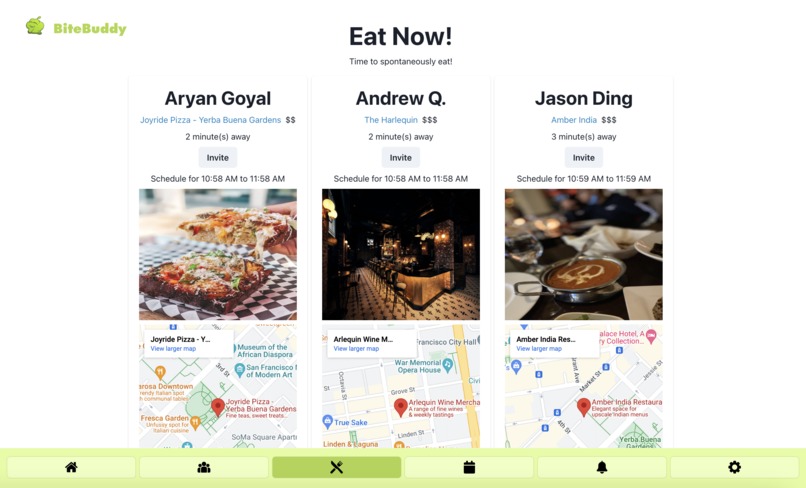
Eat Now! Who to invite...?
-
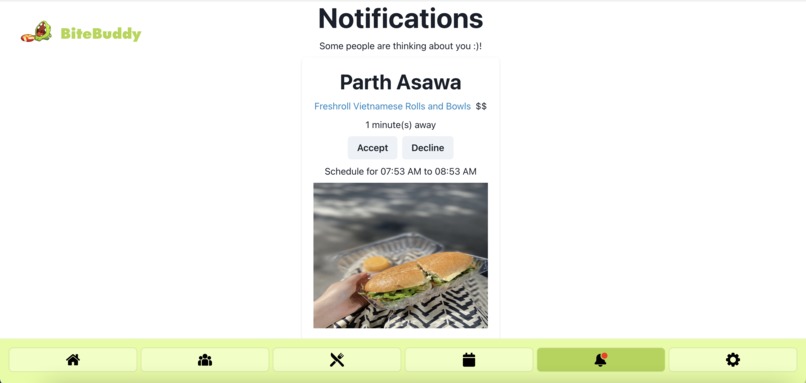
Notifications: an invite from Parth!
-
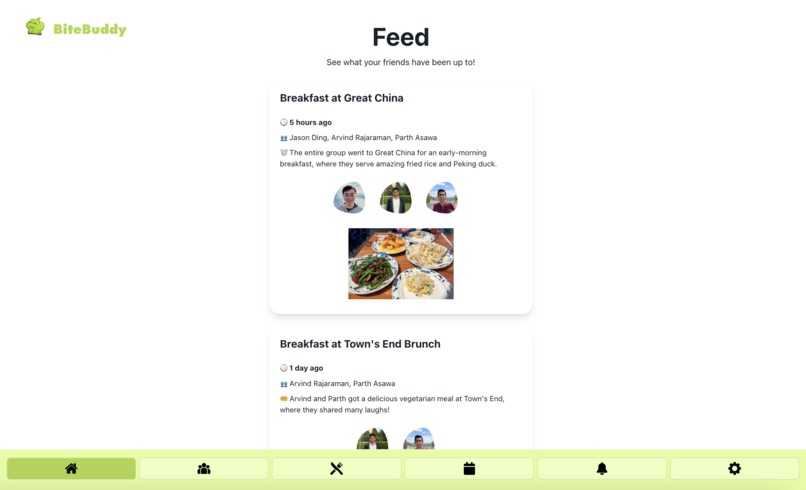
Feed: Jason, Arvind, and Parth got together recently.
-
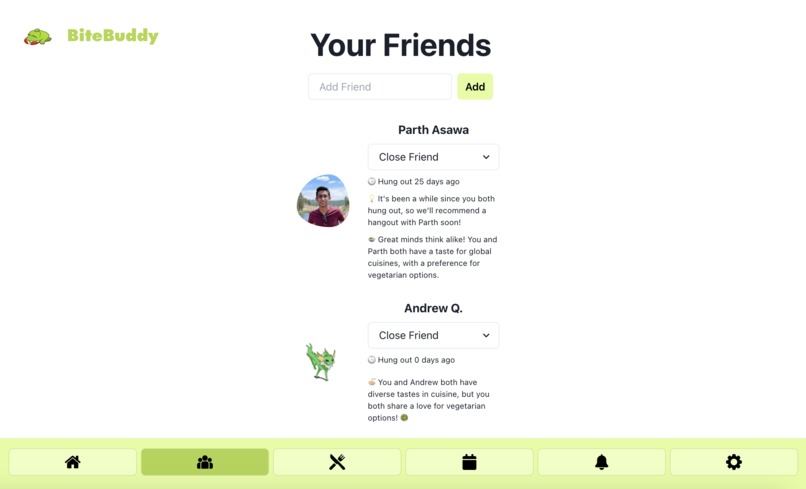
Friends: Parth and Andrew!
-
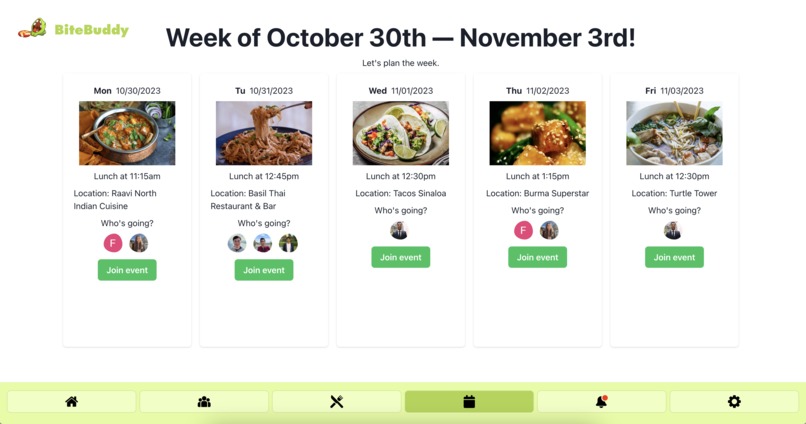
Scheduling Ahead: Groups & Individuals this week


Inspiration
We set out to build a product that solves two core pain points in our daily lives: 1) figuring out what to do for every meal 😋 and 2) maintaining personal relationships 👥.
As college students, we find ourselves on a daily basis asking the question, “What should I do for lunch today?” 🍔 — many times with a little less than an hour left before it’s time to eat. The decision process usually involves determining if one has the willpower to cook at home, and if not, figuring out where to eat out and if there is anyone to eat out with. For us, this usually just ends up being our roommates, and we find ourselves quite challenged by maintaining depth of relationships with people we want to because the context windows are too large to juggle.
Enter, BiteBuddy.
What it does
We divide the problem we’re solving into two main scenarios.
- Spontaneous (Eat Now!): It’s 12PM and Jason realizes that he doesn’t have lunch plans. BiteBuddy will help him make some! 🍱
- Futuristic (Schedule Ahead!): It’s Friday night and Parth decides that he wants to plan out his entire next week (Forkable, anyone?). 🕒
Eat Now allows you to find friends that are near you and automatically suggests nearby restaurants that would be amenable to both of you based on dietary and financial considerations. Read more below to learn some of the cool API interactions and ML behind this :’). 🗺️
Schedule Ahead allows you to plan your week ahead and actually think about personal relationships. It analyzes closeness between friends, how long it’s been since you last hung out, looks at calendars, and similar to above automatically suggests time and restaurants. Read more below for how! 🧠
We also offer a variety of other features to support the core experience:
- Feed. View a streaming feed of the places your friends have been going. Enhance the social aspect of the network.
- Friends (no, we don’t offer friends). Manage your relationships in a centralized way and view LLM-generated insights regarding relationships and when might be the right time/how to rekindle them.
How we built it
The entire stack we used for this project was Python, with the full stack web development being enabled by the Reflex Python package, and database being Firebase.
Eat Now is a feature that bases itself around geolocation, dietary preferences, financial preferences, calendar availability, and LLM recommendation systems. We take your location, go through your friends list and find the friends who are near you and don’t have immediate conflicts on their calendar, compute an intersection of possible restaurants via the Yelp API that would be within a certain radius of both of you, filter this intersection with dietary + financial preferences (vegetarian? vegan? cheap?), then pass all our user context into a LLAMA-13B-Chat 💬 to generate a final recommendation. This recommendation surfaces itself as a potential invite (in figures above) that the user can choose whether or not to send to another person. If they accept, a calendar invite is automatically generated.
Schedule Ahead is a feature that bases itself around graph machine learning, calendar availability, personal relationship status (how close are y’all? When is the last time you saw each other?), dietary/financial preferences, and more. By looking ahead into the future, we take the time to look through our social network graph with associated metadata and infer relationships via Spectral Clustering 📊. Based on how long it’s been since you last hung out and the strength of your relationship, it will surface who to meet with as a priority queue and look at both calendars to determine mutually available times and locations with the same LLM.
We use retrieval augmented generation (RAG) 📝 throughout our app to power personalized friend insights (to learn more about which friends you should catch up with, learn that Jason is a foodie, and what cuisines you and Parth like). This method is also a part of our recommendation algorithm.
Challenges we ran into
- Dealing with APIs. We utilized a number of APIs to provide a level of granularity and practicality to this project, rather than something that’s solely a mockup. Dealing with APIs though comes with its own issues. The Yelp API, for example, continuously rate limited us even though we cycled through keys from all of our developer accounts :’). The Google Calendar API required a lot of exploration with refresh tokens, necessary scopes, managing state with google auth, etc.
- New Technologies. We challenged ourselves by exploring some new technologies as a part of our stack to complete this project. Graph ML for example was a technology we hadn’t worked with much before, and we quickly ran into the cold start problem with meaningless graphs and unintuitive relationships. Reflex was another new technology that we used to complete our frontend and backend entirely in Python. None of us had ever even pip installed this package before, so learning how to work with it and then turn it into something complex and useful was a fun challenge. 💡
- Latency. Because our app queries several APIs, we had to make our code as performant as possible, utilize concurrency where possible, and add caching for frequently-queried endpoints. 🖥️
Accomplishments that we're proud of
The amount of complexity that we were able to introduce into this project made it mimic real-life as close as possible, which is something we’re very proud of. We’re also proud of all the new technologies and Machine Learning methods we were able to use to develop a product that would be most beneficial to end users.
What we learned
This project was an incredible learning experience for our team as we took on multiple technically complex challenges to reach our ending solution -- something we all thought that we had a potential to use ourselves.
What's next for BiteBuddy
The cool thing about this project was that there were a hundred more features we wanted to include but didn’t remotely have the time to implement. Here are some of our favorites 🙂:
- Groups. Social circles often revolve around groups. Enabling the formation of groups on the app would give us more metadata information regarding the relationships between people, lending itself to improved GNN algorithms and recommendations, and improve the stickiness of the product by introducing network effects.
- New Intros: Extending to the Mutuals. We’ve built a wonderful graph of relationships that includes metadata not super common to a social network. Why not leverage this to generate introductions and form new relationships between people?
- More Integrations. Why use DonutBot when you can have BiteBuddy?
Built with
Python, Reflex, Firebase, Together AI, ❤️, and boba 🧋
Built With
- python
- reflex
- scikit-learn
- together.ai




Log in or sign up for Devpost to join the conversation.